


Key Takeaways
A Tesco-like grocery delivery app usually costs £8,000 to £37,000+ ($11,000 to $51,000) based on features, design, platform choice, and build time.
To build a grocery app like Tesco, you need to do market research, feature planning, app design, choose a tech stack, and then perform development.
Tesco-like apps use platform fees, delivery charges, Clubcard points, and data insights to generate revenue.
The app must connect online shopping with in-store use so customers feel one connected journey.
Planning for AI, analytics, and new features early keeps the app relevant and popular for years.
In 2026, grocery and retail businesses in the UK are rapidly moving toward digital solutions. Tesco Grocery & Clubcard is a strong example of how physical grocery stores combine with a high-performing grocery delivery and rewards app. Today, many UK retailers and grocery chains want to build an app like Tesco Grocery & Clubcard.
However, helping them improve customer engagement, increase repeat purchases, and simplify everyday grocery shopping. Building such an app is not just about selling groceries online.
This supports weekly grocery ordering, scheduled deliveries, click-and-collect, in-store savings, and loyalty rewards. However, ensuring a consistent shopping experience across mobile and physical stores.
To build such apps, businesses must focus on ease of use, fast performance, secure payments, and features that support both in-store and online customers.
In this blog, we will explain the key steps, features, and money-making strategies needed to build a successful grocery delivery app.
Overview of the Tesco Grocery & Clubcard App
The Tesco Grocery & Clubcard app is a grocery delivery and loyalty mobile application that helps customers shop for groceries, manage deliveries, and earn rewards from one place.
The app also supports in-store shopping by offering Clubcard points to improve convenience and save money. Many businesses aim to make an app like Tesco Grocery & Clubcard to offer such a smooth shopping experience across online and physical stores.
Let us discuss the steps on how the app works:
- Download the app and create an account.
- Browse items you want to buy from different categories.
- Add selected items to the cart for online or in-store shopping.
- Choose delivery, pickup, or in-store options based on your needs.
- Review your order and complete the payment to receive the items.
Some key stats you should know:
-
According to Statista, the Tesco Groceries app was the most popular in the UK, with the highest downloads.
-
The Tesco Grocery & Clubcard has 10M+ downloads on the Play Store.
-
The app provides a great user experience, which is reflected in an impressive 4.8 rating on App Store from a total of 1.3M.
Understanding how to make an app like Tesco Grocery & Clubcard starts with looking at how the app works today and why its model continues to deliver strong business value. Read the next section for more information.
Why Invest in a Grocery App Like Tesco?
Building a grocery app like Tesco offers great benefits to startups and entrepreneurs.
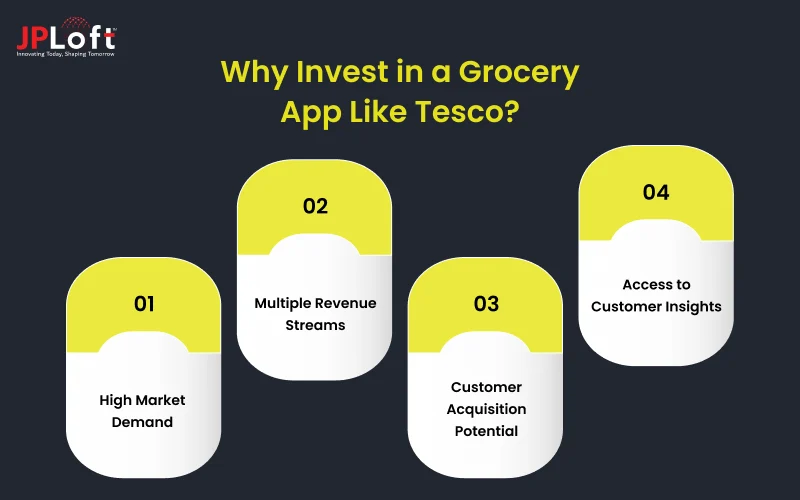
Below are the top reasons that prompt businesses to create a grocery delivery app.
1. High Market Demand
UK customers now expect easy access to groceries both online and in-store. Consider Tesco clone app development to meet this growing demand by offering quick grocery delivery, scheduled slots, and loyalty benefits.
Investing in such apps allows businesses to serve modern shoppers who prefer digital convenience while still valuing physical store access. Moreover, this can help get a place in the competitive market of the UK.
2. Multiple Revenue Streams
Tesco-like grocery app supports more than one income source. Businesses can earn through online sales, subscriptions, advertisements, in-store promotions, loyalty programs, and premium services.
However, this enables targeted offers and seasonal campaigns that increase sales. Moreover, these options help retailers grow steadily while reducing dependence on a single revenue source.
3. Customer Acquisition Potential
A grocery app makes it easier to attract and retain customers. Features like personalized offers, easy ordering, and app-only deals encourage users to stay engaged.
Businesses that create an app like Tesco can reach new customers digitally. Moreover, they can strengthen relationships with existing in-store shoppers through a unified experience.
4. Access to Customer Insights
Grocery delivery and retail apps provide valuable data about customer behavior, preferences, and buying patterns. This information helps businesses improve product listings, pricing strategies, and marketing efforts.
When you understand how to make an app like Tesco Grocery & Clubcard, these insights become a strategic asset. Thus, enabling smarter decisions, higher customer satisfaction, and steady business growth.
Essential Features to Have in a Grocery App Like Tesco
Using vital features in apps like Tesco Grocery & Clubcard helps provide seamless shopping and in-store efficiency to drive user retention and sales.
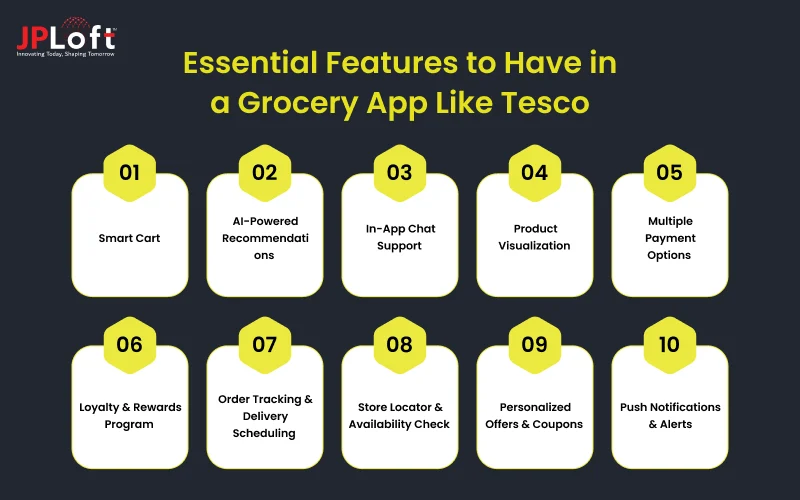
Below are the top grocery delivery app features to integrate into yours.
1. Smart Cart
A smart cart lets users add, remove, and update groceries easily while shopping in real time for better and faster purchase decisions.
2. AI-Powered Recommendations
AI in retail can be a great asset to provide suggestions for helping users discover relevant products based on past purchases and browsing history.
3. In-App Chat Support
A reliable chat support allows customers to quickly ask questions, resolve issues, and get help during shopping.
4. Product Visualization
This feature helps users view clear images and details to make it easier for customers to understand product size, use, and quality.
5. Multiple Payment Options
Different payment options allow users to pay using credit/debit cards, wallets, or digital payments, making checkout flexible and secure.
6. Loyalty & Rewards Program
A built-in loyalty program allows users to earn points on every purchase, redeem rewards, and access exclusive discounts, encouraging repeat purchases.
7. Order Tracking & Delivery Scheduling
Order tracking lets customers monitor order status in real time, while delivery scheduling allows them to choose preferred slots to improve transparency.
8. Store Locator & Availability Check
This feature helps users find nearby stores, check product availability by location, and plan in-store visits efficiently.
9. Personalized Offers & Coupons
Personalized offers deliver tailored discounts and coupons based on shopping behavior, helping users save money while increasing conversion rates.
10. Push Notifications & Alerts
Push notifications inform users about order updates, exclusive deals, low-stock reminders, and promotions, keeping customers engaged.
However, you must choose reliable mobile app development services for further processing. They will ease your roadmap to build a grocery delivery app like Tesco.
How to Build an App Like Tesco: Step-by-Step Guide
Before you start to make an app like Tesco Grocery & Clubcard, you need to take care of a few technical aspects.
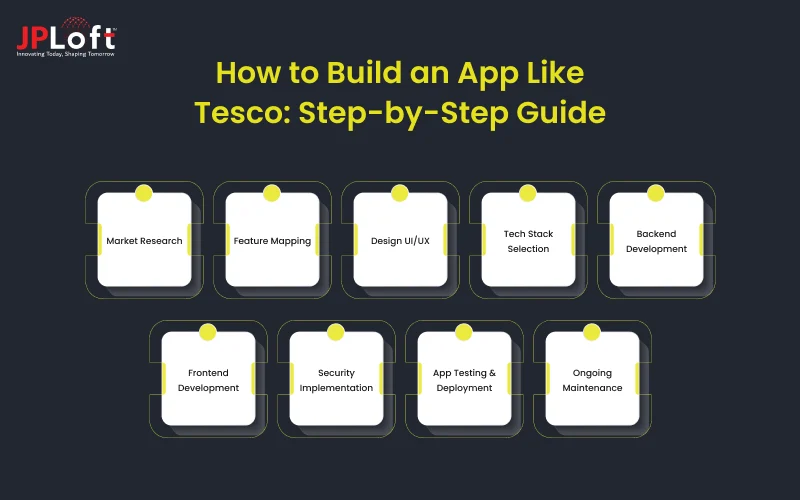
In this section, we will discuss the development process you have to undergo while developing such a platform.
A glance at the step:
-
Market Research
-
Feature Mapping
-
Design UI/UX
-
Tech Stack Selection
-
Backend Development
-
Frontend Development
-
Security Implementation
-
App Testing & Deployment
-
Ongoing Maintenance
Now, let us discuss every step in detail and clear the roadmap to build a grocery delivery app like Tesco.
Step 1: Market Research
The first step is to understand the market, users, and demand before starting the development.
► Competitor Analysis
Competitor analysis focuses on studying top grocery delivery apps to understand their features, user experience, and service models. This insight allows businesses to plan better features, avoid common mistakes, and create a stronger strategy.
► User Surveys
User surveys help gather direct feedback from potential customers about shopping habits, expectations, and pain points. Survey data support better design and feature decisions. Hence, this ensures the app solves real problems and delivers value to everyday grocery customers.
► Demand Validation
Demand validation confirms whether users are interested in the app idea before major investment. This step reduces business risk and ensures the app aligns with real customer needs. Moreover, this also helps companies move forward with confidence.
Step 2: Feature Mapping
Defining the core features helps understand app functionality and ensures a smooth journey for users and grocery chains.
► MVP Prioritization
MVP prioritization focuses on selecting only the most important features for the first app version. Launching with an MVP allows businesses to gather user feedback early and improve the app gradually based on real usage and business goals.
► User Flow Mapping
Mapping user flow shows how users move through the app from browsing the products to final checkout. Clear flows reduce confusion and improve usage. Moreover, this helps users complete tasks quickly and enjoy a smooth experience.
► API Documentation
API Documentation explains how different systems and services communicate with each other. Making clear documentation will reduce errors and improve teamwork. Moreover, this supports future scaling, which is essential for building apps like Tesco Grocery & Clubcard.
Step 3: Design UI/UX
The next step is to design a grocery app that focuses on clarity, ease of use, and visual consistency for a better experience.
► Wireframe Creation
Creating app wireframes provides a basic structure of app screens and navigation. They help teams plan layouts, content placement, and user flow early. Moreover, this allows quick changes before starting development, saving time and ensuring efficiency.
► Mobile Prototypes
Mobile app prototypes are interactive models that show how the app will look and work. This helps stakeholders test navigation and functionality at an early stage. Prototypes make it easier to identify usability issues early, align expectations, and improve overall experience.
► Usability Testing
Usability testing involves real users interacting with the app design to find issues. It helps identify confusing screens, slow actions, or unclear navigation. Feedback from testing allows teams to improve design and ensure the app is practical for everyday grocery purchase use.
Step 4: Tech Stack Selection
Choosing the right app tech stack ensures performance, scalability, and security.
► Frontend Framework
The frontend framework controls how the app looks and responds to user actions. A strong framework ensures smooth navigation, fast loading, and consistent design across devices. You must choose the right technology to improve user experience and app performance.
► Backend Database
The backend database stores all important data, including users, products, orders, and transactions. It must be secure, fast, and scalable. A well-structured database supports quick data access, accurate reporting, and stable performance, even during high traffic.
► Payment Integration
Payment integration allows users to complete purchases safely within the app. A smooth payment process reduces cart abandonment and builds trust. This also helps businesses increase conversions and revenue through a reliable checkout experience.
Step 5: Backend Development
Backend development manages the core logic and operations of the app.
► Authentication Setup
Authentication setup ensures only authorized users can access accounts and services. It includes login systems, verification, and role-based access. Strong authentication protects personal and business data, prevents misuse, and creates a secure environment.
► Microservices Build
Microservices architecture breaks the app into smaller services that handle specific tasks. This makes the system easier to scale and maintain. It allows businesses to update or expand features without affecting the entire app, supporting long-term growth and flexibility.
► Real-Time Features
Real-time features provide instant updates for orders, inventory, and notifications. They improve transparency and keep users informed at every step. Live updates enhance trust, reduce confusion, and improve the overall shopping and operational experience.
Step 6: Frontend Development
Frontend development focuses on user interaction and visual performance.
► Hybrid Screen Coding
Hybrid screen coding allows the app to work across multiple platforms using shared code. This reduces the time and Tesco like app development cost while maintaining consistent functionality. Thus, businesses can launch faster and reach more users with great quality.
► Notification Integration
Notification integration keeps users informed about order updates, offers, and important alerts. Timely notifications improve engagement and encourage repeat usage. They also help retailers communicate directly with users, improving connection and response.
► Performance Optimization
Performance optimization improves app speed, stability, and responsiveness. It includes reducing load times and improving transitions between screens. A fast and smooth app keeps users engaged, lowers drop-off rates, and delivers a better experience.
Step 7: Security Implementation
Implementing a grocery delivery app security protects user data and business systems from threats.
► Data Encryption
Data encryption secures sensitive information during storage and transmission. It prevents unauthorized access and protects personal and payment details. Strong encryption builds user trust and ensures safe transactions across online and in-store services.
► Compliance Setup
Compliance setup ensures the app follows data protection and privacy regulations. It supports responsible data handling and reduces legal risks. Meeting compliance standards is essential for operating in regulated markets like the UK and maintaining customer confidence.
► Penetration Testing
Penetration testing checks the app for security weaknesses before launch. It helps identify vulnerabilities and fix them early. Regular testing strengthens system protection and ensures the app remains secure against potential cyber threats.
Step 8: App Testing & Deployment
Performing grocery delivery app testing ensures quality and a smooth app launch.
► Unit Test Execution
Unit testing checks individual components for errors and bugs. It helps ensure each feature works correctly before full integration. However, early testing improves app stability and reduces issues during launch.
► Beta Device Testing
Beta testing allows real users to test the app on different devices and environments. It helps identify performance issues and usability problems. Thus, feedback from beta testing supports final improvements before public release.
► Smooth Deployment
Smooth deployment ensures the app is launched without service disruptions. Proper planning helps avoid downtime and ensures users can access the app easily from day one.
Step 9: Ongoing Maintenance
Considering app maintenance services keeps the app updated, secure, and scalable.
► Analytics Tracking
Analytics tracking monitors user behavior, app performance, and feature usage. It helps businesses understand what works and what needs improvement. Data insights support better decisions and continuous app enhancement.
► Update Releases
Regular updates fix bugs, improve security, and add new features. Updates keep the app relevant and competitive while improving user satisfaction over time. Doing so helps in attracting more users and keeping the active ones engaged.
► Traffic Scaling
Traffic scaling ensures the app handles increasing users and activity smoothly. It supports growth without affecting performance or user experience.
So, you can implement these steps in your process to develop a grocery app like Tesco. Moreover, you can hire mobile app developers for an easy development process for your business.
Cost to Build an App Like Tesco Grocery & Clubcard
For those who want to know the cost to develop a mobile app in UK, this section is for them.
The average Tesco like app development cost ranges from £8,000 to £37,000 ($11,000 to $51,000). Below is a breakdown of the development cost to give a fair idea.
|
App Type |
Estimated Cost (in Pounds) |
Project Duration |
|
Basic Grocery App |
8,000 to 15,000 |
3 to 4 months |
|
Mid-Level Grocery App |
15,000 to 25,000 |
5 to 7 months |
|
Advanced-Level Grocery App |
25,000 to 37,000+ |
8 to 10+ months |
However, you can hire iOS app developers after this to start. But still, there are several factors that impact the development cost. Here are some mentioned below.
-
Platform Choice: The platform you choose to build the app, like Android, iOS, or cross-platform, will affect the overall cost due to increased codebase.
-
Hiring Cost: The cost to hire mobile app developers in UK differs based on the complexity of the project, directly impacting the development cost.
-
Design Complexity: The higher the design quality you use, the more it will cost to build a grocery app like Tesco.
-
Post-Launch Updates: Investing in post-launch services is essential to keep your app updated and free from bugs.
-
Timeframe: The time required for Tesco clone app development is based on the project needs and thus increases the development cost.
Once you know how to create a grocery app like Tesco, read the next section to know the process to make money with such apps.
Monetization Models for Tesco-Like Apps
Understanding how to create a grocery app like Tesco starts with knowing how such platforms actually make money. Several mobile app monetization models help in generating revenue for your grocery delivery business.
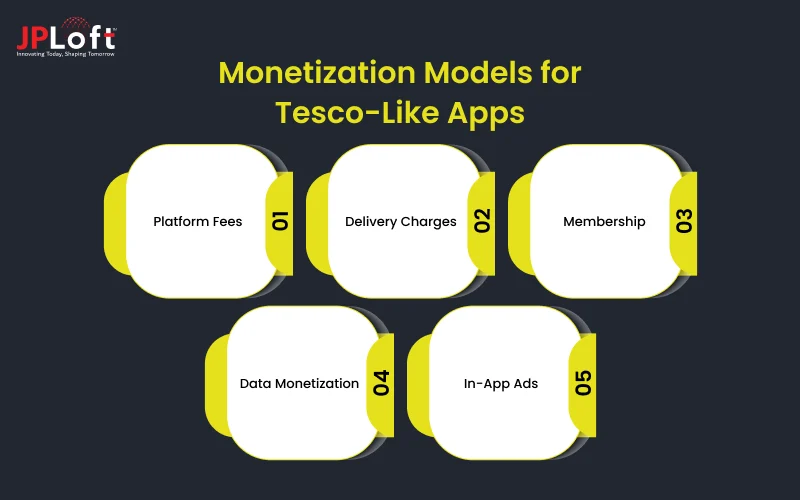
Here are a few of them discussed.
A. Platform Fees
Platform fees are small service charges paid by customers for using the grocery app. For a Tesco-like grocery app, platform fees are usually kept low and transparent so they don’t discourage repeat purchases. You can waive this fee for members or high-value orders to encourage loyalty and larger baskets.
B. Delivery Charges
Delivery charges are one of the most direct revenue sources. You can set fees based on distance, delivery time, or order value. Add surge pricing during peak hours, offer free delivery above a minimum basket size, and additional charges for super-fast delivery.
C. Membership
Memberships drive repeat orders and long-term loyalty. Offer perks like free delivery, early access to slots, and member-only discounts. Use a points system like Tesco Clubcard, where users earn points on every purchase and redeem them as vouchers to save more on future orders.
D. Data Monetization
Data monetization means using shopping behavior insights to improve sales for partners. You can offer paid reports on popular products, peak buying times, and repeat purchase trends. However, keep it privacy-safe and share only grouped data, not personal details.
E. In-App Ads
In-app ads let brands promote products inside search results, home banners, and category pages. You can sell sponsored grocery listings, seasonal campaign spots, and deal banners. Ads work best when they match user intent, so choose accordingly.
Challenges & Solutions While Building an App Like Tesco
The process to create an app like Tesco Grocery & Clubcard is not simple. You may face several grocery app development challenges in the process that can be annoying.
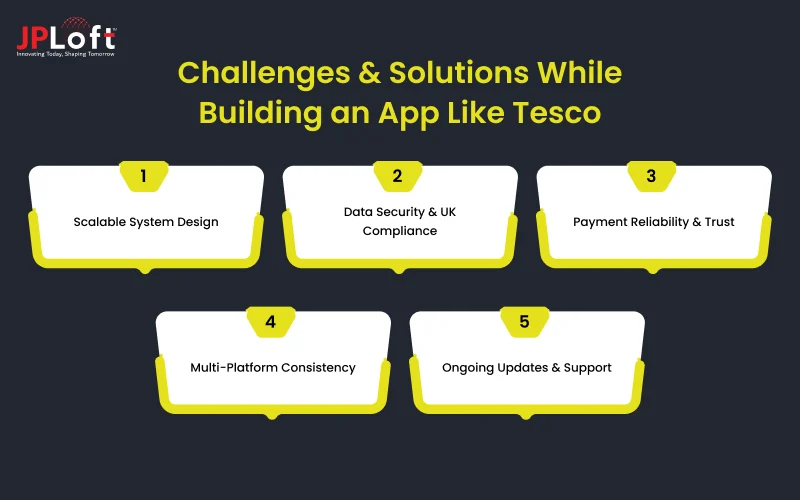
Here are a few challenges discussed with their respective solutions.
[1] Scalable System Design
Challenge: A Tesco-like app must support thousands of users, large grocery SKUs, and frequent orders without slowing down.
Solution: Use cloud infrastructure and modular backend services that scale automatically as traffic and data grow.
[2] Data Security & UK Compliance
Challenge: Handling customer data and payments requires strict compliance with UK data protection and payment standards.
Solution: Apply strong data encryption, follow GDPR guidelines, and use trusted payment providers with built-in security checks.
[3] Payment Reliability & Trust
Challenge: Failed or slow payments can cause users to abandon their carts.
Solution: Integrate multiple secure payment options and add real-time payment status checks to ensure smooth transactions.
[4] Multi-Platform Consistency
Challenge: Delivering the same experience across iOS, Android, and web can be complex.
Solution: Use cross-platform development and shared design systems to maintain consistency and reduce development effort.
[5] Ongoing Updates & Support
Challenge: Grocery delivery apps need frequent updates to fix issues and add features.
Solution: Plan long-term maintenance with regular updates, testing cycles, and monitoring to keep the app stable and competitive.
Considering these challenges and resolving them accordingly will clear your roadmap of how to develop an app like Tesco Grocery & Clubcard.
Why Choose JPLoft to Build a Grocery App Like Tesco?
Choosing the right development partner is key to building a successful grocery delivery and loyalty app. JPLoft, as a trusted mobile app development company in UK, brings strong experience in building scalable, secure, and user-friendly custom mobile apps for modern businesses.
Our team understands the UK grocery and retail market and designs solutions that support both online and in-store experiences, just like Tesco. We use a future-ready tech stack, including React Native, Flutter, Node.js, cloud-based databases, and secure payment integrations to ensure performance and scalability.
We also focus on AI-driven features, real-time updates, and strong security to match future trends. Moreover, we help businesses plan monetization, performance optimization, and long-term maintenance.
With JPLoft, you get a reliable tech partner committed to quality, innovation, and business growth. Thus, making us a smart choice to make a grocery delivery app like Tesco in 2026 and beyond.
Conclusion
Building an app like Tesco Grocery & Clubcard in 2026 requires clear planning, the right features, and a strong technical foundation. A successful grocery app must support both online and in-store experiences while focusing on performance, security, and ease of use.
From market research to ongoing maintenance, every step plays an important role in long-term success. With the right development approach and a reliable technology partner, businesses can create a scalable and future-ready grocery solution.
However, investing in a Tesco-like app helps UK retailers improve customer engagement and increase revenue. Hence, they can stay competitive in a fast-growing digital grocery market.
FAQs
The cost to build a grocery delivery app like Tesco typically ranges from £8,000 to £37,000+ ($11,000 to $51,000), depending on app complexity, features, platform choice, and development timeline. Basic apps cost less, while advanced apps with AI, real-time features, and integrations require a higher budget.
The development process includes market research, feature mapping, UI/UX design, tech stack selection, backend and frontend development, security implementation, testing, deployment, and ongoing maintenance to ensure scalability and performance.
Tesco-like apps make money through platform fees, delivery charges, memberships, in-app ads, and data insights. Combining multiple monetization models helps businesses build steady and scalable revenue streams.
Common challenges include managing high traffic, ensuring data security, maintaining real-time updates, handling inventory accuracy, and offering smooth performance across devices. These can be overcome with the right tech stack, cloud infrastructure, and continuous testing.
When considering Tesco-like app development, use key features like smart cart, AI-powered recommendations, multiple payment options, order and delivery management. You can also include loyalty programs, order tracking, delivery scheduling, and push notifications.

Priyanka Sukhwal is the Managing Director and Business Head of JPLoft, with 10+ years of experience in technology, digital product strategy, and business growth. She has worked closely with businesses building mobile applications, custom software, marketplaces, and on-demand platforms across mobility, automotive, consumer services, and startup ecosystems. At JPLoft, she focuses on understanding business models, identifying product opportunities, and helping companies plan digital solutions that can scale with changing market needs.


Share this blog