


Key Takeaways
Meal kit apps unlock recurring revenue through subscription models that improve cash flow predictability and strengthen long-term customer retention.
Personalization is the growth driver for Gousto-style platforms, increasing repeat orders by tailoring recipes, portions, and delivery preferences to user behavior.
To develop an app like Gousto, start with market research, launch an MVP with core features, then scale using data, automation, and flexible subscriptions.
Owning the app gives end-to-end control over user experience, logistics, and communication, reducing dependency on third-party marketplaces.
Scalable architecture and strong backend integration prevent performance issues as user volume, orders, and data complexity grow.
Future-ready meal kit apps evolve into lifestyle platforms, combining food, nutrition, sustainability, and smart automation.
The global meal kit delivery market is expanding fast, expected to cross USD 77 billion by 2033, driven by demand for convenience, personalization, and subscription-based food services. This rapid growth makes platforms like Gousto especially relevant for entrepreneurs and investors exploring scalable food-tech opportunities.
How to build an app like Gousto?
It starts with understanding user demand, defining a subscription-led business model, and building a feature-focused MVP that balances convenience with operational efficiency.
This guide is built to help founders plan a realistic product roadmap and help investors assess feasibility, costs, and growth potential.
It walks you through market insights, core features, development steps, cost breakdowns, monetization strategies, challenges, and future trends, giving you a clear, practical path to build and scale a Gousto-style app confidently.
Let's get started.
JPLoft helps build Gousto-style apps with scalable tech, subscription logic, and growth-focused development strategies aligned with real market demand.
A Brief Understanding of the Gousto App
Gousto originated in London, United Kingdom, and was founded to make home cooking easier, faster, and more enjoyable for busy households.
The Gousto app powers its meal kit subscription service, allowing users to select from a wide range of chef-designed recipes, manage dietary preferences, and schedule flexible weekly deliveries.
Customers receive pre-measured ingredients with clear, step-by-step cooking instructions. The app also supports subscription controls such as skipping weeks, adjusting portions, and tracking deliveries.
By combining intuitive UX, personalization, and efficient logistics, Gousto has grown into a trusted UK food-tech brand that adapts to user habits while maintaining quality, convenience, and consistency.
Let’s evaluate the overall market statistics related to below.
-
The global meal kit delivery services market size was estimated at USD 32.8 billion in 2024, and is further projected to reach USD 77.6 billion by 2033, that is growing at a CAGR of 8.8% from 2025 to 2033.

-
When it comes to the European meal kit delivery services market, the size was estimated at USD 6.4 billion in 2023, and is expected to grow at a AGR of 11.8% from 2024 to 2030.
-
Additionally, the global meal kit market size is projected to reach USD 20.3 billion by 2025, and is anticipated to surge to nearly USD 65.5 billion by 2035, that is recording a CAGR of 12.4%.
-
Based on the market insights given by Global Market Insights, this size was valued at USD 18.1 billion in 2024 and is estimated to grow at a CAGR of over 12.4% from 2025 to 2034.
These growing market statistics clearly define the reasons to make a Gousto app. However, let's get ahead with more reasons in the given section.
Reasons to Create a Gousto App
There are different reasons to build a Gousto app, such as convenience, a subscription-based revenue model, and personalization drives higher retention.
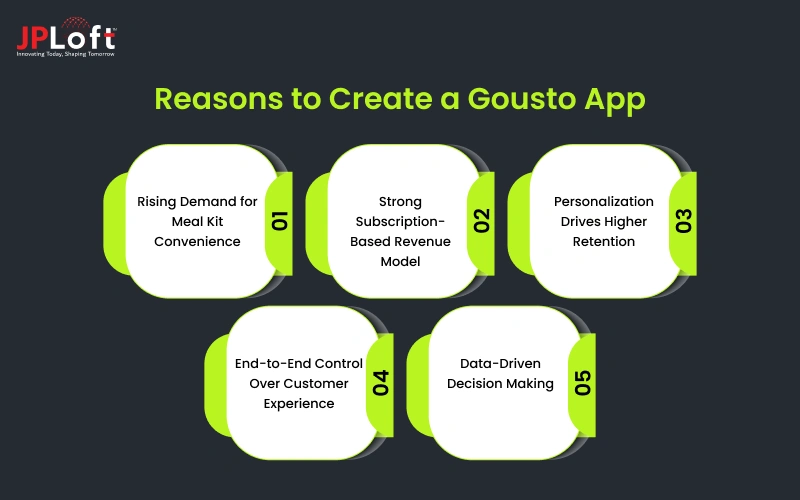
Let’s learn about all the reasons on how to build a recipe subscription box app like Gousto, below.
1. Rising Demand for Meal Kit Convenience
Consumers increasingly prefer structured meal planning with doorstep delivery. A Gousto-style app meets this demand by simplifying grocery decisions and saving time. It fits modern lifestyles where convenience and consistency matter.
The global meal kit delivery service market size is anticipated to rise from US$20.6 billion in 2025 to US$50.3 billion by 2032, and is projected to witness a CAGR of 13.6% from 2025 to 2032.
2. Strong Subscription-Based Revenue Model
Meal kit apps thrive on recurring subscriptions that create predictable monthly revenue. Flexible plans, add-ons, and upsells improve lifetime value. This model supports stable growth and better cash flow forecasting.
The worldwide meal delivery market is expected to reach USD 77.6 billion by 2033, growing at a CAGR of 8.8% from the year 2025 to 2033.
3. Personalization Drives Higher Retention
Recipe recommendations, dietary preferences, and portion control keep users engaged. Personalization makes the experience feel tailored, not generic. That directly improves repeat orders and long-term user loyalty.
Nowadays, AI in food delivery boosts efficiency, enhances customer experience, and improves restaurant operations, which helps in improving personalization.
4. End-to-End Control Over Customer Experience
Owning the app means full control over ordering, delivery schedules, and communication. You can optimize UX, reduce dependency on third-party platforms, and build a direct relationship with customers.
Along with this, if you create an app like Gousto, you get an end-to-end control over the customer experience.
5. Data-Driven Decision Making
A Gousto-like app collects valuable insights on food preferences, order frequency, and drop-off points. This data helps refine menus, pricing, and inventory planning. Smarter decisions reduce waste and increase margins.
By investing in an app like Gousto, you can make effective data-driven decisions. As it will help you to evaluate what the current users are looking for and what you can offer to multiply the orders and ultimately the revenue.
Now, proceeding with the reasons, let's get ahead with the features to include in a Gousto App.
Gousto Like App Features
The key features that you can include in an app like Gousto are dietary filters, preference settings, recipe discovery, AI recommendations, real-time features, and more.
Let's get ahead with the features to include while building an app like Gousto in the given table.
|
Feature |
Description |
|
User Registration & Profiles |
Allows users to create accounts, manage personal details, delivery addresses, and dietary preferences securely. |
|
Recipe Browsing & Discovery |
Displays chef-curated recipes with filters for cuisine, diet type, cooking time, and difficulty level. |
|
Subscription Management |
Enables users to start, pause, skip, or cancel subscriptions with full control over delivery schedules. |
|
Meal Customization |
Lets users adjust portion sizes, swap ingredients, and select meals based on calories or allergies. |
|
Weekly Menu Selection |
Shows rotating weekly menus so users can plan meals in advance and avoid last-minute decisions. |
|
Smart Recommendations |
Suggests recipes based on past orders, preferences, and user behavior to improve engagement. |
|
Order Scheduling & Tracking |
Allows users to choose delivery dates and track orders in real time from dispatch to doorstep. |
|
In-App Payments |
Supports secure payments through cards, wallets, and recurring billing for subscriptions. |
|
Push Notifications |
Sends reminders for menu selection, upcoming deliveries, payment updates, and promotions. |
|
Cooking Instructions |
Provides step-by-step cooking guidance with visuals, timers, and tips for a smooth cooking experience. |
|
Ratings & Reviews |
Enables users to rate recipes and provide feedback to improve menu planning and quality control. |
|
Admin Dashboard |
Helps admins manage menus, orders, users, subscriptions, inventory, and analytics efficiently. |
|
Customer Support Integration |
Offers in-app chat or ticket support for handling delivery issues, refunds, and queries quickly. |
|
Analytics & Reporting |
Tracks user behavior, churn, popular recipes, and subscription performance for data-driven decisions. |
Now, as you are aware of the features and why to create an app like Gousto, let's learn the complete steps of mobile app development in the following section.

How to Create an App like Gousto?
You can build an app like Gousto by beginning with the planning of the app, selecting the right number of features, designing the app, evaluating the tech stack, testing, and ending with the launch of the app.
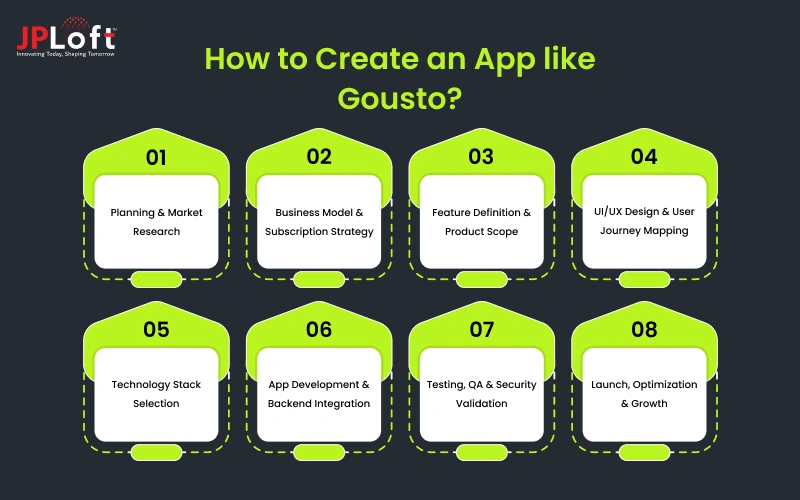
Let's learn all the steps to make an app like Gousto, below.
Step 1: Planning & Market Research
You should plan the app successfully. Here, the planning begins with identifying the current market, evaluating how the market performs when it comes to meal kit delivery.
And then planning the strategies to capture the interest of the core users through the app development.
► Understand User Demand and Pain Points
Start by identifying your core users and how they plan meals today. Study cooking habits, dietary needs, delivery expectations, and subscription fatigue.
This research highlights what users truly value, such as flexibility, simplicity, or personalization. Clear insights at this stage prevent overbuilding features that do not convert.
► Analyze Competitors and Market Gaps
Evaluate leading meal kit platforms like Gousto to understand feature depth, pricing models, and user experience.
You can create an app like Gousto by identifying gaps in regional menus, sustainability features, or customization options. Competitive analysis helps you define a strong value proposition instead of replicating existing apps.
Step 2: Business Model & Subscription Strategy
Now, it's time to define the complete business model on which the app will operate. Here you can select among the subscription-based, direct-to-consumer model, or the value & consumer-based model.
► Design Subscription Plans and Pricing
Define how users subscribe, choose meals, and manage deliveries. Weekly plans, portion-based pricing, and flexible skipping options reduce churn.
A transparent subscription structure builds trust and encourages long-term retention. Pricing should balance affordability with operational sustainability.
► Plan Revenue Streams Beyond Subscriptions
Add-ons like premium recipes, express delivery, or curated boxes increase average revenue per user. These options give customers control while unlocking incremental income.
Diversified revenue streams reduce dependency on subscriptions alone and improve financial stability.
Step 3: Feature Definition & Product Scope
Well, now it's time to select the right features for your competitive app. The features begin with user registration, and go as far as you want to make the app consumer-focused and advanced as per the current market.
► Identify MVP Features
Focus on essential features such as recipe browsing, subscription control, payments, and delivery scheduling.
An MVP allows you to launch faster and validate demand with real users. Keeping the first version lean helps control cost and shortens time to market.
► Plan Advanced Features for Later Phases
Features like AI meal recommendations, nutrition tracking, and sustainability insights should follow after launch.
These enhancements improve engagement once the core experience is stable. A phased roadmap ensures steady growth without overwhelming users or budgets.
Step 4: UI/UX Design & User Journey Mapping
In this step, the mobile app design should be created. The frontend becomes important as it is the interface that has a direct connection with the targeted users.
Hence, you should plan the user journey and evaluate what the user goes through. This will help you to define what the users will first click on in the app, what they will see, how they can access their aspected function, and much more.
► Map End-to-End User Journeys
Design seamless flows for browsing recipes, selecting meals, managing subscriptions, and following cooking instructions. When it comes to Gousto, the app has done a complete study on user behavior and also considers the data on the socio-demographic background.
Each step should feel intuitive and predictable. Clear journeys reduce friction and improve conversion from browsing to checkout.
► Focus on Simplicity and Accessibility
Use clean layouts, readable typography, and minimal steps per action. Accessibility considerations broaden your audience and improve usability for all users.
A simple interface directly impacts retention and repeat orders. Along with this, you should focus on the simplicity of the app, rather than making it complicated for the users to process.
Step 5: Technology Stack Selection
Now, it's time to build the core functionality of the app. Here, the basic functions begin with evaluating the language, identifying the prospective database, and much more.
Let’s get into the details of the mobile app tech stack.
► Choose the Right Frontend and Backend
Select frameworks that support performance, scalability, and rapid updates. The backend must handle subscriptions, recurring payments, and inventory reliably.
Strong technical foundations prevent performance bottlenecks as user volume grows.
► Plan Cloud Infrastructure and Integrations
Cloud services enable scalability, data storage, and traffic management.
Integrate trusted third-party tools for payments, notifications, and analytics. A modular setup makes future upgrades and regional expansion easier.
Step 6: App Development & Backend Integration
This stage focuses on building a food delivery app and connecting it with backend systems for subscriptions, orders, payments, and user management.
Seamless integration ensures real-time data flow between the app, inventory, and delivery operations, preventing delays and errors. A well-synced backend supports scalability, performance, and a smooth user experience as demand grows.
► Build Core App Functionality
Develop the mobile app alongside backend systems for orders, users, and subscriptions. Ensure real-time syncing between user actions and operational processes.
This phase transforms strategy and design into a working product.
► Integrate Logistics and Operations
Connect inventory management, packaging, and delivery workflows to the app. Accurate integration prevents order errors and delays.
Strong operational alignment is essential for customer satisfaction and trust.
Step 7: Testing, QA & Security Validation
It's important to pursue the mobile app testing landscape. It is all about performing diversified types of testing on the app and then enhancing the overall quality of the app.
Let’s get ahead with the testing parameter in more detail, below.
► Perform Functional and Performance Testing
Test all user flows across devices, operating systems, and network conditions. Validate subscriptions, payments, and delivery scheduling under load.
Thorough testing reduces post-launch issues and negative reviews. It is important to test regularly to enhance the quality of the app.
► Ensure Data Security and Compliance
Protect user data with encryption, secure authentication, and access controls. Regular audits help prevent breaches and ensure compliance. Strong security practices build credibility and long-term brand trust.
You should ensure that the mobile app security boosts the complete performance.
Step 8. Launch, Optimization & Growth
It is the final step but not least. Here, it's all about the deployment of the app. Deciding whether you want to launch the app on the App Store or want to submit the app to the Play Store.
You can also select the cross-platform solution if you want to target such types of audiences.
► Execute a Controlled App Launch
Release the app with a phased rollout to monitor performance and user feedback. Early insights allow quick fixes before full-scale expansion.
Controlled launches reduce risk and stabilize operations. Furthermore, you can execute a controlled app launch.
► Optimize for Retention and Scale
Analyze user behavior, churn patterns, and popular recipes. Use insights to improve personalization, expand menus, and refine logistics.
Continuous optimization turns the app into a scalable, long-term food-tech platform.
If you want to include advanced technologies such as AI or IoT, connecting with the leading AI app development services can be effective.
How Much Does It Cost to Develop an App like Gousto?
The cost to develop an app like Gousto typically starts from $15,000 and can go up to $60,000+, depending on the app’s scope, features, and technical complexity.
A basic version with core functionality such as user onboarding, recipe browsing, subscription management, and payment integration sits on the lower end of the range.
As you add advanced features like personalized meal recommendations, flexible subscription controls, real-time delivery tracking, admin dashboards, and scalable cloud infrastructure, the overall cost increases. The cost to develop a food delivery app is impacted by design quality, platform choice (iOS, Android, or cross-platform), third-party integrations, and security requirements also influence the final budget.
Long-term expenses such as maintenance, updates, and performance optimization should be planned alongside development to ensure sustainable growth. Let’s evaluate the complete cost overview in the table given below.
|
App Level |
Scope Overview |
Estimated Cost (USD) |
|
Basic App |
User onboarding, recipe browsing, basic subscription flow, and payments |
$15,000 – $25,000 |
|
Mid-Level App |
Meal customization, subscription controls, notifications, and admin panel |
$25,000 – $45,000 |
|
Advanced App |
Personalization, scalable backend, analytics, logistics integration |
$45,000 – $60,000+ |
Now, proceeding with the monetization strategies, let's learn how to cover the complete cost to develop an app like Gousto in the following section.
Key Monetization Strategies to Include in an App like Gousto
You can include monetization strategies, such as subscription-based meal plans, premium recipe upgrades, add-on products, and many more.
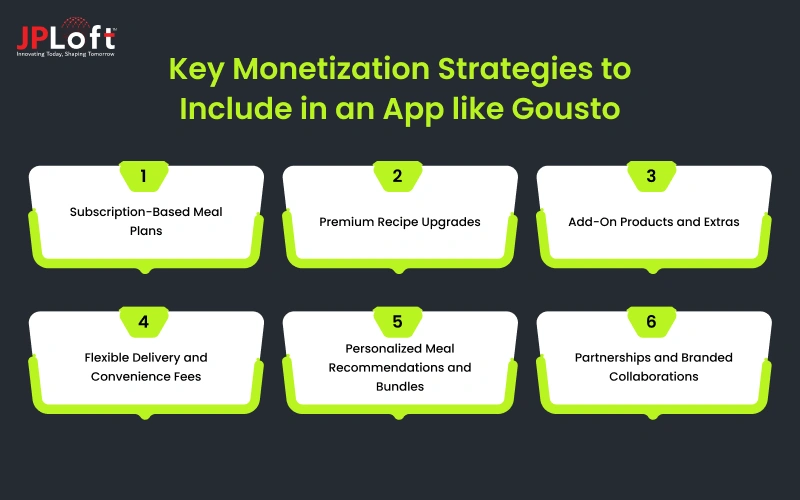
Let’s learn about the complete food delivery app monetization strategies in this section.
► Subscription-Based Meal Plans
Weekly or monthly subscriptions form the core revenue stream for a Gousto-style app. Users pay for recurring meal deliveries based on selected portions and preferences. This model ensures predictable revenue and supports long-term customer retention.
► Premium Recipe Upgrades
Offer exclusive chef-designed or specialty recipes for an additional fee. Premium meals attract users willing to pay more for variety or dietary-specific options. This strategy increases average order value without impacting base subscriptions.
► Add-On Products and Extras
Sell add-ons like desserts, snacks, beverages, or kitchen essentials alongside meal kits. These impulse purchases raise cart value while enhancing the overall customer experience. Add-ons also allow easy seasonal or promotional upselling.
► Flexible Delivery and Convenience Fees
Charge extra for express delivery, preferred time slots, or last-minute order changes. Convenience-based pricing appeals to users who value speed and flexibility. This mobile app monetization model helps offset logistics costs while generating incremental revenue.
► Personalized Meal Recommendations and Bundles
Use data insights to create personalized bundles or curated meal boxes at a premium price. Tailored offerings feel more valuable and drive higher conversion rates. Personalization strengthens engagement and lifetime value.
► Partnerships and Branded Collaborations
Collaborate with food brands or nutrition partners to offer co-branded meal kits. Sponsored recipes and exclusive collaborations create new revenue streams. Partnerships also improve brand visibility and customer trust.
What are the Key Challenges to Make an App like Gousto?
The key challenges to building a food delivery app begin with managing the subscription churn rate, logistics, and supply chain coordination, followed by personalization at scale, cost security, and much more.
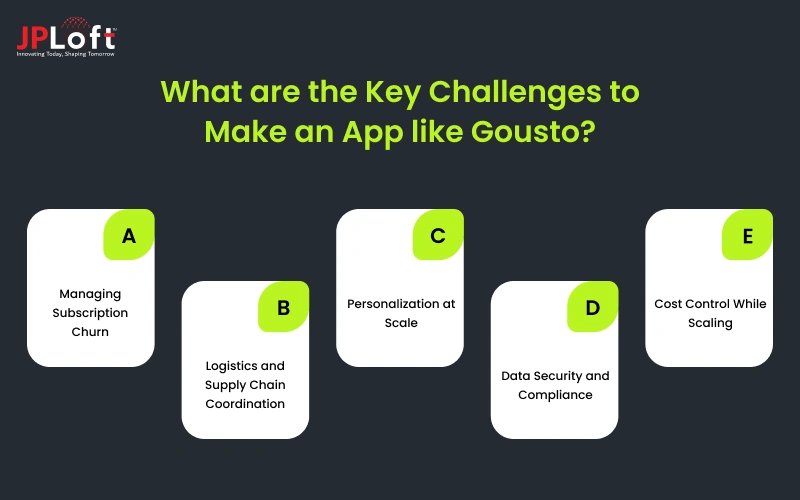
Let’s learn all the key challenges to make a food delivery app below.
Challenges 1: Managing Subscription Churn
Meal kit apps face high churn if users feel locked in or bored with menus.
You might face challenges with balancing flexibility with predictable revenue is difficult while creating an app like Gousto.
Poor churn control directly impacts lifetime value and profitability.
Challenges 2: Logistics and Supply Chain Coordination
Timely ingredient sourcing, packaging, and delivery require tight backend integration.
Any delay or mismatch affects user trust immediately. This can impact the overall Gousto like app development.
Scaling logistics without cost overruns remains a major operational challenge.
Challenges 3: Personalization at Scale
Users expect tailored recipes, portions, and dietary options.
Along with this, you might face challenges in delivering personalization without slowing performance or increasing costs is complex.
Weak personalization leads to disengagement over time when you make an app like Gousto.
Challenges 4: Data Security and Compliance
Handling user data, payments, and preferences requires strong security practices.
Compliance failures can damage reputation and invite legal risk.
Security investments add complexity but cannot be skipped. Hence, proceeding with the data security and complying with the regulations can be a challenge to create an app like Gousto.
Challenges 5: Cost Control While Scaling
As user volume grows, infrastructure and API costs rise.
Without careful planning, scalability becomes expensive. This can further impact the gousto like app development process.
Balancing growth with sustainable cost structures is critical when it's about building an app like Gousto.
To address these challenges, you can connect with the leading food delivery app development company effectively.
What is the Future of an App like Gousto?
The future of an app like Gousto lies in deeper personalization, flexible subscriptions, and smarter operations powered by data and automation.
As users demand convenience and sustainability, meal kit apps will evolve into lifestyle platforms that combine food, nutrition, and seamless digital experiences.
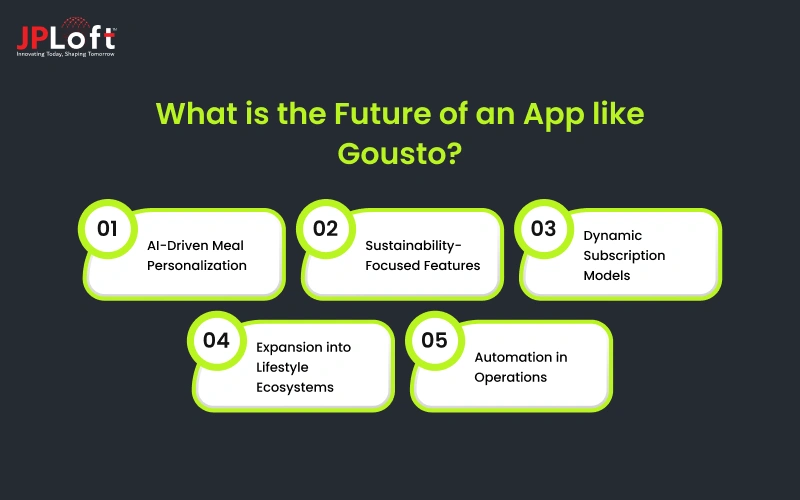
Let’s evaluate the future of an app like Gousto below.
1. AI-Driven Meal Personalization
Future apps will use AI to predict meal preferences and reduce churn.
Smarter recommendations increase order frequency.
Personalization becomes a competitive differentiator. You can proceed with building an AI app or integrating AI in Gousto for improving the User experience.
2. Sustainability-Focused Features
Users increasingly care about waste reduction and sourcing transparency.
Apps will highlight eco-friendly packaging and carbon tracking. Sustainability-focused features can be defined as the design elements in products, buildings, or services that minimize the negative environmental impact.
Sustainability directly influences brand loyalty.
3. Dynamic Subscription Models
Rigid subscriptions are fading in favor of flexible, usage-based plans.
Users want more control over frequency and spending.
Flexibility improves retention and satisfaction.
4. Expansion into Lifestyle Ecosystems
Meal apps will integrate fitness, nutrition, and wellness data.
Cross-platform experiences increase engagement.
This opens new monetization opportunities.
5. Automation in Operations
Automation will optimize inventory, forecasting, and delivery routes.
Operational efficiency lowers costs at scale.
Tech-led operations define long-term success.
Why Partner with JPLoft to Build an App Like Gousto?
Building a Gousto-style app requires more than features. It demands strong architecture, subscription logic, scalability planning, and seamless operations. As a Mobile app development company in the UK, JPLoft helps businesses design and build meal kit apps that balance user experience with operational efficiency.
JPLoft approaches development with a product-first mindset. From planning subscription models and personalization flows to integrating logistics, payments, and analytics, every element is built for growth. The focus stays on performance, security, and flexibility so your app adapts as user expectations evolve.
With experience across scalable consumer apps, JPLoft supports you from MVP to expansion, ensuring your food-tech platform is reliable, future-ready, and built for long-term success.

Conclusion
Building an app like Gousto is a strategic move in a rapidly expanding meal kit and food-tech market. Success depends on combining a strong subscription model, intuitive UX, reliable logistics, and data-driven personalization. From planning and feature selection to technology choices, monetization, and scalability, every decision directly impacts user retention and long-term profitability.
A phased development approach helps control costs while validating real demand. As consumer expectations shift toward convenience, flexibility, and sustainability, a well-built Gousto-style app can evolve into a scalable digital platform that delivers consistent value to both users and the business.
FAQs
Gousto is a meal kit subscription app that allows users to select recipes, manage weekly deliveries, and receive pre-measured ingredients with cooking instructions.
To develop an app like Gousto, start with market research and a clear subscription model focused on user convenience. Build an MVP with core features, use a scalable tech stack, and launch in phases while optimizing through user feedback and data.
Development usually takes 3 to 6 months, depending on feature scope, platform choice, and backend complexity.
Subscription-based meal plans generate predictable recurring revenue, supported by add-ons and premium upgrades.
Yes, launching an MVP with core features helps validate demand and reduces initial investment before scaling.
Common challenges include managing subscription churn, logistics coordination, personalization at scale, and cost control during growth.

Priyanka Sukhwal is the Managing Director and Business Head of JPLoft, with 10+ years of experience in technology, digital product strategy, and business growth. She has worked closely with businesses building mobile applications, custom software, marketplaces, and on-demand platforms across mobility, automotive, consumer services, and startup ecosystems. At JPLoft, she focuses on understanding business models, identifying product opportunities, and helping companies plan digital solutions that can scale with changing market needs.


Share this blog