


Key Takeaways:
Kuwait’s fintech market requires early alignment with CBK regulations and other applicable financial rules. Ignoring compliance can increase costs and delay launch.
KNET integration depends on eligible bank or payment provider partnerships, onboarding, technical requirements, and certification.
Development budgets range from KWD 20,000 to KWD 100,000+, with costs and timelines shaped by app complexity, financial integrations, security, and compliance needs.
Arabic and English support, right-to-left layouts, and local payment preferences influence the app’s design and functionality.
Security must be built into the architecture, with strong authentication, transaction verification, fraud monitoring, and audit trails supporting safer financial operations.
Kuwait’s shift toward digital payments is creating opportunities for businesses to rethink how people manage money, make payments, access financial services, and track their finances.
With non-cash payments already at about 85% of transaction value in Q2 2026, this is the market must build for.
For a startup founder or established financial business, turning one of these opportunities into a fintech app involves more than choosing features and hiring developers. Imagine a founder with a finished design.
The real questions begin there. Does the app need a Central Bank of Kuwait (CBK) license? How will customers pay through KNET? Will it feel natural in Arabic?
Each answer shapes the next, from selecting the right app type to planning security, regulatory requirements, and launch timelines. If you are wondering how to build a fintech app for Kuwait, then this guide is for you.
In this guide, we will cover more about the market, CBK/CMA compliance, KNET integration, the development process, tech stack, costs, and common challenges.
So let’s proceed.
Market Snapshot: Why Invest in Fintech App Development in Kuwait?
Kuwait's digital payment ecosystem is creating opportunities for businesses looking to simplify everyday transactions, improve access to financial services, and offer better experiences.
Growing non-cash payment activity, expanding instant-transfer infrastructure, and an established regulatory framework offer useful signals for businesses assessing the market.
Here are the key indicators to consider before investing in building a Fintech app:
-
Digital payments are growing: Non-cash payments accounted for approximately 85% of transaction value in Q2 2026, reflecting the shift toward cashless transactions.
-
Instant transfers are gaining traction: Kuwait’s WAMD instant payment service recorded approximately KWD 1.03 billion in transaction value in June 2026.
-
Consumers favor cashless methods: Visa’s January 2026 study found that 59% of surveyed consumers in Kuwait predominantly used non-cash payments.
-
The fintech ecosystem is expanding: Reports citing CBK information indicate that nine electronic payment service providers and seven electronic money providers were registered by 2026.
-
Financial inclusion remains relevant: Bank accounts held by low-income groups and domestic workers exceeded 1.47 million as of June 30, 2026.
Types of Fintech Apps You Can Build in Kuwait
Choosing the right fintech app type in Kuwait starts with identifying your target users, the financial needs you want to address, and the relevant fintech app development trends.
Payment platforms, banking apps, lending, and investment solutions, and digital wallet app development Kuwait each serve different business goals and customer segments.
Here are the common types of fintech apps you can develop in Kuwait.
|
App Type |
What it Does |
Best Suited For |
|
Digital Wallet Apps |
Enable users to store electronic money, make payments, and manage wallet balances. |
Fintech startups offering digital payment experiences or businesses building customer payment ecosystems. |
|
Payment Apps and Gateways |
Process online and in-app payments by connecting merchants with payment networks and financial institutions. |
E-commerce businesses, retailers, marketplaces, and service providers accepting digital payments. |
|
Buy Now, Pay Later (BNPL) Apps |
Allow eligible customers to split purchases into installments and manage repayment schedules. |
Retailers and fintech companies offering installment-based purchasing options. |
|
Digital Banking and Banking-as-a-Service Apps |
Provide digital access to banking services or enable businesses to deliver financial features through licensed banking partners. |
Banks expanding digital services, fintech startups partnering with banks, and businesses embedding financial services in their platforms. |
|
P2P and Instant Transfer Apps |
Support transfers between individuals and facilitate instant payment experiences through supported payment infrastructure such as WAMD. |
Remittance-related businesses, consumer finance platforms, and apps enabling person-to-person payments. |
|
Lending Apps |
Manage loan applications, eligibility assessments, repayment schedules, and borrower accounts. |
Financial institutions and eligible lending businesses digitizing loan origination and servicing. |
|
Investment Apps |
Provide access to investment products, portfolio tracking, and investment account management. |
Investment firms, wealth managers, and businesses offering regulated investment services. |
|
Open Banking Apps |
Connect financial information from participating banks through authorized APIs to support financial insights and account aggregation. |
Personal finance platforms, SME cash-flow tools, and businesses developing data-driven financial services. |
What Should Businesses Know Before Developing a Fintech App in Kuwait?
Before developing a fintech app in Kuwait, businesses should evaluate a set of factors including their target market, operating model, regulatory obligations, payment integrations, and local user expectations. These factors influence product scope, development costs, and launch timelines.
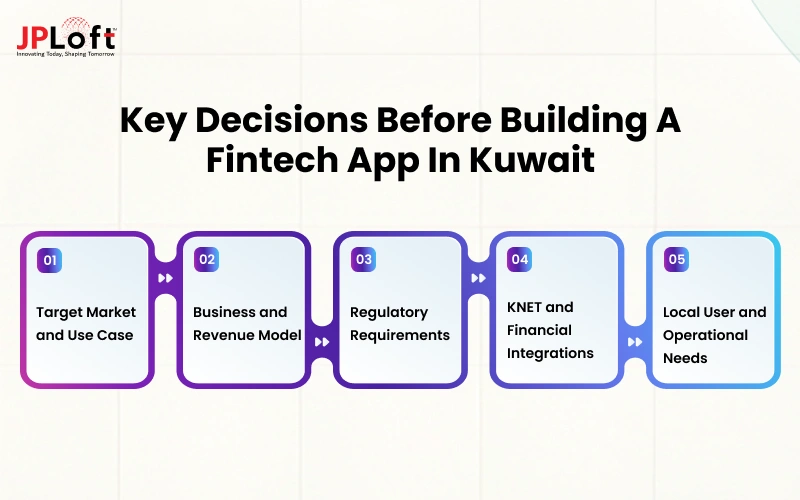
1. Define Your Target Market and Use Case
Identify the users you intend to serve and the financial problem your app will solve.
-
Target Audience: Residents, expatriates, merchants, SMEs, or financial institutions.
-
App Type: Digital wallet, payment app, money transfer service, digital banking platform, lending app, or investment platform.
-
Core Requirements: The must-have capabilities for your first release, such as KNET payments, eKYC with Civil ID or Kuwait Mobile ID, and Arabic/English interfaces.
2. Choose Your Business and Revenue Model
Determine how the service will operate and generate revenue.
-
Operating Model: Assess whether to establish a regulated business or partner with a licensed bank or payment provider, where permitted.
-
Revenue Streams: Evaluate subscriptions, merchant fees, or business-to-business services against applicable restrictions.
-
Partnership Needs: Identify third parties required to deliver banking, payment, or identity verification services.
3. Assess Regulatory Requirements
The applicable rules depend on the financial activities and services your app will offer.
-
CBK (Central Bank of Kuwait): Check requirements for relevant banking, electronic payment, and e-money activities.
-
CMA (Capital Markets Authority): Assess rules for regulated investment, securities trading, and capital market services.
-
CITRA (Communication and Information Technology Regulatory Authority): Check applicable telecommunications and IT requirements if your business or services fall within its regulatory scope.
-
Compliance Obligations: Confirm licensing, customer verification (KYC), anti-money laundering and countering the financing of terrorism (AML/CFT) duties, data protection under CITRA's data-privacy rules, and risk-management requirements.
4. Plan KNET and Other Financial Integrations
Identify the payment services your app needs and confirm access requirements early.
-
KNET Access: Assess integration through an eligible member bank or payment provider.
-
Additional Methods: Consider bank APIs, payment gateways, and WAMD transfers, subject to availability and eligibility.
-
Technical Requirements: Confirm onboarding, transaction verification, settlement, reconciliation, refunds, and testing or certification procedures.
5. Address Local User and Operational Needs
Plan an experience that supports local users and ongoing financial operations.
-
Localization: Provide Arabic and English interfaces, right-to-left layouts, and clear transaction messages for payment app development Kuwait.
-
Identity Verification: Assess suitable verification methods and integrations, including Kuwait Mobile ID where supported.
-
Security and Support: Plan authentication, fraud monitoring, customer support, dispute handling, security updates, and ongoing compliance.
Must-Have Features of a Fintech App in Kuwait
A fintech app in Kuwait needs features that simplify financial transactions while meeting local user expectations.
From bilingual interfaces and supported payment methods to secure account access and transaction tracking, each fintech app feature should align with the app's purpose and target audience.
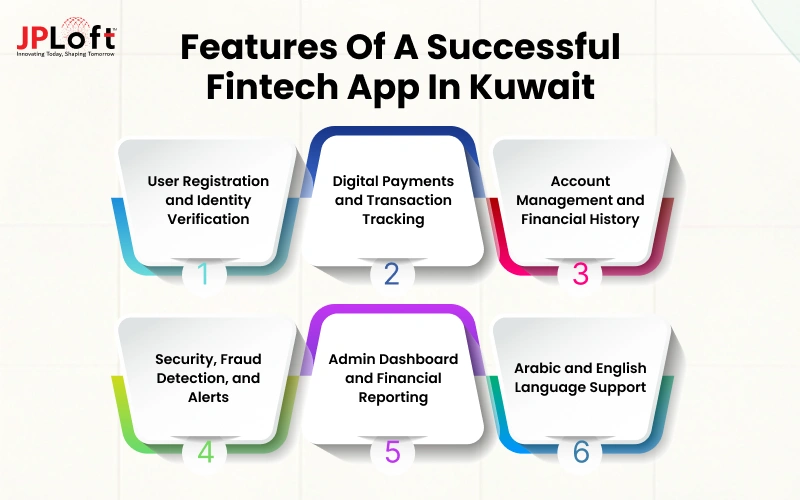
[A] User Registration and Identity Verification
Provide simple digital onboarding and eKYC using supported identity verification methods, including Civil ID or Kuwait Mobile ID where available through the chosen provider.
[B] Digital Payments and Transaction Management
Support KNET for eligible debit-card payments, other supported payment methods, and WAMD transfers where available. Include payment status tracking, receipts, and refund management.
[C] Account Management and Transaction History
Display account balances, transaction history, and downloadable statements, with filters by date and transaction type so users can find a payment quickly.
[D] Security, Fraud Prevention, and Notifications
Include multifactor authentication, biometric login, suspicious-activity alerts, and real-time notifications for payments, transfers, refunds, and account changes.
[E] Admin Dashboard and Reporting
Provide transaction monitoring, flagged-transaction review, reconciliation reports, audit logs, and exports for operational and applicable regulatory reporting.
[F] Arabic and English Localization
Offer Arabic and English interfaces with right-to-left (RTL) layouts for Arabic, and localize transaction messages, receipts, and notifications in both languages.
How Can You Prepare for Fintech Compliance and KNET Integration?
Before launching a fintech app in Kuwait, businesses need to assess the regulatory requirements for their planned financial services, check for relevant fintech app compliances and confirm the steps required to integrate local payment methods.
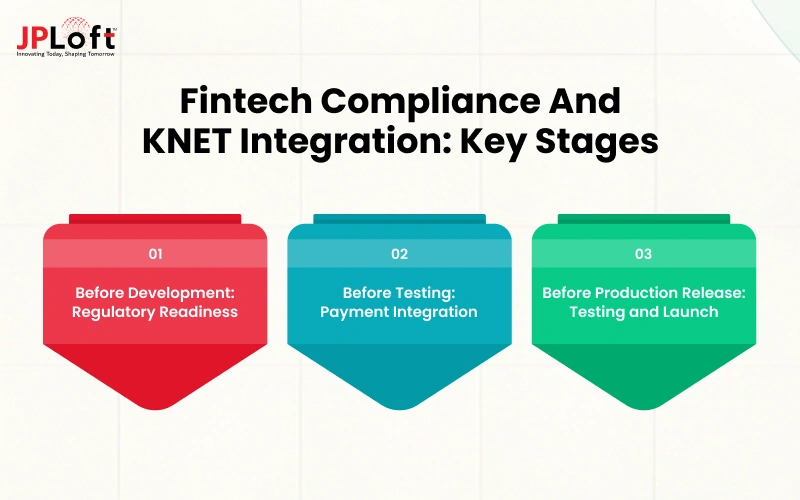
► Before Development
Regulatory Readiness
-
Identify the applicable CBK or CMA requirements for financial activities in your app.
-
Confirm licensing, approval, capital, and documentation requirements where applicable.
-
Assess AML/CFT, customer verification, data protection, and risk management obligations.
-
Check whether CBK's Wolooj regulatory sandbox, a framework for testing new fintech products under CBK supervision, suits your product.
► Before Testing
Payment Integration
-
Choose an available KNET payment integration route.
-
Complete merchant onboarding and obtain the required credentials.
-
Implement the specified secure payment flow and transaction responses.
-
Agree on settlement, reconciliation, refund, and dispute-handling procedures.
► Before Production Release
Testing and Launch
-
Verify payment status server-side rather than relying only on browser redirects.
-
Test successful and failed payments, cancellations, timeouts, retries, and duplicate requests.
-
Validate refunds, transaction records, and reconciliation reports.
-
Complete required bank or KNET certification and resolve critical issues before launch.
How to Develop a Fintech App in Kuwait: Step-by-Step Process
Whether focusing on a fintech app or specific mobile banking app development Kuwait, both requires a structured process that accounts for business goals, local payment infrastructure, regulatory requirements, and user expectations.
The following steps cover the journey from initial planning to post-launch maintenance.
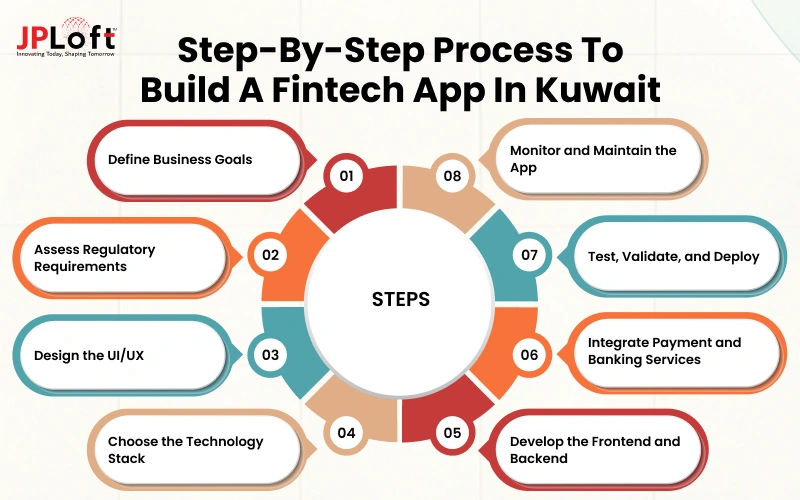
Step 1: Define Business Goals and Requirements
Conduct app market research to identify the app’s purpose, target users, core features, revenue model, and expected transaction volume. Decide whether the product will support digital payments, money transfers, lending, digital banking, or investment services. Record these decisions in a short requirements document that later steps build on.
Step 2: Assess Regulatory Requirements
Confirm which CBK or CMA requirements cover your planned financial activities. Determine licensing, approvals, and documentation needs before finalizing the product scope and launch plan. If your product is new to the market, check whether CBK’s Wolooj regulatory sandbox suits it. Early answers prevent later rework.
Step 3: Design the UI/UX
Create user journeys for registration, identity verification, payments, transfers, and transaction tracking. Design Arabic and English interfaces together, including right-to-left layouts for Arabic, and keep error and confirmation messages clear in both languages. Test app prototypes with representative users before development begins.
Step 4: Choose the Technology Stack
Select frontend and backend frameworks, databases, hosting infrastructure, and monitoring tools that fit your product. Design the architecture around expected transaction volume, integration requirements, data protection, and growth. Choices made at this stage affect app security, cost, and how easily you can add new payment methods later.
Step 5: Develop the Frontend and Backend
Build the user interface, account management features, transaction processing services, and administrative dashboard. Implement secure authentication, access controls, transaction validation, and audit logging from the first release. Release in stages, with each build tested against your requirements, so problems surface early.
Step 6: Integrate Payment and Banking Services
Connect the app with payment gateways, banking partners, identity verification services, and notification providers. For KNET, confirm the available integration route through a member bank or payment provider, then complete onboarding and certification requirements. Start these conversations early, because partner timelines often set the pace of the project.
Step 7: Test, Validate, and Deploy
Conduct app testing, evaluate successful and failed transactions, cancellations, timeouts, duplicate requests, refunds, security controls, and device compatibility. Complete bank or payment-provider certification and regulatory steps before releasing the app to production. Plan a staged rollout so you can fix issues before reaching every user.
Step 8: Monitor and Maintain the App
Track transaction failures, app performance, user feedback, and suspicious activity after launch. Plan for app maintenance including bug fixes, security patches, compatibility updates, and changes required by regulatory or payment-integration updates. Review these reports regularly, and use them to guide your next release.
Which Tech Stack Is Best for Building a Fintech App in Kuwait?
The right tech stack depends on the app’s financial services, security needs, expected transaction volume, and integration requirements.
Businesses should choose technologies that support reliable transaction processing, English-Arabic app interfaces, and connections to local payment services such as KNET through eligible providers.
|
Layer |
Technology options |
Role in the app |
|
Frontend |
Flutter, React Native, Swift, Kotlin, React |
Build mobile and web interfaces with Arabic, English, and right-to-left layout support. |
|
Backend |
Java, .NET, Node.js, Python |
Manage business logic, account operations, transaction workflows, and API requests. |
|
Database |
PostgreSQL, MySQL, MongoDB |
Store customer profiles, transaction records, and application data based on consistency and query requirements. |
|
Payment integrations |
KNET through a supported provider, bank APIs, payment gateways, WAMD where eligible |
Connect the app to supported payment and transfer services. |
|
Cloud infrastructure |
AWS, Microsoft Azure, or other suitable providers |
Host application services and support scaling, backups, and recovery. |
|
Monitoring and logging |
Centralized logs, performance monitoring, alerts, audit trails |
Track transaction errors, system performance, and security-related activity. |
What Should You Consider When Choosing the Tech Stack?
Choosing the right app tech stack influences your fintech app’s performance, security, and scalability. Consider the following factors before selecting technologies for your fintech app in Kuwait.
-
Payment Integration: Confirm provider eligibility, bank onboarding, API requirements, and applicable testing or certification before selecting an integration approach.
-
Security and Transaction Integrity: Use strong authentication, encryption in transit, server-side verification, and controls against duplicate transaction processing.
-
Security Standards: Check PCI DSS obligations if you store, process or transmit card data, consider ISO/IEC 27001 for information-security management, and confirm CBK's cybersecurity expectations for your licence type.
-
Data Protection and Hosting: Assess applicable privacy, data handling, cross-border transfer, and hosting requirements when selecting infrastructure and third-party services.
-
Reliability and Scalability: Plan monitoring, backups, recovery procedures, and capacity management to support service availability as transaction volumes grow.
How Much Does it Cost to Develop A Fintech App in Kuwait?
The cost to build a fintech app in Kuwait ranges from KWD 20,000 to KWD 100,000+ depending on the app’s complexity, features, payment integrations, and security needs.
Here is a detailed breakdown of the cost of developing a Fintech App.
|
App complexity |
What it includes |
Estimated cost |
Typical timeline |
|
Basic fintech MVP |
User registration, basic identity verification, account management, transaction history, Bilingual UI, and a single payment integration |
KWD 20,000 – KWD 35,000 |
2–4 months |
|
Mid-complexity fintech app |
Bilingual interface, enhanced identity verification, payment gateway integration, transaction notifications, refunds, and admin dashboard |
KWD 35,000 – KWD 60,000 |
4–6 months |
|
Advanced fintech platform |
Multiple financial services, banking API integrations, advanced transaction workflows, fraud monitoring, detailed reporting, and expanded security controls |
KWD 60,000 – KWD 100,000+ |
6–9+ months |
What Factors Affect the Cost of Building a Fintech App in Kuwait?
The factors affecting the fintech app development cost in Kuwait include:
-
Feature complexity: Multiple financial services and transaction workflows increase development effort.
-
Payment integrations: KNET, bank APIs, and third-party services add integration and testing requirements.
-
Arabic localization: Bilingual interfaces and right-to-left layouts affect design and quality assurance.
-
Security and compliance: Authentication, transaction monitoring, audit logs, and applicable compliance controls influence implementation costs.
-
Maintenance: Hosting, monitoring, security updates, and integration changes create recurring expenses.
What are the Common Challenges in Developing Fintech Apps in Kuwait?
Developing a fintech app in Kuwait involves challenges in regulation, payment integrations, security, and local user expectations.
Identifying relevant fintech app development challenges early helps you plan solutions, manage risk, and avoid delays during testing and launch.
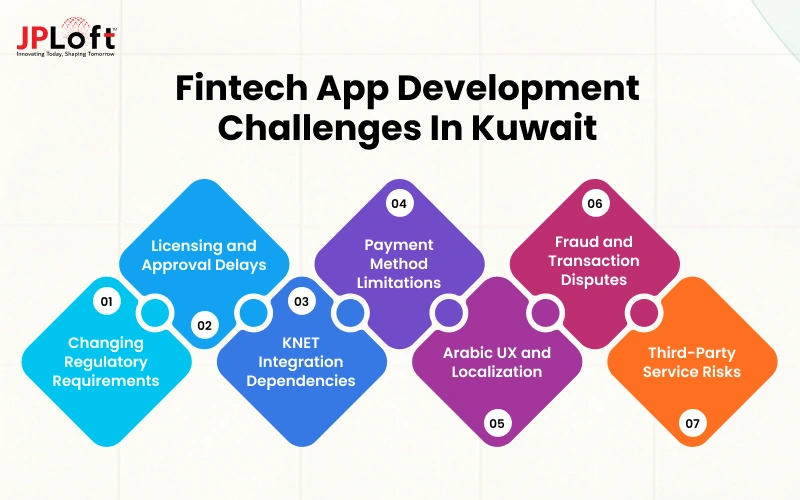
Challenge 1: Changing Regulatory Requirements
Fintech regulations and payment frameworks can change as Kuwait updates its financial services ecosystem. A new rule or an unclear licensing obligation can shift your product scope, development priorities, and launch plan.
Solution: Map your planned activities to CBK or CMA requirements during discovery, assign one person to track regulator updates, and review your scope against them at every milestone.
Challenge 2: Licensing and Approval Delays
Regulatory approvals, documentation, and compliance reviews can extend the time needed to launch a fintech app. Starting these activities late can hold back an otherwise finished product.
Solution: Start licensing and documentation work during planning, run it in parallel with development, and keep approval time as a separate line in your launch plan.
Challenge 3: Bank and KNET Integration Dependencies
Payment integration depends on the selected bank or provider, merchant onboarding, technical requirements, and any required certification. Delays in partner coordination can affect testing and release schedules.
Solution: Contact the bank or payment provider in the first month, request its technical specification and test-environment access, and book certification and testing before your planned launch date.
Challenge 4: Payment Method Limitations
KNET supports eligible local debit-card payments, but a fintech app may need additional payment methods to serve different customer segments. Availability depends on the selected provider and business model.
Solution: Decide which payment methods each customer segment needs during planning (for example, KNET for local debit cards plus a gateway for other card types), then confirm with your provider which of them it supports.
Challenge 5: Arabic UX and Localization
An app that does not handle Arabic text, right-to-left layouts, and localized transaction messages correctly can create usability issues for customers in Kuwait.
Solution: Hire UI/UX design experts and plan Arabic and English interfaces together from the first prototype, then test navigation, forms, payment screens, and notifications in both languages with native Arabic speakers.
Challenge 6: Fraud and Transaction Disputes
Unauthorized transactions, duplicate payment requests, failed transactions, and refund disputes can undermine customer trust and increase operational workload.
Solution: Combine strong authentication, transaction monitoring, and server-side payment verification, and publish a clear refund and dispute process so customers know what happens when a payment fails.
Challenge 7: Third-Party Service Risks
Fintech apps often depend on external providers for payments, identity verification, banking APIs, and notifications. Service outages, security weaknesses, or API changes can disrupt app functionality.
Solution: Compare providers on security, reliability, and support before signing. Add monitoring, error handling, and a fallback for critical integrations such as payments and identity verification.

Why Partner With JPLoft to Build and Launch a Fintech App In Kuwait?
Launching a fintech app in Kuwait requires careful planning around business goals, regulatory requirements, payment integrations, and user expectations.
As an experienced fintech app development company in Kuwait, JPLoft helps businesses navigate these decisions and turn fintech concepts into digital products aligned with local market needs.
-
Market-Aligned Product Planning: We define core features, user journeys and technical requirements around your business model and target audience.
-
Payment Integration Planning: We assess KNET, bank API and payment-gateway options, including provider onboarding, technical requirements and testing.
-
Security-Conscious Development: We build authentication, transaction validation, access controls and audit trails into the architecture.
-
Development Through Launch and Beyond: We support business analysis, UI/UX design, development, testing, deployment and maintenance, including post-launch integration updates.
With 16+ years of experience and 1,250+ projects delivered, JPLoft works with startups, growing businesses, and enterprises to develop fintech products tailored to their business objectives and Kuwait’s market requirements.
Conclusion
Launching a fintech app in Kuwait requires a clear business model, an appropriate regulatory approach, and reliable payment integrations.
From selecting the right technology stack to planning KNET connectivity, Arabic UX, and security controls, each decision influences development cost, timelines, and launch readiness.
Businesses that address these requirements early can plan development with greater clarity and reduce avoidable integration delays.
Start by defining your fintech product’s goals, confirming applicable requirements, and selecting a development partner that understands your technical needs and Kuwait’s payment ecosystem.
FAQs
A fintech app in Kuwait typically costs KWD 20,000 to KWD 100,000+, depending on complexity, features, payment integrations, security requirements and testing scope. Licensing fees, regulatory capital, bank guarantees and approval time are separate from development costs.
A basic fintech MVP in Kuwait typically takes 2–4 months, a mid-complexity app 4–6 months and an advanced platform 6–9+ months. Regulatory approvals, bank onboarding and KNET or payment certification can also extend the overall launch timeline.
No, not every app does. Requirements depend on the financial activities the app performs. Electronic payments, e-money, lending and investment services carry different regulatory obligations, so confirm the applicable CBK or CMA requirements before development begins.
Not necessarily, but KNET is the main route for local debit-card payments. Businesses typically work through a member bank or payment provider, complete merchant onboarding, build the payment flow, and meet testing and certification requirements.
Wolooj is the Central Bank of Kuwait’s regulatory sandbox framework, run through its Innovation Hub. It lets fintech firms test new products under supervision before full launch, helping them check regulatory fit early. Eligibility is set by CBK.

Savannah Bustos is a technology professional with experience across financial platforms, mobility solutions, and on-demand digital products. Her areas of expertise include FinTech, digital banking, eWallets, lending, BNPL, stock trading, fuel delivery, and taxi-booking platforms. She combines a strong understanding of business requirements with practical technology insight, helping companies evaluate challenges, define product needs, and make informed decisions about scalable digital solutions.



Share this blog