



Key Takeaways:
Faith-based dating apps work because people want partners who share their values, beliefs, and long-term relationship goals, not just surface-level compatibility.
These apps outperform general platforms thanks to culture-aligned features, deeper trust, safer environments, and stronger retention among value-driven users.
Building a successful religious dating app requires belief-aligned profiles, denomination filters, strong verification, cultural moderation, and meaningful matchmaking tools.
Development costs range from $25,000 to $100,000+, depending on features like AI matching, document verification, moderation systems, and advanced communication tools.
JPLoft helps founders build secure, culturally aligned dating platforms with custom matchmaking logic, multi-layer safety tools, and scalable architecture designed for long-term success.
People aren’t just looking for matches anymore.
They’re looking for someone who understands their beliefs, respects their traditions, and fits into the life they imagine for themselves.
Religious dating apps are platforms that match users based on shared faith, values, and cultural beliefs, helping people find compatible long-term partners.
That’s why more founders today want to understand how to create faith-based dating apps that actually feel authentic and community-focused. These apps stand out because they go deeper than looks or swipes.
They connect people through the things that genuinely matter: spirituality, lifestyle choices, cultural expectations, and relationship goals.
This shift has turned faith-based dating into one of the fastest-growing niches, and it’s easy to see why. Let’s explore how to develop a faith based religious dating app. 
Why Are Religious Dating Apps Growing So Fast Today?
These apps are growing because users want value-aligned relationships, safer spaces, and alternatives to swipe-based dating that feel more meaningful.
The rise of Religious dating app development isn’t random. You’re seeing it because people want connections that feel real, intentional, and aligned with who they are.
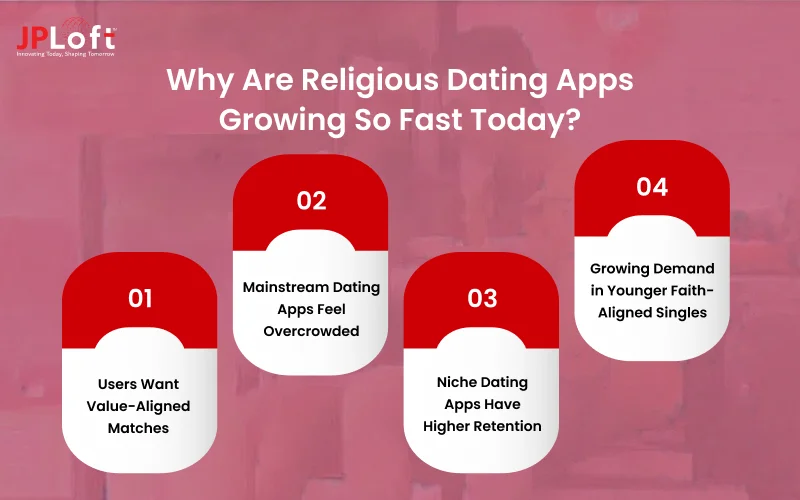
Below are four strong reasons:
1. Users Want Value-Aligned Matches
A recent Pew Research study found that 61% of adults who date online prefer someone who shares their religious beliefs, because it increases long-term compatibility.
That’s what makes religious dating apps unique: they filter for values, not just photos.
Honestly speaking, if you make a dating app, then you end up serving a community that’s actively seeking deeper, commitment-ready relationships instead of casual chats.
2. Mainstream Dating Apps Feel Overcrowded
The global dating app market crossed $9.2 billion in 2023, but 48% of users say general apps feel chaotic, superficial, or overwhelming.
This behavior directly fuels Religious dating app investment because niche platforms deliver a calmer, safer, and more predictable experience.
People trust apps that understand their cultural expectations instead of treating everyone the same.
3. Niche Dating Apps Have Higher Retention
According to Statista, niche dating apps record 25% higher weekly retention compared to popular mass-market platforms.
That’s a strong reason to invest in religious dating apps, since higher retention means a more loyal audience and better monetization potential.
When users feel understood, they simply stick around longer.
4. Growing Demand in Younger Faith-Aligned Singles
A recent Bumble Insights report shows 49% of Gen Z daters now prefer partners who share their spiritual values, a huge jump compared to previous years.
This shift makes niche platforms far more relevant today.
When you build for this growing segment, you’re creating a product that solves a real need, not just riding a trend.
Let’s move a little deeper and see what’s actually fueling this rapid rise in faith-based dating.
Key Factors Driving This Surge In Faith-Based Dating
When you look at the growth of this niche, it becomes clear that people want depth, trust, and meaningful compatibility.
That’s why more founders ask How to create a faith-based dating app that feels authentic and safe for users who prioritize their beliefs.
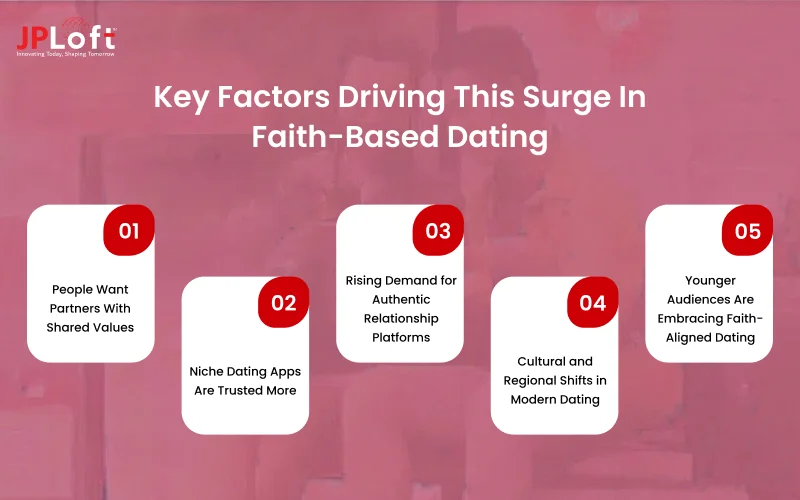
Below are the key factors pushing this rapid rise.
1. People Want Partners With Shared Values
More users today want long-term compatibility instead of fast swipes.
This makes faith-based dating app development a strong opportunity because the audience cares about things that actually sustain a relationship, beliefs, lifestyle choices, and family expectations.
When your app helps users match based on shared values, adoption grows quickly.
2. Niche Dating Apps Are Trusted More
Users feel safer in focused, community-driven platforms.
When you make secure dating apps for religious users, you automatically attract people tired of unsafe or unpredictable mainstream spaces.
Trust directly boosts retention, and niche apps usually report much stronger week-to-week user engagement.
3. Rising Demand for Authentic Relationship Platforms
Many users want something deeper than what top dating apps offer.
When you develop a religious matchmaking app, you’re serving a group that’s actively searching for meaningful, long-term intention.
This explains why niche apps outperform generic ones in both loyalty and user satisfaction.
4. Cultural and Regional Shifts in Modern Dating
In regions with strong cultural and faith influences, such as India and the UAE, users prefer platforms that respect traditions and personal boundaries.
This shift opens the door for founders planning to start a top business rooted in community values.
5. Younger Audiences Are Embracing Faith-Aligned Dating
Gen Z and Millennials are more open to online dating, yet they want a safe space where belief and identity matter.
This younger segment is pushing niche growth faster than expected, making it the right time to enter the market with a community-first product.
What Makes Faith Based Dating Apps Different From Regular Dating Apps?
Unlike mainstream dating apps, faith-based platforms prioritize beliefs, lifestyle choices, marriage intent, and value compatibility over casual matches.
Faith-based apps are built for people who care about deeper alignment. When someone joins a religious or values-driven platform, they’re looking for more than swipes; they want a partner who respects their traditions, shares their outlook on life, and matches their long-term goals.
Regular dating apps usually focus on speed, photos, and casual interactions, while faith-based apps lean toward meaningful compatibility and long-term connection. This is why they feel more intentional, safer, and community-centered.
|
Feature / Aspect |
Faith-Based Dating Apps |
Regular Dating Apps |
|
Primary Match Criteria |
Beliefs, values, lifestyle, and religious practice |
Photos, location, quick preferences |
|
User Intent |
Mostly long-term, serious relationships or marriage |
Mix of casual, short-term, and long-term |
|
Onboarding |
Includes faith, denomination, values, traditions |
Simple signup focused on age, gender, and location |
|
Safety Expectations |
Stricter moderation, identity checks, respectful environment |
Basic safety layers; higher chance of misuse |
|
Community Feel |
Close-knit, like-minded users looking for value alignment |
Broad and diverse audience with mixed intentions |
|
Communication Style |
Slower, more intentional, guided by cultural expectations |
Fast-paced, often surface-level interactions |
|
Content Rules |
Modesty, respect, and cultural sensitivity are emphasized |
More open; fewer cultural restrictions |
|
Retention Rate |
Higher due to shared beliefs and compatibility |
Lower due to saturation and casual usage |
|
Customization |
Faith-specific filters, religious practice levels |
Limited to generic filters like age or distance |
Essential Features of a Modern Faith Dating App
Core features include denomination-based filters, belief-aligned profile fields, stricter verification, privacy controls, and value-based matchmaking.
Whereas advanced features can go from AI-powered identity verification, personalized matchmaking, to much more.
Other than that, knowing about features is very important to filter what’s needed and what’s not.
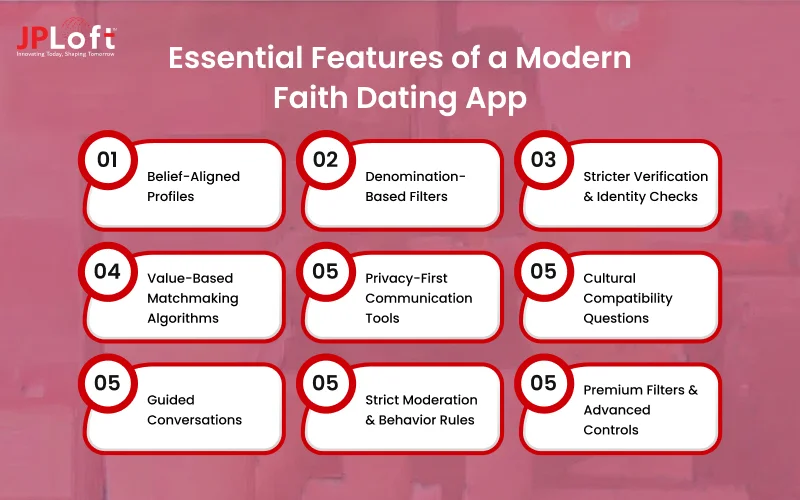
Get to know all essential features in the section below:
1] Belief-Aligned Profiles
This faith-based dating app feature lets users share their denomination, worship habits, family values, and lifestyle choices. It helps people express who they truly are instead of relying only on photos and short bios.
2] Denomination-Based Filters
Users can filter matches by beliefs, traditions, or specific religious practices. These filters keep the app relevant and ensure compatibility from the very first conversation.
3] Stricter Verification & Identity Checks
Faith-driven audiences expect safety. Multiple verification layers—ID checks, selfie confirmation, or community verification- dramatically reduce fake profiles and build trust.
4] Value-Based Matchmaking Algorithms
This feature of faith-based dating apps uses a combination of beliefs, personal values, relationship goals, and purity or lifestyle preferences to match users with long-term potential.
5] Privacy-First Communication Tools
Religion-focused users care deeply about comfort and boundaries. Features like secure chat, hidden photos, and limited profile visibility make the app feel respectful and safe.
6] Cultural Compatibility Questions
You can include questions about traditions, family expectations, festivals, cuisines, or customs. These subtle cues help match users who share similar worlds beyond just faith.
7] Guided Conversations
Built-in prompts, conversation starters, and compatibility questions remove awkwardness and help users start meaningful discussions instead of surface-level chatting.
8] Strict Moderation & Behavior Rules
Since faith-based communities expect respectful interactions, clear behavior policies and active moderation are crucial. It keeps the environment positive and community-friendly.
9] Premium Filters & Advanced Controls
This is where core dating app features like profile boosts, advanced discovery, and compatibility insights come in, giving users extra control without harming the authenticity.
How to Build a Religious Dating App From Scratch?
Creating a meaningful, culturally aligned dating platform starts with understanding what your users value.
You aren’t just building another app. You’re shaping a safe space where people connect on shared beliefs, traditions, and long-term intentions.
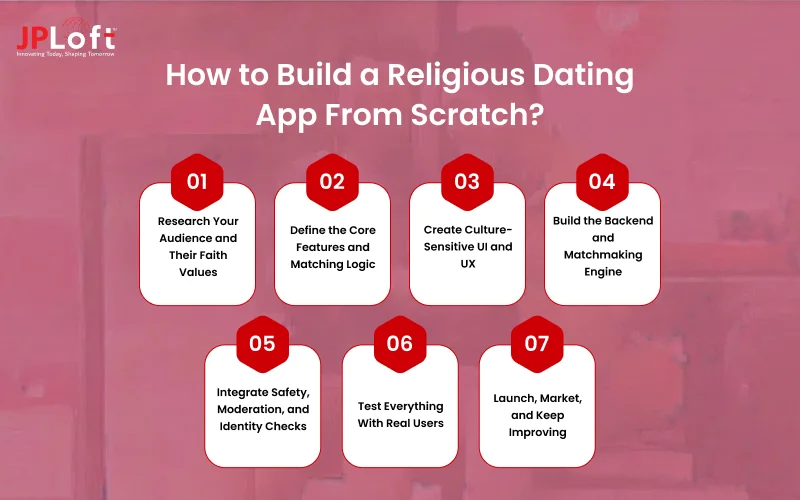
Below is a simple, clear roadmap to guide you through the process.
Step 1: Research Your Audience and Their Faith Values
Before you write a single line of code, learn what your community expects.
Every faith group has unique traditions, communication styles, and boundaries.
Talk to your potential users. See how they currently connect. Identify trust barriers that keep them from using generic apps.
This early research ensures you make a faith-based dating app that respects cultural sensitivities from day one.
Step 2: Define the Core Features and Matching Logic
Now map out what your app will actually do. Think about denomination filters, belief-based preferences, and personality cues.
This is where you decide how users will match. Will it be simple preferences, AI-powered compatibility scoring, or a mix of both?
Once you lock this in, you can confidently develop a religious dating app with features people will actually use.
Step 3: Create Culture-Sensitive UI and UX
Your design must feel warm, respectful, and safe, so your UI/UX design should lean toward calm colors, clean layouts, and elements that build trust from the first screen.
Keep the flow simple.
Start by creating a mobile app wireframe that outlines how users move from onboarding to profiles, filters, and matches. This helps you shape a journey that feels clear and intentional.
Once the structure is ready, turn it into an app prototype and test it with real users. Watch how they interact, what confuses them, and where they hesitate. These early insights help you refine the experience before development begins.
This step makes the interface more meaningful for people who want values-driven connections built on trust and comfort.
Step 4: Build the Backend and Matchmaking Engine
Here’s where the real engineering starts.
You set up databases, authentication, chat systems, and matching algorithms.
You also establish privacy layers and data-protection rules, because this audience won’t tolerate any compromise here.
This is the moment you actually build a faith based dating app that’s stable, secure, and ready to grow.
Step 5: Integrate Safety, Moderation, and Identity Checks
Trust is everything in religious dating apps.
Add multi-step verification, respectful community guidelines, and automated content filters.
Include reporting options and real human moderators for sensitive cases.
These tools protect your users and help create a faith-based dating app that feels safe and reliable every day.
Step 6: Test Everything With Real Users
You can’t skip app testing.
Run beta tests with a small group from your target community.
Watch how they interact with profiles, filters, and chat.
Ask them what feels confusing, slow, or unnecessary.
Every insight you get here saves you from expensive rework later.
Step 7: Launch, Market, and Keep Improving
Once the app is stable, it’s time to launch your app on the App Store or publish your app on the Play Store.
Promote it in community groups, faith forums, and social platforms.
Share real stories to build trust.
Keep updating features based on feedback and behavior analytics.
A dating app grows only when your users feel cared for.
And with this approach, you can confidently develop a faith-based dating app that stays relevant, scalable, and meaningful in the long run.
Once the design flows naturally, the next thing you need to lock in is trust through strong safety and moderation standards.
Must-Have Safety & Moderation Standards
Faith-based apps need strong safety layers, identity checks, and culture-aware moderation to maintain trust and prevent harassment or misuse.
After all, people join these platforms expecting honesty, respect, and a safe space where their values aren't compromised.
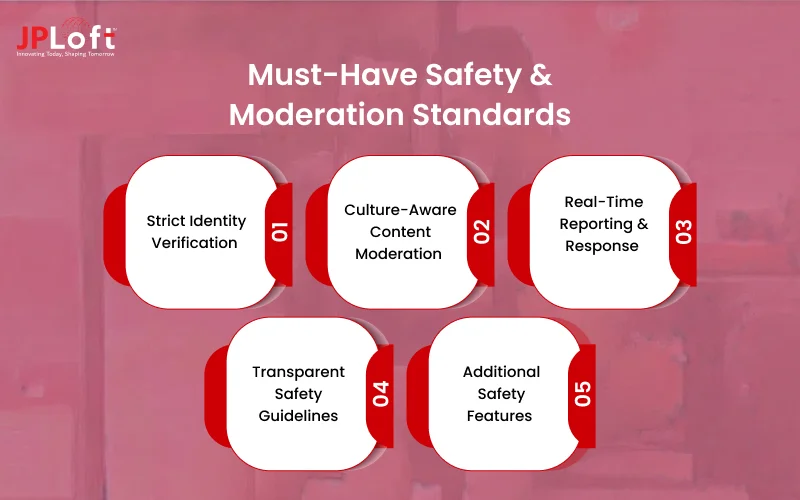
Here's how to build a faith-based dating app with safety measures that protect users while maintaining trust:
1. Strict Identity Verification
Strong verification instantly cuts fake accounts and builds trust among cautious users:
-
Phone number verification – Links accounts to real devices and prevents multiple fake profiles
-
Selfie matching technology– Uses facial recognition to confirm profile photos match real users
-
Document validation – Offers optional ID verification for users seeking extra credibility
-
Multi-step authentication– Combines multiple verification layers for maximum security -
-
Verified badge system – Highlights users who complete all verification steps
2. Culture-Aware Content Moderation
Generic filters fail in faith-based contexts. Your moderation needs cultural intelligence: -
-
Faith-specific keyword detection– AI trained to identify religious disrespect and inappropriate content.
-
Hybrid moderation system– Combines automated tools with human moderators who understand cultural nuances
-
Proactive content screening– Reviews photos, bios, and messages before they reach users
-
Context-sensitive enforcement – Recognizes when content violates faith-based community standards.
-
Cultural advisory board– Consults religious leaders to refine moderation policies.
3. Real-Time Reporting & Response
Fast action prevents harassment from escalating and keeps your community safe:
-
One-tap reporting buttons – Make flagging suspicious profiles and messages effortless
-
Categorized report types – Users specify issues: fake profiles, harassment, inappropriate content, or boundary violations.
-
24-48 hour response guarantee – Review and action all reports quickly
-
Temporary profile suspension – Automatically pause reported accounts during investigation.
-
User feedback loop – Notify reporters when action is taken to build confidence.
4. Transparent Safety Guidelines
Clarity creates confidence in values-driven platforms:
-
Public community standards – Clearly define acceptable behavior and faith-based expectations -
-
Privacy policy transparency – Explain exactly how user data is protected, stored, and used.
-
Enforcement disclosure– Share consequences for violations: warnings, suspensions, permanent bans.
-
Safety education resources – Provide tips for recognizing scams and protecting personal information.
-
Regular safety updates– Keep users informed about new protections and policy changes.
5. Additional Safety Features
Go beyond basics to create a truly secure environment:
-
Block and unmatch options– Let users control who can contact them.
-
Message filters– Auto-detect and flag potentially inappropriate content
-
Video verification calls– Offer in-app verified video chats before meeting in person
-
Safety tips and resources – Provide guidance on safe online dating practices -
-
Emergency support access– Direct line to support team for urgent safety concerns
Safety builds trust, but sustainability requires smart revenue. Once your platform earns user confidence, you need monetization models that respect their values while keeping your faith-based dating app financially viable.
Best Faith Based Dating App
Finding the top faith based dating app comes down to trust, values, and how well the platform understands cultural boundaries. These apps make it easier for like-minded people to connect with confidence, clarity, and long-term intentions.
► Christian Mingle
This is one of the most trusted religious dating app platforms for Christian singles seeking serious relationships. To create something similar, build strong filters for denomination, worship preferences, and value-based questions that help match people with shared beliefs.
► MuzMatch
A leading faith based dating app for Muslims, known for privacy tools, wali involvement, and modest profiles. To build an app like this, focus on culture-aware UI, family-inclusive features, and strong verification layers.
► JDate
One of the oldest dating apps for religious people, designed for Jewish singles seeking meaningful connections. To create a similar platform, integrate tradition-specific fields, community guidelines, and respectful communication flows that reflect Jewish values.
► Salams (formerly Minder)
A modern Muslim-focused app offering lifestyle filters, halal dating guidelines, and verified profiles. To make an app like this, include interest-based matching, safe chat controls, and community-driven moderation to protect user comfort.
► CatholicMatch
A dedicated Catholic platform built around faith questions, sacrament compatibility, and spiritual values. To build something similar, shape your onboarding around belief-led prompts and match scoring that reflects religious priorities instead of casual preferences.
► Upward (Christian Dating)
A fast-growing Christian app offering clean UI, transparent profiles, and church-aligned preferences. To create such an app, focus on simple design, meaningful bios, and matching tools that highlight spiritual alignment first.
Now that we have covered the best dating apps, it is time to talk about the overall cost of faith based dating app development.
How Much Does it Cost to Develop a Religious Dating App?
A religious dating app typically costs $25,000 to $100,000+ to develop, depending on features, security, design, and the level of customization you need.
Building a faith-focused dating platform involves more than standard matchmaking features. You need value-based filters, culture-aware onboarding, multi-layer verification, safe chat controls, and strong moderation tools. These elements increase the development scope, which directly impacts cost.
If you choose basic features like login, profiles, chat, and simple matching, the investment stays on the lower end. But if you want advanced matchmaking logic, AI-driven compatibility scoring, document verification, live moderation, or event-based features, the cost moves toward the higher range.
Design also plays a major role. A clean, respectful interface built around trust-building UX requires thoughtful planning and usability testing. Hosting, backend scaling, and ongoing maintenance add to the total budget.
Overall, the final dating app development cost depends on your vision, complexity, and long-term growth plans.
Different Monetization Models for Religious Dating Apps
Subscriptions, premium filters, profile boosts, event-based monetization, and community add-ons generate steady revenue without harming trust.
The best dating app monetization models boost trust, improve matching quality, and offer helpful upgrades without disrupting the user experience.
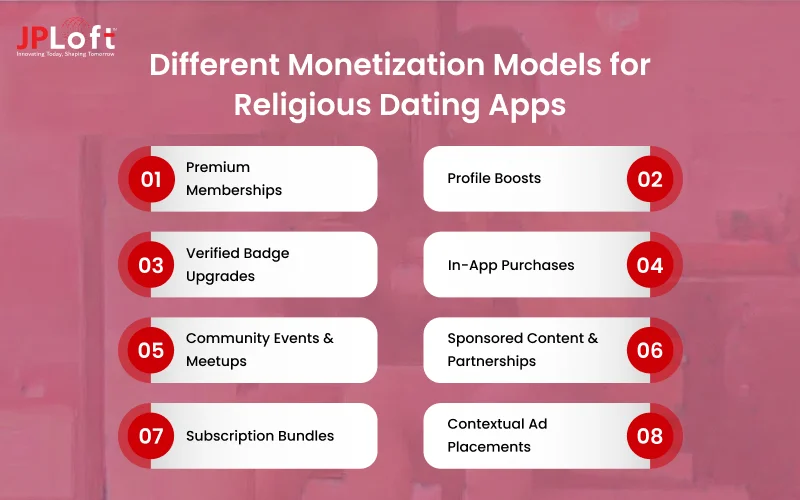
Here are some of them:
1. Premium Memberships
Paid tiers unlock advanced filters, unlimited messaging, profile insights, and priority matches, giving serious users smoother experiences while helping the platform maintain consistent long-term revenue streams.
2. Profile Boosts
Users pay to temporarily highlight their profiles during peak activity hours, increasing visibility and match opportunities without disrupting anyone’s browsing experience or altering the app’s natural engagement flow.
3. Verified Badge Upgrades
Offer optional paid verification with photo checks or document validation, helping users build trust quickly and creating a safer environment that strongly appeals to value-driven, faith-focused communities.
4. In-App Purchases
Provide optional items like Super Likes, limited conversation starters, or daily match extensions that enhance engagement without forcing subscriptions or changing the core free experience.
5. Community Events & Meetups
Host paid virtual gatherings, group discussions, or spiritual relationship sessions that encourage meaningful interactions while generating revenue through community-driven participation and content-based offerings.
6. Sponsored Content & Partnerships
Collaborate with value-aligned brands, counselors, or community organizations to display subtle promotions that feel relevant, supportive, and helpful rather than intrusive or overwhelming.
7. Subscription Bundles
Offer discounted quarterly or annual plans for committed users who want predictable costs, better features, and stronger engagement without purchasing smaller upgrades repeatedly.
8. Contextual Ad Placements
Use minimal, faith-friendly ads placed carefully in non-intrusive areas so revenue increases while keeping conversations, profiles, and matchmaking flows clean and user-focused.
Now that you know how the money flows, here’s where mobile app development companies make a real difference in turning ideas into fully working, faith-driven platforms.
How JPLoft Can Help You Create a Faith-Based Dating App?
Building a values-focused matchmaking platform needs more than coding. It needs cultural understanding, trust-building design, and the right technology backbone. That’s where JPLoft steps in.
As a leading dating app development company, we help you shape an experience that feels safe, respectful, and genuinely meaningful for faith-driven communities.
You get a custom matching engine, multi-layer safety tools, and UI flows designed for clarity and comfort.
Our team also handles real-time chat, verification systems, analytics, and scalable backend architecture, so your app can grow without breaking.
For both MVP builds and advanced platforms, JPLoft combines smart strategy, thoughtful design, and solid engineering to deliver a dating app that users rely on and enjoy.
Conclusion
Faith-based dating apps are growing fast because people want relationships rooted in shared values, meaningful compatibility, and a deeper sense of trust.
If you’re planning to build one, the real success comes from blending culture-aware design, safe user experiences, and smart monetization that respects your community.
With the right features, strong moderation systems, and a thoughtful matching engine, you can create a platform that feels authentic and reliable from day one.
And with expert guidance, your app can scale into a thriving space where users feel understood, protected, and confident in finding long-term partners.
FAQs
A faith-based dating app connects people who share similar beliefs, traditions, and values. It focuses on compatibility, long-term intentions, cultural respect, and safe interactions rather than casual swiping.
Start with market research, define essential features, design culture-sensitive UI/UX, build strong safety layers, and develop a reliable matchmaking engine. Then test, launch, and improve based on user feedback.
Key features include denomination filters, belief-aligned profiles, multi-layer verification, cultural moderation, privacy tools, guided conversations, and value-based matchmaking algorithms that support long-term compatibility.
The cost generally ranges from $25,000 to $150,000+, depending on features, security requirements, design complexity, platform choice, and the level of customization you want.
These apps use premium memberships, boosted profiles, verified badges, in-app purchases, community events, partnerships, and subscription bundles to generate revenue while keeping the user experience respectful and trustworthy.

Savannah Bustos is a technology professional with experience across financial platforms, mobility solutions, and on-demand digital products. Her areas of expertise include FinTech, digital banking, eWallets, lending, BNPL, stock trading, fuel delivery, and taxi-booking platforms. She combines a strong understanding of business requirements with practical technology insight, helping companies evaluate challenges, define product needs, and make informed decisions about scalable digital solutions.


Share this blog