


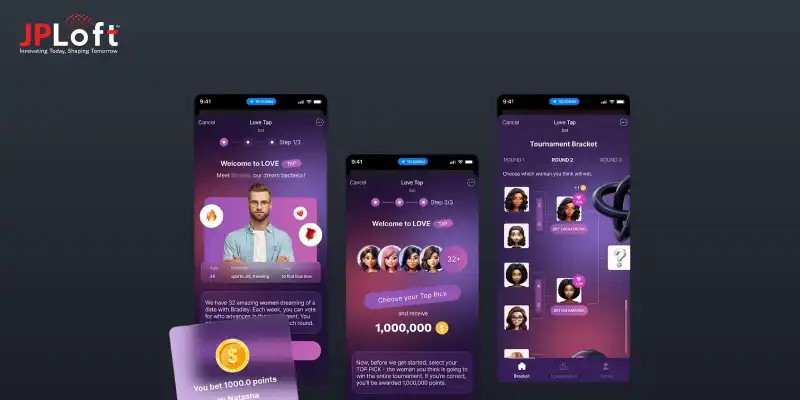
Key Takeaways
Gamification in dating apps turns swiping into a journey by adding streaks, badges, and levels that keep users emotionally invested in finding matches.
Features like reply timers, profile milestones, and compatibility quizzes increase meaningful conversations instead of shallow interactions.
Reward loops such as boosts, Super Likes, and limited-time challenges improve daily active users and long-term retention.
AI-powered personalization enhances match quality by adapting rewards, suggestions, and visibility based on real user behavior.
Smart gamification in dating apps boosts monetization through premium perks without disrupting the dating experience.
Modern dating apps are no longer just about swiping left or right. Users now look for engaging and rewarding experiences.
This is where Gamification in Dating apps plays a powerful role.
In fact, studies show that gamified experiences can increase user engagement by up to 150%. By adding elements such as rewards, streaks, levels, and interactive challenges, dating apps can create more excitement for their user.
For example, Apps like Tinder use swipe mechanics and premium boosts to create a rewarding loop that keeps users active.
These features not only enhance engagement but also drive user retention & monetization.
When implemented strategically, gamification transforms dating apps into immersive, habit-forming platforms that support long-term business growth.
What is Gamification in Dating Apps?
Gamification in dating apps refers to the use of game-like elements to make the user experience more interactive, engaging & rewarding.
Instead of simply browsing profiles, users earn points, unlock badges, maintain daily streaks, or access special features based on their activity.
These mechanics tap into psychological triggers like achievement, competition, and instant gratification, encouraging users to stay active on the platform.
For businesses planning to develop a dating app, gamification can significantly improve retention and engagement rates.
Features such as progress levels, limited-time boosts, or reward-based interactions make the platform feel dynamic rather than repetitive.
When thoughtfully integrated, gamification not only improves user experience but also increases app monetization opportunities through premium upgrades and in-app purchases.
The purpose of gamification in online dating apps is to increase user engagement by making interactions more interactive, rewarding, and habit-forming.
Key Gamification Components in Mobile Dating App
The right gamification components in a mobile dating app strategy can transform a simple platform into an addictive one.
Instead of only browsing, users feel rewarded, challenged, and emotionally invested.
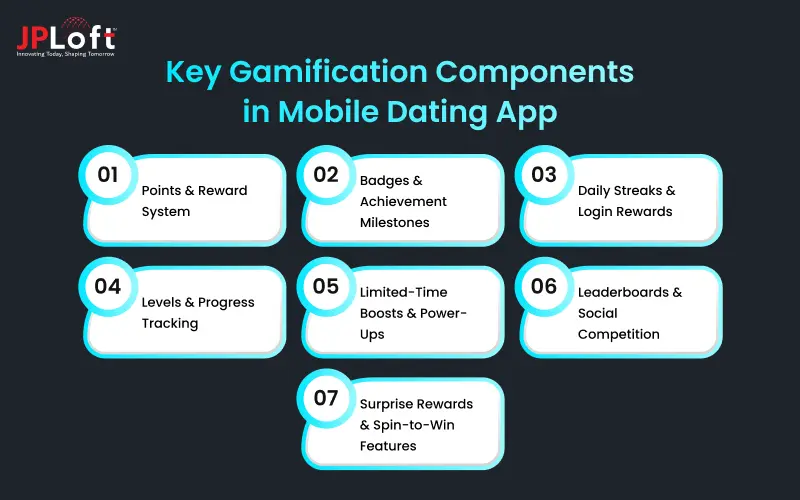
Below are the most powerful components that drive engagement and revenue in modern dating apps:
1.Points & Reward System
Points are the backbone of gamification.
Users can earn rewards for actions like profile completion, daily logins, responding quickly to messages, or maintaining conversations.
These points can unlock premium features, profile visibility boosts, or exclusive perks.
This system motivates consistent participation and reinforces positive behavior inside the app.
2. Badges & Achievement Milestones
Badges add status and social recognition.
Titles such as “Top matchmaker, “" Conversation starter,” or “Profile Star” give users something to strive for.
Public achievements increase credibility and improve engagement by encouraging users to maintain their appealing profiles.
3. Daily Streaks & Login Rewards
Daily Streaks build habit loops.
Rewarding users for consecutive logins or interactions increases daily active users & long-term retention.
The fear of breaking a streak keeps users returning consistently.
4. Levels & Progress Tracking
Progress bars and level systems make users feel like they are advancing within the platform.
Unlocking higher levels can provide access to exclusive filters, priority matching, or enhanced visibility, creating a clear sense of growth.
5. Limited-Time Boosts & Power-Ups
Time-sensitive features such as profile boosts, super likes, or extra swipes create urgency.
These mechanics often drive in-app purchases & increase monetization.
They push users to act now instead of waiting for later.
6. Leaderboards & Social Competition
Leaderboards introduce friendly competition by ranking users based on engagement or activity. This encourages higher participation and longer sessioncompetition.
A little competition often sparks a lot more activity.
7. Surprise Rewards & Spin-to-Win Features
Randomized rewards create excitement & unpredictability. Surprise elements trigger curiosity and keep users exploring the app longer.
Unexpected wins make the experience feel fresh every time.
Understand how these mechanics influence user behavior, and you start seeing engagement as a design strategy, not just a lucky outcome.
How Gamification Increases Engagement & Retention?
Dating app gamification transformactivesive users into participants.
If done strategically, gamification improves session time, boosts retention, and reduces churn.
Here’s how it drives real engagement growth:
1.Builds Habit-Driven Daily Engagement
The Role of gamification in dating app growth begins with building consistent habits.
Features like daily login streaks, reward milestones, and activity-based bonuses encourage users to return every day.
Over time, these small incentives form psychological loops that make app usage routine.
Strong habit-building frameworks are among the most effective dating app engagement strategies, helping platforms increase daily active users while reducing churn naturally.
2. Encourages High-Quality User Interaction
Smart reward systems motivate users to complete profiles, upload authentic photos, and initiate meaningful conversations.
These actions reflect proven dating app gamification techniques that go beyond surface-level swiping.
When users invest effort, match quality improves, and conversations become more genuine.
Higher interaction quality builds trust and satisfaction, increasing the likelihood that users remain active and emotionally connected to the platform long-term.
3. Aligns with Emerging Market Trends
Interactive quizzes, compatibility games, and personality challenges are rising Dating app trends that keep users entertained.
Gamification transforms routine matchmaking into an engaging experience.
Instead of endless scrolling, users participate in structured activities that feel rewarding.
Trend-driven features help apps stay competitive while continuously refreshing the user experience, which is essential for maintaining long-term interest in a crowded marketplace.
4. Strengthens Trust Through Secure Gamified Features
Effective gamification must operate and can be a strong dating app feature to present your app.
Verification badges, trust scores, and behavior-based reputation levels increase credibility within the platform.
When users feel safe, they engage more confidently. Security-driven rewards encourage authentic behavior and reduce fake profiles.
This combination of trust and engagement significantly improves retention rates and strengthens the overall brand reputation of the app.
5. Supports Regional and Global Expansion
Gamified systems can be adapted for different cultural markets.
For example, dating app development in France increasingly integrates localized competitors and culturally irrelevant interaction challenges.
Regional customization makes users feel understood and valued.
Flexible gamification frameworks allow platforms to scale internationally while maintaining engagement relevance, ensuring consistent user retention across diverse demographics.
6. Creates Healthy Competition and Motivation
Leaderboards, activity rankings, and achievements tiers introduce family competition.
Users become motivated to increase participation to improve their status within the app. Competitive elements can add interest without creating pressure.
When structured properly, gamification boosts session time and interaction frequency.
This balance of motivation and enjoyment keeps users returning regularly while maintaining a positive community environment.
7. Increases Perceived Value and Loyalty
Gamified dating app loyalty programs provide unlockable perks, boosts, and exclusive access features.
These incentives make users feel rewarded for their activity. Having a visible progress systems reinforce accomplishment and encourages continued participation.
When users consistently receive value, uninstall rates decline. Long-term loyalty grows because users associate the platform with achievement, entertainment, and meaningful connection rather than simple matchmaking.
8. Enhances Monetization Without Disrupting Experience
Premium power-ups, profile boosts, and limited-time rewards integrate seamlessly into gamified environments.
Instead of feeling like advertisements, paid features appear as natural progression tools. Users are more willing to invest when upgrades enhance their experience.
This subtle monetization strategy increases revenue while maintaining strong engagement levels, ensuring sustainable growth without sacrificing user satisfaction.
Once you understand the psychology behind engagement, the reasoning becomes simple: what is the process to gamify your dating app?
Get to know it all in the next section:
How to Gamify Your Dating App?
If you truly want to gamify your dating app, think beyond swipes and matches.Today’s users crave experiences that feel dynamic, rewarding, and slightly addictive.
Gamification transforms passive browsing into an interactive journey where every action feels meaningful.
When you gamify your dating app strategically, you build emotional triggers that keep users returning daily, not just when they’re bored but because they’re invested in the experience.
Here’s how to do it step by step:
Step 1: Define Clear Engagement Goals
Before implementing features, decide what behavior you want to amplify.
Is it daily logins, meaningful conversations, or profile completion rates? Gamification in dating apps becomes powerful only when aligned with measurable goals.
Instead of adding random streaks or points, design rewards that push users toward actions that improve match quality and long-term retention.
Step 2: Understand User Psychology Deeply
If you’re exploring how to gamify your dating app, begin with emotional triggers.
Users respond to anticipation, validation, curiosity, and achievement. Match notifications create excitement, while badges build status.
When features tap into these psychological drivers, the experience feels natural and engaging rather than manipulative or overly commercial.
Step 3: Introduce Progression Levels
People love visible growth.
Add levels such as “Explorer,” “Connector,” or “Elite Matcher” that unlock as users engage more meaningfully.
Strong dating app gamification turns endless swiping into a journey with milestones. Progress indicators motivate users to complete profiles, respond faster, and interact consistently because advancement feels rewarding.
Step 4: Create Action–Reward Loops
To effectively gamify your mobile dating app, design loops where effort leads to instant gratification.
For example, replying to five conversations could unlock a profile boost. Logging in daily might earn bonus likes.
These micro-rewards create habit cycles that encourage users to return regularly and stay active longer.
Step 5: Add Time-Limited Challenges
Urgency increases participation. Launch weekend challenges, seasonal match events, or limited-time bonus rewards.
When users know opportunities are temporary, they engage more quickly and frequently. Time-bound mechanics prevent stagnation and inject excitement into the platform, making interactions feel dynamic instead of repetitive.
Step 6: Reward Social Recognition
Recognition builds confidence and motivates participation. Highlight top responders, verified users, or profiles with high engagement.
Public acknowledgment encourages others to become more active as well.
When users feel seen and appreciated, their emotional connection with the app strengthens significantly.
Step 7: Personalize the Experience
Use behavioral data to tailor rewards, prompts, and match suggestions.
Personalized compatibility scores or custom challenges make users feel understood. When gamification adapts to individual preferences, engagement deepens.
A personalized system transforms generic features into meaningful experiences that drive long-term loyalty.
Step 8: Continuously Measure and Improve
Gamification is not static. Monitor retention, session duration, response rates, and feature adoption.
Identify which mechanics drive the most interaction and refine underperforming ones.
Continuous optimization ensures your gamification strategy evolves with user behavior and keeps delivering strong engagement results.
Now that you understand how to gamify your dating app strategically, it’s time to take inspiration from market leaders.
Let’s explore how top-performing dating apps across the UAE, France, and the USA are in the next section:
Real Examples From Top Dating Apps
To understand how engagement really scales, let’s look at the Best dating apps dominating global markets.
These platforms made it big in the market not only based on matching algorithms, but they strategically use interactive elements to keep users invested.
Here are some of the top apps:
1. Tinder
Tinder is one of the most widely used dating platforms globally, known for its simple swipe-based matching system.
It connects millions of users daily and has redefined modern online dating culture. With premium tiers, location-based discovery, and instant matching,
Tinder focuses heavily on fast interactions and visually driven engagement; understanding this is important if you want to make an app like Tinder.
How it uses gamification:
Swipe mechanics, Super Likes, Boosts, and match notifications create anticipation loops, making Tinder one of the most successful gamified dating apps globally.
2. Bumble
Bumble differentiates itself by allowing women to initiate conversations in heterosexual matches.
The app promotes respectful communication and meaningful connections.
With features spanning dating, networking, and friendships, Bumble builds a community-driven ecosystem while maintaining strong engagement through time-sensitive messaging and profile interaction features.
Knowing what it is doing differently can help you develop an app like Bumble.
How it uses gamification:
The 24-hour reply timer acts as a powerful Gamification feature in dating app design, driving urgency and faster interaction between matches.
3. Hinge
Hinge markets itself as the app “designed to be deleted,” focusing on serious relationships rather than casual swiping.
It encourages users to interact with prompts, voice notes, and detailed profiles.
By prioritizing thoughtful engagement over endless browsing, Hinge aims to foster deeper conversations and higher-quality matches.
Having similar features can help you launch a successful app like Hinge.
How it uses gamification:
Prompt responses, profile completion progress bars, and Most Compatible suggestions subtly transform Hinge into a Dating app gamified around meaningful interaction.
4. Happn
Happn uses real-time geolocation to connect users who have physically crossed paths.
The concept adds a sense of curiosity and real-world intrigue to digital dating.
By blending proximity awareness with instant notifications, Happn creates a unique discovery experience that feels spontaneous and serendipitous.
How it uses gamification:
Location-based “missed connection” alerts trigger curiosity and anticipation, encouraging frequent logins to see who crossed your path.
5. Badoo
Badoo is a social discovery platform combining dating with live streaming and profile browsing.
It allows users to meet nearby people and explore connections through multiple interaction formats.
With a strong presence in Europe and Latin America, Badoo blends social networking energy with dating functionality.
How it uses gamification:
Encounters swiping game, profile scoring, and live engagement features create playful competition and continuous interaction among users.
These examples show how leading platforms integrate game-like mechanics into their core experience.
By studying these models, you can design features that increase retention, improve interaction quality, and drive stronger monetization within your own dating platform.
So, these are some of the top dating apps that are using gamification in dating apps properly.
AI + Gamification: Smarter Match Experiences
Today’s most successful dating platforms don’t just connect people, they understand them.
When artificial intelligence blends with gamification, dating becomes more intentional, more personal, and far more engaging.
Users no longer feel like they are endlessly swiping; they feel guided toward better connections.
With AI-powered dating app development, your platform can analyze interaction patterns, response times, preferences, and compatibility signals in real time.
AI can suggest ideal matches, recommend icebreakers, and adjust visibility based on meaningful activity.
When you gamify your dating app using adaptive streaks, personalized challenges, and evolving reward systems, users feel progress that’s tailored specifically to them.
Instead of generic badges, they earn recognition aligned with their personality and behavior. Instead of random matches, they experience curated possibilities.
That sense of being understood builds trust, confidence, and emotional comfort, turning your app from a tool into a relationship journey users genuinely enjoy.
Now, with that being said, let’s get to know about the cost.
Cost to Integrate Gamification Features in Dating Apps
The cost to integrate gamification features in a dating app typically ranges between $10,000 and $75,000+, depending on complexity, real-time logic, AI involvement, and scalability requirements.
Basic reward systems cost less because they rely on simple tracking rules.
Advanced mechanics like behavior scoring, live leaderboards, and monetized boosts require deeper backend development and stronger infrastructure.
The more personalized and data-driven the gamification system becomes, the higher the investment.
Remember, every small step that you take to better your app might increase the overall dating app development cost, but it is worthwhile in the long run.
Here’s a structured cost breakdown based on feature depth:
|
Feature Level |
What’s Included |
Estimated Cost (USD) |
Timeline |
|
Basic Gamification Setup |
Badges, simple milestones, basic activity rewards |
$10,000 – $20,000 |
3–5 weeks |
|
Mid-Level Interactive System |
Streaks, level progression, limited-time challenges |
$20,000 – $40,000 |
5–8 weeks |
|
Advanced Gamified Ecosystem |
Leaderboards, reputation scores, and AI-powered personalization |
$40,000 – $75,000+ |
8–12+ weeks |
With this being said, you need the help of an experienced mobile app development company to turn your idea into reality.
How JPLoft Can Help You Integrate Gamification in Your Dating App?
Gamification only works when it feels natural. Forced features push users away. Smart systems pull them in. That’s where JPLoft steps in.
As an experienced Dating app development company, JPLoft focuses on behavior-first design. We study how users swipe, chat, pause, and return.
Then we build reward loops that strengthen those actions. From streak systems and achievement badges to trust scores and level-based unlocks, every feature is built with purpose.
Our team combines UI strategy, backend logic, and scalable architecture so your gamification mechanics don’t just look good, they perform. We also integrate monetized boosts and premium challenges without disrupting user experience.
The goal isn’t to make your app feel like a game. It’s to make it feel alive. Engaging. Addictive in the right way.
Conclusion
Gamification is no longer a bonus feature in modern dating platforms. It is a growth engine. When used strategically, it transforms casual swiping into meaningful participation.
Rewards, streaks, levels, and AI-driven personalization create emotional triggers that keep users returning consistently.
The real power lies in balance. Gamification should enhance connection, not distract from it.
When aligned with user psychology, security, and monetization strategy, it improves retention, increases session time, and strengthens loyalty.
From habit-building streaks to intelligent match recommendations, the right mechanics turn your app into an experience users enjoy daily.
And when implemented with expert development and behavioral insight, gamification becomes a long-term competitive advantage rather than a short-term trend.
FAQs
Gamification in dating apps refers to adding game-like elements such as badges, streaks, levels, and rewards to increase engagement and make interactions more interactive and habit-forming.
Gamification builds daily habits through streaks, rewards, and visible progress. These mechanics create psychological triggers that encourage users to return regularly and stay active longer.
Yes. Features like profile boosts, premium power-ups, and limited-time rewards encourage in-app purchases. When integrated naturally, they enhance revenue without disrupting user experience.
Absolutely. Even relationship-focused apps use subtle gamification like progress tracking, compatibility quizzes, and response timers to encourage meaningful engagement without making the experience feel casual.
The cost typically ranges between $10,000 and $75,000+, depending on complexity, AI integration, scalability, and real-time infrastructure requirements.

Savannah Bustos is a technology professional with experience across financial platforms, mobility solutions, and on-demand digital products. Her areas of expertise include FinTech, digital banking, eWallets, lending, BNPL, stock trading, fuel delivery, and taxi-booking platforms. She combines a strong understanding of business requirements with practical technology insight, helping companies evaluate challenges, define product needs, and make informed decisions about scalable digital solutions.


Share this blog