


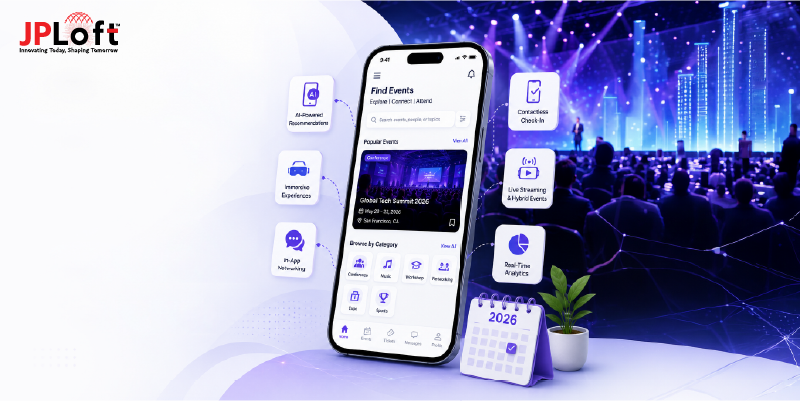
Key Takeaways:
Latest trends in event apps include blockchain, IoT, wearable devices, and gamification for an interactive event app.
Hybrid events, voice-enabled features, and offline functionality help businesses reach wider audiences.
Investing in the right event discovery app trends 2026 improves attendee engagement and streamlines event management.
Evaluate new event trends by gathering attendee feedback, monitoring competitors, and introducing features gradually.
Partnering with JPLoft helps build a secure, scalable event app that integrates the latest technologies.
Imagine using an event app that recommends the right networking opportunities, answers questions through AI voice assistants, and supports both in-person and virtual attendees.
These innovations are shaping the latest event app trends in 2026.
Earlier, event organizers managed events through manual registrations, printed schedules, and paper-based planning.
However, technologies such as AI, IoT, blockchain, and wearable devices are helping organizers automate operations and deliver smarter event experiences.
This growing demand is reflected in the market, with the event app market projected to reach $3676.71 billion by 2030 at a CAGR of 14.6%.
As event technology continues to evolve, businesses must adopt these trends to stay competitive and meet changing attendee expectations.
In this blog, we will learn about the top event app trends 2026 and valuable practices to identify trends for business.
Top Event App Trends Shaping the Industry
Businesses are looking for better ways to engage with users, improve operations, and simplify complex event management planning. Identifying the top event industry trends not only ensures these advantages but also makes events more interactive.
Here are the emerging event discovery app trends for 2026 to stay competitive in the years ahead.
1. Gamification and Engagement Tools
The gamification trend involves using game-like elements in an event app to encourage attendees to participate more actively.
Long conferences can reduce attendee interest over time. Organizers can create games, such as a virtual scavenger hunt, where attendees find hidden items and earn rewards. This is one of the most engaging trends in the event industry.
Here’s Why the Gamification Trend Matters:
-
Gamification improves engagement, leads to better session attendance, strong networking opportunities, and increased attendee visits to sponsor booths.
-
Organizers can increase revenue opportunities by allowing attendees to complete branded challenges and reflecting revenue through sponsor ads.
-
Increasing chances of attendees returning to future events and recommending to other fellow participants.
2. Contactless Check-In and Smart Badging
One of the effective trends in the event industry is the use of digital badges for contactless check-in at event venues.
Smart technologies like QR codes, NFC-enabled wristbands, and RFID enable attendees to check in quickly and conveniently, reducing long waiting queues. Attendees can tap their smart badge to enter VIP sessions or exchange contact information with exhibitors.
Here’s Why the Contactless Check-In Trend Matters:
-
It facilitates smart convenience from the moment attendees join the event.
-
Reducing longer queues and staff workload and improves focus on minimizing registration errors.
-
It helps to manage event security by allowing only verified attendees to access event sessions and restricted areas.
3. Advanced Networking
Networking is one of the biggest reasons people attend business events. AI events industry trends are transforming this event experience.
Artificial intelligence analyzes attendee profiles, industries, and event goals. Based on this information, the app recommends connecting with relevant people, exhibitors, and sponsors, and improves networking sessions.
Today, over 25% of AI-powered event features focus on personalized suggestions, improving attendee satisfaction by 40%.
Here’s Why the Advanced Networking Trend Matters:
-
Organizers can improve attendee satisfaction by making networking more relevant and productive.
-
Sponsors and exhibitors receive better-quality leads through personalized connection recommendations.
-
An advanced networking experience increases the overall value of the event and creates a differentiator from competitors.
4. The Evolution of Hybrid Events
Sometimes, attendees are not available in town to attend the event in person. A successful event must be accessible to everyone, and this is where hybrid events play a crucial role.
Such event apps allow live streaming, virtual networking rooms on Zoom and Google Meet, and deliver a smooth event experience for both in-person and remote audiences. Several business conferences use the Cvent event app for both live and hybrid events.
Here’s Why the Hybrid Event Trend Matters:
-
Sometimes, when organizers are facing budget problems and large event venues, a hybrid platform helps reach a larger audience without needing large locations.
-
It helps to record event sessions even after the event ends.
-
It allows real-time feedback through live polls and Q&A rounds, keeping both in-person and remote attendees engaged throughout the event.
5. Voice-First Event Experiences
AI events industry trends include voice-enabled systems that allow smooth conversations. Conversational voice agent mobile app development trend in the USA are becoming increasingly popular in the event industry.
It helps answer user queries and handles phone calls to resolve attendee questions. It allows quick registration, attendance confirmation, and automated feedback collection in a natural, human-like tone.
Here’s Why the Voice-First Event Trend Matters:
-
During peak event time, voice agents are necessary to handle registration calls and instant schedule changes during rush hour.
-
This trend is even more effective for larger conference events, handling peak pressures and providing easy access to event location and details.
-
Several attendees prefer using voice navigation instead of typing or manually finding the location.
6. Offline-First Event Apps
There are several event locations where poor network connectivity is one of the major event management app development challenges.
Therefore, organizers are adopting the offline-first event app experience trend. It helps attendees access the saved agendas, digital tickets, and venue maps even without an internet connection.
Here’s Why the Offline-First Trend Matters:
-
It helps attendees continue using the event app even during poor network connectivity.
-
Organizers can better focus on event management when network issues are resolved through offline-mode connectivity.
-
It helps to deliver a smooth event experience to attendees.
7. Metaverse-Powered Virtual Events
Organizers are exploring virtual event trends that allow attendees to interact with others using digital avatars. It creates an experience that feels like attending a physical event.
The virtual space in the metaverse enables attendees to explore exhibition halls, conference venues, and visit sponsor booths. This trend is widely popular in healthcare events, allowing doctors to create a virtual environment for live presentations and research demonstrations.
Here’s Why the Metaverse Trend Matters:
-
Metaverse creates an engaging event experience that keeps users engaged for longer periods.
-
It helps businesses reach a wider audience without stressing over physical venue costs.
-
It helps multiple industries present their products, explain complex ideas more effectively, and create a memorable event experience.
8. IoT-Enabled Event Experiences
IoT-enabled event experiences are one of the latest trends in event apps, allowing businesses to connect event apps with smart digital gadgets, wearables, and venue sensors.
Hire IoT developers to help you integrate robust IoT solutions with an event app. It allows for real-time tracking and streamlines event management. Further, it also helps to monitor event venue occupancy and manage in-person events more effectively.
Here’s Why the IoT Trend Matters:
-
IoT system integration trends in event apps help organizers make informed decisions for a successful event.
-
Organizers can improve crowd management, and if an unsafe situation arises, it can be handled more effectively using this technology.
-
It also helps optimize resources throughout the event. This leads to smoother operations, better attendee experiences, and lower operational costs.
9. Blockchain-Based Ticketing
During crowded or peak event times, blockchain technology helps prevent fraudulent and duplicate badge entries, fake IDs, and profile creation.
Manually managing this process can be very hectic, and the chances of fraud increase during peak event times. Many organizers partner with a blockchain development company to solve problems by creating secure digital tickets with verified ownership records.
Here’s Why the Blockchain-Based Ticketing Trend Matters:
-
Secure ticketing is very important in preventing fraudulent activities.
-
Organizers can reduce revenue losses and gain better control over fake tickets and fraudulent activities.
-
During peak event times, blockchain helps maintain transparency in the ticketing system.
10. Wearable Technology Integration
The next trend is highly popular among young and Gen Z attendees. Instead of carrying printed tickets, wearable technology allows attendees to access event services and locations with a single tap.
Further, this trend is also gaining popularity in event staff management. Organizers can access staff locations, behind-the-scenes operations, and take control over staff details, eliminating manual searches.
Here’s Why the Wearable Trend Matters:
-
It helps improve customer experience through simple, fast, and convenient facilities.
-
It provides real-time data about attendee behavior, session participation, and how to improve the experience further.
-
Wearable technology is one of the most advanced technologies, so integrating it into exciting event apps creates a competitive advantage in the industry.
11. AR/VR Event Experience
AR/VR technology allows attendees to gain real-world information by combining digital elements with the physical world. It helps them easily navigate to exhibitor booths, event halls, or other locations through 3D directional arrows.
Further, it also helps speakers or businesses showcase products such as large equipment or machinery. Attendees can explore product features virtually and understand how the equipment works.
Here’s Why the AR/VR Trend Matters:
-
Sponsors gain better product visibility; organizers allow them to present their product through a smart 3D model rather than just handing out flyers.
-
Virtual reality transforms usual physical events into immersive digital experiences by making virtual booths more tangible for remote attendees.
-
AR/VR trends improve the event experience for attendees and speakers and encourage more participation.
12. Predictive AI
Predictive AI technology analyzes past event performance, such as attendance, popular sessions, social media engagement, and attendee preferences.
Based on this analysis, AI uses machine learning and statistical models to predict future event outcomes, helping organizers make informed decisions. Several top event apps, such as Bizzabo and Cvent, use predictive AI to forecast session popularity and expected attendance.
Here’s Why the Predictive AI Trend Matters:
-
It helps event organizers make more informed decisions about venue selection, ticket pricing, and marketing campaign strategies.
-
It improves resource management by forecasting attendance, session demand, and operations requirements for events.
-
It helps organizers minimize cost, increase ROI, and improve overall event outcomes.
13. Hyper-Personalization
Hyper-personalization goes beyond basic personalization in event apps. It uses AI and machine learning to deliver an individualized experience to each attendee.
This trend analyses data from previous event interactions and attendee preferences to understand each attendee's interests and recommend relevant sessions. It continuously tracks the experience using real-time in-app behaviour.
Here’s Why the Hyper-Personalization Trend Matters:
-
It helps reduce confusing information by filtering the most valuable events based on each attendee’s interest.
-
It automatically builds an event calendar for each attendee by analyzing attendee profiles and real-time in-app behavior.
-
A hyper-personalized event approach encourages repeat participation and strengthens attendee loyalty.
14. Emotional AI
This trend uses artificial intelligence to detect and analyze human emotions and engagement in real time.
It examines facial expressions, voice tone, and speech patterns to understand reactions during the event. If emotion AI detects signals, such as reduced interaction, low engagement, or negative feedback, organizers can take immediate action to change the event format.
Here’s Why the Emotional AI Trend Matters:
-
It allows organizers to understand attendee engagement during the event, without relying only on post-event feedback.
-
Organizers can adjust events or sessions in real time, as this trend allows dynamic adjustments when attendee energy starts to decline.
-
It helps organizers identify which presentation generates higher excitement and the most positive response.
15. Sustainable Event Technologies
Sustainable event technology is the most environmentally friendly trend in event apps. It encourages the use of digital features to reduce paper waste.
For example, replacing printed brochures with digital guides, paper tickets with QR code check-ins, and printed maps with in-app map navigation. It helps save paper, encourages sustainability, and evolves events towards digitalization.
Here’s Why the Sustainable Event Trend Matters:
-
It allows organizers to update scheduled changes instantly within the app, without reprinting brochures.
-
It helps organizers lower operational costs by reducing printing, shipping, and other physical event materials.
-
It encourages eco-friendly attendee behavior through cashless payments, digital check-ins, and real-time communication through chatbots.
How to Identify Relevant Event Trends for Your App?
Identifying emerging event app development trends is not always easy. It requires the right strategy, continuous market research, and support from an experienced custom mobile app development company in the USA.
Here are the best practices to identify emerging event trends.
1. Survey Past Attendees
Surveying past attendees helps businesses understand changing attendee perceptions, track evolving event format expectations, and gather feedback from past events.
These practices help businesses understand their target audience better and adopt trends that solve real event problems instead of simply following new technologies.
2. Track Your Competitors
Never turn your back on your competitors. Always keep a close eye on their activities. Analyzing competitive event platforms helps you identify new mobile app features and engagement strategies, including social media campaigns and LinkedIn activities.
By tracking competitors' practices, it becomes easier for businesses to understand what are the latest trends in the event industry before investing in one.
3. Test New Features at Smaller Events
Introducing a new trend in a large event can be risky. Therefore, ensure mobile app testing for any new feature or technology is conducted on smaller events first; this approach is effective for business.
It helps to understand how the target audience responds to new event app development trends, save event app development cost, and boost confidence if the trend is successful.
4. Stay Flexible and Adapt Quickly
Event technology changes quickly, and businesses should be ready to adapt to new trends. Staying flexible makes it easier to improve your event app as per user and industry expectations.
A flexible event app allows businesses to add new features and integrate advanced mobile app tech stack, including AR/VR and AI trends in events.
5. Gather Real-Time Feedback
At the end, do not forget to collect feedback from attendees during the event. Collecting real-time feedback helps businesses understand what attendees like and what needs improvement.
Collect feedback through live polls, Q&A, session ratings, and in-app surveys.
It helps monitor attendee engagement, feature usage, and seamless scrolling through the app interface.
How JPLoft Helps Businesses Stay Ahead With Event App Trends
Understanding the latest trends in event apps is only the first step. The real value comes from choosing the right technologies and implementing them effectively.
JPLoft, an event management app development company, helps businesses build custom event apps with the latest technologies.
Whether it's AI, hybrid event capabilities, blockchain ticketing, wearable integration, or voice-enabled experiences, our team helps businesses adopt the trends that fit their goals.
Our approach is simple: instead of adding every trend, we focus on solutions that improve attendee engagement, simplify event management, and support long-term business growth.
Whether you are creating a new event app or upgrading an existing one, the professional team at JPLoft helps you create a modern solution and prepare for the future of event apps.
Conclusion
Event apps are no longer limited to registrations and schedules. Attendees' expectations have rapidly evolved over the years. Businesses need to build smart solutions that improve engagement and maximise ROI.
This is where emerging event app trends 2026, such as AI, hybrid events, blockchain, IoT, play a crucial role. It simplifies how businesses plan, manage, and deliver successful events.
However, while implementing these trends, it is necessary to consider that adopting every new technology is not the right approach.
Experiment with trends that match your event goals and support long-term growth. Testing new features, gathering user feedback, and staying updated with industry changes can help you make smarter investment decisions.
Finally, connecting with an experienced team can help you integrate the latest technologies while building a feature-rich event app.
FAQs
The top event app trends include AI-powered personalization, AR/VR technology, advanced gamification capabilities, voice-first event experience, offline event scheduling for checking maps and speaker details, and improving hybrid event platforms.
Wearable technology connects with smart devices such as badges, NFC wristbands, and smartwatches. It helps attendees with cashless payments, seamless control over details, and ensures real-time integration.
The latest event app trends improve user engagement through personalized sessions, seamless networking, and AR/VR technology for immersive conference gamification rewards to enhance engagement.
To implement new trends in an event app, first identify the business goals and target audience needs. Test the app at smaller events, collect user feedback, and measure success rates before and after the event app to ensure successful implementation.
AI trends in events include increasing user engagement, simplifying internal operations, reducing manual work, predicting accurate event attendee metrics, and handling customer doubts with 24/7 chatbot availability.

Kris Jacobs brings 20+ years of experience solving complex digital product challenges through strategic thinking and user-centric design. With deep exposure to on-demand services, entertainment, travel, and interactive platforms, she collaborates across teams to shape scalable, engaging solutions that align business goals with intuitive user experiences across evolving digital landscapes.


Share this blog