


Key Takeaways:
Intelligent chatbots simplify ERP interactions by enabling users to access data, automate workflows, and complete tasks through natural conversations.
Businesses can build successful ERP AI chatbots by selecting the right AI technologies, use cases, and integration strategy.
ERP AI chatbots improve productivity, reduce operational costs, and accelerate decision-making across finance, HR, procurement, and inventory management.
ERP AI chatbot development costs typically range from $15,000 to $220,000+, depending on features, integrations, and solution complexity.
Long-term chatbot success depends on strong security, high-quality data, continuous optimization, and a scalable enterprise-ready architecture.
Partner with AI experts at JPLoft to develop and integrate advanced chatbots in your enterprise workflows.
Partnering with AI experts at JPLoft can ensure secure implementation, seamless ERP integration, and long-term business value.
Imagine a task as simple as checking inventory levels or a purchase order status turning into minutes of navigating multiple ERP modules.
This is a common challenge for businesses relying on traditional ERP systems, where accessing data can often be as time-consuming as managing it.
As organizations embrace AI-driven automation, they need smarter ways to simplify ERP interactions without replacing their existing systems.
ERP AI chatbots solve this challenge by transforming complex ERP interactions into simple, natural conversations. Employees can instantly retrieve real-time data, automate routine workflows, generate reports, and complete business tasks using everyday language.
In this guide, we'll explore everything you need to know about ERP AI chatbots, their benefits, use cases, key features, development process, costs, and best practices for successful implementation.
What Is an ERP AI Chatbot and How Does It Work?
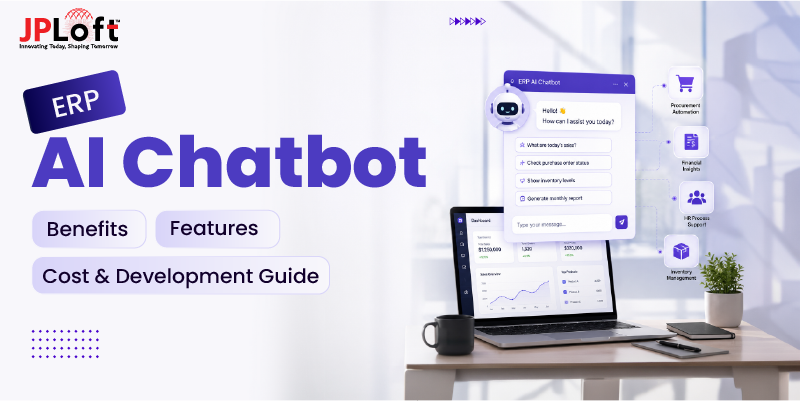
An ERP AI chatbot is a virtual assistant integrated within an existing enterprise system to help access information, automate tasks, and execute workflows through natural conversations.
Businesses looking to build an AI chatbot for ERP systems often use it to simplify complex operations and improve employee productivity.
Powered by advanced technologies including AI, NLP, and ML, these chatbots retrieve real-time enterprise data, generate reports, streamline approvals, and improve productivity.
They act as an intelligent interface, making complex enterprise databases more accessible, efficient, and user-friendly.
How Does an ERP AI Chatbot Work?
In simple terms, it can be stated that an AI-powered ERP chatbot connects users with the enterprise system through AI-driven language processing and secure integrations.
Here's how it works:
-
User Submits a Query: The user asks a question or gives a command using text or voice, such as checking inventory or approving a purchase request.
-
Intent Recognition: The chatbot uses NLP to understand the user's intent, identify keywords, and interpret the context of the request.
-
ERP Data Retrieval: The chatbot securely communicates with the ERP platform through APIs or middleware to fetch or update the required information.
-
Response Generation: Based on the retrieved data, the chatbot delivers an instant response, completes the requested action, or asks for additional details if needed.
-
Continuous Learning: Advanced AI chatbots analyze user interactions over time to improve response accuracy, personalize experiences, and automate more business processes.
How Do Enterprise AI Chatbots Transform ERP Operations?
Before proceeding further, let’s have a look at how these intelligent chatbots transform ERP operations.
An ERP chatbot doesn't replace your existing ERP software. Instead, it acts as an intelligent conversational layer that simplifies how employees interact with enterprise systems.
|
Area |
Without an ERP AI Chatbot |
With an ERP AI Chatbot |
|
Accessing ERP Data |
Navigate multiple screens and modules |
Ask questions in natural language and get instant answers |
|
Employee Support |
HR and IT teams handle repetitive requests |
Employees receive 24/7 self-service assistance |
|
Workflow Execution |
Manual approvals and repetitive tasks |
AI automates routine workflows and approvals |
|
Business Insights |
Reports generated manually |
Real-time reports and AI-powered insights on demand |
|
User Experience |
Requires ERP training and technical knowledge |
Simple conversational interface for all users |
|
Productivity |
Time spent searching for information |
Faster task completion and improved efficiency |
|
Decision-Making |
Based on static reports |
Driven by real-time enterprise data |
|
Accessibility |
Limited to ERP dashboards |
Available across web, mobile, Teams, Slack, and more |
Types of ERP AI Chatbots
There are diverse ERP AI chatbot types, each designed to address specific business needs and operational goals.
Choosing the right type depends on your enterprise ecosystem, automation requirements, and the level of intelligence your business expects from the chatbot.
Some commonly preferred ERP automation chatbot types include:
1. Rule-Based ERP Chatbots
Rule-based ERP AI assistants operate using predefined workflows, decision trees, and keyword-based responses.
They are designed to handle repetitive tasks such as answering FAQs, tracking purchase orders, or providing policy information.
These chatbots are easy to implement and cost-effective, making them suitable for organizations with straightforward business processes. However, they have limited flexibility and cannot interpret complex or unexpected queries.
2. AI-Powered Conversational ERP Chatbots
AI-powered conversational ERP chatbots leverage technologies like Natural Language Processing (NLP) and Machine Learning (ML) to understand user intent and context.
They can answer complex questions, retrieve real-time ERP data, and automate business workflows through natural conversations.
Unlike rule-based bots, they continuously improve by learning from user interactions. These chatbots significantly enhance employee productivity and user experience across enterprise operations.
3. Generative AI ERP Chatbots
Another type is Generative AI ERP chatbots, which are powered by LLMs and GenAI, and can generate human-like responses, summarize reports, and provide intelligent business recommendations.
They can interpret complex requests, analyze enterprise data, and assist with decision-making across departments.
These chatbots can generate content such as emails, reports, and meeting summaries while offering contextual and personalized responses.
4. Voice-Enabled ERP Chatbots
Voice-enabled chatbots allow users to interact with ERP systems via spoken commands rather than text.
Combining speech recognition and AI, these chatbots help employees to effortlessly execute tasks such as checking inventory, retrieving reports, updating records, or approving requests hands-free.
They are especially beneficial for warehouse staff, field service teams, and executives who need quick access to business information while on the move.
5. Multilingual ERP Chatbots
Multilingual ability enables employees, customers, and business partners to communicate with the ERP chatbot in multiple languages effectively.
Developing a multilingual chatbot enables automatic language switching, ensuring seamless interactions across global teams and regional offices.
This capability improves accessibility, enhances user satisfaction, and supports international business operations. It also helps organizations maintain consistent communication while reducing language barriers in enterprise workflows.
Key Benefits of ERP AI Chatbots for Modern Businesses
The best ERP AI chatbots help organizations improve productivity, reduce costs, and make faster decisions by simplifying workflows.
Here are the key benefits of AI chatbots justifying why businesses should plan to build an ERP AI chatbot:
A] Increased Employee Productivity
ERP chatbots eliminate the need to manually navigate multiple ERP modules. By providing instant answers, automating routine requests, and completing repetitive tasks, they allow teams to focus on higher-value work, improving overall efficiency and workplace productivity.
B] Faster Decision-Making
Users can access required information, including reports and operational insights, through simple queries. Instead of waiting for manually generated reports, decision-makers receive accurate information instantly, enabling quicker responses to changing business conditions.
C] Reduced Operational Costs
By automating repetitive workflows such as approvals, ticket handling, report generation, and employee self-service, intelligent chatbots reduce manual effort and administrative overhead. This lowers operational costs while improving the speed and accuracy of business processes.
D] Improved Employee Experience
Employees can quickly access payroll details, leave balances, company policies, expense claims, and other ERP information without depending on HR or IT teams. This approach increases convenience, reduces response times, and enhances overall employee satisfaction.
E] Enhanced Data Accuracy
ERP AI chatbots retrieve information directly from the ERP system, minimizing manual data entry and reducing the risk of human errors. Consistent and accurate data helps organizations maintain reliable records and improve operational efficiency across departments.
F] 24/7 Business Support
Unlike traditional support teams, ERP virtual assistants remain available around the clock to assist employees and customers. They answer queries, process requests, and provide business information at any time, ensuring uninterrupted support regardless of location or time zone.
G] Better Workflow Automation
ERP chatbots streamline multi-step business processes by automating approvals, notifications, reminders, and task assignments. This reduces bottlenecks, accelerates workflows, and ensures critical business operations continue without unnecessary delays.
Top ERP AI Chatbot Use Cases Across Operations
AI-powered ERP chatbots are reshaping how organizations interact with legacy enterprise systems, making business data and workflows more accessible.
From automating repetitive tasks to delivering real-time insights, these chatbots improve efficiency across departments. Below are some of the most impactful use cases of AI chatbots for enterprise resource planning.
A] HR & Employee Self-Service
HR departments handle numerous employee requests daily, making them an ideal area for ERP AI chatbot adoption. By automating routine HR processes, businesses can reduce administrative workloads while improving employee satisfaction.
-
Instantly answer payroll, leave, and attendance queries.
-
Simplify employee onboarding and document submission.
-
Provide quick access to company policies and benefits.
-
Automate leave approvals and HR support requests.
B] Finance & Accounting
Enterprise AI chatbots enable finance teams to access critical financial information without manually navigating ERP dashboards. AI in finance also automates repetitive accounting tasks, helping improve accuracy and operational efficiency.
-
Retrieve invoices, purchase orders, and payment status.
-
Generate financial reports and budget summaries.
-
Track expenses and reimbursement requests.
-
Support invoice approvals and payment reminders.
C] Inventory & Supply Chain Management
Managing inventory and supply chain operations requires real-time visibility. An ERP automation chatbot helps businesses monitor stock movement, reduce delays, and optimize inventory planning through instant access to operational data.
-
Check real-time inventory and warehouse stock levels.
-
Track shipments and delivery status.
-
Generate low-stock alerts and reorder notifications.
-
Monitor supplier performance and procurement updates.
D] Procurement & Vendor Management
Procurement teams can streamline purchasing workflows by using an ERP AI assistant to automate vendor communication and approval processes. This reduces manual effort and accelerates procurement cycles.
-
Create and track purchase requests.
-
Monitor purchase order approval status.
-
Access vendor information and contract details.
-
Receive procurement reminders and notifications.
E] Sales & CRM
Planning to create ERP AI chatbots can empower sales teams with instant access to customer and sales data. Further, allowing them to respond quickly and make informed decisions throughout the sales cycle.
-
Retrieve customer profiles and order history.
-
Generate quotations and sales reports.
-
Track sales performance and revenue metrics.
-
Schedule follow-ups and customer reminders.
F] Manufacturing & Production
Manufacturers can develop an ERP AI chatbot to monitor production activities and identify operational issues before they affect output. Integrating AI in manufacturing processes helps improve productivity while minimizing downtime.
-
Monitor production schedules and job status.
-
Check raw material availability.
-
Track machine maintenance and equipment health.
-
Receive alerts for production delays and bottlenecks.
G] Customer Support & Service Management
Enterprise AI chatbots enhance customer service by providing instant responses to common inquiries while integrating with ERP data for accurate information. This improves customer satisfaction and reduces support workloads.
-
Provide order tracking and delivery updates.
-
Retrieve invoices, warranties, and payment details.
-
Handle return and refund requests.
-
Escalate complex issues to human support agents when required.
Must-Have Features of an ERP AI Chatbot
A chatbot is only as effective as the features it offers. When focusing on how to develop an ERP AI chatbot, it is also important to plan for relevant features that it should have.
Below are the essential features every enterprise chatbot should include.
1. Natural Language Processing
The ERP chatbot you are building should be able to process natural language, understand user intent, and context instead of relying only on keywords.
This feature allows employees to ask questions naturally and receive accurate, context-aware responses without navigating complex ERP interfaces.
2. Seamless ERP Integration
Another feature to consider is the chatbot’s ability to integrate seamlessly with ERP platforms such as SAP, Oracle, Microsoft Dynamics 365, Odoo, or NetSuite through APIs.
These integrations ensure real-time access to enterprise data and allow users to perform actions directly within the enterprise system.
3. Workflow Automation
A robust ERP AI assistant should automate repetitive business processes such as leave approvals, purchase requests, invoice processing, expense claims, and task assignments.
Planning for these automation features helps reduce manual effort, speeds up operations, and minimizes human errors.
4. Role-Based Access Control
Defining the control systems throughout the AI chatbot is also among the key features to be included in ERP chatbots. Since enterprise systems contain sensitive business information, the chatbot must enforce role-based permissions.
Employees should only be able to access data and perform actions based on their designated roles, ensuring security and compliance.
5. Real-Time Data Retrieval
The chatbot should fetch live information from ERP modules, allowing users to instantly access inventory levels, sales reports, financial data, order status, or employee records.
Real-time insights enable faster and more informed business decisions, ensuring the purpose of developing a modern-day ERP chatbot is fulfilled.
6. AI-Powered Analytics & Reporting
Beyond retrieving data, an ERP AI chatbot should analyze business information and generate meaningful insights.
It can summarize reports, identify trends, highlight anomalies, and present key performance metrics to support data-driven decision-making.
7. Omnichannel Accessibility
The success of an ERP AI assistant or chatbot depends majorly on how and where the employees can actually use it.
Hence, omnichannel accessibility can be identified as the key ERP chatbot feature to have. Users should be able to interact with the chatbot across platforms, including web portals, mobile apps, and other collaboration tools.
8. Advanced Security & Compliance
Along with all, a key feature of an AI-powered ERP chatbot is enterprise-grade security. This involves focusing on end-to-end encryption, secure API communication, multi-factor authentication, audit logs, and compliance with standards like GDPR, HIPAA, or SOC 2.
These measures help protect sensitive business data and maintain regulatory compliance.
How to Build an ERP AI Chatbot in 2026?
The decision to build an ERP AI chatbot requires careful planning, selecting the right AI technologies, and seamless integration with legacy systems.
If you are wondering how to create an ERP AI chatbot, the steps below will help you build a chatbot that delivers accurate responses, automates business workflows, and provides long-term value to your organization.
Step 1: Define Business Objectives and Use Cases
The ERP AI chatbot development process starts by identifying the business challenges your chatbot will solve and the users it will serve.
Having a clear roadmap helps avoid unnecessary features and ensures the automated chatbot aligns with organizational goals.
-
Identify the departments that will use the virtual chatbot, such as HR, finance, procurement, or inventory.
-
Define the business processes and workflows you want to automate.
-
Set measurable KPIs like reduced response time, increased productivity, or lower support costs.
Step 2: Choose the Right AI Technologies
The chatbot's intelligence depends on the technologies used to build it; hence, hiring an experienced AI development company is important at this stage.
This stage involves selecting the right AI stack that can ensure better conversational accuracy, scalability, and future adaptability.
-
Select suitable Large Language Models (LLMs) and Natural Language Processing (NLP) frameworks.
-
Decide whether to use cloud-based, on-premise, or hybrid AI infrastructure.
-
Choose tools that support multilingual conversations, contextual understanding, and workflow automation.
Step 3: Design Conversational Workflows
Partner with an expert UI/UX design service provider to visualise your ERP chatbot’s conversational workflows.
The AI chatbot for enterprise resource planning should deliver intuitive and natural conversations that help users complete tasks with minimal effort.
-
Map user intents and frequently asked business queries.
-
Create conversation flows for approvals, requests, and information retrieval.
-
Include fallback responses and human handoff for complex scenarios.
Step 4: Integrate With Your ERP System
Once you have designed your intelligent ERP chatbot, the next step is to plan for a seamless connection between the chatbot and your enterprise systems.
Such integration enables real-time access to enterprise data and business processes, allowing the chatbot to function more smoothly.
-
Integrate the AI chatbot with ERP platforms like SAP, Oracle, Microsoft Dynamics 365, NetSuite, or Odoo.
-
Use secure APIs or middleware to synchronize business data.
-
Ensure the chatbot can retrieve, update, and process ERP information without affecting system performance.
Step 5: Develop and Train the Chatbot
In the ERP AI chatbot development process, the next stage involves the final development and training of the virtual assistant.
Develop the chatbot and train it using enterprise-specific knowledge to improve its accuracy and relevance.
-
Train the AI using ERP documentation, business policies, FAQs, and historical interactions.
-
Fine-tune the model to understand business terminology and user intent.
-
Continuously improve response quality through testing and feedback.
Step 6: Implement Security and Compliance
ERP AI chatbot development is not just about writing code or implementing technical features, but it also involves planning for security and compliance checks.
Since ERP systems contain sensitive business information, security should be embedded throughout the development stages.
-
Implement role-based access control and secure authentication.
-
Encrypt data during storage and transmission.
-
Ensure compliance with standards such as GDPR, HIPAA, SOC 2, or other applicable regulations.
Step 7: Test, Deploy, and Continuously Improve
Before deployment, thoroughly test and validate the chatbot's performance in real-world scenarios.
Continuous optimization ensures the solution remains accurate and effective as business needs evolve.
-
Perform functional, integration, security, and user acceptance testing.
-
Deploy the chatbot across web, mobile, or collaboration platforms.
-
Monitor performance, analyze user interactions, and retrain AI models to improve accuracy and user experience.
How Much Does an ERP AI Chatbot Cost?
The cost to build an ERP AI chatbot can range anywhere from $15,000 to $220,000 or more depending on its complexity, AI capabilities, ERP integrations, deployment model, and customization requirements.
The cost to build an AI chatbot designed to answer basic queries is significantly less than an enterprise-grade solution that automates workflows, integrates with multiple business systems, and leverages Generative AI for intelligent decision-making.
|
Chatbot Type |
Estimated Cost (USD) |
Development Timeline |
|
Basic ERP AI assistant |
$15,000 - $40,000 |
2-3 Months |
|
Mid-Level Enterprise AI Chatbot |
$40,000 - $90,000 |
3-5 Months |
|
Advanced AI-powered ERP chatbot |
$90,000 - $220,000+ |
5-9+ Months |
Common Challenges in ERP AI Chatbot Development
ERP chatbot development offers significant business value, but developing and implementing them involves several technical and operational challenges.
Addressing these AI-powered chatbot development challenges for enterprise workflows early helps ensure seamless integration, higher user adoption, and long-term success.
A] Integrating With Legacy ERP Systems
Many organizations continue to rely on legacy ERP platforms that were not built to support modern AI applications. Hence, still struggling with how to integrate an AI chatbot with ERP.
Outdated architectures, limited APIs, and compatibility issues can make chatbot integration complex, increasing development time and implementation risks.
Solution: Use APIs, middleware, and phased integration strategies to connect AI chatbots with legacy ERP systems without disrupting existing operations.
B] Ensuring Data Security and Compliance
ERP automated chatbots access sensitive financial, operational, and employee data, making security a major concern.
Without proper safeguards, businesses risk unauthorized access, data breaches, and non-compliance with industry regulations.
Solution: Implement enterprise-grade encryption, role-based access controls, secure authentication, and compliance measures throughout the chatbot lifecycle.
C] Maintaining Data Accuracy
An ERP AI chatbot can only deliver reliable responses when the underlying ERP data is accurate.
Inconsistent, outdated, or duplicate records can lead to incorrect information, reducing user trust and impacting business decisions.
Solution: Establish strong data governance practices and regularly audit ERP data to ensure chatbot responses remain accurate and reliable.
D] Understanding Complex User Queries
Employees communicate in different ways, often using abbreviations, incomplete requests, or organization-specific terminology.
Accurately interpreting these variations while maintaining conversational context can be challenging for AI models.
Solution: Work with an experienced NLP development company and continuously train AI models using real user interactions and business-specific terminology to improve response accuracy.
E] Driving User Adoption
Even a well-designed ERP AI chatbot may struggle to deliver value if employees hesitate to use it.
Resistance to change, lack of awareness, and unfamiliarity with conversational AI can slow adoption across the organization.
Solution: Ensure the chatbot has an intuitive user experience, provide training to employees, and showcase measurable productivity gains to encourage adoption.
F] Scaling With Business Growth
As businesses expand, these virtual chatbots must support more users, larger datasets, and increasingly complex workflows.
Poor backend planning can limit the platform's scalability, resulting in slower response times and reduced performance.
Solution: Consult cloud development service providers and build the chatbot on a scalable cloud architecture that can support growing workloads and evolving business requirements.
G] Continuous Maintenance and Optimization
Business processes, ERP platforms, and AI technologies evolve with time, indicating the need to update the ERP automated system.
Without ongoing updates and optimization, chatbot performance, response quality, and integration reliability can gradually decline.
Solution: Opt for software maintenance services and continuously monitor chatbot performance, retrain AI models, and update integrations to keep the solution secure and effective.
Best Practices for Building an ERP AI Chatbot
Successful ERP AI chatbot development involves more than selecting the right AI model or integrating it with your ERP system.
Following a structured development process is only the first step. Adopting proven best practices ensures your chatbot delivers accurate responses, improves user experience, and drives long-term business value.
1. Start With High-Impact Use Cases
Instead of integrating every ERP function with a chatbot at once, begin with processes that deliver immediate business value. Such processes can include HR self-service, inventory management, procurement, or customer support queries.
This approach reduces implementation risks, accelerates deployment, and allows businesses to measure ROI before expanding chatbot capabilities.
2. Choose the Right AI and ERP Technology Stack
Select AI models, NLP frameworks, and integration tools that align with your business objectives and existing ERP ecosystem.
A scalable technology stack ensures better performance, seamless integrations, and the flexibility to support future AI advancements and business growth.
3. Prioritize Data Quality
An ERP AI chatbot's responses are directly linked to the accuracy of the information it retrieves, making careful planning for data quality and its source critical.
Enforcing robust data governance, removing duplicate entries, and correcting discrepancies help maintain clean, organized, and current ERP data. Ultimately, superior data quality results in more dependable insights and fosters stronger user trust.
4. Implement Enterprise-Grade Security
Since ERP systems contain sensitive business information, security should be embedded throughout the development process.
Use role-based access control, encrypted communication, secure authentication, audit logging, and regulatory compliance measures to safeguard enterprise data and prevent unauthorized access.
5. Design Natural and Intuitive Conversations
Create conversational workflows that feel intuitive and easy to use. A seamless conversational experience improves user adoption and overall productivity.
Support natural language queries, provide contextual responses, and include fallback mechanisms or human handoff for complex requests.
6. Monitor Performance and Scale Strategically
To ensure the success of your enterprise AI chatbot, track key performance indicators such as response accuracy, task completion rates, user satisfaction, and automation success.
Use these insights to identify opportunities for improvement, optimize workflows, and gradually expand the chatbot across additional departments, users, and business processes while maintaining performance and reliability.
How JPLoft Can Help Build an Efficient & Scalable ERP AI Chatbot?
An ERP AI chatbot is more than just another software feature. Building a solution that delivers real business value requires more than advanced AI capabilities. It demands a deep understanding of enterprise workflows, seamless ERP integration, robust security, and a scalable architecture that grows with your business.
Partnering with JPLoft, an experienced AI chatbot development company, ensures your ERP chatbot delivers accurate insights, automates critical workflows, and drives measurable business outcomes.
At JPLoft, we specialize in developing custom ERP AI chatbot solutions tailored to your operational needs. From strategy and AI model selection to ERP integration, deployment, and continuous optimization, our experts build secure, intelligent, and future-ready solutions.
Whether you're using SAP, Oracle, Microsoft Dynamics 365, NetSuite, Odoo, or a custom ERP, we help you unlock the full potential of AI-powered enterprise automation.
Final Words
Enterprise AI chatbots are transforming how users interact with enterprise systems by making data more accessible, automating repetitive workflows, and enabling faster, data-driven decisions.
From HR and finance to procurement and supply chain management, these intelligent assistants improve operational efficiency while enhancing employee and customer experiences.
Building an ERP AI chatbot requires the right AI technologies, seamless ERP integration, robust security, and a clear implementation strategy.
By investing in a scalable, well-designed solution, businesses can streamline operations, reduce costs, and unlock greater value from their ERP ecosystem. As AI continues to evolve, ERP AI chatbots will play an increasingly important role in driving enterprise productivity and digital transformation.
FAQs
Yes, advanced AI-powered ERP chatbots can integrate with leading ERP platforms, including SAP, Oracle ERP Cloud, Microsoft Dynamics 365, NetSuite, Odoo, Infor, and custom ERP solutions.
The development timeline depends on the chatbot's complexity, features, and integration requirements. A basic ERP chatbot typically takes 2-3 months to develop, while advanced enterprise solutions with custom workflows, Generative AI, and multiple ERP integrations can take 5-9+ months or longer.
Building an enterprise AI chatbot involves defining business goals, selecting the right AI technologies, designing conversational workflows, and integrating the chatbot with enterprise systems like ERP or CRM. Regular testing and continuous optimization ensure long-term performance, accuracy, and scalability.
Yes, but only when built with enterprise-grade security practices. Features such as role-based access control, end-to-end encryption, secure APIs, multi-factor authentication, audit logs, and compliance with standards like GDPR, HIPAA, and SOC 2 help protect sensitive business information.
An ERP AI chatbot improves productivity by providing instant access to ERP data, automating repetitive tasks, and enabling faster decision-making. It also enhances employee experience, reduces operational costs, and helps organizations maximize the value of their ERP investment while supporting long-term digital transformation.

Rahul Sukhwal is the CEO and Founder of JPLoft, a visionary technologist with 18+ years at the forefront of emerging tech innovation and software engineering. He channels deep software engineering and AI expertise into building smarter, scalable solutions that shape how forward-thinking businesses worldwide harness the true power of AI.


Share this blog