


Key Takeaways:
CVS Pharmacy app combines prescription management, healthcare services, wellness shopping, and digital convenience within one platform.
Rising demand for digital healthcare makes investing in CVS Pharmacy-like apps profitable with recurring revenue and strong customer retention.
Steps to develop app like CVS Pharmacy are planning, healthcare integrations, compliance, secure workflows, testing, and maintenance.
Revenue models for CVS Pharmacy-like apps include telehealth consultation, subscriptions, advertising, and delivery fees.
The cost to build app like CVS Pharmacy ranges from USD 20,000 to USD 180,000+, depending on the requirements.
JPLoft builds secure, scalable pharmacy apps with end-to-end development and long-term technical support for business growth.
Prescription refills are no longer limited to pharmacy counters. Today, users prefer to order medicines, upload prescriptions, consult pharmacists, and track deliveries through a single mobile app.
This shift has made digital pharmacy platforms a valuable investment for healthcare providers, pharmacy chains, and startups looking to improve patient convenience. If you're one of these, knowing how to make an app like CVS Pharmacy can help you reach your goal and audience seamlessly.
A well-planned pharmacy app can improve medication access, increase customer retention, and create new revenue opportunities while maintaining secure healthcare standards. In this blog, you will learn how to develop a pharmacy app like CVS, core features, estimated cost, and revenue models.
By the end, you will have a clear roadmap for building a secure, scalable, and user-friendly pharmacy application.
What is the CVS Pharmacy App?
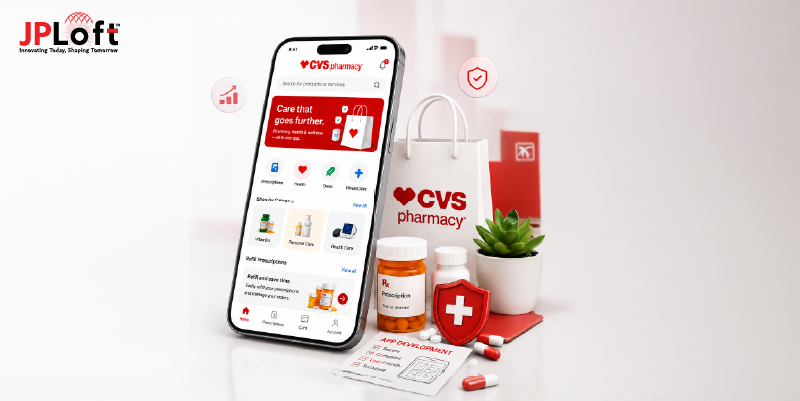
The CVS Pharmacy app is a mobile healthcare and pharmacy platform. It lets users order medications, manage prescriptions, schedule vaccinations, access healthcare services, and shop for health and wellness products from their smartphones.
It combines pharmacy services with digital healthcare features to simplify medication management and improve patient convenience. Beyond pharmacy services, it offers rewards, personalized discounts, and secure payment options.
For businesses planning to create an app like CVS Pharmacy, it serves as an excellent example of how technology can deliver accessible, efficient, and patient-focused experiences on one app.
Recent Market Statistics for CVS Pharmacy
Here are the recent market statistics for a CVS Pharmacy app:
-
The CVS Pharmacy app has 10M+ downloads on the Play Store and has a 4.7 rating by 1.6M users on the App Store.
-
CVS Pharmacy has been ranked 2nd on the 'Top Free iPhone Apps' chart in the 'Medical' category in the United States, according to SensorTower.
-
The first quarter of the year 2026 witnesses a total revenue increase to USD 100.4 billion, up 6.2% year-over-year, as estimated by CVS Health.
Why Invest in an App Like CVS Pharmacy?
The growing demand for digital healthcare has made pharmacy apps a profitable business opportunity. Investing in how to create a pharmacy app like CVS helps you improve customer engagement, streamline operations, and generate recurring revenue.
1. Growing Demand for Digital Healthcare
Consumers increasingly prefer managing prescriptions, consultations, and medicine deliveries through mobile apps. Investing in a CVS Pharmacy-like app helps businesses meet changing customer expectations while expanding digital healthcare services and improving accessibility for patients across multiple locations.
2. Expanding Revenue Opportunities
A CVS Pharmacy-like app development generates revenue through medicine sales, subscription plans, telehealth consultations, wellness products, insurance partnerships, and in-app promotions. Multiple income streams create sustainable business growth while reducing dependence on traditional in-store pharmacy transactions.
3. Operational Efficiency
Automating prescription processing, inventory updates, appointment scheduling, and payment management reduces manual workload. Digital workflows help pharmacies serve more customers efficiently while minimizing errors, improving staff productivity, and delivering faster.
4. Improved Customer Retention
Features like prescription refill reminders, loyalty rewards, medication tracking, and personalized health recommendations when you build an app like CVS Pharmacy encourage repeat usage. A seamless digital experience builds customer trust, strengthens long-term relationships, and increases retention through consistent engagement.
5. Competitive Advantage
Launching a feature-rich pharmacy app enables businesses to compete with leading healthcare providers. Advanced capabilities such as telemedicine, AI-powered recommendations, real-time delivery tracking, and secure prescription management help differentiate services in the growing digital healthcare market.
6. Scalable Business Growth
A pharmacy app supports expansion into new cities, integrates with multiple pharmacy locations, and connects with healthcare providers. Its scalable architecture enables businesses to add services, onboard partners, and accommodate growing customer demand without major operational disruptions.
Key Features of an App Like CVS Pharmacy
To make an app like CVS Pharmacy successful, combine prescription management, healthcare services, loyalty programs, and digital convenience into one platform.
The following medicine delivery app features define the user experience while helping the pharmacy improve efficiency and customer retention:
|
Feature |
About the Feature |
Business Benefits |
|
Prescription Refill Management |
Allows users to refill eligible prescriptions directly through the app with just a few taps. |
Saves time by eliminating phone calls and in-store refill requests. |
|
Medication Reminders |
Sends notifications reminding users when it's time to take or refill medications. |
Helps improve medication adherence and reduces missed doses. |
|
Medication History |
Provides access to previous prescriptions and refill records within the app. |
Helps users review past medications and manage ongoing treatments. |
|
Rx Delivery |
Offers home delivery for eligible prescriptions with order tracking. |
Provides convenient access to medications without visiting a pharmacy. |
|
Store Locator with Pharmacy Services |
Helps users find nearby CVS locations and view available pharmacy services. |
Makes it easy to locate the nearest pharmacy and available healthcare services. |
|
Appointment Scheduling |
Allows users to book vaccinations and select healthcare services at CVS locations. |
Enables quick scheduling without making phone calls. |
|
Digital Coupons and Personalized Deals |
Delivers app-exclusive offers based on shopping history and preferences. |
Helps users save money on medications and health products. |
|
Health Records Access |
Displays vaccination records and selected health information within the app. |
Gives users quick access to important healthcare records when needed. |
|
Secure Prescription Payments |
Supports secure digital payments for prescription orders and healthcare services. |
Enables fast, secure, and convenient transactions. |
|
Order History and Tracking |
Allows users to view previous purchases and track current pharmacy and retail orders. |
Makes it easy to monitor purchases and reorder frequently used products. |
Step-by-Step Process to Develop an App Like CVS Pharmacy
Starting with how to make a pharmacy app like CVS requires integrating prescription management, pharmacy operations, healthcare services, and regulatory compliance into one secure platform. Following effective steps helps you build a successful app within budget and timeline.
Below are the steps for how to build an app like CVS Pharmacy successfully:
Step 1: Define Your Pharmacy Service Model and Compliance Requirements
Start to make an app like CVS Pharmacy by deciding what type of pharmacy platform you want to build. Unlike a standard eCommerce app, a CVS-like application must support regulated healthcare services.
Determine whether your app will offer:
-
Prescription medicine ordering
-
Over-the-counter product sales
-
Home delivery
-
Vaccination booking
-
Telehealth consultations
-
Pharmacy pickup
At this stage, identify the healthcare regulations that apply to your target market. Plan how prescriptions will be verified, how patient records will be protected, and how pharmacy licenses will be managed.
If you plan to operate in multiple states or countries, account for regional pharmacy laws before development begins.
Step 2: Design User Experience and Pharmacy Workflows
To build an app like CVS Pharmacy, you require a simple interface because users may include patients managing regular medications, elderly customers, or caregivers handling family prescriptions.
The design process should focus on creating separate experiences for different users:
-
Patient mobile app screens
-
Pharmacy management dashboard
-
Healthcare provider interface
-
Navigation structure
-
Prescription upload flow
-
Medicine ordering journey
-
Appointment booking experience
Designers create wireframes and prototypes to visualize how users interact with the platform. The focus should be on reducing unnecessary steps while making critical actions such as prescription refills, medicine purchases, and appointment scheduling easy to complete.
Step 3: Choose the Right Technology Stack
Selecting the right technology stack ensures that the pharmacy app remains secure, scalable, and capable of handling increasing users and healthcare data.
The technology selection includes:
-
Mobile development frameworks such as Flutter, React Native, Swift, or Kotlin
-
Backend technologies like Node.js, Java, or .NET
-
Databases for storing user profiles, prescriptions, and orders
-
Cloud platforms for secure hosting
-
API technologies for healthcare and payment integrations
The chosen technology should support real-time inventory updates, secure patient data management, telehealth features, and future expansion.
Step 4: Develop Core Pharmacy App Features
This is the main development phase where developers transform approved designs into a functional application. The development team builds both the customer-facing app and pharmacy management systems.
Core features to include when you develop a medicine delivery app:
Patient Application
-
User registration and profile management
-
Medicine search and product browsing
-
Prescription upload and verification
-
Prescription refill requests
-
Medicine ordering
-
Home delivery tracking
-
Payment integration
Pharmacy Dashboard
-
Prescription review and approval
-
Inventory management
-
Order processing
-
Customer management
-
Delivery coordination
-
Sales and service analytics
Make a clone-like CVS Pharmacy app with these services encourages customers to rely on the platform for ongoing healthcare needs rather than occasional medicine purchases.
Step 5: Integrate Healthcare Services and Third-Party Systems
A CVS-like pharmacy app requires multiple integrations to provide complete healthcare services. These integrations improve automation and create a seamless experience for users and pharmacy teams.
Important integrations include:
-
Electronic prescription systems
-
Healthcare record platforms
-
Telehealth consultation solutions
-
Payment gateways
-
Delivery management platforms
-
Maps and location services
-
Insurance verification systems
Healthcare integrations must follow security standards to protect patient information and ensure reliable data exchange between different platforms.
Step 6: Prioritize Security, Privacy, and Performance Testing
Healthcare applications manage sensitive patient information, making mobile app security a critical development priority.
Before launch, perform extensive testing on:
-
Patient authentication
-
Prescription verification workflows
-
Payment security
-
API integrations
-
Healthcare data encryption
-
User permissions
-
Pharmacy dashboards
-
Appointment scheduling
-
Delivery tracking
Conduct performance testing to ensure the app remains responsive during peak prescription periods, vaccination campaigns, and seasonal medicine demand.
Regular security assessments help avoid medicine delivery app challenges and protect patient information while keeping up with healthcare standards.
Step 7: Launch, Monitor, and Continuously Improve the Platform
Publishing app to the Play Store and App Store is only the beginning. A successful CVS Pharmacy-like app development requires continuous optimization based on customer behavior and pharmacy operations.
After deployment, monitor:
-
Prescription completion rates
-
Refill requests
-
Delivery performance
-
Appointment bookings
-
Inventory shortages
-
Customer retention
-
User feedback
-
App performance metrics
Use analytics to identify bottlenecks in prescription processing, improve delivery efficiency, and personalize medication reminders or health recommendations.
Continuous improvements after you develop app like CVS Pharmacy ensure your app remains reliable, scalable, and aligned with evolving customer expectations and healthcare regulations.
Tech Stack Required to Build an App Like CVS Pharmacy
Developing an app like CVS Pharmacy requires a secure, scalable, and pharmacy-compliant tech stack. The right technologies ensure smooth prescription management, telehealth integration, real-time inventory updates, secure payments, and reliable performance across devices.
The table shows the popular mobile app tech stack used to make a CVS Pharmacy-like app:
|
Technology Layer |
Recommended Technologies |
Purpose |
|
Mobile App Development |
Flutter, React Native, Swift (iOS), Kotlin (Android) |
Build high-performance mobile applications for iOS and Android users. |
|
Backend Development |
Node.js, Java (Spring Boot), .NET Core, Python (Django) |
Manage business logic, prescription workflows, APIs, and user authentication. |
|
Database |
PostgreSQL, MySQL, MongoDB |
Store patient profiles, prescriptions, orders, and healthcare records securely. |
|
Cloud Infrastructure |
AWS, Microsoft Azure, Google Cloud Platform |
Enable secure hosting, scalability, backups, and disaster recovery. |
|
API Integration |
REST APIs, GraphQL |
Connect payment gateways, pharmacy systems, healthcare services, and third-party platforms. |
|
Telehealth Integration |
Twilio, Agora, Zoom Video SDK |
Support virtual consultations between patients and healthcare professionals. |
|
Payment Gateway |
Stripe, PayPal, Braintree, Authorize.Net |
Process secure payments for prescriptions, appointments, and healthcare products. |
|
Maps & Location Services |
Google Maps Platform, Mapbox |
Locate nearby pharmacies, estimate delivery routes, and support store navigation. |
|
Push Notifications |
Firebase Cloud Messaging (FCM), Apple Push Notification Service (APNs) |
Send refill reminders, prescription updates, delivery alerts, and appointment notifications. |
|
Inventory & Pharmacy Integration |
HL7 FHIR APIs, Pharmacy Management System APIs |
Synchronize prescription data, medicine inventory, and pharmacy operations in real time. |
|
Testing Tools |
Selenium, Appium, Postman, JMeter |
Validate functionality, APIs, performance, and security before production releases. |
How Much Does it Cost to Develop an App Like CVS Pharmacy?
The CVS Pharmacy-like app development cost typically ranges from USD 20,000 to USD 180,000+. The final cost to build a medicine delivery app depends on the complexity, healthcare integrations, compliance requirements, supported platforms, and the number of features.
|
App Type |
Estimated Cost |
Best For |
|
Basic Pharmacy App (MVP) |
$20,000 to $40,000 |
Independent pharmacies launching digital prescription refills and medicine ordering. |
|
Mid-Level Pharmacy App |
$40,000 to $90,000 |
Regional pharmacy chains offering home delivery, prescription transfers, rewards, and appointment booking. |
|
Advanced CVS-Like Pharmacy App |
$90,000 to $180,000+ |
Large pharmacy networks requiring telehealth, pharmacy management, real-time inventory, healthcare integrations, and enterprise-level security. |
Factors That Affect CVS Pharmacy App Development Cost
The following are the factors that affect the CVS Pharmacy-like app development cost:
-
Healthcare compliance: Implementing healthcare regulations, secure patient data handling, and audit logging increases development effort.
-
Telehealth integration: Adding virtual consultations, appointment scheduling, and provider connectivity raises both development time and costs.
-
Inventory and pharmacy system integration: Synchronizing real-time medicine availability, prescription processing, and order fulfillment with existing pharmacy systems requires custom APIs.
-
Third-party services: Payment gateways, SMS notifications, delivery partners, mapping services, and identity verification platforms add integration costs.
-
Platform choice: Developing separate native apps for iOS and Android generally costs more than building a cross-platform solution.
-
Security requirements: End-to-end encryption, secure authentication, role-based access, and continuous security testing are essential investments for healthcare applications.
When you create a clone-like CVS Pharmacy app that is well-planned, it requires a higher initial investment than a standard app. An optimally planned app combines pharmacy operations, digital healthcare, and regulatory compliance.
Latest Trends in CVS Pharmacy App Development
The digital pharmacy industry is evolving beyond online medicine ordering. Modern CVS Pharmacy-like apps are adopting AI, connected healthcare, and intelligent automation to improve patient outcomes while streamlining pharmacy operations.
Here are the latest trends shaping pharmacy app development in 2026:
1. AI-Powered Prescription Verification
AI helps pharmacists review prescriptions faster by detecting incomplete information, dosage inconsistencies, and potential medication conflicts. This improves prescription accuracy while reducing manual verification time.
2. Integrated Telehealth and Virtual Care
Pharmacy apps are becoming complete healthcare platforms by offering virtual consultations, digital prescriptions, and follow-up care within a single application. This creates a seamless patient experience from diagnosis to medication delivery.
3. Personalized Medication Management
AI-driven analytics enable pharmacy apps to provide personalized medication reminders, refill schedules, health recommendations, and adherence tracking based on patient history and prescription patterns.
4. Electronic Prescription (eRx) Integration
Direct integration with electronic prescribing systems allows healthcare providers to send prescriptions digitally to pharmacies, reducing paperwork, minimizing medication errors, and speeding up prescription fulfillment.
5. Smart Medication Reminders
Advanced reminder systems now adapt to prescription schedules, refill dates, and treatment plans. Intelligent notifications help improve medication adherence, especially for patients managing chronic conditions.
6. Digital Health Record Integration
Integrating electronic health records allows patients to access prescriptions, immunization records, allergies, and medication history from a single application. This supports more coordinated and personalized healthcare.
7. AI Chatbots for Pharmacy Support
AI-powered virtual assistants answer medication-related questions, assist with refill requests, provide order updates, and guide users through pharmacy services, reducing customer support workloads.
8. Predictive Inventory Management
Using predictive analytics, pharmacy apps forecast medicine demand based on seasonal trends, refill history, and purchasing behavior. This helps pharmacies optimize inventory levels and reduce stock shortages.
How Do Apps Like CVS Pharmacy Make Money?
When you build app like CVS Pharmacy, it can generate revenue from multiple channels by combining pharmacy services, digital healthcare, and wellness offerings. Choosing the right app monetization strategy helps maximize profitability while delivering long-term value to users.
A. Prescription Medication Sales
The primary revenue comes from selling prescription medications through licensed pharmacies. Customers place refill requests or new orders, while the platform earns revenue on every fulfilled prescription transaction.
Revenue Source: Prescription medicine sales, dispensing fees, insurance reimbursements, and pharmacy service charges.
B. Home Delivery Fees
Generate additional income by charging customers for doorstep delivery of prescriptions and healthcare products. Premium delivery options can further increase revenue while improving customer convenience.
Revenue Source: Standard delivery charges, express delivery fees, and scheduled delivery services.
C. Telehealth Consultation Fees
Integrate virtual healthcare consultations with licensed physicians or pharmacists. Patients pay consultation fees, while the platform earns a percentage from every completed online appointment.
Revenue Source: Doctor consultations, pharmacist counseling, and commissions for virtual healthcare appointments.
D. Memberships and Subscription Plans
Offer premium memberships that provide free deliveries, exclusive discounts, faster prescription refills, and personalized healthcare benefits. Recurring subscriptions create predictable monthly and annual revenue.
Revenue Source: Monthly subscriptions, annual memberships, and premium healthcare plans.
E. Health Insurance Partnerships
Partner with insurance providers to process eligible prescriptions and healthcare services. The platform earns through reimbursement agreements and collaborative healthcare programs.
Revenue Source: Insurance reimbursements, healthcare partnerships, and claim processing agreements.
F. Sponsored Health and Wellness Promotions
Healthcare brands can promote approved wellness products, vitamins, and medical devices within the app. Sponsored placements generate advertising income while maintaining relevance for users.
Revenue Source: Sponsored product listings, wellness campaigns, and healthcare brand advertisements.
Why Choose JPLoft for CVS-Like Pharmacy App Development?
Building a CVS-like pharmacy app requires expertise in healthcare workflows, prescription management, secure data handling, and seamless user experiences.
JPLoft, a medicine delivery app development company, helps you build pharmacy apps like CVS that support real-world clinical and pharmacy workflows. It includes prescription refill management, pharmacist verification, medication reminders, vaccination scheduling, telehealth integration, and home delivery.
Our team focuses on building solutions like CVS Pharmacy with similar features, such as prescription refill systems, medicine ordering, pharmacy dashboards, telehealth integrations, appointment scheduling, and secure payment capabilities.
We understand the importance of healthcare compliance and implement strong security practices to protect sensitive patient information. From designing intuitive interfaces to integrating third-party healthcare services, JPLoft creates scalable pharmacy applications tailored to your business goals.
With experience in building scalable apps, we help startups, pharmacies, and enterprises launch reliable digital pharmacy solutions that improve medication access and enhance patient engagement.
Conclusion
The process of how to create a pharmacy app like CVS focuses on simplifying prescription management, connecting patients with the pharmacy, and delivering a seamless medication experience.
From prescription refills to home delivery, every feature should focus on improving accessibility and patient convenience. The success of such apps depends on meeting healthcare regulations, protecting sensitive patient data, and integrating reliable pharmacy management systems.
While costs to create a clone-like CVS Pharmacy app vary by complexity and functionality, investing in the right tech creates long-term value for pharmacies and startups. Partnering with the right company ensures your solution is scalable, compliant, and ready for future growth.
With a strategic roadmap and the right development approach, you can launch a pharmacy app that meets modern healthcare expectations while creating sustainable business opportunities.
FAQs
To develop a CVS Pharmacy app, start by defining pharmacy services, prescription workflows, and healthcare compliance requirements. Then build features like prescription refills, telehealth, medicine delivery, secure payments, and pharmacy integrations before testing, launching, and continuously improving the platform.
The CVS Pharmacy-like app development cost typically ranges from USD 20,000 to USD 180,000+. The final investment depends on features, healthcare integrations, compliance requirements, supported platforms, development complexity, and customization needs.
Businesses should invest in a CVS Pharmacy-like app to expand their digital healthcare service offerings and improve patient convenience. It increases customer retention, creates recurring revenue opportunities, streamlines pharmacy operations, and strengthens long-term business growth in healthcare.
A CVS Pharmacy-like app generates revenue through prescription medicine sales, OTC product purchases, and delivery fees. Additional income comes from telehealth consultations, subscriptions, healthcare services, insurance partnerships, and sponsored wellness product promotions.
Core features include prescription refills, prescription transfers, medication reminders, and real-time prescription tracking for better convenience. Additional features include telehealth, vaccination scheduling, pharmacy locator, home delivery, rewards, secure payments, and family prescription management.

Meet Yashwant, the CTO of JPLoft. With 18+ years of industry experience, he brings deep technical expertise and visionary leadership to complex digital challenges. From scalable software architectures to emerging technology implementations, Yashwant drives innovation that empowers businesses across diverse industries to build future-ready, secure, and high-performing digital solutions.


Share this blog