


Key Takeaways
Investing in an app like Depop simply means tapping into a fast-growing secondhand fashion market driven by Gen Z and mobile-first shopping habits.
Social-first marketplace features help increase engagement, repeat usage, and community-driven growth beyond simple buying and selling.
The process to build an app like Depop works best when you launch an MVP, validate users early, and scale features step by step.
Flexible monetization models such as commissions, promoted listings, and subscriptions support steady and sustainable revenue growth.
Future-focused Depop-style apps build long-term value with AI personalization, strong trust systems, and scalable architecture.
JPLoft helps businesses build secure, scalable marketplace apps that align with UK regulations, user behavior, and growth goals.
The UK secondhand fashion market is booming and is projected to reach £12.5 billion by 2027, driven largely by Gen Z and millennial shoppers who prefer sustainable, mobile-first platforms.
This growth naturally raises an important question: How can you develop a marketplace app like Depop in the UK?
The short answer is by combining social commerce, secure technology, and a scalable peer-to-peer marketplace model tailored to UK user behavior and regulations.
Apps like Depop succeed because they blend resale fashion with community, discovery, and sustainability, all inside a mobile experience users return to daily.
This guide is built to help entrepreneurs validate the business opportunity and understand the development process, while giving investors clarity on costs, timelines, monetization, and scalability.
From features and tech stack to challenges and future trends, this guide offers a complete roadmap to building a Depop-style marketplace that’s ready for the UK market.
All About Depop App
Depop is known as a social e-commerce platform that concentrates on the retail and purchasing of used fashion items. It is particularly popular among Gen Z and millennial consumers.
This platform combines e-commerce and social media, enabling users to set profiles, follow other users, like items, and stay updated on the latest trends through their feeds.
Depop is a social e-commerce marketplace app headquartered in London, United Kingdom, where its operations are based and expanded globally from offices in the UK and beyond.
Another key element of this platform is its strong focus on sustainability, which appeals to environmentally conscious consumers and supports responsible resale.
Alongside this, understanding the cost to hire mobile app developers in the UK is important when building features like in-app messaging, secure payments, and smooth shipping integrations that keep the experience seamless and reliable.
Let’s learn about the market statistics below.
-
The UK digital market size was valued at USD 21.15 billion in 2023 and is predicted to reach USD 37.55 billion by 2030, at a CAGR of 8.4% from 2024 to 2030.
-
Additionally, the UK b2c e-commerce market generated a revenue of USD 219.6 billion in 2023 and is further expected to reach USD 326.8 billion by 2030.
-
When it comes to Depop, the app has generated over $788 million in gross merchandise sales in 2024, and over 45 million people have signed up to Depop.
Why Build an App like Depop?
There are many reasons why you should proceed to build an app like Depop, such as the growing trend of the resale fashion market, a strong appeal to Gen Z, sustainability, the circular economy advantage, and more.
Before you decide on how to hire mobile app developers in the UK, it's crucial to evaluate why you need to build one. Let's get ahead with the reasons below.
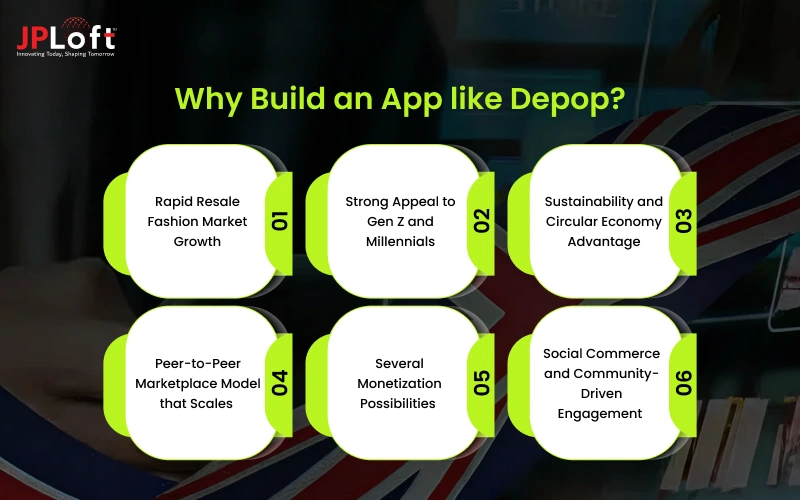
Let’s figure out the complete list of reasons below.
1. Rapid Resale Fashion Market Growth
The second-hand fashion marketplace is growing more quickly than regular retail, buoyed by a younger set of users who are not only looking for cheaper alternatives but also for unique styles.
An app like Depop taps right into that expanding resale economy. With demand growing, platforms that allow peer-to-peer selling enjoy steady user growth and stay relevant in the long term.
2. Strong Appeal to Gen Z and Millennials
Depop's social-first model mirrors exactly how younger users shop today: discovery, interaction, and personal expression are all important to them, not just product listings.
Building a similar app means you will capture high engagement, frequent usage, and strong brand loyalty from a digital-native audience.
3. Sustainability and Circular Economy Advantage
Eco-conscious shopping is no longer optional; a Depop-like app empowers reuse, hence lesser fashion waste, positioning your business in line with sustainability objectives.
This will attract socially responsible users and brands to your platform, building up their trust for long-term adoptions.
4. Peer-to-Peer Marketplace Model that Scales
An app like Depop scales organically through network effects; adding more sellers means more listings attract more buyers.
This self-reinforcing loop allows growth without holding inventory, keeping operational costs lower while expanding globally.
5. Several Monetization Possibilities
Depop-like applications can be monetized through a wide range of revenue streams, including commissions on sales, promoted listings, featured sellers' tools, and even brand partnerships.
Having such flexibility reduces dependence on one source of income and further stabilizes revenues as the platform grows.
6. Social Commerce and Community-Driven Engagement
With a combination of social feeds, follows, likes, and messaging, these apps keep users active well beyond purchases.
Engagement with the community creates retention, repeat transactions, and organic growth, making the platform more of a lifestyle destination than just a marketplace.

Features to Include in an App like Depop
The features to include in an app like Depop are user management, social commerce, product listings, search and discovery, messaging, and payments. In the given list of the top features, you can capture the overall features.
When you develop a mobile app, it's essential to look forward to the core features and even the advanced features, from which you can start with the app.
Let’s learn about the features in the given table.
|
Feature Category |
Feature Name |
Description |
|
User Management |
User Signup & Profiles |
Users can create buyer or seller profiles with bios, profile images, and storefront-style pages that build identity and trust. |
|
Social Commerce |
Follow & Feed System |
Users follow sellers, like items, and discover products through a personalized, social-style content feed. |
|
Product Listings |
Item Upload & Management |
Sellers upload items with photos, videos, pricing, tags, condition, and descriptions through a simple listing flow. |
|
Search & Discovery |
Smart Search & Filters |
Advanced search with filters for size, brand, price, category, condition, and trends enables faster product discovery. |
|
Messaging |
In-App Chat |
Buyers and sellers communicate directly to ask questions, negotiate pricing, and clarify shipping details. |
|
Payments |
Secure In-App Payments |
Built-in payment processing supports cards and digital wallets, ensuring secure and smooth transactions. |
|
Shipping |
Shipping Integration |
Shipping labels, order tracking, and delivery updates are managed directly within the app. |
|
Trust & Safety |
Ratings & Reviews |
Users rate and review each other after transactions, improving transparency and reducing fraud risks. |
|
Social Engagement |
Likes, Saves & Shares |
Users can like items, save listings, and share products to increase engagement and organic reach. |
|
Seller Tools |
Order & Inventory Management |
Sellers manage orders, track inventory, handle returns, and monitor sales from a unified dashboard. |
|
Monetization |
Promoted Listings |
Sellers pay to boost item visibility in search results or feeds, creating a scalable revenue stream. |
|
Notifications |
Push Notifications |
Real-time alerts notify users about messages, likes, orders, shipping updates, and price changes. |
|
Moderation |
Content & Fraud Controls |
Automated and manual moderation tools help prevent fake listings, spam, and policy violations. |
|
Analytics |
Seller Performance Insights |
Sellers access data on views, likes, conversions, and revenue to optimize their listings. |
|
Admin Panel |
Platform Management Dashboard |
Admins control users, listings, disputes, payments, and platform settings from a centralized system. |
|
Scalability |
Multi-Currency & Localization |
Support for multiple currencies and regions enables smooth global expansion of the marketplace. |
How to Create a Marketplace App like Depop?
You can create a marketplace app like Depop after evaluating the right strategies and steps. Here, these steps begin with the vision of the market, research of the market, defining the core features, selecting the right model, designing, and launching the app effectively.
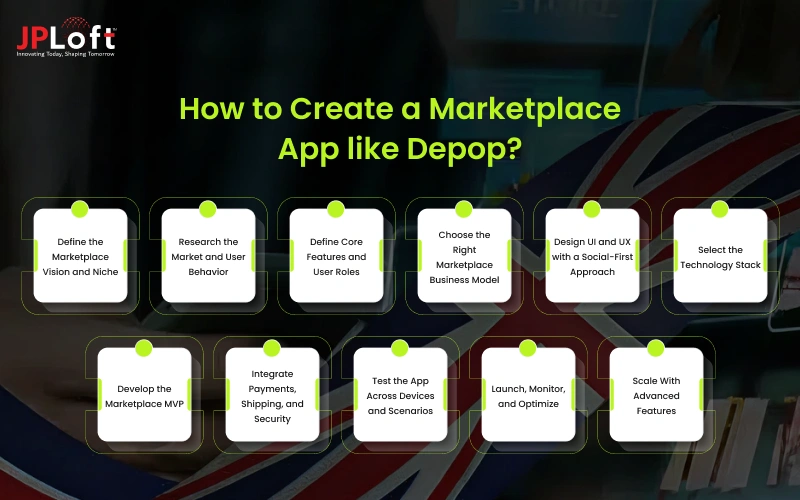
Let’s evaluate the complete series of steps below.
Step 1: Define the Marketplace Vision and Niche
You can develop an app like Depop when you know what the market can bring. The market is all about clarifying the value proposition and then making choices related to UI/UX and other elements, effectively.
► Understand Your Core Audience-: Identify who your users are, what they buy or sell, and how they prefer to interact inside a marketplace. Study their age group, spending habits, social behavior, and trust expectations. Clear audience insight helps you design features that feel natural and relevant.
► Clarify the Value Proposition-: Decide what makes your app different, such as sustainability, creator-driven selling, or community-based discovery. A strong value proposition influences branding, UX choices, and marketing strategy. It also helps users instantly understand why your platform exists.
Step 2: Research the Market and User Behavior
The market research is all about analyzing the competitors and validating the user demand. Here, you should evaluate the competitors present in the market, along with identifying the user behavior. Let’s observe each aspect closely, below.
► Analyze Competitors and Gaps-: Study similar platforms to understand their strengths, weaknesses, and feature limitations. Analyze user reviews, engagement patterns, and complaints to spot unmet needs. This research helps you avoid copying flaws and focus on improvement.
► Validate User Demand-: Test your idea using surveys, interviews, or waitlists to confirm real interest. Early validation ensures you are solving meaningful problems instead of making assumptions. It also helps refine your feature roadmap before development begins.
Step 3: Define Core Features and User Roles
The core features are based on identifying the buyer, seller, and prioritizing the MVP aspect. Let's evaluate further aspects of core features below.
► Identify Buyer, Seller, and Admin Needs-: List essential features for each role, including listings, chat, payments, moderation, and analytics. Clearly separating responsibilities improves usability and simplifies platform management. This structure also supports easier scaling later.
► Prioritize MVP vs Future Features-: Decide which features are required for launch and which can be added later. Focus on functionality that delivers immediate value to users. This approach controls costs and shortens time to market.
Step 4: Choose the Right Marketplace Business Model
You should select the right marketplace business model. This model is all about evaluating the monetization strategies that totally depend on translation-based commission, listing or posting fees, freemium features, and subscription plans to access.
► Select Monetization Strategies-: Choose revenue models such as transaction fees, promoted listings, subscriptions, or brand partnerships. The monetization approach should align with how users already behave. Poorly planned monetization can hurt adoption and trust.
► Align Revenue With User Value-: Ensure users feel they receive clear value in exchange for fees. When sellers succeed financially, the platform grows naturally. Balanced monetization supports long-term sustainability without damaging user experience.
Step 5: Design UI and UX with a Social-First Approach
Now, another step here is mobile app design it is all about framing the first impression of the users effectively.
When you make an app like Depop, the design should deliver a unique, edgy, DIY aesthetic inspired by urban culture, featuring bold fonts and modular layouts to empower the user's creativity.
► Create Intuitive User Journeys-: Design smooth flows for browsing, listing items, messaging, and checkout. Reduce friction at every step to keep users engaged. A simple experience improves retention and conversion rates.
► Focus on Visual and Social Elements-: Include feeds, likes, follows, and collections to encourage discovery. Social interactions keep users active even when they are not transacting. This transforms the app into a daily habit rather than a one-time tool.
Step 6: Select the Technology Stack
The mobile app tech stack is the full set of tools, languages, frameworks, as well as services that are used to build, run, and maintain an app. Let’s evaluate the complete tech stack and how you can use it for building an app like Depop.
► Choose Scalable Frontend and Backend Tools-: Select technologies that support real-time updates, messaging, and high traffic loads. Scalability ensures your app performs well as users and listings grow. The wrong stack can limit future expansion.
► Plan Infrastructure and Integrations Early-: Account for payments, shipping, analytics, and moderation tools upfront. Early planning prevents costly architectural changes later. A stable infrastructure supports faster feature rollouts.
Step 7: Develop the Marketplace MVP
You should develop the marketplace MVP now. It's all about ensuring a focus on core features that connect buyers and sellers to validate the idea among the real users. Let’s learn how to build a marketplace app like Depop, below.
► Build Core Marketplace Flows-: Develop onboarding, listings, search, chat, and checkout first. Keep the MVP focused, stable, and easy to use. Avoid adding advanced features before validating demand.
► Test Early With Real Users-: Release the MVP to a limited audience and gather feedback quickly. Observe how users interact with key flows. Early insights help fix usability issues before public launch.
Step 8: Integrate Payments, Shipping, and Security
Now, under this step, you should proceed with integrating the payments, shipping, and security standards. To build an app like Depop, it's essential to integrate payments, shipping, and security standards.
► Implement Secure Transaction Systems-: Add payment gateways, escrow handling, refunds, and payouts. Smooth financial flows build confidence among buyers and sellers. Secure payments are essential for marketplace credibility.
► Strengthen Platform Safety-: Implement fraud detection, identity checks, and data encryption. Safety features protect users and the platform from abuse. Strong trust systems increase transaction volume.
Step 9: Test the App Across Devices and Scenarios
Now, under this step, you should test the app across diversified devices. It is a step to consider when it comes to Depop-like app development. Without testing, you cannot overcome the unidentified challenges or errors.
► Perform Functional and Usability Testing-: Mobile app testing all features across devices, screen sizes, and operating systems. Validate both buyer and seller journeys thoroughly. Consistency improves user satisfaction. Apart from this, you should perform functional and usability testing.
► Validate Performance and Security-: Test app speed, load handling, and data protection. Fix performance bottlenecks early. A stable launch prevents negative reviews and churn. Along with this, to create a buy and sell app like Depop, you should ensure that your app is effectively secured and protected.
Step 10: Launch, Monitor, and Optimize
Now, it's time to launch your app on the App Store, or you can submit an app to the Play Store, and even both, based on your target users.
► Release With Analytics in Place-: Track user behavior, engagement, and conversion metrics from day one. Analytics reveal how users actually use the app. Data-driven insights guide smarter improvements.
► Iterate Based on Real Usage-: Improve features, onboarding, and monetization based on user data. Continuous optimization keeps the app competitive. Iteration is key to long-term success.
Step 11: Scale With Advanced Features
If you have created the MVP at the first place, then its important now to scale the app with the advanced features such as AI, IoT, and many other technologies.
► Introduce Intelligent and Growth Features-: Add AI recommendations, personalization, seller analytics, and automation. Advanced features improve discovery and seller success. They also increase platform differentiation.
► Expand to New Markets Gradually-: Support multiple regions, currencies, and languages as demand grows. Gradual expansion reduces risk while increasing reach. A phased approach ensures stability during growth.
Tech Stack to Build a Clone of Depop
The tech stack to create an app like Depop is react native, Swift, Kotlin, Next.js, Node.js, PostgreSQL, MongoDB, and more.
Let's evaluate the complete tech stack to include in the app, like Depop, in the table below.
|
Layer |
What It Covers |
Recommended Options |
|
Mobile App (Frontend) |
iOS + Android app UI, navigation, feed, listing flow |
React Native, Flutter, Swift (iOS), Kotlin (Android) |
|
Web App (Optional) |
Web marketplace for browsing and seller dashboard |
Next.js, React, Vue |
|
Backend API |
Business logic, user accounts, listings, orders, payouts |
Node.js (NestJS/Express), Django, Laravel, Spring Boot |
|
Database |
Users, listings, orders, messages, reviews |
PostgreSQL, MySQL |
|
NoSQL Database |
Feed, activity logs, flexible data, high read/write |
MongoDB, DynamoDB |
|
Cache |
Fast load for feed, search results, sessions |
Redis |
|
Search Engine |
Fast search + filters for brand, size, price, category |
Elasticsearch, OpenSearch, Algolia |
|
Real-Time Chat |
Messaging, typing indicators, read receipts |
WebSockets, Socket.IO, Firebase Realtime Database |
|
Media Storage |
Store product photos and videos |
AWS S3, Google Cloud Storage |
|
CDN |
Faster media delivery globally |
Cloudflare, AWS CloudFront |
|
Payments |
Card payments, wallet payments, payouts |
Stripe, PayPal, Adyen |
|
Shipping |
Labels, tracking, delivery updates |
Shippo, EasyPost, AfterShip |
|
Authentication |
Login security, social login, token auth |
OAuth 2.0, JWT, Firebase Auth, Auth0 |
|
Notifications |
Push notifications and transactional alerts |
Firebase Cloud Messaging, Apple Push Notification Service |
|
Analytics |
User behavior, funnels, retention, events |
GA4, Mixpanel, Amplitude |
|
Crash Reporting |
App stability and bug tracking |
Firebase Crashlytics, Sentry |
|
Admin Panel |
User moderation, disputes, reports, content control |
React Admin, Retool, Custom dashboard |
|
Moderation & Safety |
Spam detection, abusive content, fraud signals |
Manual moderation tools, ML rules engine, third-party moderation APIs |
|
Cloud Infrastructure |
Hosting, scaling, networking |
AWS, Google Cloud, Microsoft Azure |
|
CI/CD |
Automated builds, testing, releases |
GitHub Actions, GitLab CI, Bitrise |
|
Monitoring & Logs |
System health, API performance, alerts |
Prometheus + Grafana, Datadog, ELK Stack |
Cost to Make an App like Depop
The cost to make an app like Depop typically ranges from $20,000 to $80,000+, depending on features, design depth, and platform complexity. A basic MVP with core functionality such as user profiles, product listings, search, chat, and secure payments sits on the lower end of the range.
As you add social feeds, advanced filters, real-time messaging, moderation tools, and scalable backend architecture, the cost to develop an app in the UK increases. UI and UX design also play a major role, especially for social-first marketplaces that rely on discovery and engagement.
Additional costs may come from third-party integrations, security measures, and post-launch optimization. Planning the scope carefully helps balance budget, performance, and long-term growth.
Let's consider the table related to the cost figure, below.
|
App Complexity |
Estimated Cost Range |
What It Typically Includes |
|
Basic App (MVP) |
$20,000 – $35,000 |
Core features like user profiles, listings, search, messaging, basic payments, and simple UI. |
|
Medium App |
$35,000 – $60,000 |
Social feeds, advanced search filters, secure payments, shipping integration, moderation tools, and improved UI/UX. |
|
Advanced App |
$60,000 – $80,000+ |
AI-based recommendations, scalability architecture, advanced analytics, fraud detection, multi-region support, and high-end UX design. |
After learning about the cost, let's evaluate how you can cover the cost to make an app like Depop in the following section.
How to Monetize an App like Depop?
You can monetize an app like Depop by including the business modes such as commission, transaction-based model, seller’s subscription plans, payment & service fees, value-added services, and others.
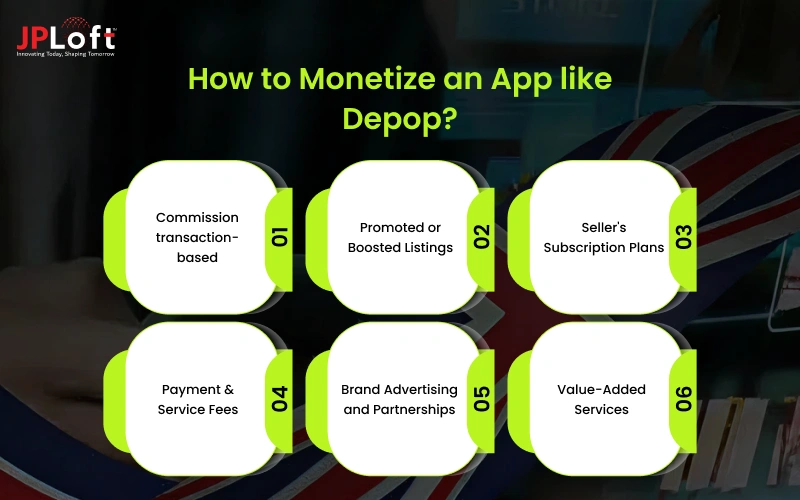
The selection of a mobile app monetization strategy will impact the overall development process of an app like Depop.
1. Commission transaction-based
Charge a small percentage or flat fee on every completed sale. This model grows organically with marketplace activity and aligns revenue for the platform with the success of its sellers.
It provides the right incentives to ensure quality listings and consistent transactions at no upfront cost to the user.
2. Promoted or Boosted Listings
These are usually paid promotions to appear at the top of search results or social feeds. This model works exceptionally well in discovery-driven marketplaces where visibility matters.
This allows the seller to self-select for growth while keeping basic selling free.
3. Seller's Subscription Plans
Offer recurring plans, such as monthly or yearly, with benefits that include reduced commissions, advanced analytics, or bulk listing tools.
Subscriptions give you predictable, ongoing revenue. They attract serious sellers who want to scale faster, too.
4. Payment & Service Fees
Have a small service fee for handling and keeping payments and payouts safe. Users will accept this once there is a way to add trust and reliability.
These fees help pay for things like infrastructure, security, and the operational cost of a platform.
5. Brand Advertising and Partnerships
Offer in-app collection or campaign promotions by brands. This is more effective once the platform has stabilized with a consistent flow of traffic and clear segmentation of users.
It adds revenue without disrupting core marketplace flows.
6. Value-Added Services
Offer value-added services: item authentication, faster payouts, or premium support are examples of very real pain points for sellers.
They provide a revenue stream while enhancing the overall quality of your marketplace.
Proceeding with the monetization parameters, let's switch to the complete list of challenges in the given section.
Challenges to Develop an App like Depop
The challenge to make an app like Depop includes creating trust between buyers and sellers, managing comment moderation, and delivering the social-first user experience.
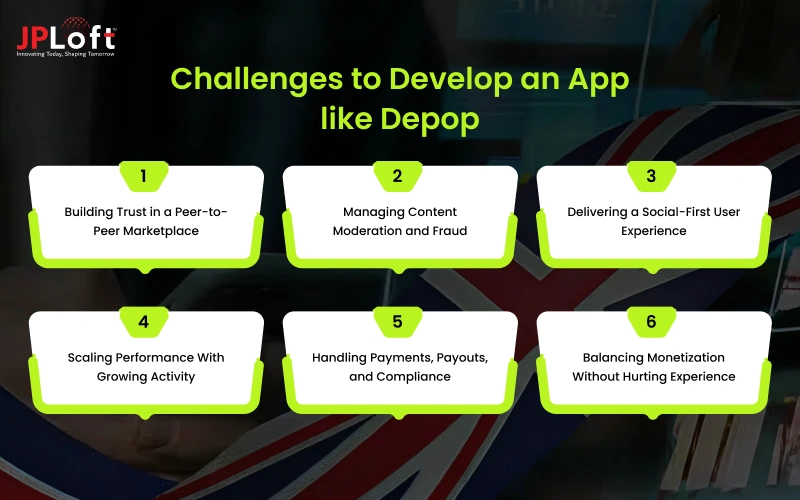
Here is the list of challenges while building an app like Depop, below.
Challenge 1: Building Trust in a Peer-to-Peer Marketplace
Creating trust between buyers and sellers is one of the biggest challenges. You need strong identity checks, secure payments, ratings, and dispute handling. Without trust, users hesitate to transact, which slows platform growth.
Challenge 2: Managing Content Moderation and Fraud
User-generated listings bring risks like fake items, scams, and policy violations. Manual moderation does not scale, while automation alone is not enough. A balance of tools and human review is required to protect the marketplace.
Challenge 3: Delivering a Social-First User Experience
Depop-style apps rely on discovery, feeds, and interaction, not just transactions. Designing a smooth social experience while keeping performance fast is complex. Poor UX can reduce engagement and retention quickly.
Challenge 4: Scaling Performance With Growing Activity
As users, listings, and messages increase, performance issues can appear. Real-time feeds, chat, and search require a scalable architecture. Weak infrastructure leads to slow load times and app crashes.
Challenge 5: Handling Payments, Payouts, and Compliance
Supporting secure payments, refunds, and seller payouts adds technical and regulatory complexity. Payment failures or delays damage user trust. Compliance requirements vary by region and must be handled carefully.
Challenge 6: Balancing Monetization Without Hurting Experience
Introducing fees and promotions without frustrating users is challenging. Poorly placed monetization can reduce seller participation. The platform must generate revenue while keeping the experience fair and transparent.
Proceeding with the challenges to create an app like Depop, you should know what the future holds, in the following section.
What is the Future of Apps like Depop?
The future of apps like Depop is shaped by the growing demand for social commerce, sustainability, and personalized shopping experiences.
As resale fashion becomes mainstream, these platforms will move beyond basic listings to offer richer discovery and community-driven interactions. AI-powered recommendations will play a bigger role, helping users find items that match their style, size, and buying behavior. Let’s list the future of apps like Depop below.
-
AI-powered personalization will drive smarter product discovery using style preferences, browsing history, and purchase behavior to increase engagement and conversions.
-
Social commerce features like short-form videos, live selling, and creator-led storefronts will become central to user interaction and discovery.
-
Stronger trust and safety systems will evolve through advanced fraud detection, seller verification, and transparent dispute resolution.
-
Sustainability insights and impact tracking will help users see the environmental value of resale, reinforcing circular fashion adoption.
-
Global expansion capabilities will grow with multi-currency payments, localized shipping, and region-specific compliance support.
-
Advanced seller tools and analytics will empower sellers with pricing insights, performance data, and automation for scaling their stores.
How JPLoft Helps in Launching a Mobile App like Depop?
Launching a resale marketplace app like Depop requires more than basic development. It demands the right mix of community features, scalability, and trust-focused design. As a Mobile app development company in the UK, JPLoft helps businesses turn social commerce ideas into fully functional, market-ready platforms.
JPLoft supports the entire journey, from validating the app concept and defining marketplace features to building secure user profiles, in-app messaging, payments, and shipping integrations. The team focuses on performance, moderation tools, and smooth user flows to support high engagement and repeat usage.
With a product-first approach, JPLoft ensures the app is scalable, compliant, and ready to grow. By aligning technology with user behavior and business goals, JPLoft helps brands launch competitive resale apps that attract users and sustain long-term growth.
Conclusion
Developing a marketplace app like Depop in the UK is a strategic move for businesses looking to tap into social commerce, sustainability, and Gen Z buying behavior. With the right mix of social-first design, secure transactions, scalable technology, and thoughtful monetization, such platforms can grow organically through strong network effects.
From defining a clear niche to selecting the right tech stack and scaling with advanced features, every step plays a role in long-term success. As resale fashion continues to gain momentum, investing in a Depop-style marketplace positions your business for sustainable growth and strong user engagement.
FAQs
Start by defining your niche, target audience, and core features like social feeds, messaging, and secure payments. Partner with an experienced app development team to design the UX/UI and build the platform using scalable technology. Launch with an MVP to test the market, gather user feedback, and iterate based on performance and engagement data.
Developing an app like Depop usually takes 4 to 8 months, depending on feature scope, design complexity, and platform choice. Timelines may extend if advanced social features or scalability planning are required. Working with an experienced development team and having clear requirements upfront can help streamline the process.
The cost typically ranges from $20,000 to $80,000+, based on app complexity, integrations, and UX depth. Custom features, security layers, and post-launch optimization can increase the investment. Ongoing costs like hosting, maintenance, and marketing should also be factored into your budget.
Depop-style apps combine social feeds, follows, likes, and messaging with commerce. This social-first experience increases engagement, retention, and repeat usage compared to static listing platforms. Users build personal brands and follower bases, creating community-driven discovery rather than just search-based shopping.
Trust is built through secure payments, identity verification, ratings, and dispute handling. Strong moderation and fraud detection also protect users and encourage safe transactions. Transparent seller profiles with verified badges and clear refund policies further reassure users when making purchases.
Yes, with scalable architecture, multi-currency support, and localized shipping, global expansion is possible. Region-specific compliance and gradual rollout help ensure stability during growth. Starting with similar English-speaking markets can ease the transition before expanding globally.

Priyanka Sukhwal is the Managing Director and Business Head of JPLoft, with 10+ years of experience in technology, digital product strategy, and business growth. She has worked closely with businesses building mobile applications, custom software, marketplaces, and on-demand platforms across mobility, automotive, consumer services, and startup ecosystems. At JPLoft, she focuses on understanding business models, identifying product opportunities, and helping companies plan digital solutions that can scale with changing market needs.





Share this blog