


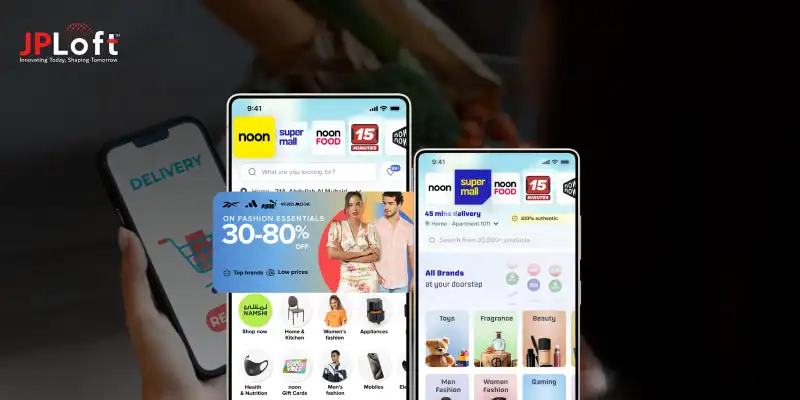
Key Takeaways
A Noon-style marketplace enables scalable growth through a multi-vendor, asset-light eCommerce model built for regional demand.
Knowing how to develop an app like Noon starts with an MVP, validated demand, and phased scaling through logistics and payments.
Core features such as search, checkout, delivery tracking, and seller tools directly improve conversions and retention.
Multiple monetization models create predictable revenue and long-term profitability for founders and investors.
The right tech stack ensures performance, security, and scalability as traffic and transactions grow.
Working with JPLoft accelerates development with marketplace expertise and growth-focused engineering.
Global eCommerce is expanding at an unprecedented pace, with digital marketplaces reshaping how consumers discover, compare, and purchase products. Platforms built around speed, convenience, and regional relevance are leading this shift, setting new benchmarks for scalable online commerce.
So, how do you develop an e-commerce app like Noon?
The short answer is by combining a proven marketplace model with the right technology, logistics strategy, monetization plan, and long-term scalability mindset.
This guide breaks down that answer in detail. It explains what makes a Noon-style marketplace work, how to structure the development process, which features matter most, and how costs, monetization, and challenges fit into the bigger picture.
The focus goes beyond coding to cover business strategy, operational planning, and growth readiness.
For entrepreneurs, this guide helps turn an idea into a viable product roadmap. For investors, it offers clarity on scalability, risk factors, and long-term value creation. If you are evaluating or planning a serious eCommerce marketplace, this guide lays out everything you need to know.
A Brief Understanding of the Noon App
Noon is an effective eCommerce marketplace established for the purpose of catering to the rapidly growing digital consumers in the Middle East.
Built with a mobile-first approach, Noon connects buyers in Dubai and the wider UAE with sellers offering electronics, fashion, groceries, beauty products, and everyday essentials through a single, convenient platform.
It allows buyers to connect with sellers for various product ranges such as electronics, fashion items, grocery items, beauty products, and other essential items through a single mobile-centric platform.
The remarkable aspect of the Noon app is its strong focus on speed, logistics, competitiveness, and regional experiences, while factors like the cost to hire mobile app developers in Dubai have supported steady growth through last-mile delivery, private brands, and in-app payments.
Let’s learn more about the marketplace, in the statistics below.

-
The global eCommerce market size was estimated at USD 25.93 trillion in 2023 and is projected to reach USD 83.26 trillion by 2030, growing at a CAGR of 18.9% from 2024 to 2030.
-
Additionally, the e-commerce market size was valued at USD 30.64 trillion in 2024. This is projected to grow from USD 36.30 trillion in 2025 to USD 169.54 trillion by 2034, this is exhibiting a CAGR of 18.7% from 2025 to 2034.
-
Based on Motor intelligence, the e-commerce market size is estimated at USD 31.22 trillion in 2025, and is expected to reach USD 73.47 trillion by 2030, growing at a CAGR of 18.67% during the forecast period of 2025 to 2030.
-
Apart from this, the downloads of the Noon app over the Play Store is 50M+ and this is estimated to grow with time. Similarly, the App Store has a high rating when it comes to the Noon app.
You can consider these stats as the basic reasons to build a mobile app like Noon. However, if you are searching for reasons apart from the revenue and growing number of downloads, then let's proceed with the following section.
Reasons to Build an App like Noon
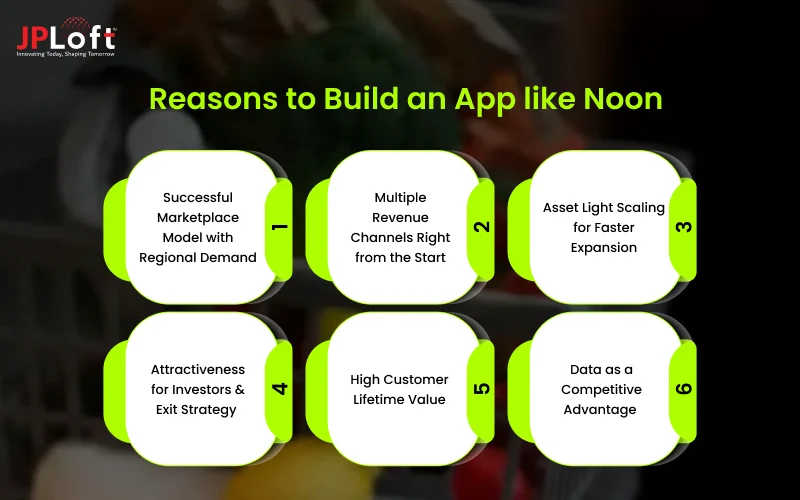
The multiple reasons to create an app like Noon include different monetization channels, a successful marketplace model, and faster expansion of the app due to an effective market model.
Let’s explore diversified reasons in the following section.
1. Successful Marketplace Model with Regional Demand
What "proves" that the Noon-style market is valid before an entrepreneur even gets started is that it indicates that large, quickly expanding regions are spending on m-commerce.
This makes it very appealing for entrepreneurs with scaling aspirations, as well as investors searching for validated ideas.
2. Multiple Revenue Channels Right from the Start
An app such as Noon is not restricted to selling goods only. The creators of the app make money through commissions, advertisements, and other areas.
The app has many revenue streams, making it more profitable. You can hire mobile app developers when it comes to identifying the core business models for building an app like Noon.
3. Asset Light Scaling for Faster Expansion
Market model enables scaling without much inventory investment. Adding new sellers can allow the founders to scale product and geographic offerings fast.
It is beneficial for investors as operational expenses can be easily managed.
4. Attractiveness for Investors & Exit Strategy
Strategically significant marketplace applications also have high visibility to purchasers, acquisition, and late-stage investing.
A successful Noon-inspired application increases value based on user base expansion, number of transactions, and data resources, making exits accessible.
5. High Customer Lifetime Value
After the customers have become accustomed to the app for daily purchases, the retention rate will increase on its own.
Services such as quick delivery, location pricing, or loyalty rewards become major factors for customers to repeat orders, making acquiring customers a long-term process.
6. Data as a Competitive Advantage
The apps in the marketplaces yield valuable insights with regard to market behavior and seller performance.
Businessmen make use of the data, while investors view it as an area that provides a competitive edge.
Now, proceeding with the reasons to build an app like Noon, you might be ready to make an e-commerce app like Noon.
Well, if yes, then let's learn about the key features that you can include in an app like Noon with the section below.
Features to Include in an App like Noon
The core features that you can include in an app like Noon are user access, product discovery, product listing, cart & checkout, and many more
Let’s discover all the features in the table below.
|
Feature Area |
Requirements |
Purpose |
|
User Access |
Phone or email login, OTP verification |
Fast onboarding and secure access |
|
Product Discovery |
Categories, search, filters |
Easy browsing across large catalogs |
|
Product Listing |
Images, pricing, descriptions, reviews |
Builds trust and supports buying decisions |
|
Multi-Seller System |
Seller onboarding, product uploads |
Enables marketplace growth without inventory |
|
Cart & Checkout |
Cart, address selection, single checkout |
Smooth purchase flow |
|
Payments |
Cards, wallets, COD, refunds |
Improves payment success and user trust |
|
Order Management |
Order tracking, status updates |
Keeps users informed |
|
Delivery & Logistics |
Delivery slots, live tracking |
Critical for customer satisfaction |
|
Offers & Discounts |
Coupons, deals, flash sales |
Drives conversions |
|
Notifications |
Order and offer alerts |
Boosts engagement |
|
Customer Support |
In-app support or help center |
Reduces friction post-purchase |
|
Admin Control |
Seller, order, and content management |
Full operational control |
Following the features can result in developing an app like Noon that is able to serve the users effectively. With a leading e-commerce app development company, you can explore more diversified features.
Now, as you are ready to proceed with integrating the right features, let's learn the complete steps to make an app like Noon in the following section.
How to Make an eCommerce App like Noon?
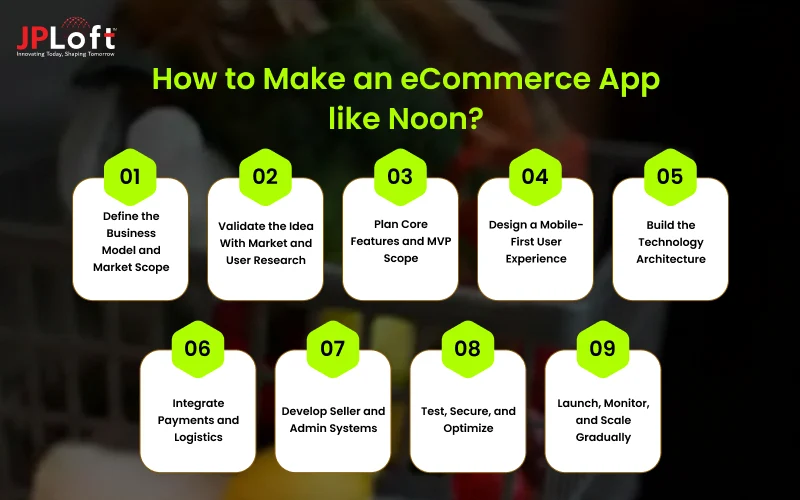
You can develop a shopping app like Noon, beginning with understanding the current market, validating the idea, planning the core features, designing the app, and then selecting the core tech stack.
Well, here, we have already detailed every aspect of an app like Noon to help you hire dedicated developers with clarity on features, architecture, and execution requirements.
Let’s learn it all in detail.
Step 1: Define the Business Model and Market Scope
This step sets the foundation for how your app will operate, earn revenue, and scale across regions. Clear decisions here prevent costly pivots later.
► Choose the right marketplace structure
To make an app like Noon, you need to decide if your app will operate as a multi-vendor marketplace, a hybrid model, or a first-party store. A marketplace model reduces inventory risk and enables faster category expansion.
► Identify target regions and categories
Focus on a limited geography and high-demand product categories initially. This helps streamline logistics, pricing strategies, and operational execution.
Step 2: Validate the Idea With Market and User Research
Before development begins, it’s essential to confirm that real demand exists and understand how users and sellers behave when planning how to develop an e-commerce app like Noon.
► Analyze competitors and pricing behavior
Study existing marketplace apps to evaluate pricing models, delivery expectations, and user experience gaps you can improve upon. Learning about the pricing behavior and the current market competitors will provide you with an edge when it comes to noon like app development.
► Define buyer and seller personas
Clear personas help shape app flows, onboarding steps, seller tools, and communication strategies for both sides of the marketplace. The personas will help you to draft how users proceed with the app. It can be further helpful to frame the complete development plan successfully.
Step 3: Plan Core Features and MVP Scope
This stage focuses on deciding what to build first without overloading the product. Planning about the core features involves defining basic and advanced functionalities of the app.
► Decide MVP vs scalable features
Start with must-have features like search, checkout, payments, order tracking, and seller onboarding. Advanced automation can be added after traction.
► Map features by user type
Separate customer app features from seller and admin panels. This keeps development organized and avoids future architectural issues. You can hire iOS developers, and you can ensure to plan core features as per the current market demand.
Step 4: Design a Mobile-First User Experience
User experience and mobile app design directly impact conversion rates and retention in an e-commerce app, making it a critical factor when deciding how to build an app like Noon.
► Create intuitive navigation and search
Strong filters, smart categories, and fast search help users discover products quickly in large catalogs. Now, you should successfully build a pattern of navigation and search while making an app like Noon. Here, you can include the filters to help users find their desired function.
► Optimize product and checkout flows
Clear visuals, transparent pricing, and minimal checkout steps reduce cart abandonment. Apart from this, you should optimize the complete app’s performance by building a mobile app wireframe and creating a prototype.
Step 5: Build the Technology Architecture
A scalable architecture ensures the app performs reliably as traffic and sellers increase. Now, you should select the mobile app tech stack, which is all about choosing the frontend, backend, database, cloud, and integrations.
► Select the right tech stack
Choose frameworks and cloud infrastructure that support high concurrency, security, and future integrations, and ensure the app uses databases like MySQL or PostgreSQL for transactions and NoSQL options such as MongoDB for scalability.
► Enable API-driven integrations
APIs allow smooth connections with payment gateways, delivery partners, analytics, and third-party services. The API driven integrations that you can include in an app like Noon are payment gateways, logistics and delivery, tracking, as well as maps and address services.
Step 6: Integrate Payments and Logistics
Payments and delivery define user trust and satisfaction. Here, you should integrate the payment gateways, logistics, and delivery tracking, maps, and address services, notifications, analytics, as well as ensure smooth operations and scalability.
► Offer region-specific payment options
Support cards, digital wallets, and cash-on-delivery based on local user preferences. Along with this, you should offer region-specific payment options, such as when it comes to building an app like Noon in Dubai, key payment measures are debit and credit cards, PayPal for international users, etc.
► Set up delivery and fulfillment logic
Implement address mapping, delivery slots, and real-time tracking to meet fast shipping expectations. Along with this, you should set up delivery and fulfillment logic. Setting up delivery and fulfillment logic involves connecting orders to real-time inventory, assigning the nearest warehouse or seller, and triggering last-mile delivery partners with live tracking.
This ensures payments, order confirmation, dispatch, and delivery status stay synchronized without delays.
Step 7: Develop Seller and Admin Systems
Strong seller and admin tools keep the marketplace running smoothly at scale. Developing seller and admin systems means building dashboards that manage products, orders, commissions, and performance analytics, which is a critical step in understanding how to create an app like Noon.
► Build seller dashboards
Sellers should manage products, pricing, orders, and performance insights with ease. Build seller dashboards that allow vendors to manage product listings, pricing, inventory, orders, and performance insights from a single, easy-to-use interface.
► Create a powerful admin panel
Admins need full visibility into users, sellers, commissions, orders, and promotions. Create a powerful admin panel that gives full control over users, sellers, orders, payments, commissions, promotions, and platform analytics from one centralized system.
Step 8: Test, Secure, and Optimize
This phase ensures the app is stable, secure, and ready for real users. Test, secure, and optimize the app through functional, performance, and security testing to ensure stability under high traffic, safe transactions, and a smooth user experience across devices.
► Perform functional and load testing
Mobile app testing should be performed under peak traffic, flash sales, and heavy checkout activity to prevent failures. Along with this, you should perform functional and load testing landscape. It comprises of multi-phase process designed to simulate real user traffic on an application.
► Implement security and compliance checks
Utilize data encryption, secure payment handling, and fraud prevention measures to safeguard the platform. Along with this, you should begin with mobile app security, which needs to be comprised of protecting user data, privacy, and functionality from cyber threats like data breaches.
Step 9: Launch, Monitor, and Scale Gradually
The launch is only the beginning of the growth journey. Apart from this, you should launch your app on the App Store and submit an app to the Play Store.
► Launch with controlled regions and categories
Start small, gather real usage data, and improve continuously before wider expansion. You should monitor and scale the app should study the guidelines related to submitting your app to the App Store, and launch your app on the Play Store.
► Use analytics to drive growth
Track conversions, drop-offs, seller performance, and repeat purchases to guide scaling decisions. Along with this, you can use the analytics for driving growth.
How Much Does it Cost to Make an App like Noon?
The cost to develop an app like Noon typically starts around $20,000 for a basic MVP and can go beyond $100,000+ for a fully scaled, multi-vendor marketplace with advanced features. What this really depends on is how complex your marketplace is at launch and how aggressively you plan to scale.
Factors such as multi-seller architecture, payment integrations, logistics management, admin controls, and mobile-first UX play a major role in shaping the budget. An MVP with essential features costs less but limits scalability.
A production-ready app designed for high traffic, fast delivery, and regional expansion requires stronger backend systems, enhanced security layers, and optimized performance. Entrepreneurs often start lean, while investors usually plan for a scalable build from day one.
|
Cost Factor |
What It Covers |
Estimated Cost |
|
MVP Development |
Core features, basic design, single region |
$20,000 – $35,000 |
|
UI/UX Design |
Mobile-first layouts, user flows |
$5,000 – $10,000 |
|
Multi-Vendor System |
Seller onboarding, dashboards |
$10,000 – $20,000 |
|
Payments Integration |
Cards, wallets, COD, refunds |
$5,000 – $12,000 |
|
Logistics & Tracking |
Delivery flow, live order tracking |
$8,000 – $18,000 |
|
Admin Panel |
User, seller, order management |
$6,000 – $15,000 |
|
Security & Testing |
Data protection, load testing |
$4,000 – $10,000 |
|
Total Estimated Cost |
MVP to full-scale marketplace |
$20,000 – $100,000+ |
Monetization Strategies to Include in an App like Noon
The monetization strategies that you can include in an app like Noon are a seller commission model, sponsored product listings, subscription plans for sellers, advertising and brand promotions, logistics, and fulfillment fees.
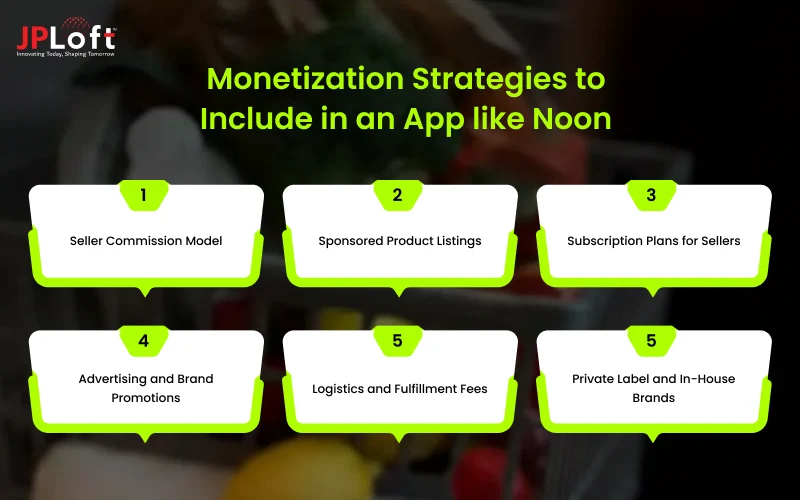
Let’s evaluate the mobile app monetization models below.
1] Seller Commission Model
Charge sellers a commission on every successful transaction completed through the platform. The commission rate can vary by category, product value, or seller tier. This creates a steady revenue stream that scales naturally as order volume grows.
2] Sponsored Product Listings
Allow sellers and brands to pay for higher visibility within search results and category pages. You can develop an app like Noon and include this monetization strategy, sponsored placements to help sellers drive faster sales, while the platform earns premium advertising revenue without impacting the user experience.
3] Subscription Plans for Sellers
Offer monthly or annual subscription packages that unlock benefits like reduced commissions, priority support, advanced analytics, or faster payouts. This model brings predictable recurring revenue and attracts serious, high-performing sellers.
4] Advertising and Brand Promotions
Monetize app traffic through banner ads, brand campaigns, and seasonal promotions, a strategy that works especially well when you build an eCommerce app like Noon, as brands pay more for exposure to high-intent shoppers.
5] Logistics and Fulfillment Fees
Charge sellers for warehousing, packaging, and delivery services managed by the platform. This not only adds a revenue layer but also improves delivery consistency and customer satisfaction.
6] Private Label and In-House Brands
Launch platform-owned product lines across popular categories. Private labels deliver higher profit margins and give the marketplace more control over pricing, quality, and customer loyalty.
Challenges to Make an App like Noon
The challenges to make an app like Noon are managing multi-vendor operations, high initial development and scaling costs, and many more.
Yes, your app can face challenges, but having awareness about these challenges can provide you with an edge in the mobile app development process.
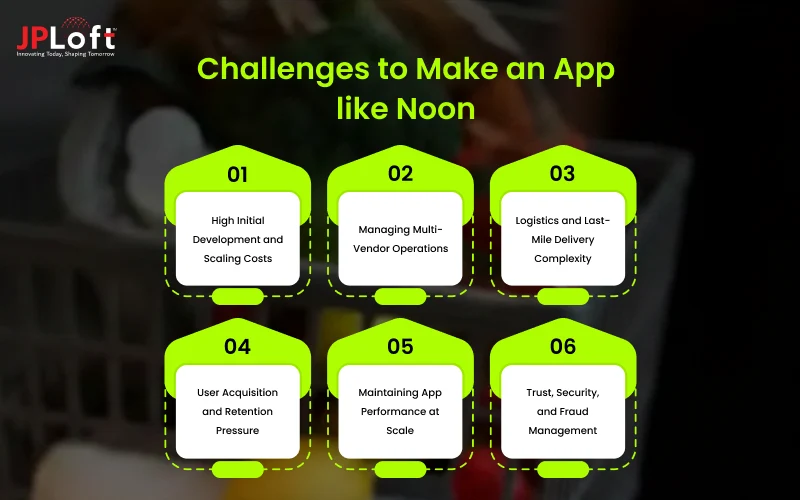
Let’s learn all these mistakes and challenges below.
Challenge 1: High Initial Development and Scaling Costs
Building a marketplace app like Noon requires significant upfront investment in technology, infrastructure, and skilled development teams. Costs increase quickly when you add multi-vendor systems, real-time logistics, and scalable backend architecture.
For early-stage founders, balancing feature depth with budget constraints becomes a constant challenge. Investors also expect a clear plan for controlling burn while scaling.
Challenge 2: Managing Multi-Vendor Operations
Handling thousands of sellers on a single platform is complex. Each seller brings different pricing strategies, inventory accuracy, and service quality.
Without strong seller tools and clear policies, inconsistencies can harm customer trust and platform reputation. Continuous seller monitoring and support are essential but resource-intensive.
Challenge 3: Logistics and Last-Mile Delivery Complexity
Fast and reliable delivery is a major expectation in modern eCommerce. Coordinating warehouses, delivery partners, time slots, and returns across regions requires tight operational control.
Delays or failed deliveries directly impact user satisfaction and retention, making logistics one of the hardest challenges to scale.
Challenge 4: User Acquisition and Retention Pressure
Entering a competitive e-commerce market means spending heavily on marketing and promotions. Acquiring users is expensive, and keeping them engaged requires consistent pricing, offers, and service quality.
Without strong retention strategies, customer acquisition costs can quickly outweigh lifetime value. You can build an e-commerce app like Noon after mitigating the challenge related to user acquisition.
Challenge 5: Maintaining App Performance at Scale
Marketplace apps experience traffic spikes during sales events and peak seasons. Ensuring the app remains fast, stable, and responsive under high load demands a strong backend architecture and continuous performance optimization.
Even short downtimes can result in revenue loss and damaged brand trust. You can connect with the leading mobile app maintenance services.
Challenge 6: Trust, Security, and Fraud Management
Handling payments, personal data, and high transaction volumes makes security non-negotiable. Fraudulent sellers, fake reviews, and payment risks must be actively monitored and prevented.
Building and maintaining trust across buyers, sellers, and payment partners requires ongoing investment in security systems and compliance processes. When you create a fashion app like Noon, it's important to ensure that the users trust the brand.
Proceeding with the challenges, let's evaluate the future of the e-commerce app like Noon in the following section.
What is the Future of an App like Noon?
The future of an app like Noon points toward deeper ecosystem ownership rather than simple product selling. Marketplace apps will evolve into everyday commerce hubs that combine shopping, payments, logistics, and services inside one experience.
When you develop an e-commerce app like Noon, it's important to note that faster delivery expectations will push stronger investments in local warehouses, predictive inventory, and last-mile automation.
Personalization will become sharper, driven by real-time user behavior, purchase history, and demand forecasting. AI-led recommendations, dynamic pricing, and smarter search will directly influence conversion and retention. At the same time, private labels and in-house brands will grow, giving platforms higher margins and tighter control over quality.
Expansion into adjacent services like grocery, quick commerce, and embedded finance will further increase user lifetime value. For entrepreneurs and investors, the long-term opportunity lies in building platforms that users rely on daily, not occasionally.
Build Your Own Noon-Like App with JPLoft
Building a Noon-like marketplace app is not just about launching an e-commerce platform. It is about creating a scalable ecosystem that connects buyers, sellers, payments, and logistics in one smooth experience. This is where JPLoft steps in with a structured, business-first approach to marketplace app development.
Our team focuses on building apps that are mobile-first, performance-driven, and ready to scale across regions. From multi-vendor architecture and secure payment flows to delivery tracking and admin control systems, every component is designed for long-term growth.
The development process starts with your business model, not just features, ensuring the app supports revenue, retention, and expansion from day one.
Recognized as the best Mobile app development company in Dubai, JPLoft helps founders and enterprises turn complex marketplace ideas into reliable, production-ready applications.
If your goal is to build a serious competitor in the eCommerce space, the foundation matters, and the right development partner makes all the difference.
Conclusion
Developing an e-commerce app like Noon is a strategic move for businesses aiming to enter high-growth digital markets with a scalable marketplace model. From understanding regional demand and defining the right business structure to building core features, selecting the right tech stack, and planning monetization, every step plays a critical role in long-term success.
While challenges like logistics, scaling costs, and competition exist, a well-planned approach backed by strong execution can turn these into growth opportunities. With the right development partner, clear vision, and phased scaling strategy, entrepreneurs and enterprises can build a marketplace app that delivers strong user adoption, sustainable revenue, and long-term market relevance.
FAQs
To develop an app like Noon, begin with market research, define a multi-vendor marketplace model, and build an MVP with core features. Gradually scale by integrating payments, logistics, analytics, and seller tools based on real user data.
A Noon-like app typically takes 4 to 8 months to develop. The timeline depends on feature complexity, platform choice, third-party integrations, and the level of scalability planned from the start.
Yes, launching an MVP helps validate demand, reduce development risk, and control initial costs. It also allows you to gather user feedback before investing in advanced features and regional expansion.
A Noon-style app should support both Android and iOS platforms. Mobile apps drive the majority of e-commerce traffic and offer better engagement, push notifications, and repeat purchase behavior.
Revenue comes from seller commissions, sponsored listings, subscription plans, advertising, logistics services, and private labels. This diversified model supports long-term profitability and scalable growth.
Yes, security is critical because the app handles payments, personal data, and high transaction volumes. Strong encryption, fraud detection, and compliance measures help maintain user trust and platform credibility.

Priyanka Sukhwal is the Managing Director and Business Head of JPLoft, with 10+ years of experience in technology, digital product strategy, and business growth. She has worked closely with businesses building mobile applications, custom software, marketplaces, and on-demand platforms across mobility, automotive, consumer services, and startup ecosystems. At JPLoft, she focuses on understanding business models, identifying product opportunities, and helping companies plan digital solutions that can scale with changing market needs.


Share this blog