


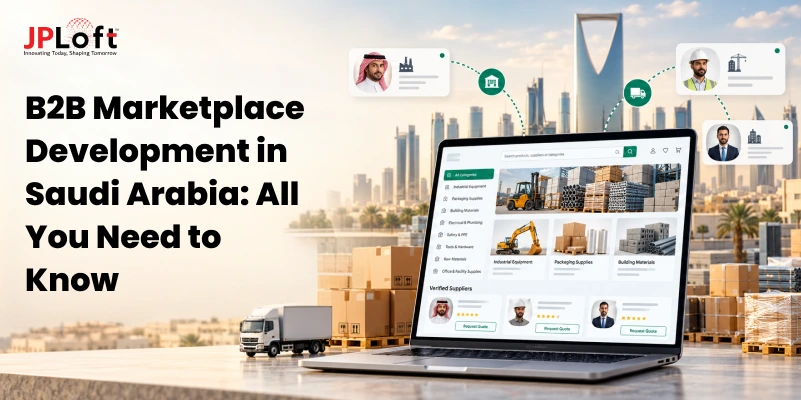
Wholesale trading is changing as more businesses move online. Buyers want better prices, trusted suppliers, and easier ways to order products in bulk.
Traditional methods often involve long negotiations, phone calls, and manual paperwork. These steps can slow down daily business operations.
As per one report, the global B2B eCommerce market is projected to reach $62.2 trillion by 2030.
A B2B wholesale marketplace brings buyers, suppliers, manufacturers, and distributors together on one online platform.
Businesses can compare products, check bulk prices, place orders, and track deliveries in one place.
In Saudi Arabia, digital growth is creating new opportunities for wholesale businesses.
An online marketplace can help suppliers reach more buyers and make product sourcing easier for retailers. It can also reduce manual work and simplify order management.
But does B2B marketplace development Saudi Arabia meet your business needs?
This guide covers the key features, development steps, costs, and important factors to consider when building a B2B wholesale marketplace in KSA.
What Is a B2B Wholesale Marketplace?
A B2B wholesale marketplace is an online platform where businesses buy and sell products in bulk. It connects manufacturers, wholesalers, distributors, and retailers in one place.
Instead of visiting multiple suppliers or placing orders through phone calls, buyers can explore products, compare prices, and place orders online.
For example, a retailer in Saudi Arabia can use a B2B wholesale marketplace to find suppliers, check bulk pricing, and order products for their store.
Suppliers can also manage product listings, receive orders, and connect with more business customers.
These platforms make wholesale trading easier by reducing manual work and improving communication between buyers and sellers.
Features such as bulk ordering, custom pricing, digital payments, and order tracking help businesses manage daily transactions more efficiently.
For businesses in KSA, building a B2B wholesale marketplace can open new sales opportunities and simplify procurement across different industries.
Why Build a B2B Marketplace in KSA?
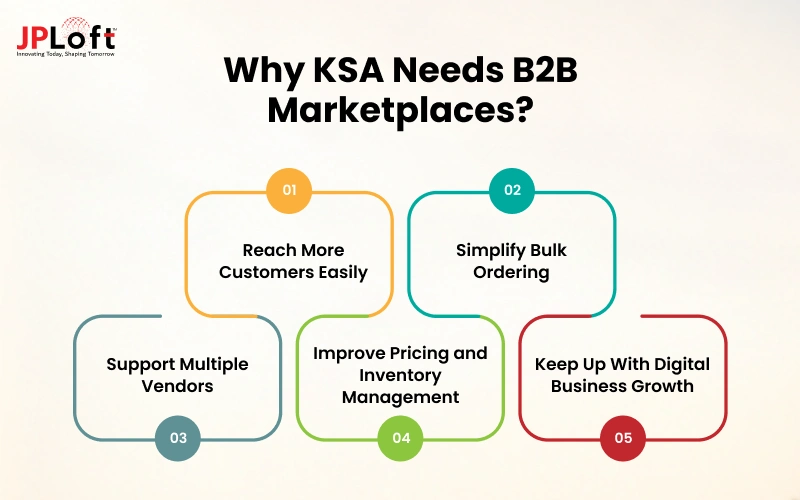
Building a B2B Marketplace in KSA helps businesses simplify wholesale trading and connect with more buyers.
Here are some key reasons to consider investing in one:
1. Reach More Customers Easily
A digital marketplace helps wholesalers connect with retailers, distributors, and other businesses in Saudi Arabia.
Instead of depending only on local contacts, suppliers can showcase their products to a wider audience. This creates more opportunities to attract bulk orders.
2. Simplify Bulk Ordering
Managing bulk orders through calls, emails, and spreadsheets can take time.
A wholesale marketplace app allows buyers to browse products, check quantities, compare prices, and place orders online.
Suppliers can manage incoming orders more easily, reduce manual work, and provide a smoother buying experience.
3. Support Multiple Vendors
A marketplace can bring several suppliers together on one platform.
With the right multi-vendor B2B marketplace features, businesses can manage vendor profiles, product catalogs, bulk pricing, and order updates.
Buyers can explore different suppliers in one place, making product sourcing simpler and giving sellers more ways to reach potential buyers.
4. Improve Pricing and Inventory Management
Wholesale buyers often need special prices based on order quantities, customer agreements, or purchase volumes.
A digital marketplace can support tiered pricing, stock updates, and customized offers.
These tools help suppliers manage product availability and pricing more clearly while allowing buyers to make informed purchasing decisions.
5. Keep Up With Digital Business Growth
Saudi Arabia’s digital transformation is encouraging businesses to adopt online tools for everyday operations.
A B2B marketplace can help wholesalers modernize their sales process, serve business customers online, and manage transactions more efficiently.
It also lays the groundwork for future improvements, such as automated order processing and business analytics.
Key Features of a B2B Marketplace in KSA
There are several app features a B2B marketplace needs that simplify bulk buying, supplier management, and order processing.
Here are some features of a B2B marketplace you should explore:
-
Vendor Registration and Management
Allow suppliers to register, create business profiles, and upload required documents.
Admins can verify vendor details, approve accounts, and monitor seller activity.
This helps buyers connect with trusted suppliers and keeps the marketplace organized.
-
Bulk Product Catalog
Give vendors the ability to list products with images, descriptions, specifications, and available quantities.
Buyers can browse categories and compare products before placing orders.
A well-organized catalog makes it easier to find suitable products for bulk purchases.
-
Bulk Ordering System
Make it simple for buyers to order products in large quantities. Include minimum order quantities, quantity selectors, and repeat-order options.
These tools reduce manual work and help buyers place orders that match their business needs.
-
Tiered Pricing and Custom Quotes
B2B buyers often expect different prices based on order volume or negotiated agreements.
Support quantity-based discounts, customer-specific pricing, and quote requests.
These features help vendors offer flexible deals and allow buyers to negotiate terms before confirming large orders.
-
Secure Payment Options
Offer suitable payment methods such as bank transfers, cards, and approved business payment solutions.
Depending on the business model, you can also support credit terms for eligible buyers.
Clear payment records help both parties track transactions and manage their finances.
-
Inventory Management
Helps vendors update stock levels and manage product availability from a central dashboard.
Automated stock updates can reduce the risk of accepting orders for unavailable items.
Buyers can make better purchasing decisions when they have accurate information about available quantities.
-
Order and Shipment Tracking
Allow buyers and vendors to monitor orders from confirmation to delivery.
Order status updates, shipping details, and delivery notifications keep everyone informed.
This reduces repeated follow-up calls and helps businesses manage their purchasing and fulfillment processes more efficiently.
-
Buyer and Vendor Dashboards
Provide separate dashboards for buyers, vendors, and administrators.
Buyers can review orders and invoices, while vendors can manage listings, sales, and customer requests.
Admins can oversee marketplace activity and resolve issues from one central interface.
-
Reports and Analytics
Include reports for sales, order volumes, customer activity, and product performance.
Vendors can identify popular products and understand buying patterns.
Marketplace administrators can use these insights to improve operations, support business growth, and make informed decisions.
Steps to Build a B2B Marketplace in Saudi Arabia
Saudi businesses are moving their buying and selling online at speed. A trusted B2B marketplace development company can help you ride this wave.
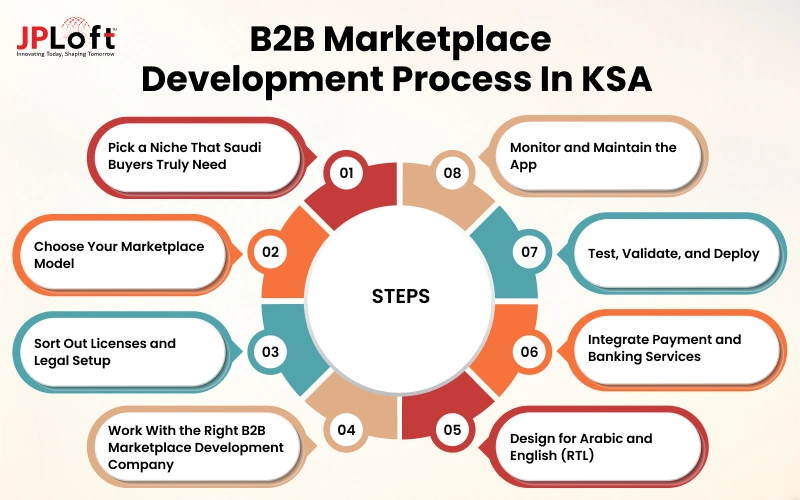
But the right roadmap comes first. Here are the 8 steps to follow:
Step 1: Pick a Niche That Saudi Buyers Truly Need
B2B eCommerce platform Saudi Arabia is growing at a tremendous rate of about 13.45% a year through 2031.
Vision 2030 is fuelling this shift. SMEs add around 20% to the national GDP today, and the goal is 35%.
Do not try to serve everyone. Pick one sector with heavy and repeat buying.
Think construction supplies, medical products, food service, or industrial parts. NUPCO’s healthcare marketplace shows how a focused B2B platform can reshape buying for a whole sector.
Once your niche is clear, it is time to decide how your platform will make money.
Step 2: Choose Your Marketplace Model
First, decide who sells and who buys. Many suppliers serving many buyers make it a multi-vendor marketplace.
You can also run an RFQ model. Buyers post a need and suppliers send quotes.
B2B buyers often want bulk pricing and custom quotes. A simple shopping cart is not enough for them.
Then pick your app revenue stream. Common choices are commission and subscription plans. Featured listings work too.
Whether you're developing a wholesale ordering app KSA or a marketplace app, keep version one simple; you can add more later.
With the model locked in, let’s make sure everything is legal.
Step 3: Sort Out Licenses and Legal Setup
Start with a Saudi commercial registration. Entities with a CR that run an e-commerce site must also register that site with the Ministry of Commerce.
Marketplaces get extra attention here. Platforms that act as intermediaries face their own set of requirements.
Foreign founders need one more step. A MISA license is the legal basis for a foreign company in the Kingdom.
Check which portal handles site registration today. It has been moving to the Saudi Business Center platform instead of Maroof.
Guard user data from day one. Data breach fines can reach one million riyals.
Paperwork done. Now you need the right people to build the platform.
Step 4: Work With the Right B2B Marketplace Development Company
Before finalizing your team, compare the cost to hire app developers in Saudi Arabia based on their experience, technical expertise, and project requirements.
Ask direct questions about ZATCA and local payments. A team that hesitates here will slow you down.
Your must-have features are simple. Vendor dashboards and RFQ tools come first. Add bulk pricing and order tracking.
Ask where your data will be hosted. Payment data rules under SAMA are strict, and gateways keep that data inside the Kingdom.
Launch with an MVP. Add advanced features once real users arrive. Whoever you hire as a B2B marketplace development company, language must be a top priority.
Step 5: Design for Arabic and English (RTL)
Think Arabic-first from the start. A website translated at the last minute may feel disconnected from local audiences.
Right-to-left design means full mirroring. Menus and tables flip. So do forms and icons.
Test long Arabic product names. Test numbers and mixed text too.
Give users a one-tap language switch. Show prices in SAR and add Hijri dates where they help.
Good language builds trust. Smooth payments close the deal.
Step 6: Integrate Local Payment Methods
MADA is a must. It is the national debit scheme, and merchants can reach over 30 million cardholders through it.
Add Apple Pay and STC Pay too. Apple Pay is the top online choice, and STC Pay is strong with younger users.
B2B buyers think differently. Bank transfers sit among the most preferred options. SADAD is the national bill payment system, and big buyers trust it.
Pick a SAMA-licensed gateway. Some global gateways do not route Mada or STC Pay at all. Check this before you sign.
For large orders, add milestone or escrow payments. Buyers feel safer, and suppliers get paid on time.
Money flow also brings tax rules. That brings us to ZATCA.
Step 7: Build ZATCA e-Invoicing Into the Core
This step cannot wait. Phase 2 needs your invoicing system to connect with the Fatoora platform and use the ZATCA format with extra invoice fields.
It rolls out in waves. Wave 1 started with turnover above SAR 3 billion, and later waves keep lowering that bar.
The net is wide now. Wave 24 covered VAT-registered businesses above SAR 375,000, and the deadline was 30 June 2026. A 25th wave was announced in July 2026.
So your suppliers will need compliant invoices soon. Your platform should make that easy.
Build in invoice generation and QR codes. Add VAT details and real-time reporting from the start.
Compliance is covered. Now fill your marketplace and go live.
Step 8: Onboard Suppliers and Launch in Riyadh
Start where the buyers are. Riyadh holds about 35% of Saudi e-commerce.
Sign a small group of verified suppliers first. A full catalogue builds trust fast.
Line up logistics early. Saudi e-commerce warehousing is forecast to grow at about 17% a year. Good partners are easier to find now.
Use local support to reach SMEs. Monsha’at links businesses with payment and e-commerce solution providers.
Track every order and every complaint. Fix problems fast. Then expand to Jeddah and Dammam.
B2B Marketplace Development Cost in KSA
Building a B2B marketplace in Saudi Arabia needs a clear budget.
Costs depend on how big you start. Overall, the cost of a B2B marketplace development is SAR 50,000 to SAR 330,000+.
B2B builds cost 30%–50% more than basic marketplaces because of approval flows and bulk orders. Use these ranges to plan 2026–2027.
|
Platform Type |
Cost (SAR) |
Cost (USD) |
Timeline |
|
MVP |
50,000 – 150,000 |
$13,000 – $40,000 |
3–4 months |
|
Mid-level |
150,000 – 330,000 |
$40,000 – $88,000 |
5–10 months |
|
Enterprise |
330,000+ |
$88,000+ |
10+ months |
When calculating overall app development cost in Saudi Arabia, you should consider ZATCA e-invoicing and local payment setup in your budget.
Maintenance adds roughly 10%-20% every year; you should start with an MVP and scale once real buyers show up.
Key Challenges and Solutions for B2B Marketplace Development in KSA
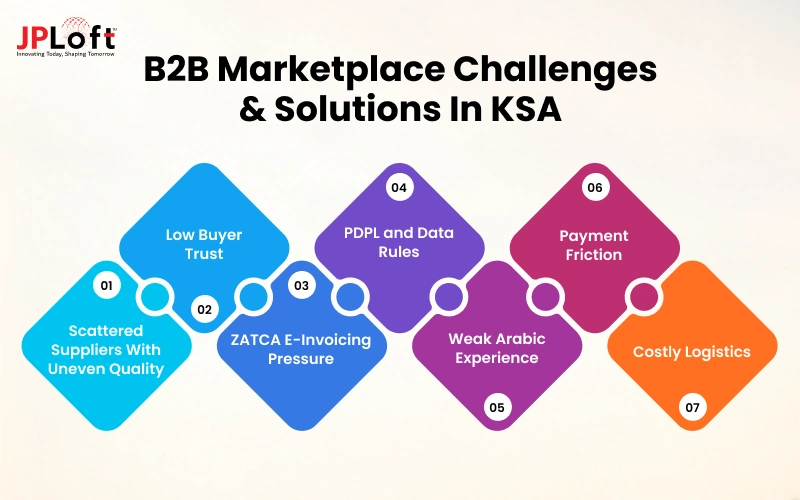
Every B2B marketplace development Saudi Arabia project hits a few roadblocks. The good news is that each one has a fix.
Here are 7 common challenges and how to beat them:
1. Scattered Suppliers With Uneven Quality
Challenge: Saudi B2B retail still deals with scattered suppliers and uneven service levels. Buyers will walk away after one poor delivery.
Solution: Verify every seller with their commercial registration. Add a quality score based on delivery time and order accuracy. Remove weak sellers fast.
2. Low Buyer Trust
Challenge: B2B orders carry high values, so one bad deal can damage a supplier’s name. A new platform has no track record yet. Buyers stay careful.
Solution: Show verified badges and real reviews. Hold payments in escrow until delivery is confirmed. Add a clear dispute process.
3. ZATCA E-Invoicing Pressure
Challenge: Phase 2 means your system must connect with the Fatoora platform and use the ZATCA format. The waves keep widening as the turnover limit drops. A late fix gets costly.
Solution: Build Fatoora integration into the core from day one. Auto-generate invoices with QR codes and VAT fields. Hire a team that has done it before.
4. PDPL and Data Rules
Challenge: The PDPL has been fully enforced since September 2024. It requires user consent and breach notification. It also limits how personal data is stored and moved.
Solution: Host your platform on a Saudi-based cloud. Add simple consent tools. Keep a breach response plan ready. Collect only the data you need.
5. Weak Arabic Experience
Challenge: A fully localized Arabic experience is a must for trust in KSA. Half-translated screens and broken RTL layouts push buyers away.
Solution: Design Arabic first. Mirror menus and tables fully. Test with native Arabic users. Keep a one-tap language switch.
6. Payment Friction
Challenge: Payment inefficiencies are a long-standing problem in Saudi B2B trade. Large orders need more than a basic card checkout.
Solution: Support Mada and bank transfers. Add SADAD bills. Use a SAMA-licensed gateway. Offer milestone payments for big deals.
7. Costly Logistics
Challenge: Shipping in Saudi B2B trade is costly and inefficient. Late deliveries hurt both the seller and your platform.
Solution: Partner with warehouse and 3PL providers. Launch in Riyadh first. Add live order tracking. Show sellers their delivery scores.
How to Choose the Right B2B Marketplace App Development Saudi Arabia?
Choosing the right development partner is essential for building a successful B2B marketplace. You should look for a company with experience in multi-vendor platforms, supplier management, bulk ordering, payment integrations, and custom business workflows.
A reliable mobile app development company in Saudi Arabia should also understand local market needs, including Arabic language support, VAT requirements, and regional payment gateways.
Check its technical expertise, communication process, project delivery approach, and post-launch support before making a decision.
JPLoft brings 16+ years of experience and 1,250+ projects across industries. Our team builds custom marketplace solutions with features that match your business goals and operational requirements.
Ready to bring your idea to life? Partner with JPLoft to build your B2B marketplace.
Conclusion
Saudi Arabia is a strong place to launch a digital wholesale platform. The demand is real, and the market is growing fast.
But success depends on smart planning. Pick a clear niche first. Choose the right model. Sort out your licenses early. Build ZATCA e-invoicing and local payments into the core. Design for Arabic and English from day one.
Keep your budget realistic too. Most platforms fall between SAR 50,000 and SAR 330,000+.
You can start with an MVP, learn from real buyers and suppliers. Then, scale step by step.
With the right plan and the right partner, b2b marketplace development Saudi Arabia can become a steady and profitable growth channel for your business.
The time to begin is now.
FAQs
Most platforms cost between SAR 50,000 and SAR 330,000+. That is about $13,000 to $88,000+. An MVP sits at the lower end. ZATCA setup and payment integration will add to your budget.
An MVP usually takes 3 to 4 months. A mid-level platform needs 5 to 10 months. Enterprise builds can go beyond 10 months. More features mean more time.
Yes. You need a Saudi commercial registration. Your e-commerce site must also be registered with the Ministry of Commerce. Foreign founders need a MISA license as well.
Yes. Phase 2 connects your invoicing system with the Fatoora platform. It rolls out in waves, and the net keeps widening. So build it into the core from day one. Late fixes cost more.
Start with Mada and Apple Pay. Add STC Pay and SADAD too. B2B buyers also like bank transfers. Use a SAMA-licensed gateway and offer milestone payments for big orders.

Priyanka Sukhwal is the Managing Director and Business Head of JPLoft, with 10+ years of experience in technology, digital product strategy, and business growth. She has worked closely with businesses building mobile applications, custom software, marketplaces, and on-demand platforms across mobility, automotive, consumer services, and startup ecosystems. At JPLoft, she focuses on understanding business models, identifying product opportunities, and helping companies plan digital solutions that can scale with changing market needs.




Share this blog