


Key Takeaways
AI helps salons improve customer experiences through personalization, automation, smarter decision-making, and operational efficiency across services.
Features such as virtual consultations, intelligent scheduling, and predictive analytics help salons deliver more value consistently.
Real-world salon platforms already use AI to streamline operations, enhance engagement, and support sustainable business growth.
Successful AI integration requires clear goals, quality data, suitable technologies, and continuous optimization after deployment.
AI implementation costs vary based on feature complexity, customization requirements, scalability needs, and development expertise involved.
Partnering with JPLoft helps salon businesses transform app ideas into scalable AI-powered solutions tailored for long-term success and growth.
Finding the right stylist, booking appointments, and getting personalized beauty recommendations can still feel time-consuming. Many salons also struggle with missed appointments, uneven schedules, and customer retention. This is where AI in salon app solutions is changing the experience for both businesses and customers.
The shift is happening at the right time. According to Grand View Research, the global spa and salon software market is expected to reach USD 3.8 billion by 2033. This growth is driven by increasing demand for automation, personalized experiences, and digital booking tools.
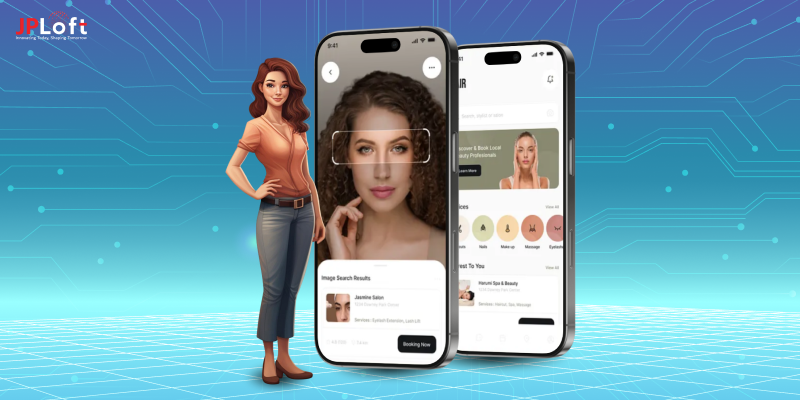
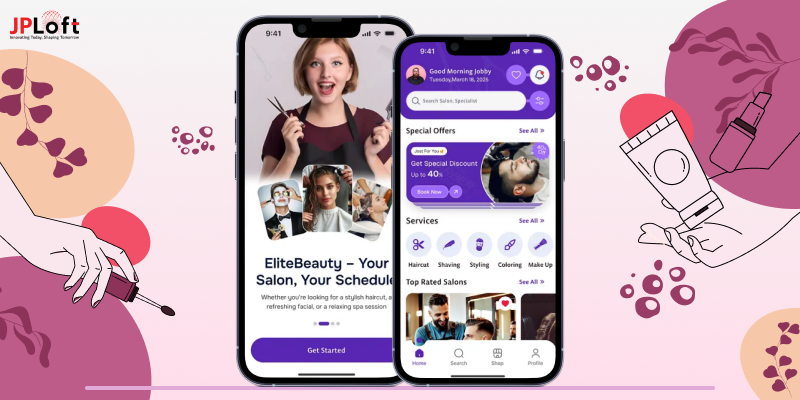
As customer expectations continue to rise, salons are turning to intelligent technologies to stay competitive. A modern AI salon app can automate bookings, recommend services, predict customer preferences, and improve daily operations.
In this guide, we will explore the top AI features, real-world use cases, business benefits, integration process, and the cost of bringing AI into salon applications.
Key Benefits of AI in Salon Apps
AI helps salons deliver faster services, better personalization, and smoother daily operations. It also supports business growth by improving customer satisfaction and reducing manual work.
Below are the key benefits that make AI a valuable addition to modern salon applications.
1. Personalized Customer Experiences
AI studies customer preferences, booking history, and service choices over time. It can suggest suitable hairstyles, treatments, and beauty packages automatically.
This level of personalization helps customers feel understood and valued. As a result, salons often see stronger loyalty, higher engagement, and increased repeat appointments from existing clients.
2. Smarter Appointment Management
Managing appointments manually can create scheduling conflicts and missed opportunities. AI helps optimize booking slots based on staff availability and customer behavior.
It can also send reminders automatically. Businesses exploring why your business needs a salon app often consider AI scheduling a major advantage for improving efficiency and reducing no-shows.
3. Better Customer Retention
Retaining customers is often more cost-effective than acquiring new ones. AI can identify customers who have not booked recently and trigger targeted offers.
It also predicts future service needs based on previous visits. These insights help salons build stronger relationships while encouraging customers to return more frequently.
4. Data-Driven Business Decisions
Salon owners generate large amounts of customer and operational data daily. An effective AI in salon app can analyze this information and uncover useful patterns.
Similar to many best salon apps, AI-powered platforms help businesses understand demand trends, popular services, and customer spending behavior to support smarter decisions.
5. Increased Revenue Opportunities
AI can recommend premium services, product bundles, and personalized promotions during customer interactions. These recommendations feel relevant rather than intrusive.
Salons can increase average order value while improving customer satisfaction. Businesses planning to build an AI salon app often prioritize these revenue-driving capabilities because of their direct business impact.
6. Future-Ready Competitive Advantage
Customer expectations continue to evolve with technology. Many of the emerging top salon app trends focus on automation, personalization, and predictive intelligence.
AI helps salons stay ahead of competitors by delivering modern experiences that customers increasingly expect. This makes the business more adaptable and prepared for long-term growth.
Top AI Features Transforming Salon Apps
AI is helping salons move beyond simple booking and management tools. Modern applications now use intelligent features to improve customer experiences, automate operations, and support business growth.
Below are the top AI-powered features transforming salon apps and helping businesses deliver smarter, more personalized services.
A. AI-Powered Appointment Scheduling
AI scheduling systems analyze booking patterns, staff availability, and peak hours automatically. They recommend suitable appointment slots while reducing scheduling conflicts.
Customers enjoy a smoother booking experience, while salons improve resource utilization.
This feature also minimizes no-shows through automated reminders and intelligent rescheduling suggestions when needed.
B. Virtual Hairstyle and Beauty Try-On
This feature uses augmented reality and AI to preview hairstyles, hair colors, and beauty treatments. Customers can visualize results before making decisions.
It reduces uncertainty and increases booking confidence. Many businesses consider such capabilities among the best salon app features because they improve engagement and support informed purchasing decisions.
C. AI Skin and Hair Analysis
AI evaluates customer photos to identify hair texture, scalp conditions, and beauty concerns. It provides personalized treatment suggestions before appointments.
This helps customers make better choices while improving consultation accuracy. Salons can offer more relevant services and recommendations based on actual customer needs and conditions.
D. AI Chatbots and Virtual Assistants
AI chatbots provide instant responses to customer questions throughout the day. Businesses exploring how to integrate an AI chatbot into your app often use them for bookings, cancellations, service inquiries, and pricing information.
Customers receive support without delays. This feature reduces staff workload while maintaining service quality, especially during busy business hours and peak appointment periods.
E. AI Stylist Matching Engine
AI matches customers with suitable stylists based on preferences, service history, expertise, and ratings. This improves customer satisfaction by connecting clients with professionals who meet their expectations.
Salons can distribute appointments more effectively while helping customers feel confident about their service choices and outcomes.
F. AI Queue and Wait Time Prediction
Busy salons often struggle with unexpected delays and scheduling disruptions. AI predicts waiting times by analyzing appointment durations and service patterns.
Customers receive more accurate updates before arrival. This improves transparency, reduces frustration, and helps salons manage daily operations with greater efficiency and control.
G. AI Demand Forecasting
AI studies historical booking trends, seasonal patterns, and customer demand. AI in salon app uses this data to predict future service requirements and busy periods.
Businesses can plan staffing levels and promotional campaigns more effectively. These forecasts improve planning accuracy and support better operational decisions.
H. AI-Based Inventory Management
Managing salon inventory manually often leads to shortages or unnecessary purchases. AI forecasts product demand using historical sales and usage data.
This helps maintain optimal stock levels. Businesses investing in advanced salon app design often integrate intelligent inventory management to improve operational efficiency and reduce wastage.
I. Voice-Enabled Booking Assistance
Voice technology allows customers to schedule appointments using natural speech commands. Businesses that create an AI-powered salon app can use this feature to improve accessibility and convenience.
Users can book services quickly without navigating multiple screens. Voice interactions help deliver a more modern and user-friendly experience.
J. Intelligent Marketing Automation
AI analyzes customer behavior and automatically creates personalized promotions. It determines the best timing, audience segments, and communication channels.
Marketing campaigns become more effective because customers receive relevant offers. This improves engagement rates while reducing the effort required for manual campaign management activities.
K. AI-Powered Review and Sentiment Analysis
Customer feedback contains valuable business insights. AI reviews ratings, comments, and survey responses to identify common concerns and positive experiences.
Salon owners gain a clearer understanding of customer satisfaction. An AI powered salon app can transform feedback into actionable recommendations that improve overall service quality.
L. Loyalty and Rewards Personalization
AI makes loyalty programs more engaging by tailoring rewards to individual preferences. Customers receive incentives based on their service history and behavior.
Similar to gamification in salon apps, personalized rewards encourage continued participation. This approach strengthens customer relationships while increasing repeat bookings and long-term brand loyalty.
These are the key AI features salon businesses should integrate into their AI salon app to deliver smarter and more personalized experiences. For seamless implementation, businesses can partner with a reputed AI development company experienced in delivering salon app solutions.
Use Cases of AI in Salon Apps
AI is solving practical challenges across customer service, operations, marketing, and business management. Instead of acting as a standalone feature, it helps salons improve specific processes that directly affect customer satisfaction and business performance.
Below are some real-world use cases showing how salons are applying AI to deliver smarter and more efficient services.
[1] Digital Beauty Consultations Before Booking
Many customers want expert guidance before selecting a service. AI enables virtual consultations by analyzing customer preferences, photos, and beauty concerns.
It helps recommend suitable treatments before appointments. Businesses exploring innovative salon app ideas and learning how to build an AI salon app often use this approach. It improves customer confidence and supports better decision-making before booking.
[2] Automated Follow-Up and Rebooking Campaigns
Salons often lose revenue when customers forget to schedule their next visit. AI identifies ideal follow-up timing based on service history and customer behavior.
It automatically sends reminders, promotions, or rebooking suggestions. This keeps customers engaged while helping businesses maintain a steady flow of repeat appointments.
[3] Multi-Location Salon Performance Management
Managing several salon branches can become difficult without centralized insights. AI compares performance across locations, identifies operational gaps, and highlights growth opportunities.
An AI salon app helps business owners monitor service demand, staff productivity, and customer activity through a single dashboard. This centralized view supports better management and decision-making.
[4] On-Demand Beauty Service Coordination
Mobile beauty services require efficient coordination between customers and professionals. AI helps assign suitable service providers based on location, availability, and expertise.
This improves service delivery and reduces scheduling issues. AI-driven workforce allocation also helps businesses optimize operations and improve resource utilization.
[5] Personalized Membership and Subscription Programs
AI analyzes customer behavior to create tailored membership plans and subscription offers. Instead of providing identical packages, salons can offer benefits aligned with individual preferences.
This increases membership value and customer satisfaction. It also helps businesses strengthen recurring revenue streams through more relevant service packages.
[6] Home Salon Service Optimization
For businesses offering at-home beauty services, AI improves route planning and appointment allocation. It helps reduce travel time while maximizing daily bookings.
This example demonstrates how AI is used in salon apps to improve field operations. Similar capabilities help streamline home service management and improve operational efficiency.
Popular Salon Apps Using AI
Many leading salon platforms use AI to improve customer experiences and streamline business operations. Their success demonstrates how intelligent technologies can support growth, convenience, and service quality.
Businesses exploring how to develop an AI salon application can learn valuable insights from these examples. Below are some popular salon apps using AI across the beauty and wellness industry.
► Fresha
Fresha uses intelligent automation to support appointment management, customer engagement, and business reporting. Businesses researching how to develop a salon app like Fresha often examine its operational capabilities closely.
The platform helps salon owners make informed decisions while simplifying workflows. Its efficiency-focused approach supports growth across multiple locations and service categories.
► Booksy
Many entrepreneurs exploring how to create an app like Booksy look at its customer-focused experience. Booksy leverages smart recommendations and automated communication to simplify bookings.
The platform strengthens customer relationships while reducing administrative effort. Its ability to balance convenience and engagement makes it popular among beauty service businesses.
► StyleSeat
StyleSeat helps beauty professionals attract and manage clients through intelligent business tools. Personalized recommendations improve service discovery and customer satisfaction.
Companies planning to develop an app like Styleseat often study its marketplace-driven approach. Many industry experts consider platforms with similar capabilities among the best AI salon app solutions today.
► Glamsquad
Glamsquad connects customers with beauty professionals through an on-demand service model. The platform focuses on convenience, efficient scheduling, and service accessibility.
Businesses aiming to develop an app like Glamsquad frequently analyze its mobile-first strategy. An AI powered salon app can adopt similar concepts to improve service coordination and customer experiences.
How to Integrate AI in a Salon App?
Integrating AI into a salon app requires careful planning, data preparation, and technology selection. A structured approach helps businesses implement useful AI capabilities while ensuring scalability, performance, and long-term value.
Below are the key steps businesses should follow to successfully integrate AI into a salon application.
[A] Define Business Goals and AI Requirements
Businesses exploring how to build an AI salon app should start by identifying the problems AI needs to solve within the application. Focus on measurable objectives such as improving bookings, customer engagement, operational efficiency, or service recommendations.
Clear goals help determine suitable AI capabilities while preventing unnecessary development efforts and keeping project requirements aligned with business expectations.
[B] Gather and Organize Relevant Data
AI systems depend on quality data for accurate performance and reliable outputs. Collect customer interactions, booking records, service preferences, inventory details, and operational information.
Businesses planning to create a salon app should establish proper data collection processes early to support future AI functionality and model training.
[C] Select the Right AI Technologies
AI salon application development requires choosing AI models and tools based on project requirements rather than trends. Different use cases may require machine learning, computer vision, predictive analytics, or natural language processing.
Selecting appropriate technologies helps improve performance, reduce complexity, and support long-term scalability requirements effectively.
[D] Build a Strong Technical Foundation
Before integrating AI, ensure the application architecture can support advanced functionality. The chosen salon app tech stack should handle data processing, API integrations, security requirements, and future updates.
A reliable technical foundation improves system stability while supporting seamless AI deployment and application performance over time.
[E] Train, Test, and Optimize AI Models
Businesses looking to build an AI app must ensure AI models undergo continuous training and validation before deployment. Test outputs using real-world scenarios and monitor performance carefully.
Regular optimization using updated data helps improve model effectiveness over time. This process improves prediction accuracy, reliability, and overall user experience across different customer interactions.
[F] Deploy and Continuously Improve the Solution
After testing, integrate AI features into the live application environment. Monitor performance, collect feedback, and track business outcomes consistently. Many businesses also partner with an app development agency in Canada for ongoing support and optimization.
Companies learning how to develop an AI salon application should treat AI as an evolving capability. Continuous improvements help maintain relevance while adapting to changing customer expectations and needs.
What is the Cost to Integrate AI in a Salon App?
The cost to integrate AI into a salon app typically ranges from $15,000 to $100,000+, depending on feature complexity, customization needs, and development requirements.
At the lower end, businesses can implement features such as appointment automation and AI chat support. Mid-range budgets support personalization and customer insights.
Higher investments are usually required for advanced capabilities like virtual consultations, predictive analytics, and computer vision.
Businesses pursuing custom AI salon app development often adopt a phased approach to control costs while expanding functionality over time.
Factors Affecting AI Integration Costs in a Salon App
Here are the key factors which affect the cost to integrate AI in a salon app.
► AI Feature Complexity: Features such as predictive analytics and virtual consultations require additional development, testing, and training efforts.
► Development Approach: AI integration cost varies based on whether businesses use third-party AI tools or custom solutions.
► Team Expertise: Companies that hire AI developers gain specialized skills for AI integration, model optimization, and performance improvements.
► Scalability Requirements: Infrastructure, future upgrades, and growing user demand can increase overall implementation and maintenance costs.
Understanding how to create an AI-powered salon app involves balancing business goals, AI requirements, and budget expectations. Many businesses start with essential AI features and expand capabilities as customer demand grows.
Challenges in AI Salon App Development
AI can improve salon applications significantly, but implementation comes with several technical and operational hurdles. Businesses must address these challenges carefully to ensure performance, reliability, and long-term success.
Below are the common challenges businesses face when developing AI-powered salon applications and the practical ways to overcome them.
Challenge 1: Data Quality and Availability
AI models depend on accurate customer, booking, and service data. Incomplete records, inconsistent formats, and limited historical information often reduce prediction accuracy and affect overall application performance significantly.
Solution: Hire dedicated developers to establish structured data collection processes and maintain data quality. Regular dataset cleaning improves model accuracy and long-term reliability.
Challenge 2: AI Integration Complexity
Integrating AI with booking systems, payment gateways, customer databases, and third-party tools can create technical complications. This remains among common salon app development challenges, often increasing implementation timelines and development effort for businesses.
Solution: Use scalable architectures and experienced development teams to simplify integrations and reduce implementation risks effectively.
Challenge 3: Security and Privacy Risks
Customer profiles, payment information, and behavioral data require strong protection. Businesses researching how to secure a salon app often discover that AI integrations introduce additional data management and compliance responsibilities.
Solution: Implement encryption, access controls, and secure APIs while following relevant privacy regulations and security standards.
Challenge 4: User Adoption and Trust
Customers may hesitate to rely on AI-generated recommendations without understanding how decisions are made. This uncertainty explains part of why salon app startups fail when user trust and transparency receive insufficient attention.
Solution: Provide clear explanations, maintain transparency, and allow users to make final service-related decisions independently.
Challenge 5: Managing AI Bias and Inconsistent Results
An AI salon app may generate inconsistent recommendations when training data lacks diversity. Biased outputs can affect customer experiences, reduce confidence, and create service suggestions that fail to meet individual expectations effectively.
Solution: Conduct regular salon app testing and follow a structured salon app maintenance process to improve accuracy continuously.
How JPLoft Can Help Build AI-Powered Salon Apps?
Building an AI-powered salon app requires the right technology, industry expertise, and development approach. JPLoft delivers end-to-end salon app development services tailored to modern business requirements and customer expectations.
Our team helps businesses design, develop, and scale intelligent salon applications with features that improve user experiences and operational efficiency. From strategy and UI/UX design to deployment and support, we manage every stage of the development process carefully.
With extensive experience in AI salon application development, we create solutions that align with your business goals and growth plans. Whether you need appointment automation, virtual consultations, predictive analytics, or personalized customer experiences, our experts can deliver reliable results.
If you are exploring custom AI salon app development, JPLoft can help transform your vision into a scalable and future-ready digital product.
Conclusion
Artificial intelligence is reshaping how salons attract, serve, and retain customers. From personalized consultations to smarter business operations, AI helps salons deliver better experiences while improving efficiency.
The growing adoption of AI in salon app solutions shows that intelligent technologies are becoming a competitive necessity rather than an optional upgrade.
Businesses that invest in the right AI capabilities can streamline workflows, improve customer engagement, and support long-term growth.
However, successful implementation requires careful planning, quality data, and a clear development strategy.
Understanding the benefits, features, costs, and challenges discussed in this guide can help businesses make informed decisions.
As customer expectations continue evolving, AI-powered salon applications will play an increasingly important role in shaping the future of the beauty industry.
FAQs
AI helps deliver personalized experiences by analyzing customer preferences, service history, and behavior. It can recommend suitable services, simplify bookings, provide virtual consultations, and improve communication. These capabilities help salons increase customer satisfaction while creating more convenient and engaging user experiences.
Some of the most valuable features include intelligent appointment scheduling, virtual beauty consultations, AI chatbots, customer analytics, inventory management, and personalized recommendations. The right feature combination depends on business goals, customer expectations, and the type of salon services being offered.
AI integration costs generally range from $15,000 to $100,000 or more. The final cost depends on feature complexity, customization requirements, development approach, and scalability needs. Advanced AI capabilities usually require higher investments than basic automation and customer support features.
Businesses should evaluate data quality, security requirements, integration complexity, and user adoption concerns. AI systems also require continuous monitoring and updates after deployment. Addressing these factors early helps reduce implementation risks and improves the chances of long-term project success.
The timeline depends on project scope and feature requirements. Basic AI integrations may take several weeks, while advanced implementations can require several months. Factors such as customization, testing, data preparation, and third-party integrations significantly influence the overall development schedule.

Rahul Sukhwal is the CEO and Founder of JPLoft, a visionary technologist with 18+ years at the forefront of emerging tech innovation and software engineering. He channels deep software engineering and AI expertise into building smarter, scalable solutions that shape how forward-thinking businesses worldwide harness the true power of AI.



Share this blog