


Key Takeaways
Successful implementation of AI agents for cybersecurity in your platform requires clear use cases, reliable data, controlled permissions, security guardrails, testing, human oversight, and continuous monitoring.
AI agents monitor threats, analyze security data, investigate incidents, and support faster responses across complex cybersecurity environments.
AI agents support threat detection, investigation, phishing analysis, threat intelligence, incident response, vulnerability management, and compliance monitoring.
AI agents provide adaptive, context-aware analysis, while traditional automation follows predefined rules for predictable and repetitive security tasks.
Challenges of implementing AI agents include data privacy, false positives, integration complexity, unauthorized actions, and adversarial attacks.
JPLoft is an expert in dealing with scalable AI agents for security systems while supporting threat detection, investigation, response, testing, and deployment.
Imagine a cyberattack unfolding in seconds, and your security team has only moments to detect it, understand it, and respond!
As cyber threats get faster and more sophisticated, cybersecurity teams can no longer rely on traditional security tools alone to manage and respond to attacks. AI agents in cybersecurity offer a practical way to automate security tasks, analyze suspicious activity, and support faster incident response.
Unlike basic automation, AI agents can assess context, connect information from multiple sources, and perform multi-step workflows within defined permissions. According to an ISC2 2025 survey, 30% of cybersecurity professionals said their teams had integrated AI security tools.
What Are AI Agents in Cybersecurity?
AI agents in cybersecurity are intelligent software systems that monitor security environments, analyze data, identify potential threats, and recommend or take action. Unlike traditional tools that mainly generate alerts, they can investigate incidents and support multiple stages of security operations.
By examining network activity, user behavior, system logs, and security alerts, these agents help teams identify suspicious patterns and respond efficiently.
AI agents in cybersecurity typically include:
-
Threat Detection: Identifying suspicious activities and potential attacks.
-
Automated Investigation: Analyzing alerts and connecting related security events.
-
Risk Assessment: Evaluating threats and prioritizing incidents.
-
Incident Response: Recommending or executing predefined security actions.
-
Continuous Monitoring: Tracking system activity to identify emerging risks.
This highlights growing interest in AI-driven security and the importance of knowing what is an agent in cybersecurity and its working.
In this blog, we will explore top real-world cases, benefits, challenges, integration steps, and the future of AI-powered cybersecurity.
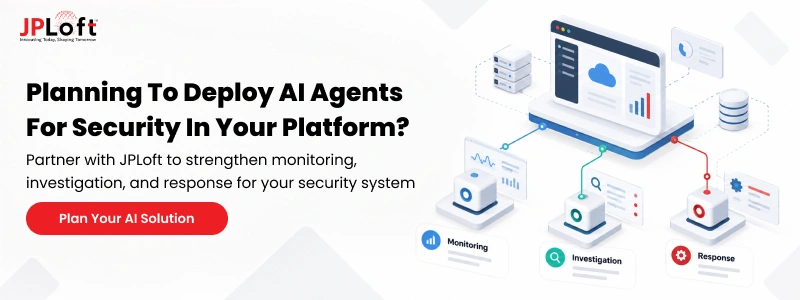
How Do AI Agents Work in Cybersecurity?
AI agents follow a continuous process to detect, analyze, and respond to potential security threats:
-
Collect Data: Gather data from network traffic, system logs, endpoints, applications, and security tools.
-
Analyze Activity: Examine collected data to identify unusual patterns, suspicious behavior, or potential vulnerabilities.
-
Detect Threats: Compare findings with threat intelligence, security rules, and behavioral patterns to identify risks.
-
Investigate Incidents: Connect related events and analyze their context to determine the nature and severity of threats.
-
Make Decisions: Assess risks and recommend the most suitable response based on security policies.
-
Take Action: Isolate devices, block suspicious activity, disable compromised accounts, or alert security teams.
-
Learn and Improve: Use new security data and feedback to improve future threat detection and response.
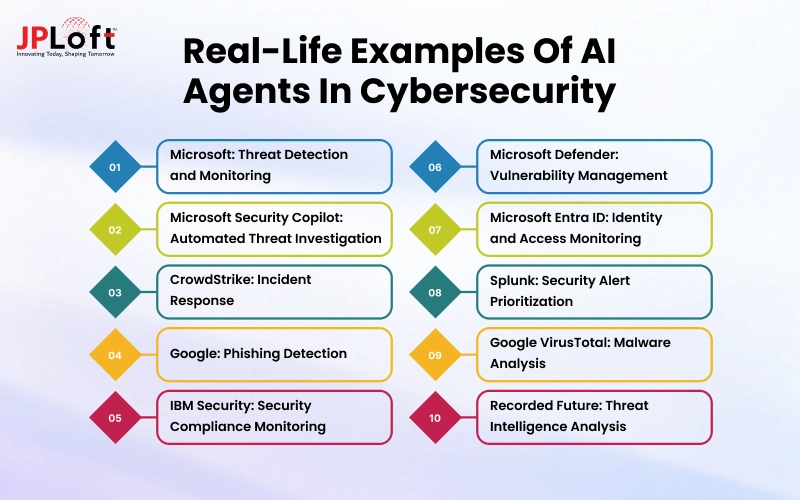
Real-Life Cases of AI Agents in Cybersecurity
Real-world applications show how AI-powered security tools help businesses address cyber threats more effectively. From detecting suspicious activity to investigating incidents and prioritizing risks, these examples demonstrate how organizations can support faster, informed decisions.
1. Threat Detection and Monitoring
Microsoft uses AI-powered security capabilities across its security products to analyze large volumes of signals and identify suspicious activity.
AI can help detect unusual login behavior, compromised devices, and potential attacks before they become larger incidents.
2. Automated Threat Investigation
Microsoft Security Copilot can help security analysts investigate alerts, summarize incidents, and connect information across security signals.
This reduces the manual effort required to understand complex incidents and helps analysts gather relevant context faster and make informed decisions.
3. Incident Response
CrowdStrike uses AI capabilities to help security teams investigate threats and respond to attacks. Automated security actions can help contain compromised endpoints and limit an attack's spread.
These capabilities can reduce response delays and help security teams manage incidents more efficiently.
4. Phishing Detection
Google uses AI and machine learning in Gmail to detect phishing, malware, and spam. These systems analyze email characteristics and suspicious patterns to keep malicious messages out of users' inboxes.
5. Security Compliance Monitoring
IBM Security tools can help organizations monitor security controls, identify risks, and support compliance activities. AI agents for cybersecurity can help teams identify areas that may require attention.
Automated monitoring can also help organizations detect control gaps and address potential compliance issues before audits.
6. Vulnerability Management
Microsoft Defender Vulnerability Management uses automated analysis to identify vulnerabilities across an organization's environment and help security teams prioritize which issues require attention first.
This enables teams to focus on high-risk weaknesses and plan remediation based on potential business impact.
7. Identity and Access Monitoring
Microsoft Entra ID uses machine learning-based risk detection to identify suspicious sign-ins, such as unfamiliar locations, unusual devices, or abnormal authentication behavior.
Security teams can use these risk signals to investigate or restrict access.
8. Security Alert Prioritization
Security platforms such as Splunk use AI and machine learning to analyze and correlate security events. This can help analysts distinguish potentially serious incidents from large volumes of routine alerts.
By connecting related events and highlighting suspicious patterns, these tools help security teams focus on higher-priority risks.
9. Malware Analysis
Google VirusTotal uses automated analysis to examine suspicious files, URLs, domains, and other security indicators.
Security professionals can use these results to investigate potentially malicious content.
10. Threat Intelligence Analysis
Recorded Future uses AI and machine learning to analyze large amounts of threat intelligence and identify relevant risks, threat actors, vulnerabilities, and indicators.
Security teams can use these insights to improve their defensive strategies.
Benefits of AI Agents in Cybersecurity
AI agents can help organizations strengthen their security operations by automating repetitive tasks, analyzing large amounts of data, and supporting faster decision-making.
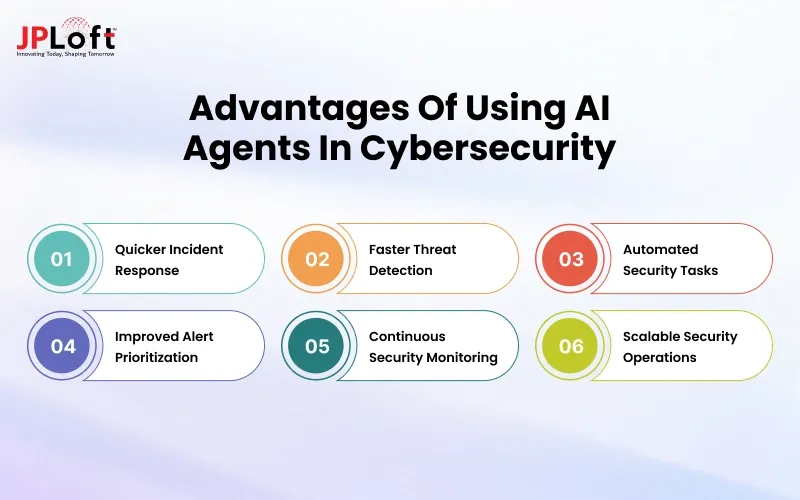
Some of the key benefits of using AI agents in cybersecurity for your platform are:
1. Quick Detection of Threats
AI agents can continuously monitor security data and identify suspicious patterns in real time.
This can help security teams detect potential threats earlier and reduce the time between an attack and its identification.
2. Faster Response to the Incident
When a threat is identified, AI agents can investigate the event and recommend or perform predefined response actions.
Top AI apps generate faster responses, helping limit the potential impact of security incidents.
3. Automates Tasks Related to Security
AI agents can handle repetitive activities such as reviewing alerts, analyzing logs, gathering threat intelligence, and checking security events.
This reduces manual workload and allows security professionals to focus on higher-value tasks.
4. Improved Alert Prioritization
Security teams often handle a large volume of alerts. AI agent security and compliance features can analyze and correlate related events.
This helps in identifying which alerts are more likely to represent serious threats, helping analysts focus their attention where it matters most.
5. Continuous Security Monitoring
Not every security alert represents a serious threat. AI agents can assess alerts based on risk, activity patterns, and available mobile app security data.
This helps teams focus their attention on incidents that need immediate action.
6. Scalable Security Operations
As organizations add users, applications, devices, and data, security monitoring becomes more complex.
AI agents can process large volumes of security information, helping teams manage growing environments more effectively.
AI Agents vs. Traditional Cybersecurity Automation
Traditional cybersecurity automation and AI agents both help reduce manual security work, but they operate differently.
Traditional automation mainly follows predefined rules and workflows, while Agentic AI use cases for cybersecurity can analyze content, adapt to changing situations, and support multi-step security tasks.
The following table shows the difference between an AI agent and traditional cybersecurity automation:
|
Factor |
Traditional Cybersecurity Automation |
AI Agents |
|
Decision-making |
Follows predefined rules and conditions |
Analyzes context and can make informed decisions |
|
Threat analysis |
Uses configured rules and signatures |
Correlates data and identifies patterns across sources |
|
Response |
Executes predefined actions |
Can select or recommend actions based on the situation |
|
Adaptability |
Requires manual rule updates |
Can handle new or changing scenarios with less rigid workflows |
|
Investigation |
Performs specific automated checks |
Can conduct multi-step investigations across security data |
|
Human involvement |
Often needed when conditions fall outside predefined rules |
Can reduce involvement in routine investigations and responses |
|
Complex tasks |
Best suited to predictable, repetitive processes |
Better suited to dynamic and multi-step security workflows |
AI agents do not necessarily replace traditional automation.
Organizations can combine both approaches, using traditional automation for predictable tasks and AI agents for situations that require analysis, content, and adaptive decision-making.
How to Implement AI Agents in Cybersecurity?
Implementing AI agents in cybersecurity requires careful planning, secure integrations, and clear boundaries for automated actions.
Organizations should not treat AI agents as standalone tools. Instead, connect them with existing security systems and respond to threats effectively.
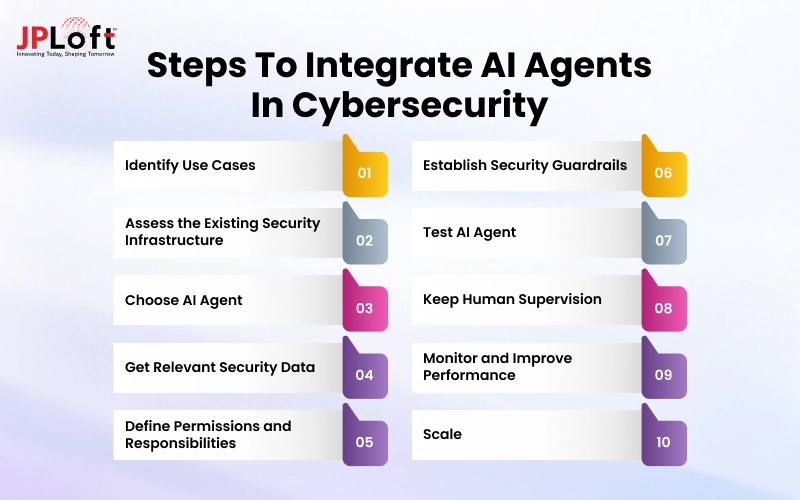
This structured implementation process of AI agents for cybersecurity compliance auditing automation can help organizations maintain control over sensitive data and critical security operations:
Step 1. Identify the Right Security Use Cases
Start by identifying cybersecurity tasks where AI agents can provide the most value.
Look for repetitive processes when you build an AI app that require analyzing large amounts of information or responding to frequent security events.
Common use cases include alert investigation, phishing detection, threat intelligence analysis, vulnerability prioritization, and incident response.
Begin with one or two well-defined use cases instead of deploying AI agents across the entire security environment at once.
Step 2. Assess the Existing Security Infrastructure
Identify the AI agent security and compliance features needed, such as SIEM platforms, endpoint security tools, identity management systems, firewalls, threat intelligence platforms, and ticketing systems.
Review your current cybersecurity tools, workflows, and data sources before introducing an AI agent.
This assessment helps identify integration requirements for AI business ideas and prevents unnecessary changes to existing security operations.
Step 3. Choose the Right AI Agent
Select an AI agent based on the security tasks it needs to perform. Evaluate its ability to analyze security data, understand context, integrate with existing tools, and handle multi-step workflows.
Organizations should also consider data privacy, access controls, audit capabilities, scalability, and response accuracy.
The right solution should fit the organization's security requirements rather than simply offering the most advanced AI capabilities.
Step 4. Connect Relevant Security Data
AI in cybersecurity needs reliable data to investigate incidents and identify potential threats.
Connect approved data sources such as system logs, endpoint events, network activity, authentication records, threat intelligence feeds, and security alerts.
Data access should follow the principle of least privilege. The agent should only receive the information required for its assigned tasks. Sensitive information should also be protected during storage, transmission, and processing.
Step 5. Define Agent Permissions and Responsibilities
Clearly define what the AI agent can access and which actions it can perform.
For example, an agent may be allowed to investigate suspicious login activity but require human approval before disabling a user account.
Use role-based access controls and separate low-risk actions from high-impact actions. This limits the potential damage if an agent makes an incorrect decision or encounters unexpected behavior.
Step 6. Establish Security Guardrails
Guardrails help control how AI agents operate within the cybersecurity environment. Define rules for data access, decision-making, escalation, and automated responses.
For example, an agent could automatically categorize a low-risk alert but require approval before isolating a production server. Maintain detailed logs of the agent's investigations, recommendations, and actions so security teams can review what happened.
Step 7. Test the AI Agent Before Deployment
Testing should take place in a controlled environment before the agent receives access to production systems. Use realistic security scenarios to evaluate how it detects threats, investigates alerts, follows policies, and responds to different situations.
Measure important factors such as detection accuracy, false positives, response time, and the quality of recommendations. App testing with an AI agent can also reveal integration problems or situations where human intervention is necessary.
Step 8. Keep Human Oversight in the Early Stages
Human oversight is important when introducing AI agents into critical security operations. Initially, allow the agent to analyze incidents and recommend actions while cybersecurity professionals review important decisions.
Once the agent demonstrates consistent performance, organizations can gradually automate selected low-risk actions. High-impact decisions should continue to include appropriate human review.
Step 9. Monitor and Improve Performance
After deployment, continuously monitor how the AI agent performs and keep track of top AI trends. Track alert accuracy, investigation time, response outcomes, false positives, failed actions, and escalation frequency.
Security teams should regularly review these results and update the agent's instructions, permissions, integrations, and workflows. Ongoing monitoring also helps identify changes in the threat environment that may require adjustments.
Step 10. Scale Across Security Operations
Once an AI agent performs reliably in an initial use case, organizations can expand its role across other security workflows. It can be connected with SIEM, SOAR, endpoint, identity, vulnerability management, and threat intelligence systems.
A gradual approach allows organizations to build trust, improve security processes, and expand automation without giving an AI agent unnecessary control over critical systems.
Challenges of Implementing AI Agents in Cybersecurity
AI agents can improve threat detection and security operations, but implementing them also introduces technical, operational, and security challenges.
Organizations need to address these concerns before giving AI agents access to sensitive systems or allowing them to perform automated actions.
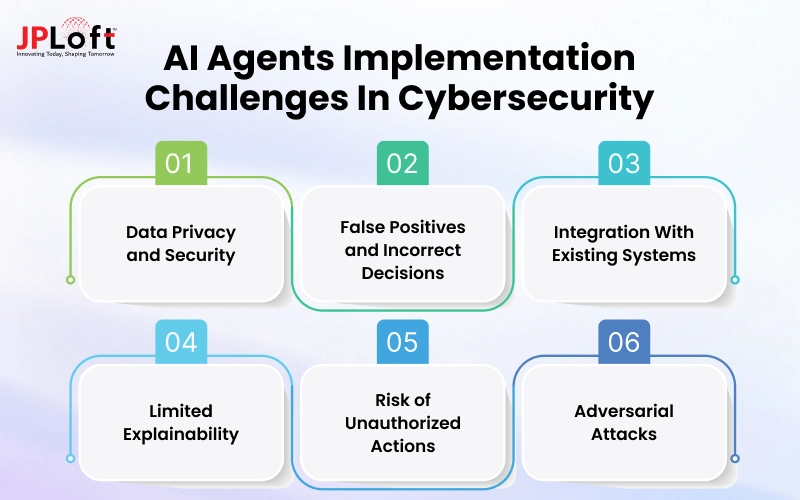
Here are the most common challenges a business can come across while integrating AI agents for cybersecurity into their platform:
Challenge 1. Data Privacy and Security
AI agents may process sensitive security logs, user information, credentials, and business data. Improper access controls or weak data handling can expose confidential information and create additional cybersecurity risks.
Solution: Use encryption, strict access controls, data minimization, and clear governance policies to protect sensitive information throughout AI agent operations.
Challenge 2. False Positives and Incorrect Decisions
AI agents can misinterpret legitimate activity as malicious or overlook certain threats. Incorrect decisions may create unnecessary alerts, disrupt users, or cause security teams to respond to harmless events.
Solution: Continuously test agents, monitor accuracy, refine detection rules, and maintain human oversight for important security decisions.
Challenge 3. Integration With Existing Systems
Organizations often use multiple security platforms, legacy systems, and disconnected tools. Integrating AI agents with these environments can require significant technical work, custom APIs, and careful data synchronization.
Solution: Use standardized APIs, phased integration, and compatible security platforms to connect AI agents with existing infrastructure efficiently.
Challenge 4. Limited Explainability
Security professionals need to understand why an AI agent identified an event as suspicious or recommended a specific response.
Limited transparency can reduce trust and make incident verification more difficult.
Solution: Choose explainable AI solutions that provide reasoning, supporting evidence, decision context, and detailed activity logs for security teams.
Challenge 5. Risk of Unauthorized Actions
AI agents with excessive permissions may accidentally modify systems, disable accounts, or trigger inappropriate responses.
Poorly controlled automation can create operational disruptions and introduce new security vulnerabilities.
Solution: Apply least-privilege access, approval workflows, action limits, and monitoring for high-impact activities performed by AI agents.
Challenge 6. Adversarial Attacks
Attackers may target AI agents through malicious inputs, prompt injection, manipulated data, or other techniques designed to influence their decisions and bypass security controls.
Solution: Secure agent inputs, validate data sources, test against adversarial scenarios, and continuously monitor agents for suspicious behavior.
Future of AI Agents in Cybersecurity
As organizations generate more security data and face increasingly complex threats, AI agents for cybersecurity can help security teams respond to threats.
They are changing how organizations approach cybersecurity by moving beyond basic automation toward intelligent, adaptive security operations.
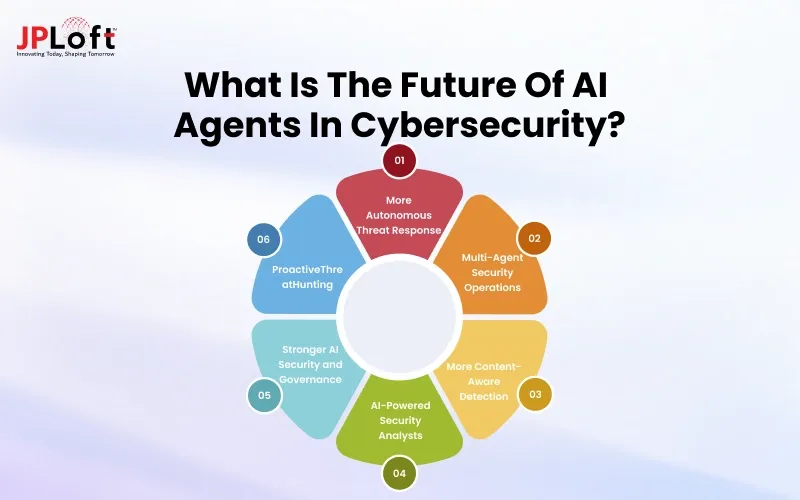
Let’s get to know the future of AI agents in cybersecurity:
1. More Autonomous Threat Response
AI agents are expected to handle more low-risk security actions with limited human intervention. They may detect a threat, investigate its source, assess its severity, and initiate predefined response steps automatically.
2. Multi-Agent Security Operations
Instead of relying on one AI agent for multiple tasks, organizations may use specialized agents that work together.
One agent could monitor threats, another could investigate incidents, while another could manage response workflows.
3. More Content-Aware Detection
The future of AI agents may combine information from identity systems, endpoints, networks, applications, and threat intelligence to understand security events in context.
This can help distinguish genuine threats from normal user activity more accurately.
4. AI-Powered Security Analysts
AI agents may increasingly act as assistants for cybersecurity professionals.
They can summarize incidents, investigate alerts, gather evidence, suggest response actions, and prepare reports, allowing analysts to spend more time on complex security decisions.
5. Stronger AI Security and Governance
As AI agents gain more access and autonomy, organizations will need stronger controls around permissions, monitoring, data privacy, model security, and human oversight.
Security frameworks and governance practices are likely to develop alongside agent-based cybersecurity.
6. Proactive Threat Hunting
Future AI agents may move beyond responding to known alerts and actively search for unusual behavior, hidden vulnerabilities, and indicators of compromise.
This could help security teams identify potential threats before they develop into major incidents.
How Can JPLoft Help Deploy AI Agents for Cybersecurity?
Your cybersecurity team can have the right tools and still struggle when alerts keep growing faster than they can be investigated.
JPLoft is here to fix that gap with experience in implementing AI agents for cybersecurity that support practical cybersecurity needs without adding unnecessary complexity.
Our team works with businesses to identify suitable security use cases, define workflows, and select the right AI technologies for their requirements.
We develop AI agents that can assist with threat detection, security monitoring, alert analysis, incident investigation, and response workflows.
JPLoft, an expert AI agent development company, also focuses on integrating AI agents with existing security systems, data sources, and business applications to create connected security operations.
Security controls, access permissions, human oversight, and testing are considered throughout the development process to help reduce operational risks.
From initial strategy and AI agent development to integration, testing, deployment, and ongoing support, JPLoft helps businesses build scalable AI-powered cybersecurity solutions aligned with their security goals and operational requirements.
Conclusion
AI agents are becoming a valuable part of modern cybersecurity as businesses deal with growing threats, large volumes of security data, and complex digital environments.
They can support threat detection, alert analysis, incident investigation, and automated response while reducing repetitive workloads for security teams.
Successful adoption of AI agent security and compliance features requires careful planning. Businesses must address data privacy, system integration, access permissions, false positives, and human oversight before deploying autonomous security actions.
The future of AI agents will likely bring more proactive threat hunting, multi-agent collaboration, and context-aware security operations.
Businesses that combine AI capabilities with strong security controls can build more responsive and scalable cybersecurity processes.
With the right strategy and implementation partner, AI agents can strengthen security operations while helping teams respond to threats faster and make better-informed security decisions.
FAQs
AI agents in cybersecurity monitor systems, analyze security data, detect threats, investigate incidents, and support automated responses. They help security teams manage complex environments while reducing repetitive manual work.
AI agents can improve threat detection, automate repetitive security tasks, accelerate incident response, prioritize alerts, and enable continuous monitoring. They also help organizations use cybersecurity resources more efficiently and consistently.
Companies using AI agents and AI-powered security capabilities include Microsoft, CrowdStrike, Google, Splunk, IBM, VirusTotal, and Recorded Future. They apply AI across threat detection, investigation, incident response, phishing detection, vulnerability management, monitoring, compliance, and threat intelligence.
Businesses should identify suitable use cases, assess existing infrastructure, select appropriate agents, connect data sources, and establish security controls. Testing, human oversight, monitoring, and gradual scaling should follow successful implementation.
Key challenges include data privacy, false positives, system integration, limited explainability, unauthorized actions, adversarial attacks, costs, and skills shortages. Organizations need strong governance, testing, permissions, and continuous monitoring to manage risks.

Rahul Sukhwal is the CEO and Founder of JPLoft, with 18+ years of experience in software engineering, emerging technologies, and digital product development. His expertise spans artificial intelligence, including AI agents, generative AI, LLMs, chatbots, computer vision, and machine learning, as well as blockchain, IoT, AR/VR, mobile, web, and enterprise software. He focuses on applying these technologies to real business challenges across industries such as healthcare, education, mobility, finance, real estate, and on-demand services.


Share this blog