


Quick Overview:
More and more restaurants now get over 25% of their sales from digital channels. Customers want to order and pay easily, and restaurants that offer this are growing faster. Here is a simple guide to the tools, costs, and steps to get started on your restaurant's digital transformation journey.
For generations, dining out meant visiting restaurants, waiting for a table, and enjoying freshly prepared food.
But customer expectations are changing. Generation Z and Alpha are changing how people interact with restaurants. For them, the experience no longer starts with walking into a restaurant or waiting in line. Their first interaction with a restaurant is increasingly digital.
By connecting online ordering, mobile apps, loyalty programs, and daily operations, restaurants can make ordering easier and encourage repeat purchases.
A reliable restaurant app development company can help restaurant businesses bring these digital experiences together and create more opportunities for repeat sales.
This growing shift toward digital experiences is not happening by chance.
Restaurant businesses are increasingly investing in digital solutions to meet changing customer expectations and improve business performance. The global restaurant digitalization market is projected to reach $49.92 billion by 2035 at a CAGR of 16.6%.
But which digital solutions actually drive sales? How are restaurant brands generating 25%+ of sales through digital channels, and what can your restaurant learn from them?
In this blog, we will explore the concept, benefits, challenges, technologies, costs, and practical strategies that can help restaurant businesses improve sales.
What Is Restaurant Digital Transformation?
Restaurant digital transformation is the process of integrating digital technologies across all restaurant operations. From kitchen management and ordering to payments, inventory, and customer service, this approach improves daily workflows, enhances customer experiences, reduces manual work, and supports better business decisions.
Let’s say two restaurants are managing daily operations:
Restaurant A follows traditional methods: Staff write down dine-in orders, manually enter delivery app orders into the billing system, and inform the kitchen about each order.
The organized chaos of multiple orders, delays, and customers waiting in queues.
Restaurant B modernizes sales through digital transformation: Orders from dine-in customers and delivery apps reach a connected POS system and kitchen display. Staff spend less time entering orders manually, and the kitchen can manage incoming orders more efficiently.
The goal is simple: make daily operations easier, serve customers better, and make smarter business decisions.
How Digital Transformation Is Changing Restaurant Business Models
Digital transformation is changing how restaurants generate revenue, manage daily operations, and make business decisions. Here are some of the ways digital transformation is improving restaurants.
-
Multiple Sales Channels: Stop depending on customers to visit your restaurants. It's time to expand to multiple sales channels through a website, mobile app, or delivery platforms.
-
Connected operations: A digital ordering system can send orders directly to kitchen screens, helping staff manage busy periods and reducing the risk of order mistakes.
-
Informed menu decisions: Identify major sales drivers by analyzing the most-ordered dishes. Instead of guessing, use sales reports to identify the most-ordered dishes, update the menu, and adjust ingredient purchases.
Why Digital Transformation Is No Longer Limited to Large Restaurant Chains
Restaurant digital transformation is no longer limited to major brands; it is becoming a practical business decision for restaurants of all sizes. Here are some of the ways digital transformation is becoming practical for all restaurants.
-
Affordable technology for smaller restaurants: Enabling subscription-based solutions allows growing restaurants to access expensive tools at a lower upfront cost.
-
Easy management without technical support: Update menus, launch offers, and manage promotional pages without depending on developers for every small change.
-
Better ordering and repeat sales: Features like faster checkout, digital payments, and loyalty rewards make ordering easier and encourage customers to return.

How Are Digital Channels Contributing to Restaurant Revenue in 2026?
Digital channels account for a significant share of growing restaurant revenue. Now, restaurants mainly ask which digital platforms are driving the most orders and how much revenue they generate. Understand the important statistics, types of digital channels, and reasons that do not contribute to restaurant profits.
What the Latest Restaurant Digital Sales Data Reveals
-
The global restaurant digitalization market is projected to reach $49.92 billion by 2035 at a CAGR of 16.6%.
-
Digital channels now account for 40% of transactions at leading restaurant chains. Additionally, online ordering and delivery are driving this growth, generating 30% higher order value compared to traditional ordering methods.
-
67% of online customers are more likely to visit restaurants more frequently when digital ordering is available.
-
POS systems account for 44% of the digital restaurant technology market, and quick-service restaurants represent 52% of the market.
Which Digital Channels Are Contributing to Restaurant Revenue?
Restaurants now use different digital channels to reach customers, simplify purchasing, and create additional revenue opportunities. Below are the different digital channels for restaurant businesses.
|
Digital channel |
How it generates restaurant revenue |
|
Restaurant mobile apps |
Allow customers to browse menus, place direct orders, and reorder meals. |
|
Direct online ordering and restaurant websites |
Generate online orders for pickup and delivery without requiring a separate app. |
|
Third-party delivery platforms |
Bring orders from customers using food delivery marketplaces. |
|
Self-service kiosks |
Allow dine-in customers to place and customize orders digitally. |
|
QR code ordering |
Lets customers scan a code, browse menus, and order from their tables. |
Why Are US Restaurants Investing in Digital Transformation?
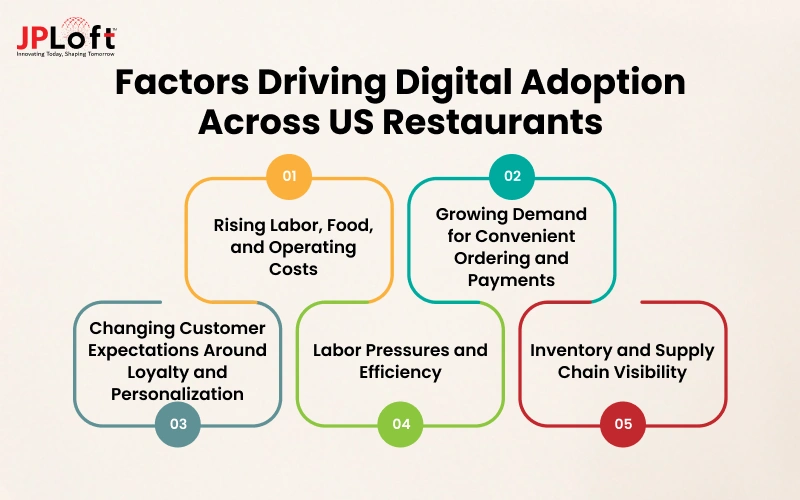
A customer who once ordered at the restaurant counter now uses a kiosk; the transaction is digital, but that doesn’t always mean a restaurant is making a profit. Therefore, US restaurant owners are investing in digital transformation to manage profitability. Here are the quick reasons for investment in restaurant digital transformation.
1. Rising Labor, Food, and Operating Costs
Higher wages, food prices, and day-to-day operating expenses of restaurants can impact profits and break-even points.
Now, smarter businesses are adopting digital tools to check inventory, reduce food waste, and automate routine tasks, such as order taking and supply chain management. This helps businesses control costs and protect profit margins.
2. Growing Demand for Convenient Ordering and Payments
Customers want to place orders without waiting in long queues. Restaurants are investing in digital ordering, self-service kiosks, and mobile payments to meet this demand. These tools help manage more orders during busy hours and make ordering easier for customers.
3. Changing Customer Expectations Around Loyalty and Personalization
Every customer's demand is different from another's, so why should their restaurant experience be? With AI, data analytics, and personalization, each visit feels personalized to individual preferences. Customers feel happy to revisit, especially when restaurant owners provide a hyper-personalized experience.
4. Labor Pressures and Efficiency
Rising labor costs and staff shortages are impacting the profitability of full-service restaurant operations. Adopting digital tools, such as self-service kiosks and AI-driven assistants, can automate repetitive tasks, simplify order management, and reduce manual work. It can help reduce human error and speed up customer service
5. Inventory and Supply Chain Visibility
Poor inventory management can lead to food waste, stock shortages, and higher operating costs. Digital inventory systems help restaurant owners prevent poor inventory controls, track food freshness, monitor supplier deliveries, and manage stock requirements. This improves purchasing decisions and reduces unnecessary expenses.
What Challenges Are Holding Restaurants Back From Digital Growth?
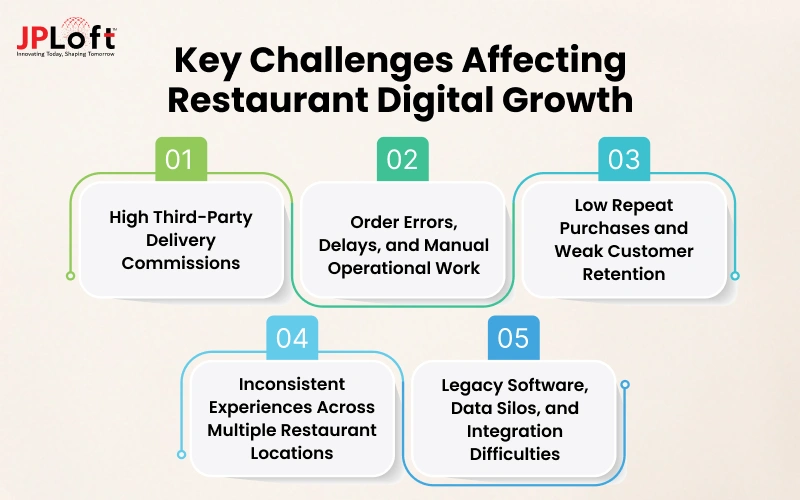
Many restaurants invest in digital tools but still struggle to achieve better business results. Digital transformation comes with its own challenges. Understanding these challenges helps restaurant owners identify operational gaps and find reliable solutions.
Challenge 1: High Third-Party Delivery Commissions
Restaurant businesses pay high third-party delivery charges. For example, DoorDash's commission plan includes 15-30%, Uber Eats takes 20% to 30%, and Grubhub charges 5 to 20% in delivery fees. These fees reduce the revenue restaurants earn from each transaction.
Solution: Restaurants can add a direct ordering system to their websites and reduce reliance on third-party platforms.
Challenge 2: Order Errors, Delays, and Manual Operational Work
Manually transferring online orders to POS and kitchen systems increases errors and delays during busy hours. It also adds pressure on restaurant staff.
Solution: Integrate online ordering platforms with your POS and kitchen display system. Orders can reach the kitchen automatically, helping staff prepare orders more efficiently.
Challenge 3: Low Repeat Purchases and Weak Customer Retention
Without loyalty programs or personalized offers, customers may choose competitors for their next meal. This makes it harder to generate repeat sales.
Solution: Introduce a digital loyalty program that rewards customers for repeat purchases. Offer points, birthday rewards, or discounts, and personalized recommendations to improve user retention.
Challenge 4: Inconsistent Experiences Across Multiple Restaurant Locations
Restaurants with multiple outlets may struggle to maintain consistent menus, prices, and promotions. These differences can confuse customers and affect brand trust.
Solution: Use a centralized management system to update menus, prices, and promotions across locations.
Challenge 5: Legacy Software, Data Silos, and Integration Difficulties
Outdated software may not connect with modern payment, inventory, and ordering tools. This creates data silos and makes business reporting difficult.
Solution: Integrate existing systems through APIs or middleware. Move business information to one platform and upgrade outdated software gradually to avoid disruptions.
How Does Restaurant Digital Transformation Increase Sales and Profitability?
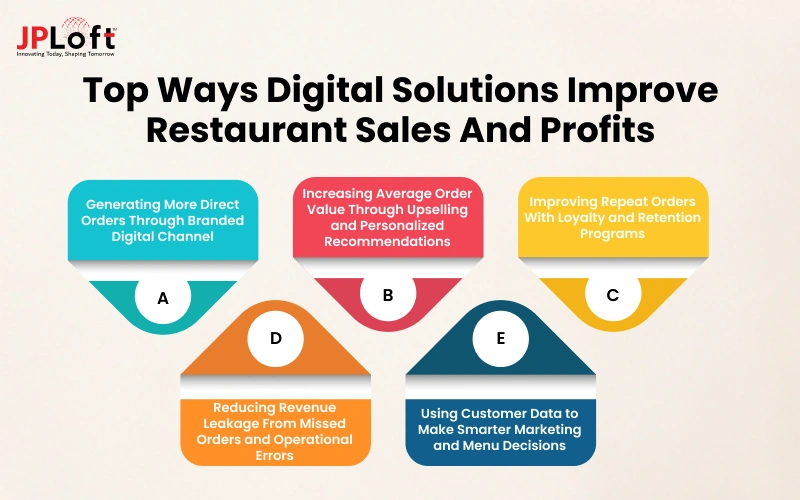
Higher sales do not always mean higher profits. Restaurants need to attract more orders while keeping daily costs under control. Restaurant digital transformation helps achieve both by improving how businesses sell, serve, and manage their operations.
Here are the proven methods for restaurant digital transformation to improve sales and profitability.
[A] Generating More Direct Orders Through Branded Digital Channels
Restaurants can use their own websites and mobile apps to accept orders directly. This reduces dependence on third-party platforms and reduces hefty commission fees, markups, or revenue-sharing cuts.
For example, a restaurant can encourage delivery app customers to place their next order through its website. This helps control the entire user experience, including visually attractive food presentation, pricing strategy, and customer service standards.
[B] Increasing Average Order Value Through Upselling and Personalized Recommendations
Digital ordering systems can suggest relevant add-ons to consumers. A customer ordering a burger might see an option to add fries or upgrade to a meal. These small additions increase the average order value without requiring restaurants to attract more customers.
Another way is personalized recommendations. By analyzing past customer data, it becomes easier to share recommendations with upgraded or premium features.
[C] Improving Repeat Orders With Loyalty and Retention Programs
Loyalty programs give customers a reason to return. Restaurants can offer reward points, exclusive deals, or personalized offers based on previous purchases.
For example, Domino's rewards let customers earn points on eligible orders and redeem them for free menu items. Similarly, Chipotle rewards give customers points on purchases, which they can redeem for food and other rewards.
[D] Reducing Revenue Leakage From Missed Orders and Operational Errors
One of the major challenges of the restaurant business is losing sales through missed orders or operational mishandling.
Therefore, integrating online ordering with the POS and kitchen display system helps orders reach the right team automatically. This reduces manual errors, cancellations, and potential revenue loss.
[E] Using Customer Data to Make Smarter Marketing and Menu Decisions
Sales reports and customer data help restaurant owners understand what people actually order. If a dish receives many views but few purchases, the owner can review its price or menu placement.
These insights also help restaurant businesses create strategic offers instead of spending money on promotions that do not guarantee results.
Which Technologies Are Driving Restaurant Digital Transformation in 2026?
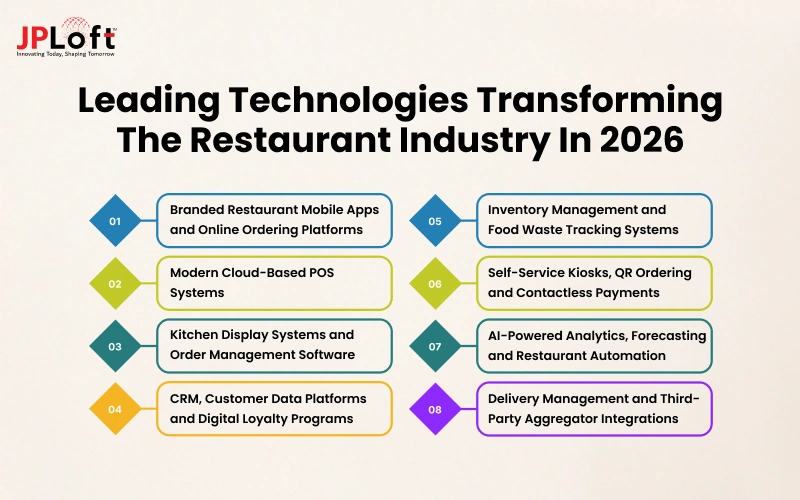
The next step is understanding the right technologies to improve restaurant operations, customer experience, and overall profitability in 2026. It is not just a one-way path; here are the multiple technologies driving digital transformation success.
1. Branded Restaurant Mobile Apps and Online Ordering Platforms
Digital channels allow customers to browse menus, place orders, and make payments directly with your restaurant.
-
Usage: Offer a branded app or website where customers can order meals, choose delivery or pickup, and receive order updates.
-
Business Impact: Direct ordering can reduce third-party commission expenses, improve customer relationships, and create more opportunities for repeat purchases.
2. Modern Cloud-Based POS Systems
Point-of-sale software stores sales and transaction data online, allowing restaurant businesses to access updated information across locations.
-
Usage: Use it to process payments, update menus, track sales, and monitor performance across multiple outlets.
-
Business impact: Faster transactions, more accurate sales records, and better visibility into revenue across locations.
3. Kitchen Display Systems and Order Management Software
Digital systems help send incoming orders to kitchen screens and help staff manage preparation and fulfillment.
-
Usage: Connect online orders, POS transactions, and delivery orders so kitchen teams can view and prepare them in one place.
-
Business impact: Fewer manual entry mistakes, better team coordination, and faster service during busy hours.
4. CRM, Customer Data Platforms and Digital Loyalty Programs
A customer relationship management tool that organizes customer information, tracks purchase history, and manages rewards and marketing campaigns.
-
Usage: Identify frequent customers, offer relevant rewards, and send promotions based on previous orders.
-
Business impact: More targeted marketing, stronger customer retention, and increased opportunities for repeat sales.
5. Inventory Management and Food Waste Tracking Systems
These are software systems that track ingredient stock, monitor usage, and record food waste.
-
Usage: Set stock alerts, track ingredient consumption, and compare inventory levels with expected demand.
-
Business impact: Better purchasing decisions, fewer stock shortages, and reduced food waste help protect restaurant margins.
6. Self-Service Kiosks, QR Ordering and Contactless Payments
Digital ordering and payment options that allow customers to place orders without depending entirely on staff.
-
Usage: Install kiosks at counters, add QR codes to dining tables, and accept digital payments.
-
Business impact: More convenient ordering, fewer queues, and less pressure on front-of-house staff during peak hours.
7. AI-Powered Analytics, Forecasting and Restaurant Automation
Restaurant businesses use AI tools that analyze restaurant data, predict demand, and automate selected business tasks.
-
Usage: Forecast busy periods, suggest inventory requirements, identify sales patterns, and recommend personalized menu offers.
-
Business impact: Better demand planning, smarter marketing decisions, and improved control over food and labor costs.
8. Delivery Management and Third-Party Aggregator Integrations
It is software that connects delivery platforms and manages orders, drivers, and delivery status from a central system.
-
Usage: Connect platforms such as Uber Eats and DoorDash with your POS to receive orders and update menus from one place.
-
Business impact: Less manual order handling and fewer coordination errors.

Custom Restaurant Apps vs White-Label and SaaS Ordering Platforms
|
Factor |
Custom App |
White-label platform |
SaaS ordering platform |
|
Development |
Built around specific requirements |
Existing platform with your branding |
Ready-to-use software |
|
Customization |
High |
Limited to available options |
Depends on the provider |
|
Initial cost |
Usually higher |
Usually lower |
Usually lower |
|
Launch time |
Longer |
Faster |
Faster |
|
Best suited for |
Complex needs and long-term plans |
Restaurants wanting branded ordering quickly |
Restaurants needing affordable ordering tools |
How Is AI Transforming Restaurant Sales and Daily Operations?
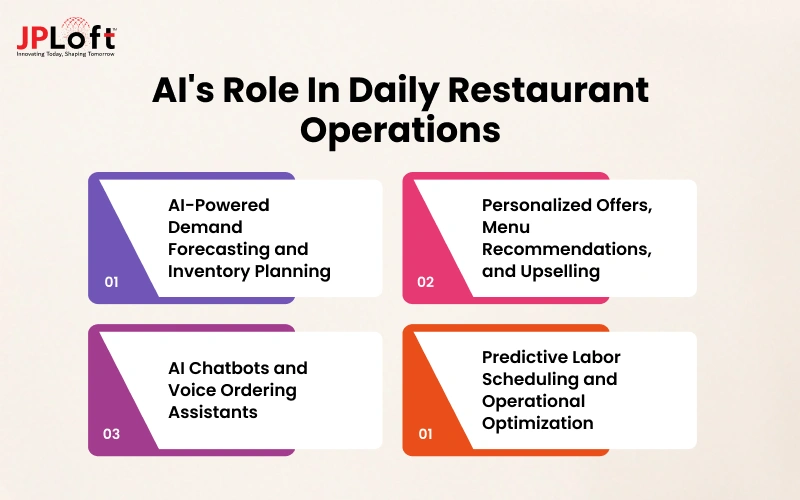
The role of AI-enabled operations should improve restaurant decisions or remove repetitive processes. The best way to use AI technology is to focus on the challenging parts of restaurants and then put it into a solution. Still confused?
Here are the most critical use cases of AI in restaurant sales and daily operations.
1. AI-Powered Demand Forecasting and Inventory Planning
-
Problem: Restaurants are often stuck with inventory management challenges, with too much or too little stock, because they cannot accurately predict daily demand.
-
AI Solution: AI analyzes past sales, seasonal trends, weather, and busy hours to estimate future demand.
-
Business Result: Restaurants can plan inventory more accurately, reduce food waste, and avoid running out of popular ingredients.
2. Personalized Offers, Menu Recommendations, and Upselling
-
Problem: Generic offers may not interest customers or encourage them to place another order.
-
Digital Solution: AI studies past order data and recent customer preferences to recommend relevant meals, add-ons, and personalized offers.
-
Business Result: Restaurants can encourage repeat purchases and increase the average order value through more relevant recommendations.
3. AI Chatbots and Voice Ordering Assistants
-
Problem: Staff spend time answering routine questions about menus, prices, delivery, and reservations.
-
AI Chatbot Solution: AI chatbots and voice assistants handle common queries and guide customers through the ordering process.
-
Business Result: Customers get quicker responses, while employees have more time to focus on food preparation and kitchen service, rather than replying to queries.
4. Predictive Labor Scheduling and Operational Optimization
-
Problem: The challenges of labor shortages or employee absences during rush hours can delay service and increase staffing or labor expenses.
-
Operational Solution: AI analyzes historical order patterns and busy periods to help managers plan staff schedules.
-
Business Result: Restaurants can hire staff according to expected demand during rush hours, manage labor costs, and maintain smoother service.
Where AI Adds Real Value, and Where Restaurants Should Be Cautious
Now that you know the role of AI in improving restaurant business operations, customer experience, and improving profits. AI adds real value when it solves a specific restaurant problem, such as reducing food waste, predicting demand, or improving order accuracy.
However, restaurant businesses should be cautious about relying on inaccurate data, making every customer interaction automated, or investing in tools without clear business benefits. Start with one operational need, measure the results, and expand AI use only when it delivers value.
How Should Different Restaurant Business Models Approach Digital Transformation?
Not every restaurant needs the same digital tools. The right approach depends on your business model, order volume, and operational needs. Here is the comparison table to help you understand which restaurant business model should approach digital transformation.
|
Restaurant business model |
Business priorities |
Technology to prioritize |
|
Independent Restaurants |
Build direct customer relationships and encourage repeat orders. |
Branded ordering website, POS system, CRM, and digital loyalty program. |
|
Quick-Service Restaurants (QSRs) |
Process high order volumes quickly across different channels. |
Self-service kiosks, kitchen display systems (KDS), and order management software. |
|
Full-Service Restaurants |
Improve reservations, table management, payments, and guest experiences. |
Online reservation systems, digital menus, and contactless payments. |
|
Cloud Kitchens |
Manage online orders, delivery operations, and kitchen workflows. |
Online ordering platforms, aggregator integrations, KDS, and inventory management software. |
|
Multi-Location Chains and Franchises |
Maintain consistent operations and visibility across all locations. |
POS, menu management, and inventory systems. |
|
Restaurant Startups |
Establish essential digital systems without making large initial investments. |
Mobile-friendly ordering, website, digital payments, and basic CRM. |
How to Build a Restaurant Digital Transformation Strategy: Step-by-Step
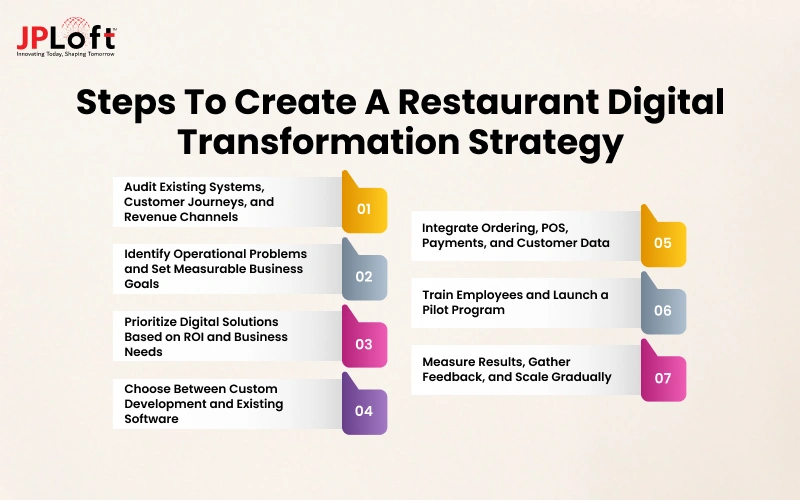
With so many digital transformation tools and technologies emerging in the restaurant business, you need a clear strategy to make the right choice. Here is the step-by-step process to create a restaurant digital transformation strategy.
Step 1: Audit Existing Systems, Customer Journeys, and Revenue Channels
Review your current POS, ordering channels, payment systems, and customer journey. Identify how customers place orders, where delays occur, and which channels generate the most revenue.
Step 2: Identify Operational Problems and Set Measurable Business Goals
List the main problems affecting your restaurant, such as high order errors, food waste, or low repeat purchases. Identify operational problems at each stage or across multiple restaurant locations; it helps to create a clear strategy and solutions.
Step 3: Prioritize Digital Solutions Based on ROI and Business Needs
Next, identify which restaurant operations need improvement and choose technology accordingly. For example, invest in an online ordering system if you want more direct orders. Choose a POS system to manage sales and payments, or an inventory management system to reduce food waste.
Step 4: Choose Between Custom Development and Existing Software
Decide whether ready-made software meets your needs or custom solutions offer better control. Consider your budget, required features, integration needs, and future expansion plans.
Step 5: Integrate Ordering, POS, Payments, and Customer Data
Connect your ordering channels, POS, payment systems, and customer records. Several businesses use restaurant app development services to integrate these APIs. This helps keep orders, payments, and sales information consistent across restaurant operations.
Step 6: Train Employees and Launch a Pilot Program
Train your staff to use the new systems before a full launch. Test the setup at one location or through one ordering channel to identify issues.
Step 7: Measure Results, Gather Feedback, and Scale Gradually
Lastly, after implementing a successful restaurant digital transformation strategy, measure results by tracking order accuracy, service time, operating costs, and customer feedback. Improve the setup based on results before expanding it across more locations or channels.
How Much Does Restaurant Digital Transformation Cost in 2026?
Restaurant digital transformation can cost between $20,000 and $500,000+ in 2026. The final investment depends on restaurant size, number of locations, technology requirements, and the level of customization.
|
Platform Transformation |
Estimated Cost |
Estimated Timeline |
|
Small Cafe |
$20,000 to $50,000 |
1 – 4 weeks |
|
Quick-Service Restaurant (QSR) |
$50,000 to $150,000 |
3–4 months |
|
Full-Service Restaurant |
$150,000 to $500,000+ |
4–6 months |
Key Factors That Influence Digital Transformation Costs
-
Restaurant Size and Locations: A single restaurant needs fewer systems than a multi-location chain. More outlets increase setup, licensing, and integration costs.
-
Technology Requirements: Adding basic online ordering costs less than implementing mobile apps, POS, kitchen systems, and loyalty programs together.
-
Customization: Custom features, branded interfaces, and complex workflows increase development costs.
-
Existing Infrastructure: Upgrading current systems may cost less than replacing outdated hardware and software.
-
Developer Expertise: Hiring an experienced developer will increase costs, as their technical knowledge helps handle complex integrations, security requirements, and custom features.
-
Third-Party Integrations: Connecting payment gateways, delivery platforms, inventory tools, and CRM systems adds integration and licensing costs.
Custom Development vs SaaS: Upfront and Ongoing Expenses
-
SaaS Solutions: Typically cost around $1,000 to $5,000+ per month, depending on features, users, and locations.
-
Custom Development: Can cost around $10,000 to $150,000 for tailored restaurant platforms. It requires higher upfront investment but offers greater control over features and integrations.
Hidden Costs of Maintenance, Training, Migration, and Security
-
Maintenance: Budget around 10–20% of the initial development cost annually for updates, bug fixes, and performance improvements.
-
Staff Training: Training can cost $2,000 to $5,000+, depending on staff size and system complexity.
-
Data Migration: Moving customer, menu, and order records to new systems may cost $3,000 to $6,000+.
-
Security: Budget for security audits, data protection, access controls, and compliance updates ranges between 12-20%. These costs depend on the systems and data involved.
How Startups and Existing Restaurants Can Prioritize Their Budgets
For Startups:
-
Online Ordering: Allow customers to place orders directly through digital platforms.
-
Basic POS: Manage orders, billing, and sales from one system.
-
Digital Payments: Accept online payments and reduce manual payment handling.
For Existing Restaurants:
-
Order Management: Upgrade systems that cause order delays or missed orders.
-
Workflow Automation: Reduce manual work in billing, inventory, and kitchen operations.
-
Data Integration: Connect disconnected systems to improve data sharing and reporting.
How Can Restaurant Owners Measure Digital Transformation ROI?
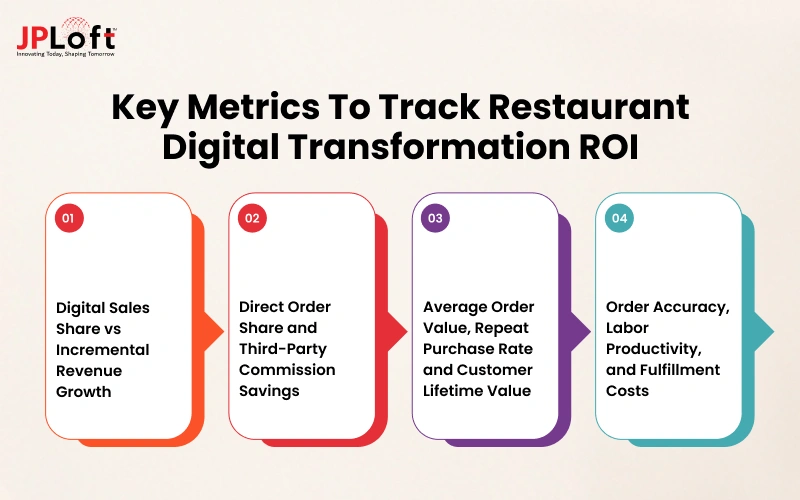
Digital transformation is a helpful strategy to improve restaurant operations. But the success depends on the impact it creates on your business. Therefore, tracking the ROI and measurable impact is necessary to understand how these affect customer retention, operating costs, and overall profitability.
Here are the important metrics to measure:
1. Digital Sales Share vs Incremental Revenue Growth
Digital sales share shows how much of your total revenue comes from online channels. Incremental revenue growth measures whether your restaurant is earning more than before.
2. Direct Order Share and Third-Party Commission Savings
Another important way to track ROI is to track how many online orders come through your own website or app instead of delivery marketplaces.
More direct orders can reduce commission expenses and give your restaurant better access to customer data. Compare commission costs before and after introducing direct ordering.
3. Average Order Value, Repeat Purchase Rate and Customer Lifetime Value
These metrics show whether digital channels are helping you earn more from existing customers.
-
Average Order Value (AOV): Average amount spent per order.
-
Repeat Purchase Rate: Percentage of customers who order again.
-
Customer Lifetime Value (CLV): Estimated revenue generated by a customer over their relationship with your restaurant.
Use these measures to understand whether loyalty programs, personalized offers, and recommendations are encouraging valuable customer relationships.
4. Order Accuracy, Labor Productivity, and Fulfillment Costs
Digital transformation should also improve daily operations. Track order errors, preparation time, staff hours per order, and delivery or fulfillment costs. If connected POS and kitchen systems reduce mistakes or manual work, these improvements can lower operating expenses.
Calculating ROI and Payback Period With a Practical Example
Restaurant owners can calculate ROI by comparing the financial benefits of a digital investment with its total cost.
ROI formula:
Net Benefit − Investment Cost
ROI (%) = ──────────────────── × 100
Investment Cost
For example: Suppose a restaurant invests $27,000 in a direct ordering platform. By shifting marketplace orders to its own channel, it saves $4,500 per month after ongoing platform and payment costs.
Initial investment: $27,000
Monthly net savings: $4,500
Annual net savings: $54,000
Payback period: 6 months
First-year ROI: 100%
Real-World Examples of Restaurant Digital Transformation
The food industry has seen some massive shifts due to digital transformation. Let’s explore how some established brands apply restaurant digital transformation.
Restaurant brands are investing in their own websites and mobile apps to make ordering easier and encourage customers to order again.
For instance,
-
McDonald's has expanded its digital ecosystem through mobile apps, delivery, self-service kiosks, and loyalty programs.
-
Starbucks uses its mobile app and Rewards program to connect ordering with customer loyalty. Customers can order ahead, pay through the app, earn rewards, and use personalized offers.
-
Domino's started as a traditional pizza restaurant where customers mainly ordered by phone. It later introduced online and mobile ordering, followed by Pizza Tracker in 2008.
Customers could easily customize pizzas, place orders, and track deliveries. This made ordering more convenient, improved customer experience, and helped Domino's make digital ordering a key part of its business.
How Connected POS and Kitchen Systems Improve Order Operations
When restaurants receive orders through dine-in counters, mobile apps, websites, and delivery platforms, managing them separately can create delays and mistakes.
Connected ordering and kitchen systems help bring these orders into one workflow. Staff can view incoming orders, send them to the kitchen, track preparation, and manage pickup without repeatedly entering the same information.
Lessons Restaurant Startups and Independent Operators Can Learn From Established Brands
1. Building direct ordering channels is no longer optional if you want to reduce dependence on delivery platforms.
2. Use loyalty programs to encourage repeat orders: Starbucks demonstrates how rewards can keep customers engaged and improve repeat visits and purchases.
3. Connect ordering with kitchen operations: McDonald's shows the value of preparing digital orders efficiently. Smaller restaurants can connect their POS with kitchen display systems so staff can receive and track orders without manual coordination.
What's Next for Restaurant Digital Transformation Beyond 2026?
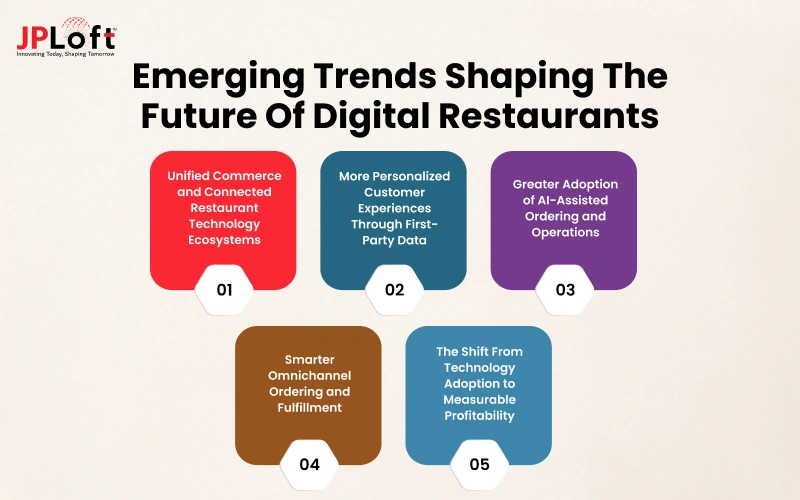
Restaurant digital transformation will move beyond adopting separate tools. Several restaurant businesses are focusing on optimizing operations and improving customer experience.
And it's not just this; there is more to this transformation. Here are the future trends in restaurant digital transformation to find out what's coming next.
1. Unified Commerce and Connected Restaurant Technology Ecosystems
Restaurants will increasingly connect in-store sales, websites, mobile apps, delivery platforms, POS, and inventory systems. This gives owners a more complete view of orders, revenue, and operations across channels.
2. More Personalized Customer Experiences Through First-Party Data
Restaurants will place greater value on customer data collected through their own ordering channels and loyalty programs. Businesses can use these insights to send relevant offers, recommend meals, and encourage repeat purchases without relying only on broad discounts.
3. Greater Adoption of AI-Assisted Ordering and Operations
AI will play a larger role in tasks such as demand forecasting, inventory planning, customer support, and menu recommendations. However, the focus should remain on practical results. It is vital to check whether these tools save time, improve decisions, or reduce operating costs.
4. Smarter Omnichannel Ordering and Fulfillment
Customers may order through a restaurant's website, app, kiosk, or delivery marketplace. Restaurants will need systems that manage these orders together without creating confusion for kitchen teams.
5. The Shift From Technology Adoption to Measurable Profitability
Having more digital tools will not automatically make a restaurant more profitable. Businesses need to evaluate technology based on its contribution to direct sales, repeat orders, labor efficiency, food cost control, and customer retention.
How Can JPLoft Help Restaurants Build a Connected Digital Ecosystem?
Still managing separate systems for orders, payments, customers, and daily operations can make restaurant growth difficult. Restaurant businesses need connected technology that simplifies these processes and supports better business performance.
JPLoft offers custom restaurant app development solutions that help restaurant businesses connect these processes through custom digital solutions.
With 16+ years of experience, 130+ experts, and 1,250+ completed projects, we understand how technology can solve different business challenges.
Our team develops custom restaurant apps and online ordering platforms based on your business requirements.
By connecting POS systems, payment gateways, kitchen displays, inventory tools, and loyalty programs, we help restaurants manage daily workflows while giving customers a smoother ordering experience.
Whether you run a single restaurant, manage multiple locations, or operate a cloud kitchen, we build solutions around your business model.
You can launch a new digital platform, upgrade existing software, or add integrations without replacing systems that already work. Connect with our team and digitalise your restaurant.
Conclusion
Implementing digital transformation in restaurants is not just about adopting the latest gadgets. It is a strategic approach to manage operations and services and improve customer experience.
From direct ordering and loyalty programs to connected POS systems and AI-powered tools, every technology solution addresses a complex restaurant need.
You need to start with the right approach based on your restaurant model, budget, and growth plans. Before investing, identify your biggest operational challenges, such as high third-party delivery commissions, disconnected POS, order errors, delays, and manual operational work.
Remember to implement the right strategy by auditing existing systems, identifying operational problems, choosing solutions based on higher ROI, training staff with new systems, and measuring results gradually.
FAQs
Restaurant digital transformation means using modern technology to improve customer satisfaction, handle operational tasks, and maintain growth as the business scales. It handles ordering, payment, employee management, and marketing.
Digital transformation is important for restaurants in 2026 to meet changing customer expectations, adopt AI and automation, manage operating costs, maintain service levels with fewer staff, and improve restaurant efficiency.
Restaurant businesses generate more than 25% of sales through digital channels. However, this share can vary based on restaurant format and model.
Digital transformation increases restaurant revenue with a higher average order value, faster service, reduced third-party commission charges, fewer no-shows, and a more personalized customer experience.
Small restaurants should invest in technologies, including a point-of-sale system to record and receive orders, employee scheduling software for managing shifts, and a direct online ordering system.
Not always. Restaurants with frequent repeat customers may benefit from apps, while smaller businesses can start with mobile-friendly websites and online ordering.
Yes. A restaurant can reduce reliance on third-party platforms by encouraging direct orders.
Restaurants can connect ordering platforms to their POS through built-in integrations, APIs, or middleware for menu sync, order routing, and payment.
A restaurant digital transformation costs between $20,000 and $500,000+. A small cafe may need $20,000 to $50,000 for basic digital systems. A quick-service restaurant (QSR) may spend $50,000 to $150,000 on kitchen management systems. Full-service restaurants may require $150,000 to $500,000 for advanced integrations.
Restaurant digital transformation typically takes 3–6 months, depending on the project's complexity, development, integration, testing, and deployment.
ROI means return on investment; it helps to measure the profits a restaurant business generates from technology investments. A few metrics are used to measure profitability, average order value, labor costs, order processing time, error rates, and customer satisfaction.
Custom software suits restaurants with specific workflows or growth needs and a higher budget, while ready-made solutions are often more affordable and faster to implement.
The biggest challenges in restaurant digital transformation involve high upfront costs, disconnected systems, data security risks, employee training, and integration difficulties.
AI helps restaurant owners increase sales through demand forecasting, personalized recommendations, and predicting customer demand and suggesting relevant menu items based on consumer preferences.

Conor has 10+ years of experience in software development, application engineering, solution design, and UX/UI. He has worked across digital products in restaurant technology, food and grocery delivery, healthcare, media, streaming, and social platforms, bringing both technical and user-experience perspectives to product development. His experience working with large organizations and growth-focused digital products helps businesses translate complex requirements into practical, user-focused solutions.


Share this blog