


Qatar's digital economy is growing fast, and more businesses are turning to mobile apps to reach customers, streamline operations, and stay competitive.
But before any idea turns into a product, one question comes first: what is the cost to build an app in Qatar?
The answer depends on many factors.
Mobile app development in Qatar typically costs between QAR 20,000 and QAR 500,000+, and the final number is shaped by features, design, AI integration, platform, and more.
Qatar-specific needs, such as Arabic and English support and local payment options, can also change app development costs in Qatar.
This guide breaks down the mobile app development cost by app type, industry, and development stage.
If you are comparing options, working with an experienced mobile app development company in Qatar can help you get an exact estimate from the start.
Quick Answer: How Much Does it Cost to Develop a Mobile App in Qatar?
The cost of developing a mobile app in Qatar typically ranges from QAR 20,000 to QAR 500,000+ (about $5,500 to $137,000+).
The final price depends on the app's complexity, features, design, platform, and the team you hire.
A simple app with basic screens and limited features sits at the lower end. A mid-level app with user accounts, payments, and an admin panel costs more.
Advanced and enterprise apps with real-time tracking, multiple user roles, AI features, and strong security can go well past QAR 400,000.
Qatar adds a few cost factors of its own.
Bilingual Arabic and English design, local payment integrations, and data privacy compliance all add to the budget, so a Qatar-ready app costs more than a basic English-only build.
Since Qatari Riyal costs are often compared against international quotes, here is a simple reference.
The table below shows the estimated cost in both currencies:
|
App Complexity |
Estimated Cost (QAR) |
Estimated Cost (USD) |
|
Basic App |
QAR 20,000 – 70,000 |
$5,500 – $19,200 |
|
Medium-Complexity App |
QAR 70,000 – 150,000 |
$19,200 – $41,200 |
|
Advanced App |
QAR 150,000 – 400,000 |
$41,200 – $109,900 |
|
Enterprise / AI-Powered App |
QAR 400,000 – 500,000+ |
$109,900 – $137,400+ |
Conversion rate used: 1 USD = 3.64 QAR.
Note: For an accurate estimate, speak with an application development company that understands the Qatari market and has proven technical expertise.
Factors Affecting the Cost to Develop a Mobile App in Qatar
The mobile app development cost in Qatar is never a fixed number, because every app is built around different goals, features, and users.
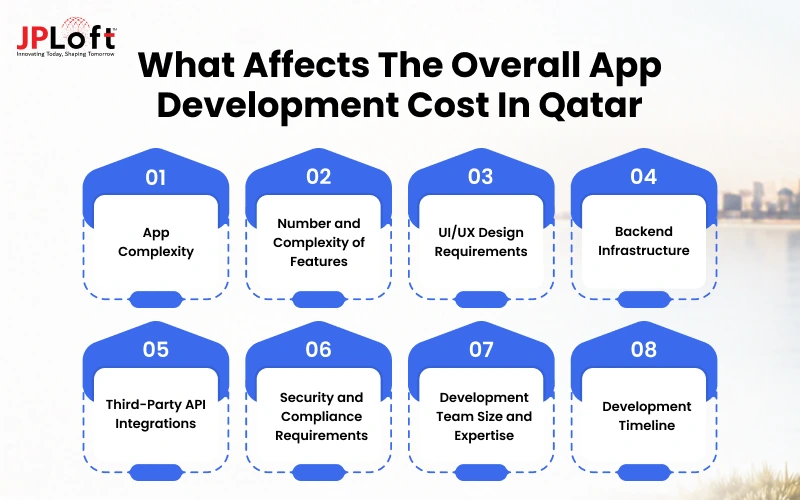
Here are the main elements that shape the final price of your app:
Factor 1. App Complexity
Average Cost: QAR 20,000 – QAR 500,000+ ($5,500 – $137,400+)
Complexity is the biggest factor in your budget because it determines how much work goes into every other part of the app.
A simple app with a few screens is quick to build, while a large app with many user types, live data, and smart features needs far more planning, coding, and testing.
Before you ask for quotes, decide which of these groups your idea belongs to, since agencies price each group very differently.
How much will it cost?
-
A basic app with simple screens and limited features costs around QAR 20,000 – 70,000 ($5,500 – $19,200).
-
A medium app with user accounts, payments, and an admin panel costs around QAR 70,000 – 150,000 ($19,200 – $41,200).
-
An advanced app with live tracking, multiple user roles, or custom tools costs around QAR 150,000 – 400,000 ($41,200 – $109,900).
-
An enterprise or AI-powered app can reach QAR 400,000 – 500,000+ ($109,900 – $137,400+).
Factor 2. Number and Complexity of Features
Average Cost: QAR 3,000 – QAR 80,000 per feature ($800 – $22,000)
Every app feature you add is a small project of its own, with its own design, coding, and testing.
A login screen is quick to build, but a feature like live delivery tracking has to talk to maps, update in real time, and work smoothly on weak internet connections.
That is why two apps with the same number of features can still have very different prices.
A smart way to control the cost is to list every feature you want and sort them into must-haves and nice-to-haves.
Launching with the must-haves first lets you test your idea with real users and add the extras later, when you know which ones people actually use.
How much will it cost?
-
Simple features like sign-up, profiles, and basic search cost around QAR 3,000 – 10,000 each ($800 – $2,700).
-
Medium features like in-app chat, push notifications, and payments cost around QAR 10,000 – 30,000 each ($2,700 – $8,200).
-
Complex features like real-time tracking, video calling, and AI recommendations cost around QAR 30,000 – 80,000 each ($8,200 – $22,000).
Factor 3. UI/UX Design Requirements
Average Cost: QAR 7,000 – QAR 70,000 ($1,900 – $19,200)
The difference between a failed and a successful mobile app is its UI/UX design.
Good design makes the app look attractive and also makes it easy to use, so people can find what they need without thinking too hard.
A polished design takes more time because designers need to research users, sketch the screens, build clickable samples, and fix problems before any coding starts.
The design costs go up in Qatar because many businesses want a bilingual app that works well in both Arabic and English.
Arabic reads from right to left, so the whole layout has to be flipped properly, and that takes extra care from the design team.
How much will it cost?
-
A simple design based on ready-made templates costs around QAR 7,000 – 15,000 ($1,900 – $4,100).
-
A fully custom design made for your brand costs around QAR 15,000 – 40,000 ($4,100 – $11,000).
-
A premium design with animations, Arabic and English layouts, and a full design system costs around QAR 40,000 – 70,000 ($11,000 – $19,200).
Factor 4. Backend Infrastructure
Average Cost: QAR 10,000 – 150,000 ($2,700 – $41,200)
The backend is what works behind the app, even though users never see it.
It stores data, manages accounts, handles orders, and sends information between the app and your servers.
A strong backend keeps the app fast when thousands of people use it at the same time, while a weak one makes the app slow or even crash during the busy hours.
The price depends on how much data you handle and how many users you expect.
An app for small local businesses can run on a simple setup, but an app built for fast growth needs cloud servers that can scale up automatically as more people join.
How much will it cost?
-
A basic backend for a small app costs around QAR 10,000 – 30,000 ($2,700 – $8,200).
-
A medium backend with databases, admin dashboards, and user roles costs around QAR 30,000 – 80,000 ($8,200 – $22,000).
-
A large-scale backend built for heavy traffic costs around QAR 80,000 – 150,000 ($22,000 – $41,200).
Monthly hosting adds roughly QAR 400 – QAR 4,000 ($110 – $1,100) depending on usage.
Factor 5. Third-Party API Integrations
Average Cost: QAR 2,000 – 30,000 per integration ($550 – $8,200)
Most apps do not build everything from scratch.
They connect to ready-made services such as maps, payment gateways, SMS providers, and analytics tools, which saves time and lets you offer professional features faster.
These connections are called API integrations, and each one needs developers to set it up, test it, and make sure it keeps working when the other service updates.
For businesses in Qatar, local payment options such as QPay are a common requirement, because customers expect to pay the way they usually do.
Some services also charge their own monthly or per-use fees, which are separate from the app development cost, so it helps to ask your agency for a full list of these running costs.
How much will it cost?
-
Simple integrations like SMS, email, and analytics cost around QAR 2,000 – 7,000 each ($550 – $1,900).
-
Medium integrations like maps, social login, and payment gateways cost around QAR 7,000 – 15,000 each ($1,900 – $4,100).
Complex integrations like banking systems, business software, and government services cost around QAR 15,000 – 30,000 each ($4,100 – $8,200).
Factor 6. Security and Compliance Requirements
Average Cost: QAR 7,000 – 90,000 ($1,900 – $24,700)
People trust apps with their names, phone numbers, locations, and payment details, so protecting that information is a basic need.
Security work includes encrypting data, setting up safe logins, controlling who can see what, and testing the app for weak spots before hackers find them.
Skipping it might save money now, but one data leak can cost far more through lost customers and legal trouble.
Compliance means following the rules for your industry and country.
In Qatar, apps that handle personal data need to respect the national data privacy law, and fintech or healthcare apps face extra rules from their own regulators.
Meeting these rules takes extra planning, documentation, and testing, which is why regulated industries cost more.
How much will it cost?
-
Basic protection like secure logins and encrypted data costs around QAR 7,000 – 20,000 ($1,900 – $5,500).
-
Medium protection with secure payments, role-based access, and regular testing costs around QAR 20,000 – 50,000 ($5,500 – $13,700).
-
High-level protection for fintech and healthcare apps, including compliance checks and security audits, costs around QAR 50,000 – 90,000 ($13,700 – $24,700).
Factor 7. Development Team Size and Expertise
Average Cost: QAR 90 – 450 per hour ($25 – $125)
The people building your app affect the prices as much as the app itself.
A full team usually includes a project manager, designers, developers, testers, and sometimes a business analyst, and each of them is paid for the time they spend on your project.
A bigger team can finish faster, while a smaller team costs less per month but may take longer.
Experience also matters more than most people expect. Local agencies in Doha are easy to meet in person and understand the market well, but they generally charge the highest rates.
An experienced mobile app development company in Saudi Arabia or nearby Gulf countries like the UAE offers a middle ground, since they are familiar with Arabic users and regional payment habits at a slightly lower price.
How much will it cost?
-
Freelancers and offshore teams charge around QAR 90 – QAR 180 per hour ($25 – $50).
-
Mid-size agencies charge around QAR 180 – QAR 300 per hour ($50 – $80).
-
Large or Qatar-based agencies charge around QAR 300 – QAR 450+ per hour ($80 – $125+).
Factor 8. Development Timeline
Average Cost: 15 – 25% extra for rushed delivery (QAR 10,000 – 100,000 or $2,700 – $27,500)
Time and money are closely linked in app development because the longer a team works on your project, the more it costs.
The app development timeline can vary based on the app’s complexity and features.
A simple app can be ready in one to three months, a medium app usually takes three to five months, and an advanced app can take five to nine months or more.
These periods cover planning, design, coding, testing, and fixing problems before the launch.
If you need the app faster, the agency has to put more people on the project at the same time, and that raises the price.
How much will it cost?
-
A basic app built in 1 – 3 months may carry a rush fee of around QAR 10,000 – 20,000 ($2,700 – $5,500).
-
A medium app built in 3 – 5 months may carry a rush fee of around QAR 20,000 – 50,000 ($5,500 – $13,700).
-
An advanced app built in 5 – 9+ months may carry a rush fee of around QAR 50,000 – 100,000 ($13,700 – $27,500).
 Post-Launch Support and Maintenance
Average Cost: QAR 4,000 – 100,000 per year ($1,100 – $27,500)
Launching the app is the first step, since phones, operating systems, and user needs keep changing.
New iPhone and Android updates can break features that worked fine before, so developers need to keep the app up to date.
App maintenance services also cover fixing bugs, improving speed, renewing security, and adding small features based on what your users ask for.
How much will it cost?
-
A basic app costs around QAR 4,000 – 15,000 per year to maintain ($1,100 – $4,100).
-
A medium app costs around QAR 15,000 – 40,000 per year ($4,100 – $11,000).
-
An advanced app costs around QAR 40,000 – 100,000 per year ($11,000 – $27,500).
Why Mobile Apps Are In Demand in Qatar?
Mobile apps have become a core part of daily life and business in Qatar, which is why more companies are setting aside budgets to build them.
Before you work out the cost of mobile app development in Qatar, it helps to understand what is driving this demand.
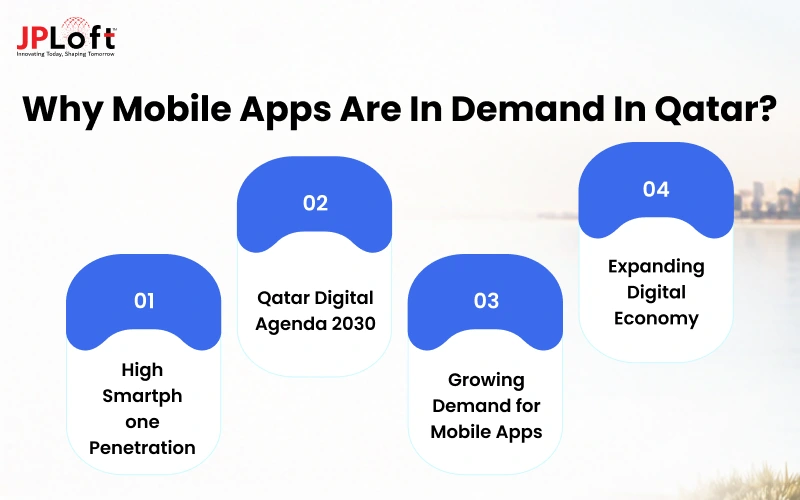
Here are the main reasons businesses are investing in apps:
1. High Smartphone Penetration
Almost everyone in Qatar uses a smartphone, with penetration estimated at around 97%.
This means businesses can reach nearly their entire audience through an app, which makes the investment worthwhile and easier to justify against the development budget.
2. Qatar Digital Agenda 2030
Qatar's Digital Agenda 2030 encourages businesses and government services to move online, which has pushed many companies to launch apps for their customers and teams.
This national direction means mobile apps are becoming a regular part of doing business.
3. Growing Demand for Mobile Apps
Customers in Qatar are used to ordering food, booking rides, paying bills, and shopping from their phones, so they expect the same convenience from every brand.
Businesses without an app risk losing customers to competitors with a faster, simpler experience.
4. Expanding Digital Economy
Qatar's digital economy keeps growing through e-commerce, fintech, healthcare, and on-demand services, and each of these areas depends heavily on mobile apps.
This growth gives startups and established companies new chances to reach users and earn steady revenue.
Cost by Development Team: Freelancer vs Local Agency vs Offshore Team vs In-House in Qatar
How much does it cost to build an app in Qatar? The answer changes a lot depending on who builds it, because each type of team charges differently and offers a different level of support.
A freelancer can suit your small budget, but may not be a reliable option. A Qatar-based agency brings local knowledge and face-to-face meetings; an offshore team gives you strong quality at a lower rate.
An in-house team gives you full control with higher long-term costs.
Here is how the four options compare:
|
Team Type |
Average Rate |
Typical Project Cost |
Pros |
Cons |
|
Freelancer |
QAR 70 – 180 per hour ($20 – $50) |
QAR 20,000 – 80,000 ($5,500 – $22,000) |
Lowest cost, quick to start, and good for small or simple apps |
One person may not cover design, testing, and backend well, and support can stop if they become unavailable |
|
Local Agency |
QAR 300 – 450+ per hour ($80 – $125+) |
QAR 120,000 – 500,000+ ($33,000 – $137,400+) |
Easy in-person meetings, strong local market knowledge, and a full team under one roof |
Highest price and fewer choices for specialized skills like AI or advanced tech |
|
Offshore Team |
QAR 90 – 180 per hour ($25 – $50) |
QAR 30,000 – 200,000 ($8,200 – $55,000) |
Good quality at a lower rate, large pool of skilled developers, and flexible team size |
Time zone differences and fewer face-to-face meetings, so clear communication is important |
|
In-House Team |
QAR 12,000 – 30,000 per developer per month ($3,300 – $8,200) |
QAR 300,000 – 900,000+ in the first year ($82,400 – $247,300+) |
Full control, deep knowledge of your business, and the team is always available |
Highest long-term cost, slow hiring, and ongoing expenses like salaries, equipment, and software |
App Development Cost in Qatar by Industry
The cost to develop a mobile app in Qatar changes a lot from one industry to another, because every sector needs its own features, security level, and user experience.
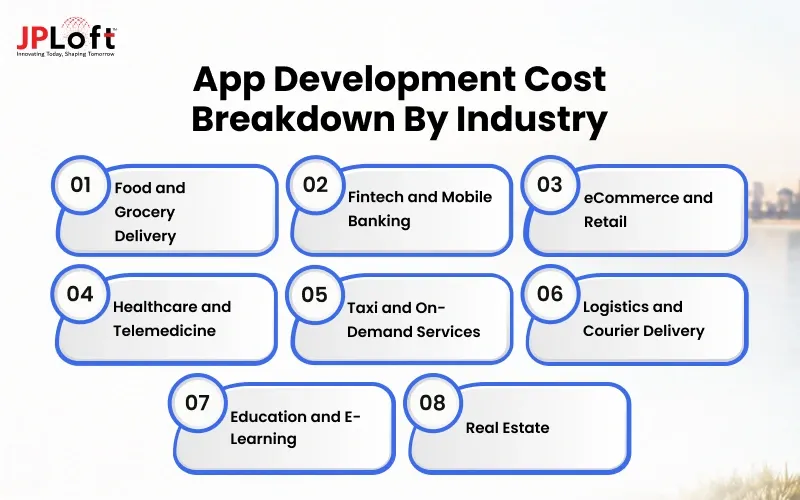
Here is what you can expect to pay in the most popular industries:
1. Food and Grocery Delivery
Hungry customer in Qatar want their meals and groceries delivered at the tap of a screen, which
makes food delivery one of the busiest app categories in the country.
These apps need a customer app, a restaurant panel, a driver app, live order tracking, and online payments, which is why the work takes more than one app.
The cost to build a food delivery app in Qatar: QAR 60,000 – 200,000 ($16,500 – $55,000)
2. Fintech and Mobile Banking
Fintech apps put an entire bank in the user's pocket, from sending money and paying bills to saving and tracking expenses.
They need the strongest security of any industry and must follow the rules set by Qatar's financial regulators, so they take longer to design and test.
The cost to develop a fintech app in Qatar: QAR 150,000 – 500,000+ ($41,200 – $137,400+)
3. eCommerce and Retail
A well-built shopping app turns a phone into a store that never closes, letting customers browse, pay, and track orders from anywhere.
Local payment options like QPay and support for both Arabic and English are important here, since they help more shoppers complete their purchases.
The cost to create an eCommerce app in Qatar: QAR 50,000 – 250,000 ($13,700 – $68,700)
4. Healthcare and Telemedicine
Healthcare apps let patients see a doctor, book a visit, and check their medical records without leaving home, which saves time for patients and clinics alike.
Because they deal with private health information, they need extra protection and careful testing, which adds to the price.
The cost to develop a healthcare app in Qatar: QAR 80,000 – 350,000 ($22,000 – $96,200)
5. Taxi and On-Demand Services
With one tap, on-demand apps bring a ride, a cleaner, or a repair expert straight to the customer's door.
They rely on live maps, instant matching, and fair pricing, and the app usually has separate versions for customers, providers, and admins.
The cost to develop a taxi or on-demand app in Qatar: QAR 100,000 – 400,000 ($27,500 – $109,900)
6. Logistics and Courier Delivery
Logistics apps keep every parcel and driver visible on the map, so businesses always know where an order is and when it will arrive.
They need route planning, delivery proof, and clear status updates, which keep customers informed and help companies run smoothly.
The cost to develop a logistics app in Qatar: QAR 90,000 – 300,000 ($24,700 – $82,400)
7. Education and E-Learning
Education apps turn any phone into a classroom, giving students lessons, quizzes, and live classes whenever they want to learn.
They are often simpler to build than other industries, though adding video lessons and Arabic language support raises the price.
The cost to build an education app in Qatar: QAR 40,000 – 180,000 ($11,000 – $49,500)
8. Real Estate
Real estate apps make house hunting faster by putting listings, photos, and virtual tours right in the buyer's hand.
Features like map-based search, saved listings, and instant alerts for new properties make the app more useful and add to the cost.
The cost to create a real estate app in Qatar: QAR 50,000 – 200,000 ($13,700 – $54,900)
How to Reduce the Mobile App Development Cost in Qatar?
The cost of mobile application development in Qatar can feel high at first, but a few smart planning decisions can bring it down without lowering the quality of your app.
Most overspending comes from unclear plans, too many features at launch, and changes made halfway through the project, all of which can be avoided.
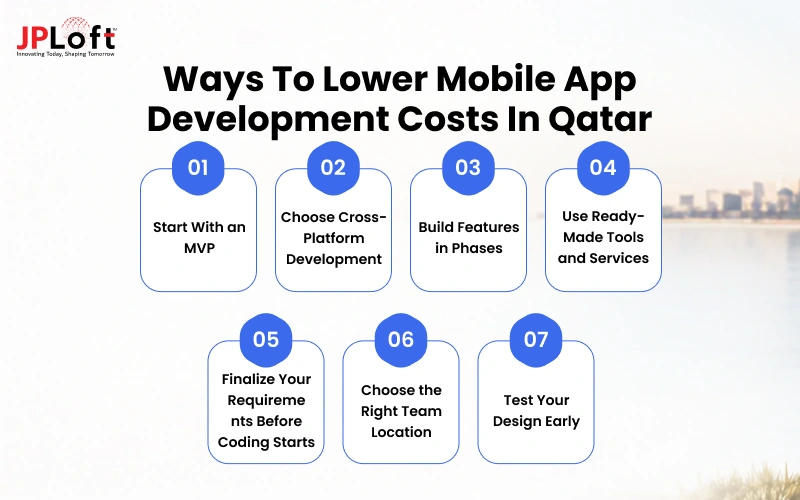
Here are practical tips to help you save money:
1. Start With an MVP
An MVP is a simple first version of your app that includes only the most important features.
Launching it first lets you test your idea with real users before spending on the full product, and the feedback shows you which features are worth building next.
MVP development helps you control initial costs while validating your app idea before investing in advanced features.
2. Choose Cross-Platform Development
Cross-platform frameworks like Flutter and React Native let developers build one app that works on both iPhone and Android, instead of creating two separate apps.
This can cut development costs by around 20 – 30% compared with building natively, and it also makes future updates faster.
3. Build Features in Phases
Instead of building everything at once, divide your feature list into must-haves, useful extras, and future ideas.
Spreading the work over several releases keeps your upfront budget lower and lets you add features only when your users and income can support them.
4. Use Ready-Made Tools and Services
Payment gateways, maps, chat, and notifications are available as ready-made services, so there is no need to build them from scratch.
Connecting to these tools saves weeks of development time, and the extra monthly fees are usually much smaller than the cost of custom building.
5. Finalize Your Requirements Before Coding Starts
Changing the plan in the middle of development is one of the most common reasons budgets grow, since every change means redesigning and recoding parts of the app.
Writing down your goals, features, and screens clearly at the start helps your team give a fixed and accurate quote.
6. Choose the Right Team Location
Local agencies in Qatar usually charge the highest rates, while offshore and regional teams can offer similar quality for much less.
A mix of the two often works well, such as working with a trusted offshore team while keeping regular video meetings for clear communication.
7. Test Your Design Early
Fixing a problem on a design sketch costs far less than fixing it after the app is built.
A clickable prototype lets you and a few test users try the app flow in advance, so you can correct confusing screens before any coding starts.

How Can JPLoft Help You Develop an Affordable App in Qatar?
Launching an app on a sensible budget is easier with a team that plans carefully before writing any code.
JPLoft works with businesses to turn their ideas into well-built apps while keeping the cost clear and under control.
Here is how JPLoft can help:
-
Clear planning first: The team reviews your goals, audience, and features before development starts, so you receive a realistic estimate with no surprise charges later.
-
MVP-first approach: JPLoft helps you launch with the features that matter most, then add more as your app grows, which keeps your starting budget manageable.
-
Cost-saving technology: Cross-platform tools like Flutter and React Native allow one app to run on both iOS and Android, saving time and money.
-
Qatar-ready design: Apps can be built with Arabic and English support and local payment options, so they feel natural to customers in Qatar.
-
Flexible hiring options: You can hire dedicated developers or extend your own team, paying only for the skills you need.
-
Support after launch: Regular updates, bug fixes, and maintenance keep your app running smoothly, so small issues do not turn into expensive problems.
Conclusion
Developing an app in Qatar does not have to drain your budget when you plan it well.
The final price depends on your features, design, platform, and the team you choose, so knowing these factors early helps you make smarter decisions.
Starting with an MVP, choosing cross-platform development, and planning your maintenance budget can all keep your spending under control without hurting quality.
If you are ready to turn your idea into a working app, speak with an experienced team, share your goals, and get a clear estimate that fits your plan.
FAQs
The cost usually ranges from QAR 20,000 to QAR 500,000+ ($5,500 to $137,400+), depending on the app's complexity, features, design, and team. A basic app sits at the lower end, while advanced apps with live tracking, payments, or AI features cost more.
A basic app can take 1 to 3 months, a medium app usually takes 3 to 5 months, and an advanced app can take 5 to 9 months or more. Clear requirements and quick feedback from your side help the project finish on time.
Maintenance usually costs QAR 4,000 to QAR 100,000 per year ($1,100 to $27,500), based on the size of the app. This covers bug fixes, security updates, performance improvements, and support for new phone updates.
Yes, a startup can begin with an MVP that includes only the core features, and build it with a cross-platform framework. This keeps the first investment low, and you can add more features once you see how users respond.
It can, because an Arabic version needs a right-to-left layout, translated content, and extra testing on every screen. The added cost is usually small compared with the benefit, since it helps your app feel natural to many users in Qatar.

Priyanka Sukhwal is the Managing Director and Business Head of JPLoft, with 10+ years of experience in technology, digital product strategy, and business growth. She has worked closely with businesses building mobile applications, custom software, marketplaces, and on-demand platforms across mobility, automotive, consumer services, and startup ecosystems. At JPLoft, she focuses on understanding business models, identifying product opportunities, and helping companies plan digital solutions that can scale with changing market needs.



Share this blog