



Key Takeaways:
LLM agents go beyond answering questions by planning tasks, making decisions, and executing actions across real workflows with minimal human supervision.
LLM agents are best suited for complex, ongoing tasks that involve multiple steps, changing inputs, and tool interactions, while simpler tasks often do not require an agent-based approach.
Successful LLM agent development depends on structure, including clear goals, defined boundaries, well-designed workflows, memory handling, and safety controls.
Real-world LLM agent use cases exist across industries, including customer support, software development, internal knowledge management, sales operations, and IT.
Key technical components of the LLM agent include agent core, planning module, memory, tools, and ethe valuation loops.
LLM agent development comes with challenges, including unpredictable behavior, high costs, hallucinations, and tool misuse.
The cost to build LLM agents ranges from $10,000 to $250,000+ and vary based on complexity, advanced workflows, integrations, and ongoing operational needs.
Future LLM agents will focus on multi-agent collaboration, stronger control, smarter memory, deeper system integration, and continuous optimization.
Partnering with experienced developers at JPLoft can help build successful LLM models that can deliver real value.
AI has reached a point where getting answers to the questions through AI are no longer enough. But nowadays, businesses expect AI systems to plan tasks, make decisions, and carry work forward with minimal supervision.
This shift is resulting towards a growing interest in LLM agents, AI systems designed to think through problems and act across real workflows instead of stopping at a single response.
Yet, building an LLM agent is not as simple as connecting a language model to a prompt. It requires careful planning, the right technical components, and a clear understanding of how agents behave in real environments.
From defining goals and workflows to managing memory, tools, and safety controls, every choice shapes how reliable the agent will be once it goes live.
In this blog, we break down what an LLM agent is, how they work, and how to develop an LLM agent step by step. Whether you are exploring ideas or planning execution, this blog gives you a clear path to building LLM agents that deliver real value.
What is an LLM Agent?
An LLM agent is an AI system that does more than just generate text. It can understand a goal, determine the necessary steps, and take independent actions to complete a task.
While a basic Large Language Model responds only when prompted, an LLM agent works through problems in a structured way and moves tasks forward without constant human intervention.
Understanding how do LLM agents works can help you better plan for LLM agents as per your business needs.
An LLM agent is composed of several interconnected components before that help the agent to understand instructions and generate responses.
-
A decision loop helps it choose the next action based on results so far.
-
Memory allows it to keep track of past steps and context.
-
Tool access lets it interact with real systems such as APIs, databases, or internal software.
With just a description, the difference becomes clear in real use. Building a standard LLM might explain how to prepare a report, but an LLM agent can gather data, review it, summarize key points, and share the output with the right system or team. It does not stop at advice. It completes the task.
For businesses, this shift matters. Understanding how to build LLM agents supports ongoing work, reduces manual effort, and handles complex workflows more reliably. They turn AI from being a helper that answers questions into a system that actively supports daily operations and decision-making.
When (and when not) to use agents?
LLM agents are a good fit when the task involves multiple steps, decisions, and ongoing context. If you are figuring out how to develop an LLM agent for tasks that require planning, tool usage, or repeated actions, an agent-based approach makes sense.
Examples of such scenarios include handling customer requests from start to finish, pulling data from different systems, or supporting internal teams with structured workflows.
Agents also work well when tasks do not follow a fixed path. In these cases, understanding how LLM agents work becomes important because the agent reviews results, decides the next step, and adjusts its actions. This flexibility is one of the main reasons businesses invest in LLM agent development for research, analysis, and operational support.
That said, agents are not always needed. If the task is simple, short, or one-time, building an agent adds unnecessary cost and setup effort. A direct prompt or basic automation often solves the problem faster. Agents also require careful planning, testing, and control. Without clear limits, they may behave inconsistently or use more resources than expected.
The right approach is balance. Build an LLM agent when autonomy adds value. Skip it when a simpler solution meets the goal just as well.

Benefits of Investing in LLM Agents
LLM agents help businesses use AI solutions more practically. Implementing LLM agents assists with real work and ongoing processes rather than just answering questions. Further, when planned properly, they bring steady improvements across teams and systems.
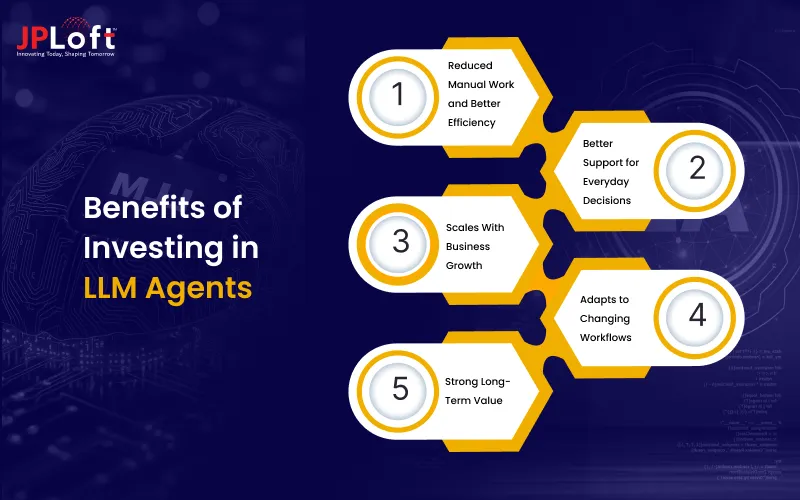
Here are some of the key benefits of investing in LLM agents:
1. Reduced Manual Work and Better Efficiency
Building an LLM agent can take care of repeated and structured tasks on its own. This reduces manual effort and gives teams more time to focus on work that needs human thinking and oversight.
2. Better Support for Everyday Decisions
LLM agents can review information, keep track of context, and suggest next steps based on what is happening. The focus on LLM agent development helps teams leverage technology to make clearer and more consistent decisions in areas like operations and customer support.
3. Scales With Business Growth
Once in place, agents can handle more work without adding the same level of human resources. This makes large language model agent development useful for businesses that expect steady growth but want to control costs.
4. Adapts to Changing Workflows
LLM agents do not rely on fixed rules or the data on which the model has been trained. But with time, these LLM agents adjust their actions when inputs or conditions change. Such an approach ensures that the businesses enjoy updated workflows without rebuilding systems.
5. Strong Long-Term Value
LLM agents also contribute to long-term or strong value creation. By focusing on developing large language model agents, businesses create AI systems that continue to support daily operations and deliver value over time.
Real World Use Case of LLM Agents
LLM agents are already supporting real business operations where tasks require context, decisions, and follow-through.
Below are real-life examples that show how organizations apply them in practice.
Case 1: Customer Support and Service Operations
Platforms like Zendesk use LLM-powered agents to assist support teams throughout the ticket lifecycle.
The LLM agent reviews past conversations, understands the customer issue, suggests accurate responses, and updates ticket details automatically. This reduces response time and improves consistency, while human agents step in only for complex or sensitive cases.
Case 2: Developer and Engineering Support
GitHub Copilot works as an LLM agent inside the developer workflow. It understands the existing codebase, suggests code snippets, identifies errors, and helps with debugging in real time.
Hence, developers are using LLM agents to speed up development while maintaining control over final decisions and code quality.
Case 3: Internal Knowledge and Workflow Management
Tools like Notion use LLM agents to help teams access internal knowledge faster. The agent searches documents, summarizes content, and answers employee questions within the workspace.
Investing to build an LLM agent help reduces time spent searching for information and helps teams stay focused on their tasks.
Case 4: Sales and CRM Operations
Salesforce Einstein is another industry example justifying the use of LLM agents to review customer data, track engagement, and suggest next actions for sales teams.
The LLM agent development by Salesforce highlights high-intent leads, prepares summaries before calls, and supports follow-ups. Such an LLM agent use case helps sales teams prioritize work and respond with better context.
Case 5: IT and System Monitoring
Many modern-day enterprises create an LLM agent to monitor system logs and alerts across platforms. The agent reviews large volumes of data, identifies unusual patterns, explains possible causes, and escalates issues only when needed.
Such data and analytics provide the IT teams with clearer insights and reduce alert fatigue during daily operations.
Step-by-step process to develop an LLM Agent
Developing an LLM agent requires a structured and well-thought-out approach. Each step builds on the previous one and directly affects how reliable, useful, and controllable the agent will be in real-world scenarios.
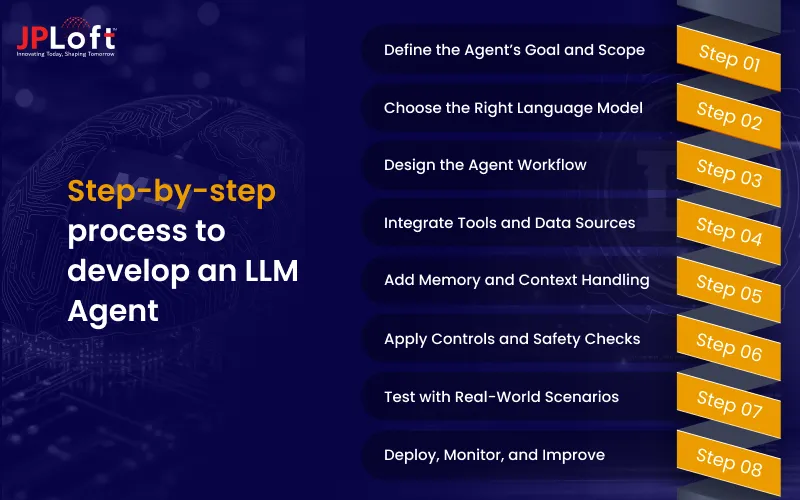
Here is the step-by-step process for large language model agent development.
Step 1: Define the Agent’s Goal and Scope
The development stage starts with setting up the direction. Without a clear goal and scope, the LLM agent development would result in wasted effort and unpredictable results. Hence, it is important to:
► Identify the core problem-
Start by clearly defining the problem the LLM agent is expected to solve. This could be automating a workflow, supporting decision-making, or handling a recurring task.
► Set clear boundaries
It is important to define the boundaries within which the LLM model will work. Decide what the agent is allowed to do and where it must stop.
These boundaries prevent the agent from taking unnecessary or risky actions and help maintain control once it is deployed in live environments.
► Define success criteria
Establish measurable indicators such as task completion accuracy, time saved, or response quality.
These benchmarks make it easier to evaluate performance and guide improvements during and after development.
Step 2: Choose the Right Language Model
The language model plays a central role in how the agent understands instructions and produces outputs.
Selecting the right model is a key decision to be made in large language model agent development as it significantly affects performance, cost, and reliability.
► Match the model to the task
Different tasks require different levels of reasoning and response depth. Hence, select a model that fits the complexity of the agent’s responsibilities, rather than choosing the most powerful option by default.
► Consider data sensitivity
Decide whether a hosted model, private deployment, or fine-tuned version best meets security and compliance needs. Such can help plan for data sensitivity and its regulation as per the set norms.
Step 3: Design the Agent Workflow
Workflow design defines how the agent processes tasks from start to finish. This step further focuses on logic and structure, which are essential when you build an LLM agent for real operational use.
► Plan task breakdown
Decide how complex LLM agent development tasks will be divided into smaller steps. Breaking tasks down helps the agent process information more accurately and reduces the chance of errors during execution.
► Set decision checkpoints
Include points where the agent reviews its progress before moving forward. These checkpoints help catch issues early and ensure actions align with the intended goal.
Also, prepare the agent for situations where results differ from expectations. This allows it to adjust actions instead of failing or producing unreliable outputs.
Step 4: Integrate Tools and Data Sources
Tool integration allows the agent to move beyond text responses and perform real actions. This step turns planning into execution and is a key part of practical LLM agent development.
► Connect APIs and systems
At this stage, API and third-party integrations are planned, which include providing the agent access to the databases, internal tools, or third-party services to complete tasks. This enables the agent to retrieve information and trigger actions independently.
► Manage data flow
Along with integrating APIs and tools, it is important to define the data flow and ensure data passed between systems remains structured, accurate, and consistent. Clean data flow helps the agent produce reliable results across different workflows.
Step 5: Add Memory and Context Handling
Memory planning allows an LLM agent to maintain continuity across interactions. Without proper memory design, the agent treats every task as new, which limits its usefulness in ongoing workflows and complex processes.
► Decide what the agent should remember
When developing LLM Agents, ensure they are able to identify which information needs to persist across interactions, such as user preferences, past actions, or task history. Limiting memory to relevant details helps maintain clarity and prevents unnecessary data accumulation.
► Choose the right memory structure
Decide how memory will be stored and accessed, whether as short-term context for active tasks or long-term storage for recurring workflows. A clear structure improves accuracy and response consistency.
Step 6: Apply Controls and Safety Checks
Defining controls during the LLM agent development phase is critical to ensure that the agent behaves responsibly. This step focuses on reducing risks and maintaining predictable behavior when developing large language model agents for business use.
► Validate outputs before action
Implement checks or the testing of the model that review the agent’s output before it triggers actions. This helps identify errors early and prevents incorrect or harmful responses.
► Limit access to sensitive systems
Restrict the agent’s permissions based on its role. Controlled access ensures that only necessary tools and data are available, reducing the chance of misuse.
► Define fallback behavior
Plan how the agent should respond when it cannot complete a task or encounters uncertainty. Safe fallback responses help maintain system stability and user trust.
Step 7: Test with Real-World Scenarios
Testing -the developed platform ensures the agent performs as expected when launched for the final users. At this stage of LLM agent development, the testing results help refine behavior and improve reliability before full deployment.
► Simulate real workflows
Test the agent using actual tasks and realistic data. This reveals how it performs in daily operations and highlights areas that need improvement.
► Identify edge cases
Look for unusual inputs or conditions that may cause errors. Addressing these cases early reduces failures after deployment.
► Refine prompts and logic
Use test results to improve instructions, decision logic, and tool usage. Small adjustments here can significantly improve overall performance.
Step 8: Deploy, Monitor, and Improve
Deployment marks the beginning of continuous optimization. An LLM agent needs to be monitored and updated constantly to remain effective as needs evolve.
► Monitor performance and usage
Track accuracy, response quality, and system usage to understand how the agent performs over time. Monitoring helps identify issues before they impact users.
► Collect feedback and insights
Gather input from users and system logs to understand real-world behavior. Feedback provides valuable direction for future updates.
► Improve and adapt regularly
Update the agent as workflows, tools, or business goals change. Ongoing improvement ensures the agent continues to deliver value over the long term.

Key Technical Components Required to Build an LLM Agent
To build an LLM agent that works in real environments, the system must be structured around a few essential components.
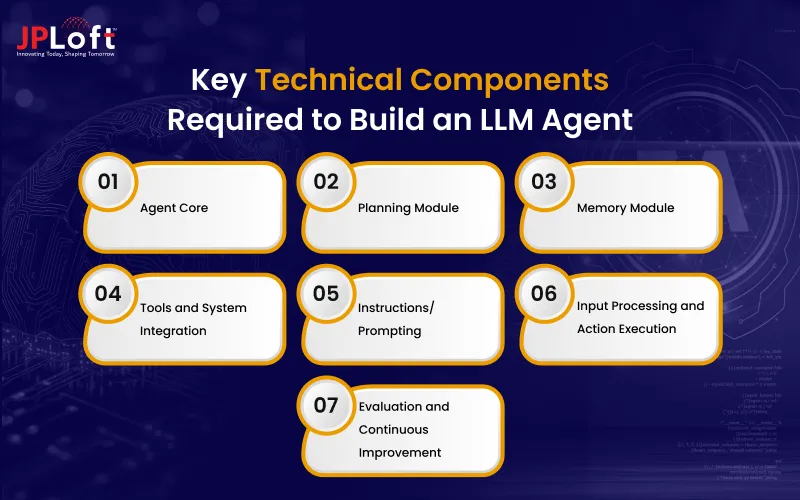
Here are some of the key components to consider that can help control how the agent understands goals, plans actions, interacts with tools, and improves over time. When any one of these is missing or weak, the agent becomes unreliable or difficult to manage.
Component 1. Agent Core
The agent core is the component of the Large Language Model that handles understanding and reasoning. It interprets input, evaluates context, and decides what action should be taken next.
The quality and performance of this core directly impact how well the agent understands instructions and responds to complex tasks.
Component 2. Planning Module
Another component to be focused on is the planning module, which helps the LLM agent break a larger goal into smaller, logical steps. Instead of trying to complete everything at once, the agent plans actions in sequence.
This planning ability is what allows the agent to handle multi-step workflows with better control and accuracy. Hence, is one of the most important components to focus on when planning to develop an LLM agent.
Component 3. Memory Module
Memory module helps the agent keep track of past interactions and task progress. Short-term context supports active tasks, while long-term memory stores useful information for future use.
Hence, it is important to focus on proper memory design while developing a large language model agent that prevents repetition and improves consistency across sessions.
Component 4. Tools and System Integration
Another key component to be focused on is the tool and system integration that allows the agent to interact with real systems such as APIs, databases, and internal platforms.
This component turns the agent into an active system that can retrieve data, trigger actions, and complete tasks instead of only generating text.
Component 5. Instructions/Prompting
In the process of understanding what are agents in LLM focus on the instructions that define how the agent should behave, what rules it must follow, and which goals matter most.
Setting up clear behavior control helps limit errors and keeps outputs aligned with business needs throughout LLM agent development.
Component 6. Input Processing and Action Execution
This component manages how the agent receives information and how decisions turn into actions.
It connects user or system input with the agent’s reasoning and ensures actions are executed correctly through approved tools.
Component 7. Evaluation and Continuous Improvement
Evaluation allows the agent to review outcomes and improve over time. Such an approach allows making improvements and upgrades to the LLM agent.
By tracking performance and learning from results, the agent becomes more reliable and better aligned with real-world requirements.
Challenges in LLM Agent Development And Potential Solutions
Developing an LLM agent can have several benefits for the businesses, but they also introduces a set of technical challenges that appear once the system moves beyond controlled testing.
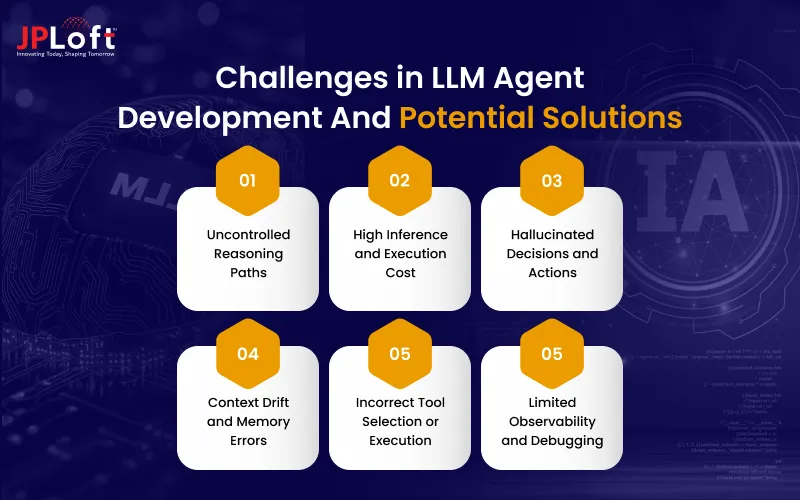
These challenges affect reliability, cost, and system safety. Addressing them at the development phase helps teams build agents that perform consistently in production environments.
Challenge 1: Uncontrolled Reasoning Paths
LLM agents can follow reasoning paths that technically satisfy a prompt but fail to meet system intent. This happens when planning logic is too open or when decision boundaries are not clearly defined, leading to unexpected actions.
Solution: Introduce structured planning logic, explicit task constraints, and decision checkpoints when creating an LLM agent. Enforcing intermediate validation steps helps keep execution aligned with system goals.
Challenge 2: High Inference and Execution Cost
Agent-based workflows often require multiple inference calls and tool interactions for a single task. Over time, this increases compute usage and operational cost, especially in continuous or high-volume systems.
Solution: Optimize task sequencing, limit recursive reasoning loops, and apply caching for repeated outputs. Model selection should be based on task complexity rather than default capacity when planning to build an LLM agent.
Challenge 3: Hallucinated Decisions and Actions
The developed LLM Agents may generate actions based on assumed information rather than verified data. But if such occurs in production systems, this can lead to incorrect decisions or unsafe operations.
Solution: Ensure ground agent reasoning through external data retrieval and enforcing action gating. Every output should pass validation checks before triggering downstream processes.
Challenge 4: Context Drift and Memory Errors
Improper memory handling can cause agents to lose track of task state or rely on outdated context. Such can lead to inconsistent behavior across sessions and reduces the reliability of the LLM Agents.
Solution: Separate short-term task state from long-term memory and apply time-based or relevance-based memory updates when planning to develop an LLM agent to maintain accuracy.
Challenge 5: Incorrect Tool Selection or Execution
Agents may select the wrong tool or execute tools in the wrong order if the tool logic is loosely defined. This can result in failed workflows or partial task completion.
Such a gap results in impacting the overall performance of the developed LLM agent.
Solution: Define explicit tool schemas, usage rules, and execution conditions. Adding pre-execution checks ensures tools are only invoked when required.
Challenge 6: Limited Observability and Debugging
Without visibility into agent decisions, diagnosing failures becomes difficult. Lack of observability in the process to create an LLM agent and deployment slows improvement and increases maintenance effort.
These challenges need to be addressed as they can impact value delivered by LLM agents.
Solution: Hire AI developers who can implement detailed logging of reasoning steps, tool calls, and outcomes. Monitoring these signals supports debugging and continuous system refinement.
Cost to Develop an LLM Agent: What Businesses Should Expect
The cost to develop an LLM agent varies based on what the agent is expected to do and how deeply it integrates into business workflows. Building LLM agents is expensive than the cost to build AI agents and require planning logic, memory handling, tool access, and ongoing monitoring, which directly influence the overall budget.
For a basic LLM agent with a limited scope and simple task flow, development costs usually start between $10,000 and $50,000. These agents typically handle narrow use cases with minimal integrations and basic decision logic.
A mid-level LLM agent that supports multi-step workflows, connects with several tools, and manages context more effectively often falls in the range of $50,000 to $100,000. This level is common for operational automation and internal business use cases.
For advanced LLM agents designed for complex decision-making, enterprise workflows, and multiple integrations, development costs can range from $150,000 to $250,000 or more. These agents require stronger planning, safety controls, and extensive testing.
Along with such LLM agent development cost, businesses should also plan for ongoing operational costs. Model usage, infrastructure, monitoring, and optimization typically add $3,000 to $15,000 per month, depending on usage volume and system complexity.
Future Trends in LLM Agents
LLM agents are moving toward more structured and dependable systems. As organizations use them in real operations, the focus is shifting from experimentation to long-term reliability and control.
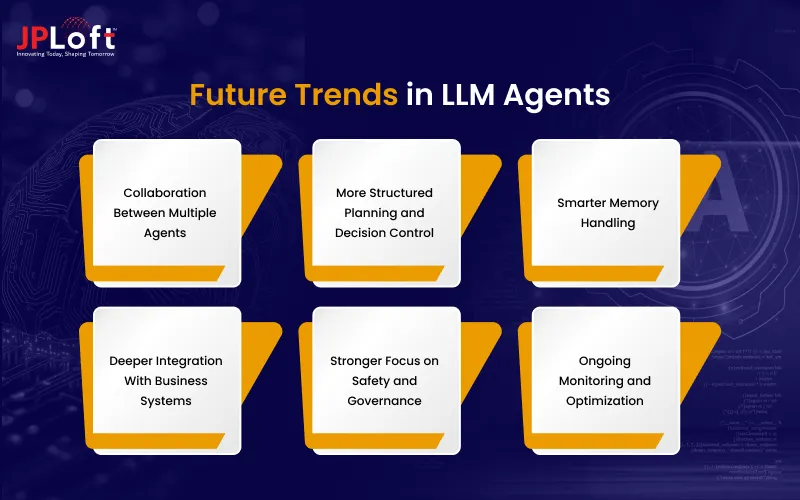
Here are some of the key trends that shows how LLM agent development will evolve.
1. Collaboration Between Multiple Agents
Future systems will rely on multiple agents working together, each with a defined role. One agent may focus on planning, another on execution, and another on validation.
This collaboration will improve accuracy, reduce failure points, and will makes complex workflows easier to manage and scale. Hence, the future LLM agent development best practices will revolve around ensuring such collaborations.
2. More Structured Planning and Decision Control
Planning logic will become more structured, with clear limits on how agents break down tasks and choose actions.
Review points will be built into workflows when planning how do LLM agents work, so agents can verify progress before moving forward. This reduces unexpected behavior and keeps execution aligned with business rules.
3. Smarter Memory Handling
The advance use of memory systems will introduce a key transformation in the large language model agent development. It will contribute to a shift toward relevance-based storage instead of saving all past interactions.
Agents will recall only the information needed for the current task. This improves consistency while reducing errors caused by outdated or unnecessary context.
4. Deeper Integration With Business Systems
LLM agents will integrate more rigorously with internal tools, APIs, and data platforms. Such integrations will allow these agents to support end-to-end workflows across teams.
Stronger integration also helps maintain accuracy and security when agents interact with enterprise systems.
5. Stronger Focus on Safety and Governance
As agents gain more autonomy, governance will become a core requirement. Permission controls, activity logs, and compliance checks will be built into agent systems.
These measures help ensure agents operate responsibly within defined limits. Businesses are recommended to hire dedicated developers who can help plan for such safety and governance.
6. Ongoing Monitoring and Optimization
Another key trend that will transform the process to create an LLM agent is the ongoing monitoring and real time optimization.
Such monitoring will play a larger role in long-term agent success. Teams will track performance, behavior, and costs to identify issues early. Further, continuous optimization helps agents remain useful as business needs and systems change.

Why Partner With JPLoft For LLM Agent Development?
Building an LLM agent requires more than technical setup. It demands clear goals, controlled system design, and an understanding of how agents perform in real business environments.
Partnering with JPLoft, an experienced LLM development company, helps businesses move from experimentation to reliable implementation.
JPLoft follows a structured approach to LLM agent development, focusing on stability and real-world usability. Every agent is built around defined objectives, clear boundaries, and measurable outcomes.
This ensures the system remains aligned with business workflows instead of becoming complex or unpredictable over time. Key components such as planning logic, memory handling, tool integration, and safety controls are designed to work together as a unified system.
Security and operational control are treated as core requirements from the start. The developers at JPLoft applies validation layers, permission controls, and monitoring mechanisms early in development. This reduces risk when agents interact with internal systems, data, or users.
As a trusted partner in the LLM development process, JPLoft also supports the complete lifecycle of agent development. From initial planning and architecture design to deployment, monitoring, and ongoing improvement, the focus stays on long-term performance.
Conclusion
LLM agents are transforming how AI is applied in real business environments. Unlike basic models that only respond to prompts, agents are designed to plan tasks, take actions, and adapt across ongoing workflows.
As LLM agent development continues to mature, the focus is shifting toward consistency, control, and long-term usability. Businesses that understand how LLM agents work and invest in the right architecture are more likely to see lasting value. Also, a clear development process also helps reduce risk and avoid unpredictable behavior once agents move into production.
Whether you are exploring how to build an LLM agent or planning to scale existing systems, success depends on thoughtful design and ongoing improvement. When developed correctly, LLM agents support daily operations, reduce manual effort, and improve decision-making. With the right planning, developing large language model agents becomes a practical step toward smarter and more efficient business workflows.
FAQs
An LLM agent is an AI system that can plan tasks, make decisions, and take actions on its own. A regular LLM only responds to prompts. An agent uses memory, tools, and decision logic to complete multi-step workflows instead of giving one-time answers.
LLM agents work by breaking goals into steps, using tools to fetch data or trigger actions, and reviewing results before moving forward. This loop allows them to handle tasks like workflow automation, data analysis, and system monitoring with minimal human input.
LLM agents work by breaking goals into steps, using tools to fetch data or trigger actions, and reviewing results before moving forward. This loop allows them to handle tasks like workflow automation, data analysis, and system monitoring with minimal human input.
To build an LLM agent, start by defining the agent’s goal and scope, then design its workflow, memory, and tool access. Testing, safety controls, and monitoring are added before deployment to ensure the agent works reliably in real environments.
An LLM agent is an AI system that can plan tasks, make decisions, and take actions on its own. A regular LLM only responds to prompts. An agent uses memory, tools, and decision logic to complete multi-step workflows instead of giving one-time answers.

Rahul Sukhwal is the CEO and Founder of JPLoft, a visionary technologist with 18+ years at the forefront of emerging tech innovation and software engineering. He channels deep software engineering and AI expertise into building smarter, scalable solutions that shape how forward-thinking businesses worldwide harness the true power of AI.




Share this blog