


Key Takeaways
App development in Dallas requires planning, market research, technology selection, skilled hiring, testing, and continuous updates.
Mobile app development in Dallas uses technologies like Flutter, React Native, AI, cloud computing, and secure backends for scalability.
Businesses face challenges like high competition, rising costs, talent hiring issues, security concerns, and maintaining performance.
Custom mobile app development in Dallas ranges from USD 10,000 to USD 150,000+, depending on the app complexity.
Future trends include AI integration, 5G apps, AR/VR experiences, blockchain security, and cross-platform development.
Businesses prefer JPLoft for its expertise, agile approach, skilled developers, transparent communication, and timely deliveries.
Businesses planning to build a mobile app in Dallas can make a smart move to grow in this competitive and tech-driven market. The city has quickly become a strong hub for innovation, with over 330+ app development companies operating, making it an ideal place to turn your app idea into reality.
Whether you want to improve customer engagement, streamline operations, or launch a new digital product, having the right development approach is key. From choosing the right technology stack to hiring skilled developers, every step plays an important role in your app’s success.
Mobile app development company offers access to experienced talent, modern infrastructure, and a supportive business environment that helps speed up development. However, without a clear plan, the process can feel complex and overwhelming.
In this blog, you will learn how to develop mobile app in Dallas step by step, along with practical insights to help you make informed decisions.
Why is Dallas a Growing Hub for Mobile App Development?
Dallas has quickly transformed into one of the most promising locations to build a mobile app, attracting startups, enterprises, and tech talent alike. It gained popularity for its powerful mix of economic strength, innovation, and accessibility.
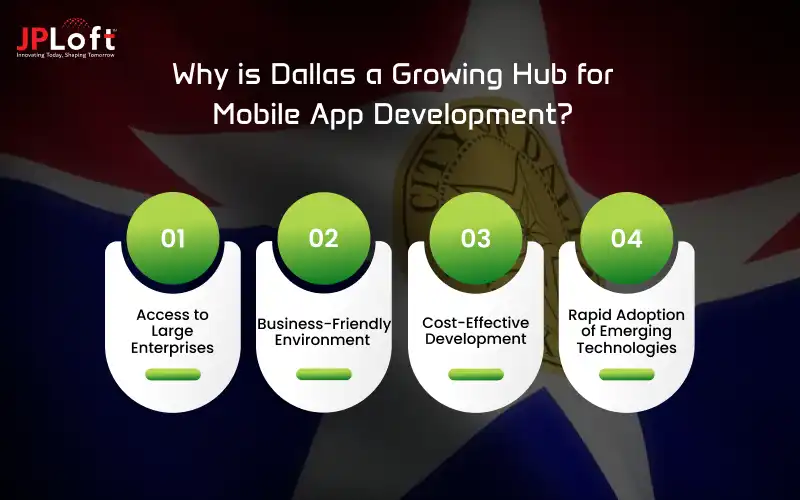
The following are the reasons for the growing demand for development services:
1. Access to Large Enterprises
Dallas is home to many large enterprises and Fortune 500 companies that actively invest in digital transformation. This creates strong demand for apps and opens opportunities for partnerships, giving developers exposure to large-scale projects and helping businesses build robust, high-quality solutions.
2. Business-Friendly Environment
Dallas attracted $1.9 billion in venture capital with 15-20% annual growth, supporting 193+ funded startups. Dallas provides a highly business-friendly environment with low taxes, fewer regulations, and strong government support. These advantages to make a mobile app in Dallas help you to establish operations, reduce costs, and focus more on innovation, product development, and scaling efficiently.
3. Cost-Effective Development
Global mobile app revenue is projected at $626+ billion by 2030, boosting local opportunities. Compared to major tech cities like San Francisco or New York, Dallas offers more affordable development services. Businesses can build high-quality apps at budget-friendly rates.
4. Rapid Adoption of Emerging Technologies
Companies in Dallas actively adopt emerging technologies such as artificial intelligence, blockchain, AR/VR, and 5G. This encourages developers to create a mobile app in Dallas that is innovative and future-ready, helping businesses stay competitive while enhancing user experiences.
Dallas combines talent, affordability, innovation, and opportunity, making it a strategic choice for businesses looking to build a powerful app. Now, let's look at the step-by-step process on how to build a mobile app in Dallas successfully.
Step-by-Step Process to Develop a Mobile App in Dallas
If you develop a mobile app in Dallas, you require a clear and structured approach. Each step helps reduce risks, control costs, and ensure a successful launch.
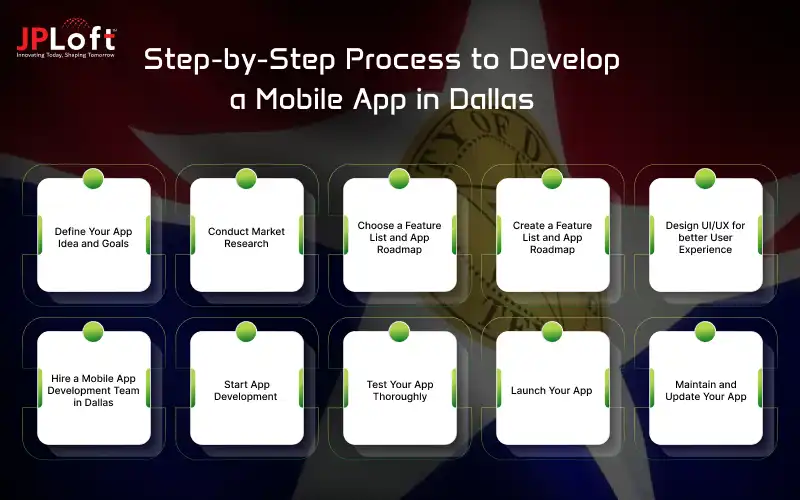
Here is a simple step-by-step process to help you with how to make a mobile app in Dallas:
Step 1: Define Your App Idea and Goals
Start by identifying the purpose of your app. Understand the problem it will solve and who your target users are. Clear goals help shape features, design, and overall development strategy. Focus on one core idea instead of adding too many features at the beginning.
A well-defined idea reduces confusion during development and ensures your team stays aligned with business objectives. It also helps in creating a strong foundation for future enhancements and scalability.
Step 2: Conduct Market Research
Research your competitors and study similar apps in your industry. Analyze what works well and where users face issues. This helps you develop a mobile app in Dallas with improved features and user experience.
In Dallas, you can also explore local business trends to align your app with market demand. A well-defined idea reduces confusion during development and ensures your team stays aligned with business objectives. It also helps in creating a strong foundation for future enhancements and scalability.
Step 3: Choose a Feature List and App Roadmap
Decide whether you want a native, hybrid, or cross-platform app. Native apps offer better performance, while cross-platform ones reduce app development time and cost. Your decision should depend on your budget, timeline, and target audience.
Choosing the right approach ensures efficient use of resources and better app performance. It also impacts long-term maintenance, scalability, and overall user experience.
Step 4: Create a Feature List and App Roadmap
List all the features you wish to include in your custom mobile app development in Dallas. Divide them into must-have and advanced features. This helps you build a minimum viable product (MVP) first and then improve it over time. A clear roadmap keeps your project focused and organized.
A structured roadmap helps avoid feature overload and keeps development on track. It also ensures timely delivery while allowing room for future updates and improvements.
Step 5: Design UI/UX for better User Experience
A simple and clean design improves user engagement. Create app wireframes and app prototypes to visualize your app before development starts. Focus on easy navigation, fast loading, and responsive design.
Good UI/UX plays a major role in your app’s success. User-friendly design increases retention and encourages users to spend more time on your app. It also reduces confusion and improves overall satisfaction with the product.
Step 6: Hire a Mobile App Development Team in Dallas
Choose experienced developers who understand your business goals. You can locally hire software developers or build an in-house team. Dallas offers access to skilled professionals, making it easier to find the right talent for your project.
Working with the right team improves communication and ensures high-quality output. It also helps in meeting deadlines and handling technical challenges effectively.
Step 7: Start App Development
This is the main stage of how to make a mobile app in Dallas, where developers turn your idea into a working product. The process usually includes frontend and backend development.
Regular updates and communication with your team help ensure everything stays on track. Following agile practices allows flexibility and continuous improvements during development. It also helps in quickly adapting to changes or new requirements.
Step 8: Test Your App Thoroughly
Mobile app testing is important to remove bugs and improve performance. Conduct multiple tests such as functional testing, usability testing, and performance testing. A well-tested app provides a smooth user experience and reduces the chances of failure after launch.
Early and regular testing helps identify issues before they become major problems. It also ensures your app meets quality standards and user expectations.
Step 9: Launch Your App
Once your app is ready, publish the app on the iOS App Store and Google Play. Make sure your app follows all guidelines and requirements. A proper app launch on the Play Store helps attract initial users and build visibility.
A strong launch plan includes marketing, promotions, and user onboarding strategies. This helps generate downloads and creates momentum in the early stages.
Step 10: Maintain and Update Your App
App development does not end after launch. Regular updates are needed to fix bugs, improve features, and stay relevant in the market. Collect user feedback and make improvements to keep users engaged.
Ongoing maintenance ensures your app performs smoothly over time. It also helps you stay competitive by adapting to new trends and user needs.
A clear plan, the right team, and continuous improvement are the keys for businesses to build a mobile app in Dallas with better efficiency for long-term success. The next important step is to evaluate the cost of development in Dallas.
How Much Does It Cost to Develop a Mobile App in Dallas?
The cost to develop a mobile app in Dallas typically ranges between USD 10,000 to USD 150,000+. This price depends on the complexity, features, and development approach of the app. This range aligns with industry benchmarks and the choice of the mobile app development services in USA.
Below is a table to understand your budget breakdown for mobile app development in Dallas:
|
Development Stage |
Estimated Cost Range (in USD) |
Description |
|
Planning & Research |
$1,000 – $5,000 |
Market research, idea validation, project scope |
|
UI/UX Design |
$3,000 – $15,000 |
Wireframes, prototypes, user experience design |
|
Frontend Development |
$10,000 – $40,000 |
App interface and user-side functionality |
|
Backend Development |
$10,000 – $50,000 |
Servers, databases, APIs, integrations |
|
Testing & QA |
$5,000 – $15,000 |
Bug fixing, performance testing, security checks |
|
Deployment |
$1,000 – $5,000 |
App store launch and configuration |
|
Maintenance (Annual) |
15% – 25% of cost |
Updates, bug fixes, performance improvements |
Cost Based on App Complexity
The cost to build a mobile app may vary depending on the app's complexity:
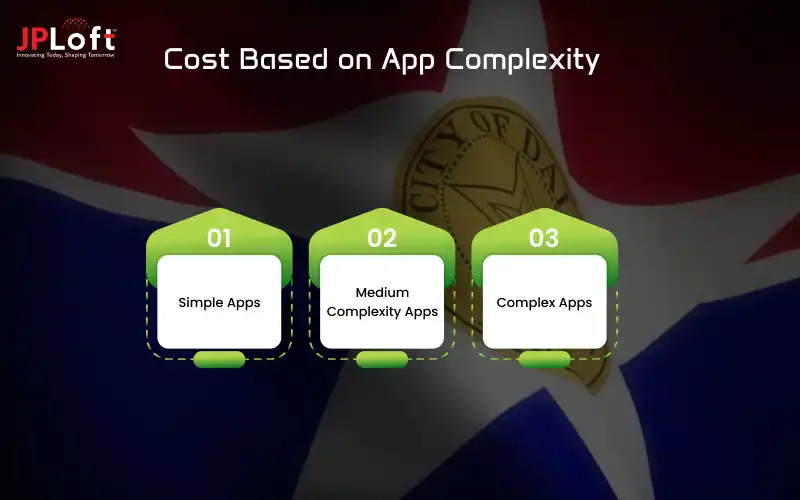
1. Simple Apps
Estimated Cost (in USD): $10,000 – $40,000
Features: Includes basic features such as simple UI, limited screens, and minimal backend functionality.
2. Medium Complexity Apps
Estimated Cost (in USD): $40,000 – $100,000
Features: These apps include features like user login, APIs, payment integration, dashboards, and admin panels.
3. Complex Apps
Estimated Cost (in USD): $100,000 – $150,000+
Features: Advanced mobile app features include real-time features, AI integration, custom backend systems, and high-level security.
Whether you are building a simple MVP or a feature-rich app, having a clear scope and strategy helps you stay within budget while achieving your business goals. In the next section, we will explore the top technologies used to create a mobile app in Dallas.
Top Technologies Used for Mobile App Development in Dallas
Mobile app development in Dallas is driven by modern, scalable, and performance-focused technologies. Hire dedicated developers in Dallas, as they adopt a mix of frameworks, programming languages, and advanced tools to build high-quality apps for different industries.
Here is a table for the top technologies used in mobile app development in Dallas:
|
Category |
Technologies |
Purpose / Benefits |
|
Cross-Platform Frameworks |
Flutter, React Native, Kotlin Multiplatform |
Build apps for multiple platforms using a single codebase, reducing time and cost |
|
Native Development |
Kotlin (Android), Swift (iOS) |
High performance, better security, and full access to device features |
|
Backend Technologies |
Node.js, .NET |
Scalable server-side development and efficient handling of app logic |
|
APIs & Communication |
REST APIs, GraphQL |
Smooth data exchange between frontend and backend systems |
|
Cloud & Backend Services |
Firebase, AWS |
Real-time database, storage, hosting, and scalability |
|
UI/UX Design Tools |
Figma, Adobe XD, SwiftUI |
Create user-friendly, interactive, and visually appealing app interfaces |
|
Emerging Technologies |
AI, AR/VR, 5G |
Enable smart app features, immersive experiences, and faster performance |
|
DevOps & Deployment Tools |
Docker, Kubernetes, Jenkins, GitHub Actions |
Automate deployment, improve scalability, and ensure continuous integration |
|
Testing Tools |
Automated Testing Tools |
Detect bugs early and ensure app quality and performance |
App development in Dallas relies on a mix of modern frameworks, powerful programming languages, cloud technologies, and emerging innovations. Choosing the right combination helps you build futuristic apps. But addressing potential development challenges early helps ensure long-term success.
Common Challenges in Mobile App Development in Dallas
Mobile app development companies in Dallas offer many advantages, but businesses still face several challenges during the process. Accounting for these app development challenges early can help you plan better and avoid costly mistakes.
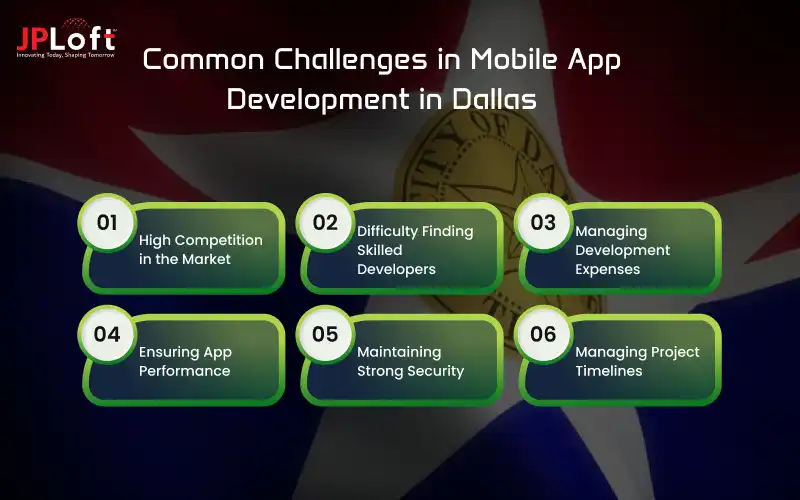
Below are the common challenges in mobile app development in Dallas that are generally faced by businesses:
Challenge 1: High Competition in the Market
Dallas has a fast-growing tech ecosystem with many startups and enterprises building mobile apps. Standing out becomes difficult as businesses compete for user attention, innovation, and market share across multiple industries.
Solution: Focus on a unique value proposition, strong branding, and user-focused features to differentiate your app from competitors.
Challenge 2: Difficulty Finding Skilled Developers
Although Dallas has a strong talent pool, hiring experienced developers with the right technical skills and industry knowledge can still be challenging, especially for complex or niche app requirements.
Solution: Partner with experienced development companies or use a structured hiring process to select skilled and reliable developers.
Challenge 3: Managing Development Expenses
Budget management is a common concern, as app development involves design, development, testing, and maintenance costs. Without proper planning, expenses can increase and affect overall project success.
Solution: Start with an MVP, prioritize essential features, and plan the budget carefully to control costs and avoid unnecessary spending.
Challenge 4: Ensuring App Performance
Users expect fast, smooth, and responsive apps. Poor performance, slow loading times, or frequent crashes can lead to negative reviews and low user retention when you make a mobile app in Dallas.
Solution: Optimize code, conduct performance testing, and use scalable technologies by the assistance of experienced app maintenance services to ensure smooth performance.
Challenge 5: Maintaining Strong Security
As cyber threats increase, protecting user data is critical. Weak security measures can lead to data breaches, loss of trust, and legal issues for businesses operating in Dallas.
Solution: Implement strong encryption, secure APIs, and regular mobile app security testing to protect user data and prevent vulnerabilities.
Challenge 6: Managing Project Timelines
Attracting users is not enough. Keeping them engaged over time is a major challenge, especially when users have many alternative apps available.
Solution: Use personalized features, push notifications, and regular updates to improve user engagement and retention.
By understanding these challenges in mobile app development in Dallas and applying the right solutions, businesses can navigate and achieve long-term success effectively. While challenges can impact your app development, they also highlight areas where innovation is rapidly evolving.
Future Trends in Mobile App Development in Dallas
Mobile app development in Dallas is evolving rapidly as businesses adopt advanced technologies to stay competitive. With the city’s strong tech ecosystem, these trends are shaping how modern apps are designed, developed, and experienced.
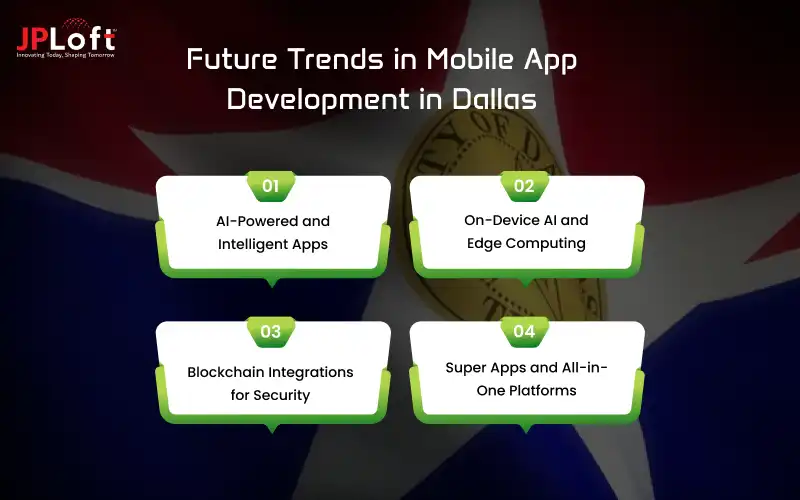
The popular future trends for mobile app development in Dallas that every business should know about are:
1. AI-Powered and Intelligent Apps
AI is becoming the foundation of mobile apps rather than just an added feature. Apps now use AI for personalization, automation, and predictive user experiences. Businesses in Dallas are building smarter apps by getting AI app development services that adapts to user behavior and delivers real-time insights.
2. On-Device AI and Edge Computing
Apps are shifting from cloud dependency to on-device processing. This improves speed, reduces latency, and enhances data privacy. Dallas companies are adopting AI in app development and edge computing to deliver faster and more secure app experiences, even with limited internet connectivity.
3. Blockchain Integrations for Security
Blockchain is gaining traction in mobile app development, especially in industries like fintech and healthcare. Partnering with an experienced blockchain development company enhances transparency, data security, and trust. Dallas companies are increasingly using blockchain for secure transactions and decentralized applications.
4. Super Apps and All-in-One Platforms
The concept of building a super app is growing globally and gaining attention in Dallas. These apps combine multiple services like payments, messaging, and shopping into a single platform, improving convenience and user engagement.
AI, speed, security, and immersive experiences drive the future of how to build a mobile app in Dallas. Businesses that adopt these trends early can build innovative, scalable, and future-ready mobile apps.
Why Businesses Choose JPLoft for Mobile App Development in Dallas?
Businesses choose JPLoft for mobile app development in Dallas because of its strong focus on quality, innovation, and client success. With years of experience across industries, JPLoft understands what it takes to build apps that deliver real business value.
JPLoft, an experienced mobile app development company in Dallas, follows an agile development approach, which ensures flexibility, faster delivery, and continuous improvements throughout the project.
Our team works closely with clients to understand their goals, target audience, and market needs. This helps businesses launch apps that are not only functional but also engaging and easy to use.
The company also offers access to skilled developers who are experienced in modern technologies like AI, cloud integration, and cross-platform frameworks. This ensures your app is scalable, secure, and ready for future growth.
With transparent communication, timely delivery, and dedicated support, JPLoft has become a trusted partner for businesses looking to develop high-quality mobile apps in Dallas.

Conclusion
Knowing how to develop mobile app in Dallas offers businesses a strong advantage due to its growing tech ecosystem, skilled talent, and cost-effective opportunities. Following a structured development process, choosing the right technologies, and understanding potential challenges, businesses can build apps that deliver real value to users.
Dallas provides the right environment to turn ideas into scalable digital products, but success depends on clear planning and execution. As the industry continues to evolve, staying updated with future trends such as AI, 5G, and immersive technologies will help businesses remain competitive.
Focusing on user experience, performance, and security is equally important for long-term growth. Whether you are a startup or an established enterprise, investing in mobile app development companies in Dallas can open new opportunities for innovation and business expansion.
With the right strategy and team, you can create an app that stands out and drives lasting success.
FAQs
Businesses prefer Dallas due to its strong tech ecosystem, skilled talent pool, and cost-effective development services. The city offers a business-friendly environment, access to modern technologies, and growing demand across industries, making it ideal for building scalable mobile applications.
The process includes defining the app idea, conducting market research, choosing the right technology, designing UI/UX, developing the app, testing for quality, launching on platforms, and maintaining it with regular updates based on user feedback.
Popular technologies include Flutter and React Native for cross-platform apps, Swift and Kotlin for native development, and backend tools like Node.js and Firebase. Advanced technologies such as AI, cloud computing, and APIs are also widely used.
Common challenges include high competition, difficulty in hiring skilled developers, managing development costs, ensuring app performance, maintaining security, and keeping up with evolving technologies. These issues can impact timelines, quality, and overall app success if not handled properly.
The cost typically ranges from USD 10,000 to USD 150,000+, depending on app complexity, features, and development approach. Simple apps cost less, while advanced apps with custom features, integrations, and high security require a higher budget.

Priyanka Sukhwal is the Managing Director and Business Head of JPLoft, a results-driven leader with 10+ years of experience steering technology ventures and business growth. Her strategic acumen and deep understanding of digital markets and on-demand solutions have consistently translated into innovations that help businesses scale, evolve, and lead in competitive landscapes.


Share this blog