


Key Takeaways
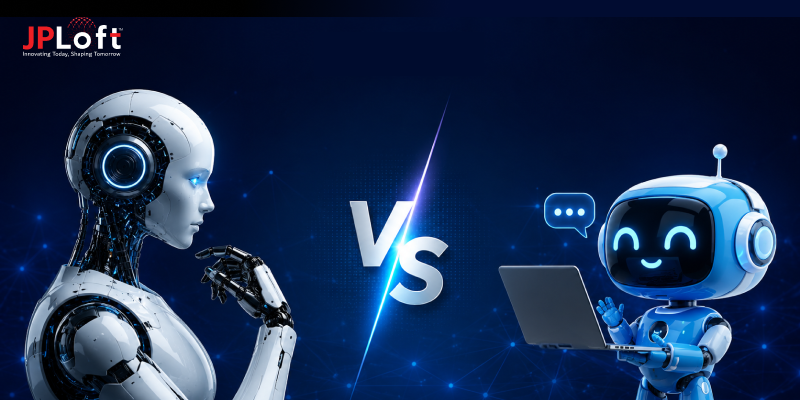
AI agent vs chatbot comes down to one core difference: chatbots focus on conversations, while AI agents focus on completing tasks and workflows.
Chatbots are best for FAQs, appointment booking, lead qualification, and other structured customer interactions with predictable flows.
AI agents are better suited for workflow automation, cross-system execution, and business processes that require context, decision-making, and action.
The right choice depends on factors like business goals, task complexity, system integration needs, human dependency, budget, and future scalability.
For many businesses, the best approach is not choosing one over the other, but using AI chatbots for front-end interactions and AI agents for deeper operational execution.
The way businesses interact with their customers is transforming rapidly. Simple automated replies are no longer enough when customers expect faster solutions and smarter systems.
This is where the discussion about AI agents vs. chatbots becomes important.
Chatbots introduced automation to conversations by handling queries and guiding users. Now, AI agents are pushing this further by not just responding, but understanding intent, making decisions, and completing tasks across systems.
This shift is creating a clear divide between the two solutions, especially for businesses aiming to scale operations and reduce manual effort.
In this blog, we will discuss the difference between an AI agent vs chatbot for business, and how to choose the right level of intelligence for your workflows.
What is an AI Agent vs. a Chatbot? Pros, Cons, and Core Capabilities
Businesses often wonder whether they need a chatbot or should build AI agents, but both serve very different roles in digital systems.
Understanding the differences between the two starts with how each one is built and what level of work it can actually handle.
► What is a Chatbot?
A chatbot is designed to respond to queries, follow predefined logic, and guide users to complete basic tasks.
Most chatbots work through rule-based flows or intent recognition. When a user asks a question, the system matches it with a known response and replies accordingly.
The AI chatbots are more intelligent than traditional chatbots, offer customized responses, understand situations, and can close a conversation without human intervention.
Nowadays, building AI chatbots is commonly preferred across customer support, lead capture, and basic automation across websites, apps, and messaging platforms.
Pros of Chatbot
-
Low cost and quick to deploy
-
Effective for repetitive queries
-
Reduces basic support workload
Cons of Chatbot
-
Limited understanding of complex requests
-
Depends on predefined conversation paths
-
Struggles with context-heavy interactions
► What is an AI agent?
An AI agent is an advanced system that goes beyond conversation. It is not meant to handle general user queries, but to complete the entire task autonomously.
AI agents don’t have a fixed rule book, but they follow a set operating procedure when a query arises and respond accordingly. Defining such operating procedures and testing them are also considered key challenges in building AI agents.
AI agents can understand goals, break tasks into steps, and execute actions across connected systems. Unlike a chatbot, its role does not end with providing answers.
For example, an AI agent integrated in a service workflow can reschedule appointments, update records, and trigger notifications without manual intervention.
AI agent Pros
-
Handles complex workflows efficiently
-
Enables deep automation across systems
-
Works well for enterprise-scale operations
AI agent Cons
-
Higher cost to develop AI agents and integration complexity
-
Requires strong system connectivity and governance
-
Needs careful control to avoid execution risks
AI Agent vs. Chatbot: Key Differences That Matter
Understanding the difference between AI chatbots and AI agents is not just about going through definitions. It is important to understand how these impact business automation design, customer experience, and internal workflows.
This evaluation becomes important when businesses evaluate scalability, automation depth, and long-term efficiency, and look for an AI development services provider.
The table below breaks down how both AI chatbots and agents behave across critical dimensions.
|
Parameter |
Chatbot |
AI agent |
|
Core Purpose |
A chatbot is designed to respond to user queries and guide conversations within a fixed structure. It focuses on interaction and support. |
An AI agent is designed to achieve a goal. It interprets intent, plans actions, and works toward completing tasks across systems. |
|
Working Approach |
It follows predefined flows, rules, or trained intents to generate responses. It reacts to user input rather than initiating actions. |
It uses contextual reasoning to break down goals into steps and decide how to execute them dynamically. |
|
Autonomy Level |
It depends entirely on user prompts and stops after delivering a response. |
It operates with partial to high autonomy and can continue workflows without repeated instructions. |
|
Task Handling Ability |
Best suited for simple and linear tasks like FAQs, bookings, and basic support queries. |
Handles multi-step and interconnected tasks that require coordination across systems and data sources. |
|
Decision Making |
Selects answers based on predefined logic or the closest intent match. |
Evaluates context and determines the best sequence of actions to achieve the desired outcome. |
|
Context Handling |
Works with limited conversational memory, often session-based. |
Maintains a longer context and uses it to improve continuity across tasks and interactions. |
|
System Integration |
Integrates with a small set of tools, like help desks or basic CRM modules. |
Connects with multiple enterprise systems such as CRM, ERP, APIs, and databases to execute actions. |
|
Business Output |
Provides information, answers, or redirects users to relevant resources. |
Delivers completed actions such as updates, processing, and workflow execution. |
This comparison makes it clear that the AI agent vs chatbot comparison is not just about which is better, but is a shift from conversational support to execution-driven intelligence.
Business Use Cases: Where Chatbots and AI Agents Fit Best
The selection between a chatbot and an AI agent can not be done based on technology alone. This decision needs to be made depending on how complex the operations are and what kind of output the system needs to deliver.
Some business processes only require conversation support, while others demand full execution across workflows.
This is where the AI agent vs chatbot for business distinction becomes practical rather than theoretical.
A. When Chatbots Are the Right Fit
AI chatbot development works best in structured environments where user queries are repetitive and follow predictable patterns. They focus on interaction efficiency rather than decision-making or task execution.
They are commonly used for:
-
Customer support and FAQ automation
-
Appointment booking and scheduling requests
-
Lead qualification through simple conversational flows
-
Basic service requests and status updates
-
First-level assistance before human handover
Chatbots fit well in startups and SMBs where the primary goal is to handle high volumes of similar queries without increasing support costs. They perform reliably when interactions stay within defined boundaries and do not require system-level actions.
B. When AI agents Are the Better Choice
AI agents become valuable when business processes move beyond conversation and require coordinated action across systems. They are designed to handle complexity, context, and execution in real time.
They are commonly used for:
-
Workflow automation across multiple departments
-
Intelligent customer support that goes beyond replies into resolution
-
Internal operations such as reporting, approvals, and task routing
-
Data updates across CRM, ERP, and business platforms
-
End-to-end service execution involving multiple systems
This is where AI agents vs chatbots for enterprises becomes important. Enterprises rely on AI agent development solutions when accuracy, coordination, and automation depth directly impact operational efficiency.
AI Agent vs. Chatbot for Business: How to Choose the Right One
Choosing between chatbot and AI agent trends becomes easier when businesses evaluate a few clear decision factors.
Instead of treating it as a technical comparison, entrepreneurs should look at how the system will actually behave inside real workflows.
Here are the key factors that can help businesses decide between AI agents vs. chatbot solutions:
1. Define the Primary Business Goal
Start by identifying what the system is expected to achieve within the business workflow. This helps set the foundation for the entire chatbot vs AI agent decision.
-
If the goal is to respond to user queries, share information, or guide users through basic interactions, a chatbot is usually sufficient.
-
If the goal extends to completing tasks, triggering actions, or managing end-to-end workflows, planning for a suitable AI agent framework becomes a more suitable choice.
2. Evaluate Task Complexity
Understanding task complexity helps determine how far the system needs to go beyond simple responses. Based on the need for self-learning AI agents vs rule-based chatbots, customer interactions can be determined.
-
Chatbots perform well when tasks are structured, predictable, and follow a fixed flow, such as FAQs or basic service requests.
-
When tasks involve multiple steps, dependencies, or dynamic conditions, advanced features of AI agents handle them more effectively.
3. Assess Decision-Making Requirements
Another factor to be considered when deciding between the models and to hire AI developers to build either an AI chatbot or AI agent is the role of autonomous decision-making in the operational process.
-
Chatbots operate on predefined rules or intent-based responses and deliver answers based on matching patterns.
-
AI agents go further by analyzing context, interpreting intent, and selecting the most relevant action path. When reasoning is required instead of static responses, AI agents provide a stronger capability.
4. Check System Integration Needs
The level of integration required with business systems also influences the choice between a virtual agent vs AI chatbot.
-
Chatbots typically connect with limited tools such as helpdesk platforms, basic CRM modules, or website widgets.
-
AI agents are designed for deeper integration across multiple systems like CRM, ERP, APIs, and databases, enabling them to execute real actions.
5. Understand Human Dependency
The selection between the AI agents vs chatbots solutions is also based on how much human involvement is expected in the workflow. Businesses should define the level of automation they expect in a workflow.
-
Integrating chatbots in your app or business workflow often requires escalation to human agents when queries go beyond predefined limits.
-
AI agents reduce this dependency by handling end-to-end tasks and executing workflows with minimal manual intervention.
6. Consider Budget and Implementation Effort
Budget and development efforts also play a major role in decision-making. The development and integration cost for both varies at large.
-
The cost to build and deploy an AI chatbot is effective, and even its deployment process is faster, making it suitable for early-stage automation.
-
AI agents require higher investment due to system integrations, data handling, and architectural complexity, but they deliver deeper automation value over time.
7. Plan for Scalability and Future Growth
When performing an AI agent vs chatbot comparison, it is important to think beyond current needs and evaluate future scalability.
-
A key benefit of AI-powered chatbots is that they are effective when automation requirements are limited, stable, and no major scalability is expected.
-
On the other hand, AI agents are better suited for businesses expecting expansion across departments, systems, and workflows where automation needs will grow in complexity over time.
Conclusion
The difference between AI chatbots and AI agents lies in purpose and depth of execution.
A chatbot is built to communicate. It handles user queries, follows predefined flows, and supports routine interactions efficiently. An AI agent is built to act. It understands intent, plans steps, and completes tasks across systems with minimal input.
Apart from how these chatbots and AI agents work, it is also important for the business to evaluate their operational workflow before finalizing a model. Chatbots work well for structured conversations and basic support, whereas AI agents are better suited for workflows that require autonomous decision-making and execution.
As businesses scale, many move from simple conversational tools to intelligent automation systems. The real focus is not choosing one over the other, but aligning the solution with the level of complexity and outcomes required.
FAQs
An AI agent is a system that understands goals, plans actions, and completes tasks across tools and workflows. A chatbot is designed to respond to user queries using predefined flows or trained intents. The key AI agent vs chatbot difference is execution. Chatbots focus on conversation, while AI agents focus on outcomes.
In 2026, the main difference lies in autonomy and decision-making. Chatbots handle structured conversations and basic support. AI agents manage multi-step workflows, make decisions based on context, and execute tasks across connected systems. This makes the AI agents vs chatbots difference in 2026 a shift from interaction to automation.
AI agents are more powerful when businesses need workflow automation, system integration, and decision-based execution. However, chatbots are still effective for FAQs, lead capture, and simple customer interactions. The choice in AI agents vs traditional chatbots depends on complexity and business goals.
A virtual agent usually refers to a more advanced AI system that can handle broader tasks, while an AI chatbot focuses mainly on conversational responses. Virtual agents often include AI agent-like capabilities such as task execution, while chatbots remain interaction-focused.
Not always. AI agents can replace chatbots in complex workflows, but chatbots are still useful for lightweight, high-volume interactions. Many businesses use both together, where chatbots handle first-level queries, and AI agents manage deeper automation and execution tasks.

Rahul Sukhwal is the CEO and Founder of JPLoft, a visionary technologist with 18+ years at the forefront of emerging tech innovation and software engineering. He channels deep software engineering and AI expertise into building smarter, scalable solutions that shape how forward-thinking businesses worldwide harness the true power of AI.



Share this blog