



Key Takeaways
Top challenges in building an enterprise app start with weak market research and unclear scope, leading to scope creep, delayed timelines, and unnecessary cost escalation.
Complex integration, scalability, and performance issues require a modular architecture to support growth without slowing down core business operations.
Security and compliance challenges must be handled early to protect sensitive data, reduce legal risk, and maintain enterprise-level trust.
Poor user adoption remains a major risk when usability, training, and change management are ignored during implementation.
High development and maintenance costs can be controlled through agile workflows, automation, and standardized components.
Partnering with JPLoft helps businesses overcome enterprise app challenges using secure architecture, scalable systems, and a long-term growth strategy.
Do you know that large enterprises account for 57.8% of the mobile enterprise app development platform market in 2025?
Well, it's true, when you enter an enterprise industry or think about converting your app into reality, there can be certain challenges that you might face.
Therefore, the question arises as “What are the top challenges in building an enterprise app?”
Well, the challenges while making an enterprise app can be many, such as a lack of market research, poor design of an app, complicated integration process, and many more.
In this guide, you will learn the complete list of challenges in building an enterprise app.
Let’s begin.
What is an Enterprise App and How Does it Work?
An enterprise app is a large-scale software system that is particularly designed to manage and automate an organization’s core business operations.
Along with this, such apps target individual users, as enterprise apps cater to the complex needs of companies, government agencies, and large institutions, which have handling tasks such as employee management, resource planning, and much more.
Here, these applications are built to accommodate thousands of users. The enterprise apps cater to the complex needs of companies, government agencies, and large institutions that are handling tasks such as resource planning, data analytics, and employee management.
In short, the working process of Enterprise apps.
- User Authentication: Employee logs in using credentials. System verifies identity and grants access based on role permissions.
- Data Input & Processing: User enters business information. Application validates data, applies business rules, and processes it according to workflows.
- Data Storage & Integration: Validated data is securely saved in the database and synchronized with other connected devices and enterprise systems.
- Analysis & Reporting: The system analyzes processed data and generates dashboards, reports, and insights for business decisions.
- Output & Notifications: Application delivers results to users through reports, alerts, and notifications about completed actions or required approvals.
Well, as you learned about the app and the working process, one of the important parameters to build an enterprise app is assessing in-depth research related to enterprise apps.
Now, as we proceed further, let’s evaluate the complete market stats and other related statistics related to an enterprise app in the following section.
Market Overview of Enterprise Apps
Do you know that the current market of an enterprise app is projected to reach USD 625.66 billion by 2030, which is growing at a CAGR of 11.8% from 2025 to 2030?
Well, let's evaluate some more statistics in this section related to an enterprise app.
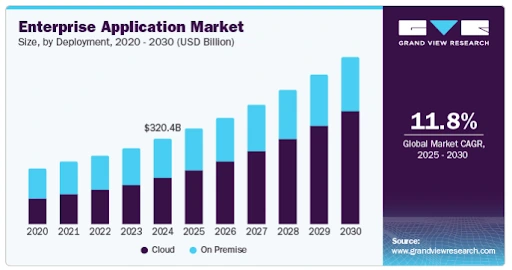
-
The enterprise app market in the Asia Pacific region is projected to experience the fastest CAGR of 15.3% from 2025 to 2030.
With the market stats covered, let’s explore the complete list of challenges involved in building an enterprise app in the next section.

Top Challenges in Creating an Enterprise App
The challenges in building an enterprise app can include a lack of market research, inappropriate design of the app, poor scalability of the app, and many more.
Let’s evaluate the complete list of challenges in building an enterprise app.
1. Lack of Market Research
Poor market research can fail the app, and this can even lead to scope creep because you will not be aware of the target audience and their behavior.
Along with this, ignoring the market research will lead to losing your place or position in the market to competitors.
Without an in-depth market study, you will not be aware of the prospective strategies used by the competitors in retaining and gaining market share.
Solution:
The solution for this issue is, you should consider a complete market study of your prospective market research.
Considering the market research can help evaluate your project scope, identify the current users’ demands, and how these demands are changing in this prospective competitive environment. It will help you to address the issues related to competitor analysis.
2. Complex Integration Requirements
When you begin with the enterprise app features and the third-party integrations, you might face challenges related to the complete integration process.
Each system may use different protocols, data formats, and APIs, making integration technically demanding. Hence, evaluating the right integration or even using the wrong integrations can be one of the significant challenges while creating an enterprise app.
Solution:
Ensuring real-time data synchronization across all platforms without disruptions requires extensive planning and robust middleware solutions. Enterprise apps must seamlessly connect with multiple existing systems like ERP, CRM, databases, and legacy platforms.
3. Scalability and Performance
Poor scalability can lead to system crashes, slow response times, and frustrated users, ultimately impacting business operations.
This can create an issue in the UI/UX of an app, which will impact the overall user experience in the long run.
If you lack in planning for the scalability of the app, then it can result in a poor app’s lifecycle, affecting its overall architecture, performance, maintenance, and the ability to support the growing user base.
Solution:
Enterprise applications need to handle thousands of concurrent users across multiple locations without performance degradation.
The system must scale efficiently as the organization grows, accommodating increased data volumes and user load. Here, the solution is to plan the scalability for your app while developing it.
4. Security and Compliance
Another crucial challenge faced while building an enterprise app is security and compliance. If you are losing security, you will lose the user’s trust in the long run.
Protecting sensitive business data from cyber threats while meeting industry regulations like GDPR, HIPAA, or SOX is critical. Any mobile app security breach can result in significant financial losses, legal penalties, and damage to the company's reputation.
Solution:
Enterprise apps require multi-layered security, including encryption, secure authentication, and regular vulnerability assessments.
Hence, it is important to proceed with the security protocols, and also crucial for enhancing the trust of a user in an enterprise app.
It is one of the proactive approaches that reduces legal and financial risk and enhances business resilience.
5. User Adoption and Change Management
This is one of the crucial challenges in creating an enterprise app, as poor user adoption rates or a lack of change management can result in ineffective app development.
Employees often resist transitioning from familiar legacy systems to new enterprise applications. Without proper training, intuitive design, and clear communication of benefits, adoption rates remain low.
Solution:
Organizations must invest in comprehensive change management strategies to ensure smooth transitions and maximize the app's ROI.
Here, you should opt for the user adoption and change management training for the employees, as it will be helpful to enhance their skillset. It is one of the important solutions when it comes to such a challenge.
6. High Development and Maintenance Costs
Building enterprise-grade applications requires significant financial investment in skilled developers, infrastructure, and a technology stack. Ongoing maintenance, updates, security patches, and feature enhancements add to the total cost of enterprise app development.
Budget overruns are common due to scope creep, unforeseen technical challenges, and extended development timelines.
Solution:
You should proceed with the combination of strategic planning, efficient processes, modern technology, and automation.
Here, the key approaches comprise adopting agile methodologies, prioritizing modular design, and implementing robust automated testing. This can further result in optimizing the overall cost and will benefit in the long run. You can connect with the leading mobile app maintenance services to maintain your app.
7. Cross-Platform Compatibility
You should be aware of this challenge, as with complicated platforms or evading the core users over the platforms can even result in failure of the app. Different screen sizes, hardware capabilities, and OS versions further complicate the development process.
Along with this, debugging issues is one of the crucial challenges when it comes to creating an enterprise app.
Solution:
Enterprise apps must function seamlessly across various devices (desktop, mobile, tablets) and operating systems (Windows, iOS, Android).
Ensuring consistent user experience and functionality across all platforms requires additional development effort and testing. You should evaluate the process of submitting an app to the App Store or launching the app on the Play Store.
8. Inappropriate App Design
Inappropriate mobile app design or ineffective page responsiveness can impact the overall user experience and even the retention rate of users on the platform. With an effective user design, you will not be able to attract potential users to the app.
Hence, it is one of the top challenges in making an enterprise app. With a poor design, your app will not work smoothly.
Solution:
The solution to inappropriate enterprise app design starts with clear user research and defined user journeys. Align UI and UX decisions with real user needs, accessibility standards, and business goals.
Use wireframes and prototypes early to validate usability. Regular testing and feedback help refine the design before development scales. You can connect with the top UI/UX design services to address such challenges for your customized app.
9. Data Migration from Legacy Systems
Another challenge in developing an enterprise app is data migration from the legacy system. It is basically a technical and logistical issue.
Transferring vast amounts of historical data from old systems to new enterprise apps is complex and risky. Data may be stored in outdated formats, contain inconsistencies, or lack proper documentation.
Solution:
Ensuring data integrity, preventing loss during migration, and minimizing downtime during the transition process requires meticulous planning and execution.
You should consider a detailed data audit system to identify formats, dependencies, and quality issues. Implementing automated migration tools with rollback plans can be an important solution for this issue.
10. Customization vs. Standardization Balance
Different departments within an organization often have unique workflow requirements and preferences. Hence, the challenge can be finding the right balance between customization and standardization.
Over-customization can lead to complexity, higher costs, and difficulties in future updates. Hence, this is an important challenge to consider while creating an enterprise app.
Solution:
A crucial solution for this issue is maintaining a balance between customization and standardization. For suppose in customization, it is important to focus on adaptability, security, integration, and user experience.
While standardization requires you to focus on a balanced approach of technical guidelines, process consistency, and alignment with business objectives. Hence, it's important to keep the balance between these two models.
11. Long Development Cycles
Enterprise applications typically require extensive development time due to their complexity, multiple stakeholder requirements, and rigorous testing needs.
Long development cycles can result in the final product being outdated by the time it launches.
Agile methodologies help, but coordinating large development teams and managing changing requirements remains difficult.
Solution:
To cope with such a challenge, it is important to use low-fidelity wireframes, the lean method, you need to design a review before planning sprints, and to go with automated testing.
Along with this, it is important to follow agile and two-week sprints. You can use strategies such as code optimization, caching, minimization, image optimization, and much more.
12. Performance Monitoring and Analytics
Tracking application performance, user behavior, and system health in real-time across distributed enterprise environments is technically challenging.
Organizations need comprehensive monitoring tools to identify bottlenecks, predict failures, and optimize resource allocation. Without proper analytics, it's difficult to measure ROI and make data-driven decisions for improvements.
Solution:
The solutions for performance monitoring and analytics comprise specialized software tools and strategic practices.
You should identify performance trends, needs to set realistic and data-driven goals, along with this, you need to monitor real-time performance. Here, you need to align performance with business objectives.
Now, as you follow the challenges while making an enterprise app, let's evaluate the best team to hire mobile app developers in the following section.
Why Choose JPLoft to Create an Enterprise App?
Choosing the right partner for an enterprise app begins with reliability, scalability, and long-term vision. Enterprise applications demand secure architecture, seamless integrations, compliance readiness, and the ability to scale as business operations grow.
Without the right expertise, these requirements often become major challenges that increase risk, cost, and implementation time.
A strong development partner ensures performance under heavy workloads, smooth user experiences across devices, and systems that evolve with changing business needs. This foundation reduces risk, controls costs, and accelerates digital transformation.
This is where JPLoft stands out as a trusted enterprise app development company. JPLoft combines deep technical expertise with strategic planning to build enterprise-grade applications tailored to complex business environments.
From architecture design to deployment and ongoing support, JPLoft delivers secure, scalable, and future-ready enterprise solutions that drive efficiency, innovation, and measurable business growth globally.
.webp)
Conclusion
The creation of an enterprise application requires overcoming numerous issues, ranging from security compliance and scalability to integration and adoption.
It is important to mitigate the challenges in building an enterprise app through performance monitoring, data migration, selecting cross-platform compatibility, and performing a detailed market study.
It becomes an important task for the enterprise to standardize amid customization, estimate the cost, and ensure smooth data migration from the legacy system. By overcoming such issues, you can create enterprise applications for driving efficient enterprise operations. It also ensures the fulfillment of future enterprise requirements, which is only possible when you collaborate with professional application developers.
FAQs
There are different challenges of enterprise apps, such as poor market study, complexity in integration of an app, data migration from the legal system, high maintenance and update costs, cross-platform compatibility, and security, as well as compliance.
Successful adoption requires comprehensive change management, including employee training, intuitive UI/UX design, and clear communication of app benefits. Organizations should involve end-users early in the development process, gather continuous feedback, and address concerns proactively.
Enterprise apps support large user bases and growing data volumes. Without scalability planning, apps face performance issues, downtime, and high maintenance costs. Scalable architecture ensures long-term stability as business operations expand.
Enterprise apps often rely on ERP, CRM, payment, and analytics systems. Each integration adds development time, testing effort, and maintenance cost. Poor integration planning can lead to data inconsistencies and operational bottlenecks.
Security should be built from the earliest development stage, not added later. Early implementation reduces risks, prevents costly rework, and ensures compliance with regulations like GDPR or industry standards. Late security fixes often increase cost and delay launches.

Savannah is a passionate tech enthusiast with a sharp understanding of client needs across diverse digital domains. With expertise spanning financial platforms, on-demand solutions, and emerging technologies, she brings a unique blend of analytical insight and interpersonal skills, helping businesses decode complexities and make informed decisions in today's rapidly evolving digital world.




Share this blog