


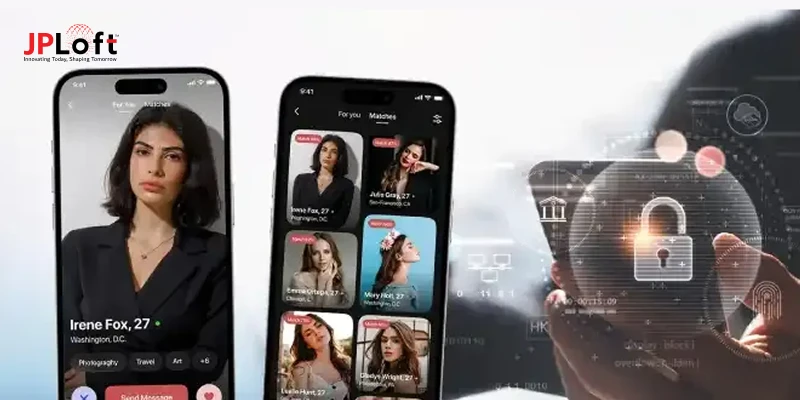
Key Takeaways:
Dating app security must be built into the architecture from day one, not added after launch when the damage is already done.
The most exploited vulnerabilities in any dating app are technical, insecure APIs, weak authentication, and insufficient encryption, which are development failures first.
AI-powered tools like deepfake detection, behavioral biometrics, and predictive risk scoring are the new baseline for any secure dating platform.
GDPR and CCPA compliance are trust signals that users, investors, and regulators actively look for before engaging with your platform.
Visible security features like verification badges and privacy dashboards are what turn first-time users into loyal ones.
Dating app security has never been more critical.
With over 350 million people using dating platforms globally, these apps have become prime targets for cybercriminals, data brokers, and predators.
Users share sensitive personal details, location, photos, preferences, and financial information, creating a goldmine for hackers if left unprotected.
When these dating apps fail to protect users, the consequences are severe: identity theft, financial fraud, stalking, doxxing, and emotional trauma.
High-profile breaches, like the Ashley Madison leak, exposed millions of private profiles, destroying lives and reputations overnight.
Beyond breaches, weak dating app security enables fake profiles, catfishing scams, and non-consensual image sharing.
As digital intimacy grows, so does user vulnerability. Robust security isn't optional; it's the foundation of trust that keeps users safe and platforms credible.
In this blog, one by one, we will talk about threats, security features, and best practices to secure dating apps.
Let’s get into it:
What is Dating App Security?
Dating app security refers to the combination of technical safeguards, privacy protocols, and user-safety features. Together, they protect individuals on online dating platforms from data breaches, identity theft, harassment, and unauthorized access.
At its core, it encompasses:
-
End-to-end encryption to secure private conversations
-
Identity verification to eliminate fake profiles
-
User data privacy controls to limit third-party data sharing
-
Secure authentication, including two-factor login
-
Real-time content moderation to flag harmful behavior
Every dating platform, regardless of size, needs robust online dating protection because users share deeply personal information that, if exposed, can cause lasting real-world harm. Trust is the currency of dating apps; without security, that trust collapses entirely.
For developers and entrepreneurs, these features are not optional. They are essential when you create a dating app that users can trust and rely on.
From building an app for a niche community to mass markets, understanding the best ways to secure your dating app is the first step to winning your users.
But you can't build the right defenses until you know exactly what threats are coming for you.
Top Security Threats in Dating Apps
Love might be blind, but cybercriminals certainly aren’t.
Dating platforms sit at a unique intersection of motion and data, making them extraordinarily attractive targets for bad actors.
The security of a dating app can never be an afterthought; it’s a frontline battle fought every single day against increasingly sophisticated threats.
And the numbers prove it: three out of four major dating platforms score a D or F grade for cybersecurity.

Here's what's lurking beneath the surface:
1. Insecure API Endpoints
Most dating app breaches don't happen through the front door; they happen through poorly secured APIs that developers left exposed during build.
Unprotected endpoints, missing authentication tokens, and improper rate limiting give attackers direct access to your entire user database without ever triggering a single alarm.
Every unvalidated API call is an open invitation to extract sensitive user data at scale.
What We Do: We implement token-based authentication, strict rate limiting, and input validation on every API endpoint we build.
Every data pathway is locked down at the architecture level, ensuring your entire infrastructure is secured long before a single user ever touches your app.
2. Data Leaks and Breaches
A single data breach on a dating platform can expose millions of users simultaneously, including names, email addresses, preferences, photos, and conversations.
Unlike financial apps, dating platforms store emotionally sensitive data that can be weaponized for blackmail, public shaming, or coordinated harassment campaigns.
This reputational damage can kill your platform.
What we do: As a mobile app development company experienced in launching a variety of dating platforms, we focus on end-to-end encryption, secure database architecture, and rigorous access control protocols.
Every data touchpoint, from registration to messaging, is engineered with data breach prevention at its core.
We don’t patch security after launch. We architect it before a single line of user-facing code is written.
3. Identity Theft
Identity Theft is often seen as one of the huge challenges in dating apps.
Users willingly share full names, birthdays, workplaces, and linked social accounts, all the raw ingredients needed for personal data theft and sophisticated takeover attacks.
Once compromised, stolen identities are sold on the dark web, used to defraud others, or leveraged to destroy victims’ personal and professional lives.
What we do: We integrate Veriff for AI-powered document verification and biometric selfie-matching, alongside Lasso for intelligent identity risk-scoring, ensuring every user on your platform is exactly who they claim to be.
4. Payment Fraud
Another dating app risk that can diminish your app’s popularity is “Payment fraud.”
Now, how it happens, premium features, in-app purchases, and subscription that make dating apps financially rewarding, and equally attractive to fraudsters.
Payment fraud on dating platforms ranges from stolen credit card abuse and chargeback scams to phishing schemes disguised as legitimate billing notifications.
One compromised transaction flow can trigger regulatory penalties, chargebacks, and devastating user churn.
What we do: Our team integrates PCI-DSS-compliant payment gateways, real-time transaction monitoring, and multi-layered financial fraud protection into every dating app we develop.
We partner with industry-leading payment processors and implement tokenization to ensure sensitive financial data never touches your core systems.
This level of protection is only possible when you hire app developers experienced in secure payment architecture.
5. Location Privacy Risks
“Near you’’ features are powerful engagement tools, and potentially catastrophic security vulnerabilities when poorly implemented.
Without proper geolocation security, bad actors can use basic distance-spoofing techniques for domestic abuse survivors.
LGBTQ+ users in unsafe regions, and underage users who may have bypassed age gates.
What we do: We develop location data protection using fuzzy location masking, adjustable proximity radius settings, and strict opt-in geolocation controls, giving your users full ownership over what they share and with whom.
Our proximity feature safety framework ensures your “near you” functionality drives matches, not danger.
Because a truly great dating app makes users feel excited to be found, never exposed.

Must-Have Security Features for Dating Apps
Security doesn't begin at launch; it begins at the blueprint stage.
When people join a dating app, they're not just creating an account; they're handing over their name, location, photos, and private conversations.
Every feature in a dating app must carry a security responsibility. Dating app safety isn't a checkbox; it's the entire foundation. Here's what genuinely secure platforms are built with:
|
Security Feature |
What It Does |
Why It Matters |
|
Profile Verification |
Validates user identity through document checks, selfie-matching, and biometric confirmation |
Eliminates fake profiles, catfishing, and romance scammers before they reach real users |
|
End-to-End Encryption |
Encrypts every message, photo, and media file exchanged between users |
Ensures private conversations stay private — completely unreadable to third parties |
|
Secure Login Systems |
Combines two-factor authentication, OAuth login, and session timeout controls |
Blocks unauthorized account access even when passwords are compromised |
|
AI Fraud Detection |
Monitors behavioral patterns and flags suspicious activity in real time |
Identifies and removes bad actors automatically before damage is done |
|
Privacy Settings for Users |
Gives users full control over location sharing, profile visibility, and data permissions |
Empowers users to define their own safety boundaries on their own terms |
So, these are some of the features that can be beneficial for your dating app, and you must have in your app.
Let’s get to know the best practices to secure your dating app:
Best Practices to Secure Your Dating App
Every entrepreneur looking to start an online dating business eventually faces the same critical question: how do you actually protect the people using your platform?
The brutal truth? Users will forgive a clunky UI. They will never forgive a breach. Every best practice listed below isn't theoretical advice; it's a battle-tested development discipline that separates platforms users trust from platforms users abandon.

Here's how to build security for your dating app right from the first day:
1. Adopt a Security-First Development Mindset
The most overlooked ways to secure dating apps start not in the code but in the culture. Security cannot be a final-stage checklist. It must be embedded into every sprint, every feature decision, and every architecture discussion from day one.
-
Define security requirements before writing a single line of code
-
Conduct threat modeling sessions at the start of every development phase
-
Train every developer on OWASP Top 10 vulnerabilities
-
Make security sign-off a mandatory gate before any feature ship
2. Implement Strong Authentication Protocols
The single most powerful tip to secure a dating app is controlling who gets in — and how. Weak authentication is the open door that every hacker walks through first.
-
Enforce multi-factor authentication (MFA) across all user accounts
-
Integrate OAuth 2.0 for secure third-party login options
-
Implement session expiry controls to auto-logout inactive users
-
Use bcrypt or Argon2 for bulletproof password hashing
3. Encrypt Everything — No Exceptions
Understanding how to secure your dating app comes down to one non-negotiable principle — encryption is non-optional. When calculating the cost to develop a dating app, encryption infrastructure is the last place to cut corners. If data exists on your platform, it must be encrypted.
-
AES-256 encryption for all data stored on servers
-
TLS 1.3 protocols for all data in transit
-
Encrypt user metadata, not just messages and photos
-
Ensure encryption keys are rotated regularly and stored separately
4. Build a Fortified Backend Infrastructure
The security of a dating app lives and dies in its backend. A beautiful frontend means nothing if the server architecture underneath it is riddled with exploitable gaps.
-
Deploy apps behind Web Application Firewalls (WAF)
-
Use containerization to isolate services and limit breach spread
-
Implement DDoS protection at the infrastructure level
-
Conduct regular server hardening audits to eliminate misconfigurations
5. Integrate Verified Identity Checks
Anonymous access is a luxury that fraudsters exploit relentlessly, and if you're serious about how to secure your dating app, knowing exactly who is on your platform at all times isn't a feature; it's the foundation on which everything else is built.
-
Use Veriff or Jumio for AI-powered identity verification & tough security
-
Implement liveness detection to prevent photo spoofing at signup
-
Add phone number verification as a baseline onboarding requirement
-
Flag accounts that show suspicious identity inconsistencies automatically
6. Deploy AI-Powered Threat Detection
A secure dating app doesn't just react to threats, it anticipates them. Intelligent, real-time monitoring is what separates platforms that catch problems early from those that discover breaches in the headlines.
-
Use machine learning models to detect abnormal user behavior patterns
-
Automate fake profile detection using image recognition technology
-
Monitor login anomalies like unusual locations or rapid account switching
-
Set up real-time alerts for suspicious mass messaging or data scraping attempts
7. Stay Ahead of Compliance Requirements
The importance of dating app security extends directly into legal territory. Non-compliance doesn't just attract fines, it si;nals to investors and users alike that your platform cannot be trusted with sensitive data.
-
Built with GDPR and CCPA compliance baked into the data architecture
-
Implement cookie consent management and transparent privacy policies
-
Maintain detailed data processing records for regulatory audits
-
Appoint a dedicated Data Protection Officer (DPO) for enterprise-level apps
8. Make Security a Visible User Feature
The greatest benefits of the security of a dating app are only valuable if users can see and feel them. Visible security builds confidence, and confident users stay, engage, and pay.
In a crowded dating app market, user-visible security is one of the most underrated dating app ideas that converts first-time visitors into long-term loyal users.
-
Display verification badges prominently on approved profiles
-
Give users a clear, accessible privacy dashboard to control their data
-
Send real-time security notifications for logins and profile changes
-
Publish a transparent security page explaining how you protect users
9. Test, Audit, and Test Again
Truly future-proof security features in dating apps aren't built once and forgotten; they're continuously stress-tested against an ever-evolving threat landscape. Every update, every new feature, and every third-party integration is a potential new vulnerability, and ongoing testing is the only way to stay ahead of it.
-
Schedule quarterly third-party penetration testing.
-
Run automated vulnerability scans after every major update
-
Launch a bug bounty program to incentivize ethical hacker discoveries
-
Document and review every security incident to prevent recurrence
With best practices being clear, let’s find out how AI, which is currently a famous technology, is shaping the dating market.
Role of AI in Dating App Security
Artificial intelligence has fundamentally changed what's possible in dating app security, moving platforms from reactive damage control to intelligent, real-time threat prevention.
AI in dating apps is no longer a futuristic feature; it's the sharpest weapon in a developer's security arsenal.
Secure dating apps built today don't just rely on rules and filters; they think, learn, and adapt continuously to protect users from threats that evolve faster than any manual system ever could.

Here's how AI is transforming dating app security in ways nothing else can:
1. Deepfake Detection
Around three-quarters of deepfake attacks target CEOs and other C-suite executives.
The Problem: AI-generated faces have become so convincing that even trained human moderators can’t reliably spot them. This creates entirely fake identities that deceive thousands of genuine users.
The AI Solution: Among the most powerful use cases of computer vision in tech today, deepfake detection stands out as the most critical for dating platforms. Computer vision models scan every uploaded profile photo at the pixel level, detecting synthetic faces and GAN-generated images in milliseconds.
2. NLP-Based Scam Detection
The Problem: Romance scammers follow carefully crafted scripts designed to build false trust and extract money from vulnerable users, often before victims realize anything is wrong.
The AI Solution: As dating app trends shift toward AI-first safety infrastructure, Natural Language Processing models have become the sharpest tool in fraud prevention. They monitor private conversations in real time, catching financial solicitation language, manipulation tactics, and copy-paste scam scripts the moment they surface.
3. Behavioral Biometrics
The Problem: Once a hacker accesses a legitimate account, traditional security systems can't distinguish the intruder from the real user, and damage done under a stolen identity is catastrophic.
The AI Solution: AI builds an invisible behavioral fingerprint for every user, analyzing typing rhythm, scrolling speed, and navigation patterns. The moment behavior shifts dramatically, the system flags a potential takeover and triggers re-verification automatically: zero friction, maximum protection.
4. Real-Time Content Moderation
The Problem: Explicit imagery and non-consensual content get uploaded to dating platforms daily. Human moderation teams simply cannot review content fast enough at scale.
The AI Solution: AI vision models scan every uploaded image in milliseconds, removing harmful content before it ever reaches another user's screen. Understanding the importance of dating app security means recognizing that content moderation is a legal and ethical responsibility only AI can execute at modern platform speeds.
5. Predictive Risk Scoring
The Problem: The most dangerous users aren't the ones who've been reported; they're the ones who haven't been caught yet.
The AI Solution: AI assigns every new account an invisible risk score at registration, analyzing device fingerprints, IP reputation, and behavioral signals to flag high-risk users before they interact with anyone. The most underrated tip to secure a dating app that every development team should build first.
6. Geolocation Anomaly Detection
The Problem: Bad actors manipulate GPS data and use VPN masking to deceive nearby users and bypass regional restrictions entirely.
The AI Solution: AI cross-references real-time location against login history and device signals, instantly catching impossible travel scenarios and spoofing attempts before any harm is done. A direct benefit of dating app security is that genuine users feel it every single day.
How JPLoft Can Help You Develop a Secure Dating App?
As a dating app development company, JPLoft knows that security isn’t just a feature; it’s why users keep coming back. With over 1,100 projects delivered and a 95% client retention rate, our solid portfolio includes numerous secure dating platforms.
We build protection into every app from day one, not as an afterthought. Our apps feature identity verification, end-to-end encryption, AI-powered fraud detection, and compliance-ready architecture.
We don’t just slap on a security plugin; we design platforms that make users feel safe enough to be vulnerable, the heart of any dating app.
When you partner with JPLoft, you’re not just hiring developers; you’re getting a team that treats your users’ safety as seriously as you do.
Conclusion
Dating app security isn't a problem you solve once and move on from; it's a commitment you make to every single person who trusts your platform with their most personal moments.
Knowing how to secure your dating app goes far beyond ticking compliance boxes or adding a verification layer at launch.
It means building a culture of security from the first line of code, engineering protection into every feature, and treating user safety as the product, not just a part of it.
The threats are real, the stakes are high, and users today are more aware than ever of what a secure platform looks and feels like.
The dating apps that win long-term aren't just the ones with the best matching algorithm; they're the ones users feel genuinely safe on. That trust is earned through every decision made during development, and lost in a single breach.
If you're serious about building a platform people actually stay on, security is where that journey begins.
FAQs
The most effective approach combines AI-powered identity verification, biometric selfie-matching, and behavioral pattern detection. Tools like Veriff and Lasso help validate every user at onboarding — ensuring fake profiles are caught before they ever reach real users on your platform.
Security integration costs vary based on depth and complexity. Basic security features start from around $8,000–$15,000, while a full enterprise-grade security stack — including AI fraud detection, GDPR compliance, and penetration testing — can range from $30,000 to $80,000+. Investing in security upfront is always cheaper than recovering from a breach later.
If your dating app serves users in Europe or collects data from European citizens anywhere in the world, GDPR compliance is legally mandatory, not optional. Non-compliance can result in fines of up to €20 million or 4% of global annual revenue, whichever is higher.
From a development standpoint, the most critical threats are API vulnerabilities, weak authentication layers, and insufficient data encryption. These are the entry points most attackers exploit first. On the user-facing side, AI-generated fake profiles and deepfake identity fraud have made traditional verification methods completely obsolete.
At a minimum, quarterly penetration testing and automated vulnerability scans after every major update are recommended. Security is not a one-time event every new feature, third-party integration, or platform update introduces potential new vulnerabilities that need to be actively tested and addressed.

Savannah is a passionate tech enthusiast with a sharp understanding of client needs across diverse digital domains. With expertise spanning financial platforms, on-demand solutions, and emerging technologies, she brings a unique blend of analytical insight and interpersonal skills, helping businesses decode complexities and make informed decisions in today's rapidly evolving digital world.



Share this blog