



Key Takeaways
Flutter enables cost-efficient, cross-platform app development, making it an ideal choice for startups and enterprises aiming for faster launches.
The Flutter app development cost typically ranges between $30,000 and $120,000+, depending on features, complexity, scalability, and long-term maintenance needs.
Strategic planning around features, design, backend architecture, and testing helps control development expenses and avoid hidden costs later.
Choosing the right monetization strategy early supports better ROI while keeping development and operational costs balanced.
Partnering with an experienced team like JPLoft ensures expert guidance, transparent execution, and scalable Flutter solutions built for long-term business success.
Flutter has rapidly emerged as a go-to framework for building high-performance, visually consistent mobile applications across platforms using a single codebase. Backed by Google, it helps startups and enterprises accelerate development timelines while maintaining scalability and native-like user experiences.
So, how much does it cost to build a Flutter app? On average, the cost typically ranges between $30,000 and $120,000+, depending on app complexity, feature set, UI/UX depth, backend infrastructure, and development location.
This blog breaks down Flutter app pricing in detail, covering cost components, hidden drivers, optimization techniques, and monetization strategies, so you can plan your investment with clarity and confidence.
All About Flutter App
Flutter is an open-source UI software development kit developed by Google that enables businesses to build high-performance applications for mobile, web, and desktop, using a single codebase.
Instead of developing separate apps for Android and iOS, Flutter simplifies the process while delivering smooth, native-like experiences.
► What Makes Flutter Stand Out?
-
Single codebase, multiple platforms – Faster development with reduced effort
-
Dart-powered performance – Compiles directly to native code
-
Rich widget library – Highly customizable UI components
-
Hot reload functionality – Instant updates during development
For businesses exploring a reliable Flutter app development guide, these advantages translate into quicker launches, easier updates, and consistent UI across platforms.
► Real-World Adoption
Flutter isn’t just for prototypes or startups. Leading brands like Google Ads, Alibaba, and BMW actively use Flutter for production-grade applications, proving its scalability and long-term viability.
It’s a strong choice whether you’re launching an MVP or looking to create a mobile app that supports rapid growth.
► Cost Perspective
While Flutter significantly reduces development time through code reusability, the cost to develop a Flutter App still varies based on:
-
Feature complexity
-
UI/UX customization level
-
Third-party integrations
-
Backend and API architecture
Understanding how Flutter works at a foundational level helps businesses evaluate technical feasibility, development timelines, and budget expectations before diving into detailed cost breakdowns.

Average Cost to Develop a Flutter App
The average cost to develop a Flutter app generally falls between $30,000 and $120,000+, depending on the app’s complexity, features, and overall development scope.
Flutter’s single codebase approach helps reduce duplication efforts, but pricing still varies based on how simple or advanced the final product needs to be.
For a basic application with limited screens and minimal backend requirements, development usually starts around the lower end of the range.
Mid-level apps with user authentication, custom UI elements, and third-party integrations sit in the mid bracket.
More advanced Flutter applications, such as those with real-time functionality, complex APIs, and scalable infrastructure, tend to reach the higher end of the pricing spectrum.
While Flutter offers cost efficiencies, the Flutter app development cost should always be evaluated as a strategic investment.
Businesses that plan for future scalability, performance optimization, and long-term growth often find better ROI even when initial development costs are higher.
Quick Cost Breakdown
|
App Type |
Estimated Cost Range |
|
Basic Flutter App |
$30,000 – $45,000 |
|
Mid-Level Flutter App |
$45,000 – $75,000 |
|
Advanced Flutter App |
$75,000 – $120,000+ |
This breakdown provides a practical reference point for businesses assessing timelines and budgets before moving into detailed cost drivers and optimization strategies.
Factors Impacting the Overall Cost to Make a Flutter App
The overall cost to make a Flutter app isn’t defined by a single line item. Instead, it’s shaped by a combination of technical, design, and business decisions made throughout the development lifecycle.
Understanding these cost drivers helps you plan realistically, avoid surprises, and align your budget with long-term goals.
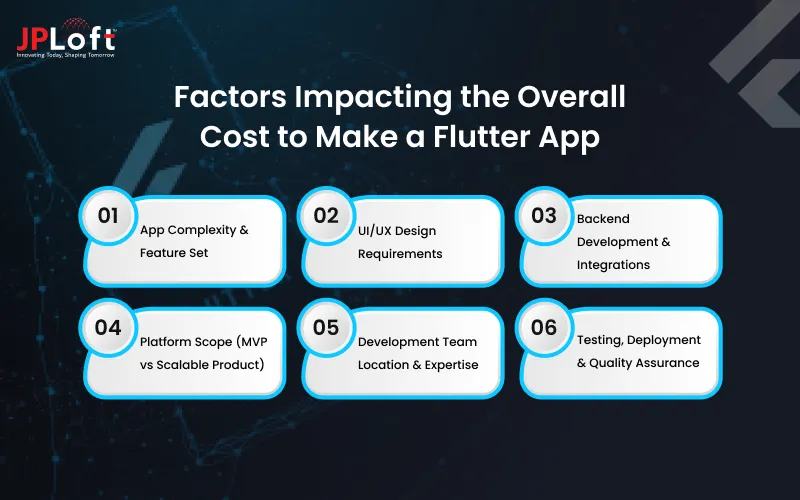
Below are the most important factors that influence pricing, broken down clearly and comprehensively.
1. App Complexity & Feature Set
One of the biggest contributors to the cost to create a Flutter App is how complex the app is.
-
Simple apps with static content and basic navigation cost less
-
Feature-rich apps with real-time updates, payments, chat, or dashboards cost significantly more
As features grow, so does development time, testing effort, and backend complexity, directly increasing the cost to make a Flutter app.
2. UI/UX Design Requirements
Flutter offers flexible widgets, but customization impacts pricing.
Apps that rely heavily on animations, custom transitions, and unique branding require more design and frontend development effort.
A highly polished interface can raise the Flutter app development cost, but it also improves user engagement and retention, making it a worthwhile investment for competitive products.
3. Backend Development & Integrations
The backend determines how scalable and secure your app will be. Costs increase when apps require:
-
Real-time databases
-
Cloud infrastructure
-
Third-party API integrations (payments, maps, analytics, CRM)
Your chosen mobile app tech stack plays a critical role here, as different technologies vary in setup, scalability, and maintenance costs.
4. Platform Scope (MVP vs Scalable Product)
While Flutter supports cross-platform development, the scope still matters:
-
MVPs focus on core features and cost less
-
Enterprise-grade apps need scalability, monitoring, and advanced security
This difference significantly affects the complete cost to develop a Flutter App, especially when future expansion is planned from day one.
5. Development Team Location & Expertise
Hourly rates vary by region and experience level. For example, partnering with a specialized mobile app development company in Denver may offer strong communication, domain expertise, and quality assurance, but often at a higher hourly cost compared to offshore teams.
Choosing the right team impacts not just pricing, but also delivery speed, code quality, and long-term maintainability.
6. Testing, Deployment & Quality Assurance
Comprehensive testing ensures your app performs well across devices and platforms.
Manual testing, automated testing, and performance optimization all add to the cost to develop a Flutter App, but they significantly reduce post-launch issues and user complaints.
Cost Breakdown by Key Factors
|
Cost Factor |
Estimated Price Range |
|
App Complexity & Features |
$10,000 – $40,000 |
|
UI/UX Design |
$5,000 – $20,000 |
|
Backend Development & APIs |
$8,000 – $30,000 |
|
Platform Scope & Scalability |
$7,000 – $25,000 |
|
Development Team Location |
$15 – $100/hour |
|
Testing & Quality Assurance |
$3,000 – $10,000 |
When all these elements are combined, they shape the overall cost to make a Flutter app and determine whether your product is built just to launch, or built to scale. Planning each factor carefully allows you to control costs while still delivering a high-quality application.
Hidden Drivers Impacting the Cost to Make a Flutter App
While feature lists and development hours are easy to estimate, several hidden cost drivers quietly influence the cost to make a Flutter App over time. These are often overlooked during initial planning but can significantly affect the final budget if not addressed early.

1. Third-Party SDKs & Licensing Fees
Many Flutter apps rely on third-party services for payments, analytics, push notifications, or maps.
While some tools are free initially, usage-based pricing or premium plans can add recurring expenses, increasing the Flutter app development cost as your user base grows.
2. App Security & Compliance Requirements
Security layers such as data encryption, secure authentication, and compliance with regulations (GDPR, HIPAA, PCI-DSS) require extra development and testing.
These safeguards directly impact the complete cost to develop a Flutter App, especially for fintech, healthcare, or enterprise apps.
3. Performance Optimization & Device Compatibility
Flutter apps must be optimized for different screen sizes, OS versions, and hardware capabilities.
Performance tuning, memory optimization, and handling edge cases often add unplanned development hours, raising the cost to create a Flutter App beyond initial estimates.
4. Post-Launch Maintenance & Updates
The cost doesn’t end at launch. Regular updates, bug fixes, OS compatibility upgrades, and performance improvements are essential for long-term success.
Investing in reliable mobile app maintenance services helps control these recurring costs and prevents major technical debt.
5. Scaling Infrastructure Over Time
As user numbers increase, backend infrastructure needs to scale.
Cloud hosting, database expansion, and monitoring tools can gradually raise the overall cost to build a Flutter App, especially if scalability wasn’t planned from the beginning.
Hidden Cost Drivers & Estimated Impact
|
Hidden Cost Driver |
Estimated Cost Impact |
|
Third-Party SDKs & APIs |
$1,000 – $10,000/year |
|
Security & Compliance |
$3,000 – $15,000 |
|
Performance Optimization |
$2,000 – $8,000 |
|
App Maintenance & Updates |
$5,000 – $20,000/year |
|
Infrastructure Scaling |
$2,000 – $12,000/year |
Accounting for these hidden drivers early helps businesses maintain control over the cost to make a Flutter App while ensuring long-term stability, security, and performance.
How to Reduce the Flutter App Development Cost?
Reducing development expenses doesn’t mean compromising on quality. With the right planning and technical decisions, businesses can effectively manage the Flutter App development cost while still building a scalable and high-performing product.
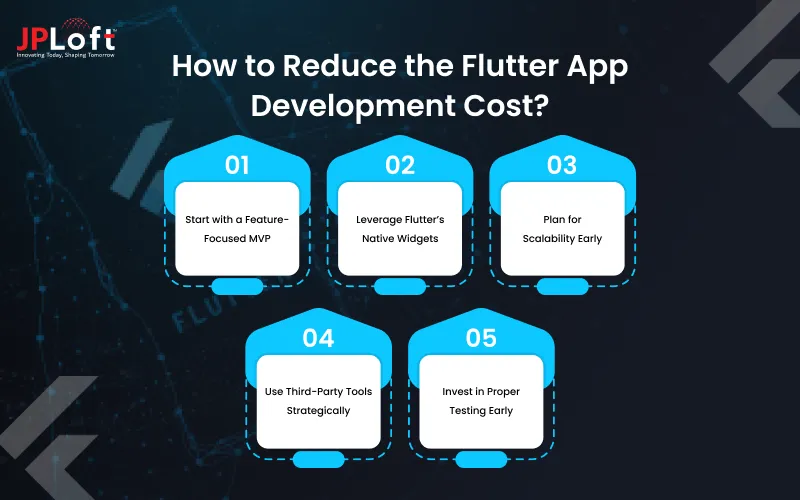
Below are practical, proven strategies to optimize costs.
1] Start with a Feature-Focused MVP
Launching with a Minimum Viable Product (MVP) allows you to validate your idea using only essential features.
This approach minimizes initial development effort and helps control the cost to build a Flutter App while gathering real user feedback for future improvements.
2] Leverage Flutter’s Native Widgets
Flutter’s built-in widget library reduces the need for heavy UI customization.
By using standard components where possible, development time is shortened, leading to a lower cost to create a Flutter App without sacrificing performance or usability.
3] Plan for Scalability Early
Designing scalable architecture from the beginning avoids costly rewrites later.
Early planning helps manage the overall cost to build a Flutter App, especially when your app needs to support growing user demand or additional features over time.
4] Use Third-Party Tools Strategically
Pre-built APIs and plugins can save significant development hours.
However, selecting only necessary and reliable tools prevents unnecessary licensing fees and keeps the cost to make a Flutter App under control.
5] Invest in Proper Testing Early
Catching bugs during development is far cheaper than fixing issues post-launch.
Early testing reduces rework, improves performance, and ultimately lowers the long-term Flutter app development cost.
Cost Optimization Impact Overview
|
Cost-Saving Strategy |
Estimated Cost Reduction |
|
MVP-First Approach |
20% – 30% |
|
Using Built-In Widgets |
10% – 20% |
|
Scalable Architecture Planning |
15% – 25% |
|
Optimized Third-Party Integrations |
10% – 15% |
|
Early Testing & QA |
10% – 20% |
By applying these strategies, businesses can significantly reduce development expenses while ensuring the app remains robust, future-ready, and competitive.
Monetization Strategies to Include While Building a Flutter App
Monetization strategies ensure your Flutter app generates revenue while supporting long-term growth.
Planning during development helps manage the Flutter App development cost efficiently.
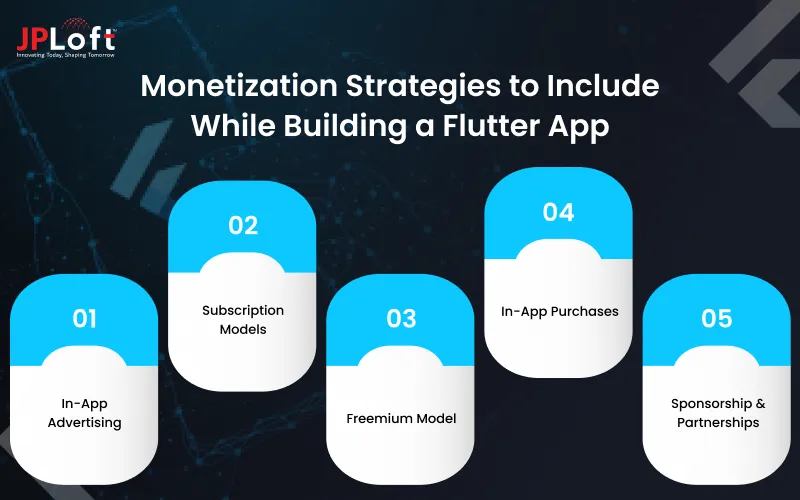
Below are effective strategies to maximize profitability without overspending.
1. In-App Advertising
Integrating advertisements generates revenue from impressions and clicks, lowering the cost to develop a Flutter App during initial launch phases significantly.
Using targeted ad networks improves engagement, enhances revenue streams, and complements marketing efforts effectively.
Building ads placement into the mobile app wireframe ensures optimal visibility without disrupting user experience or navigation flow.
2. Subscription Models
Implementing subscription plans ensures recurring revenue, balancing the Flutter App development cost while encouraging continuous user engagement for long-term growth.
Monthly or yearly subscriptions provide predictable cash flow, supporting ongoing updates and maintenance.
Developing a functional mobile app prototype allows testing subscription flows before full-scale development, saving costs and improving usability.
3. Freemium Model
Offering a freemium version allows free access and encourages premium upgrades, reducing the cost to make a Flutter App for user acquisition campaigns.
Paid tiers provide advanced features, generating revenue while maintaining accessibility for casual users.
Careful planning during the design phase helps design a mobile app that clearly differentiates free and premium functionalities.
4. In-App Purchases
Selling virtual goods, content, or services boosts revenue without significantly affecting the overall cost to build a Flutter App.
Integrating secure payment gateways ensures safe transactions and builds user trust effectively.
In-app purchases complement other monetization models like freemium and subscriptions, maximizing overall revenue potential efficiently.
5. Sponsorship & Partnerships
Collaborating with brands or sponsors generates additional income while improving the cost to create a Flutter App value proposition.
Partnerships provide exclusive content, co-marketing opportunities, or premium features.
Well-planned sponsorship ensures monetization remains meaningful and non-intrusive, enhancing long-term user satisfaction and engagement levels.
Estimated Impact of Monetization Strategies
|
Strategy |
Potential Revenue Impact |
Cost Influence |
|
In-App Advertising |
$2,000 – $10,000/month |
Minimal |
|
Subscription Models |
$3,000 – $15,000/month |
Medium |
|
Freemium Model |
$1,500 – $8,000/month |
Low |
|
In-App Purchases |
$2,000 – $12,000/month |
Medium |
|
Sponsorship & Partnerships |
$3,000 – $20,000/month |
Medium |

Connect with JPLoft and Build Your Flutter App
Building a high-performing Flutter application requires more than just the right framework; it demands strategic planning, technical expertise, and cost-efficient execution.
At JPLoft, we help businesses transform ideas into scalable, secure, and future-ready Flutter apps while keeping development budgets aligned with business goals.
As a trusted Flutter app development company, JPLoft combines deep Flutter expertise with proven delivery processes to help startups and enterprises build apps that perform, scale, and generate ROI.
From MVP development to full-scale product launches, our team ensures transparency in timelines, pricing, and execution, so you always stay in control of your investment.
If you’re planning to build a Flutter app and want clarity on costs, features, and scalability, our experts are ready to guide you every step of the way.
Conclusion
Understanding the cost of building a Flutter app is essential for making informed development and budgeting decisions.
From core features and design requirements to hidden expenses and monetization strategies, every choice directly influences the final investment.
Flutter’s cross-platform capabilities help optimize development efforts, but careful planning is still required to avoid unnecessary costs.
By evaluating technical scope, scalability needs, and long-term goals early, businesses can control expenses while building a high-performing application.
When approached strategically, the complete cost to develop a Flutter App becomes a calculated investment that supports growth, user engagement, and long-term success, rather than an unpredictable expense.
FAQs
The cost usually ranges between $30,000 and $120,000+, depending on app complexity, features, design depth, and backend requirements. Simple apps fall on the lower end, while feature-rich or scalable apps require higher investment.
For startups, the average cost to make a Flutter App typically starts around $30,000–$50,000 for an MVP. Costs increase as advanced features and scalability are added.
The cost to build a Flutter App is mainly influenced by feature complexity, custom UI/UX design, backend infrastructure, integrations, and testing requirements. Ongoing maintenance can also add to long-term costs.
Yes, Flutter is generally cost-effective because a single codebase supports multiple platforms. This significantly reduces development time and overall expenses compared to building separate native apps.
What’s the cost to build a Flutter App? For advanced functionality like real-time updates, payments, or cloud scalability, costs often range between $75,000 and $120,000+, depending on scope.
To estimate the Flutter App Development Cost, businesses should define requirements clearly, prioritize features, and consult experienced development teams for detailed cost breakdowns and timelines.

Meet Yashwant, the CTO of JPLoft. With 18+ years of industry experience, he brings deep technical expertise and visionary leadership to complex digital challenges. From scalable software architectures to emerging technology implementations, Yashwant drives innovation that empowers businesses across diverse industries to build future-ready, secure, and high-performing digital solutions.




Share this blog