


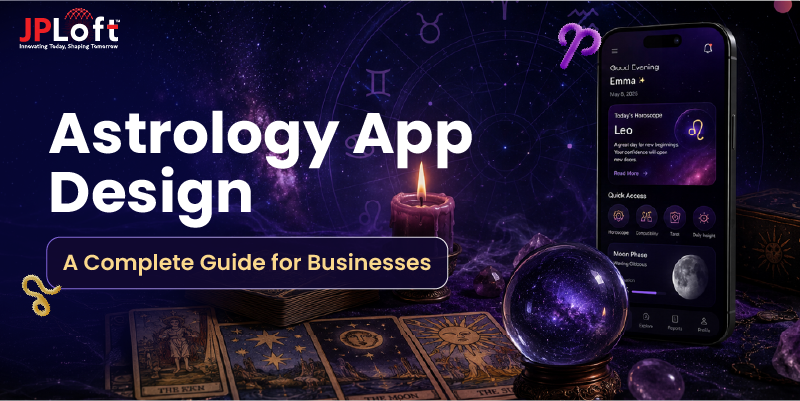
Key Takeaways:
An astrology app UI design combining personalization, intuitive navigation, and simple user experiences builds trust and credibility.
A well-designed astrology app supports business growth, better engagement, increases subscriptions, and drives higher conversions.
Core design components include a responsive interface, personalized journeys, and strong security in an astrology platform.
A structured design process begins with defining your audience, planning user flows, prototyping, testing, and final launch.
Partnering with JPLoft helps transform your astrology app prototype into a user-centric and successful platform.
The first impression of an astrology app starts with the design. The first few screens' interface often decides whether users continue exploring the app features or close it.
Users want to find their horoscope, birth chart, or personalized reading without struggling to understand the app. A well-planned astrology app UI design makes these journeys simple, clear, and easy to explore.
For businesses, investing in a responsive design creates a unique visual identity, improves engagement, and makes booking consultations much easier.
However, turning these design goals into a high-performing astrology platform requires careful planning, the right design components, user flows, testing, and emerging design trends.
In this blog, we will explore the essential components of astrology app design, the process, industry trends shaping design inspiration, and beyond.
Why Astrology App Design Matters for Business Success?
A good, visually appealing, and mobile-responsive design of an astrology app turns complex features into simplified data. Businesses must follow astrology app design best practices before planning to build an astrology app for better success.
1. Increases User Trust in the Platform
Astrology apps heavily depend on trust. A visually appealing, mobile-responsive design and simple navigation increase user trust.
Users are more likely to book services and download personalized reports if the app is clear, reliable, and offers a professional interface.
2. Improves User Engagement
Users spend more time on apps they find easy to use and that help them quickly access the information or functions they need.
Therefore, the design of the astrology app must keep users engaged with interactive features such as birth chat, horoscope readings, and AI chatbots.
3. Higher Conversion Rates
Good app design makes subscriptions, payments, and consultation bookings easier to complete without confusion.
This well-designed payment journey supports how astrology apps make money through subscriptions and in-app payments.
4. Encourages Social Sharing
Many users like to share their horoscope records with their friends and family.
Adding attractive share cards and social media integration within the app increases organic app visibility and business popularity.
Components of Astrology App Design
When you are creating an astrology app, every design detail matters. It is about creating a simple, smooth, and engaging user experience. Thus, here are important components of astrology app design.
[A] User Interface
The user interface shapes how users see, explore, and interact with the features of the astrology application. To create a user interface, keep the color palette minimal in deep blues and gold.
Use clear graphics, zodiac symbols, and planetary icons to make astrology features easier to recognize and understand for users.
[B] Personalized User Experience
Create a personalized user experience by hiring a dedicated developer. The team will help add interactive features, such as zodiac signs, daily, weekly, or annual horoscope reports.
Utilize AI-driven capabilities to implement an automated astrologer to answer questions about users’ planetary signs. These features improve user experience with the app.
[C] Responsive Design
A responsive astrology mobile app design improves engagement and supports a consistent experience across different devices and screen sizes.
From small smartphone screens to larger desktop displays, the app should automatically adjust the layout of birth charts, typography, and buttons. Users should also be able to scroll smoothly through calendars, charts, and sliders.
[D] Intuitive Navigation
Organized content helps users explore an astrology app without confusion. The app navigation must allow easy movement between features such as personalized readings, birth charts, horoscope reports, and consultations.
For businesses, intuitive navigation helps organize multiple astrology app functions without making the app feel complicated.
[E] App Security
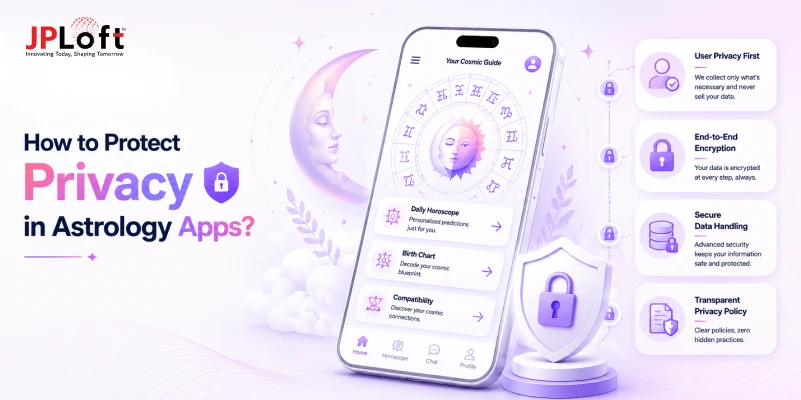
Another important component is ensuring astrology app security. Astrology apps collect personal details from the user, including birth dates, times, locations, and account information.
So, when creating an app design, ensure security by encrypting data, using security protocols, and using HTTPS for data protection. Use clean code and a secure backend for fast loading. Finally, use secure logins and comply with GDPR and CCPA.

How to Design an Astrology App?
Designing an astrology app involves a careful mix of market research, planning, creativity, and user-centric design. Here are the key steps to understand how to design an astrology app.
Step 1: Define Your Goals and Target Audience
Before jumping into the designs and overall astrology app design process, take a moment to identify who you are designing the app for.
Businesses planning to start an online astrology business should define their target audience and app goals before finalizing the design. It drives user engagement, complies with the right monetization strategies, and reduces high churn rates.
Follow these steps to identify target audience and goals:
-
Conduct market research to determine whether your app will focus on beginners or users looking for live astrology consultations.
-
Identify the astrology app features your niche audience prefers most: daily horoscope, natal charts, compatibility, tarot readings, or AI-powered astrology guidance.
-
Before designing the app, consider user retention, subscription model, and consultation booking process.
Step 2: Plan User Flow
Another step in the astrology app UI/UX design guide is planning the user flow for the audience. Map out how users will move through the app. A well-planned user flow helps users utilise the app without any confusion and increases engagement.
When designing the app, structure the important actions in a step-by-step flow by considering trusted UI/UX design services.
Follow these steps to plan user flow:
-
Define the core challenges users face with the competitor’s app design and map out requirements based on user needs.
-
Allow users to share their birth date, birth time, and location through a guided and simplified astrology app design process.
-
Reduce unnecessary and heavy-loading navigation by allowing users to easily complete registration, book astrology services, and unlock premium services through a subscription model.
Step 3: Create Wireframes and Prototype
Mobile app wireframes are the basic blueprints of the astrology app. They help designers decide where important elements such as horoscope cards, consultation CTA button, and subscription banner should appear.
Once the wireframe is finalised, it is converted into a prototype. This helps bring the design to life and lets users experience how the app will work and interact with its functions.
Follow these steps to create a wireframe and prototype:
-
Start by designing the layout of each screen. It includes the registration form, home dashboard, and consultation booking section. This helps to plan screens that will later support astrology API integration.
-
After finalising the wireframe, building a prototype helps the business understand how users will sign up, enter the birth details, and book an astrologer through the app.
-
Before deploying the app, test the prototype with a small group of real-world users to ensure each CTA button and astrology feature works smoothly.
Step 4: Test and Improve the Design
Before launching the final app design, it is necessary to conduct astrology app testing. At this stage, you will gain better confidence and clarity about how the app functions.
Here, all you need to focus on is whether the designs, visual elements, and functions are coming together.
Follow these steps to test the user interface of an astrology app:
-
Conduct usability testing of the app. It helps to understand how users will interact with the app, view horoscopes, generate birth charts, and consult an astrologer.
-
Collect users’ feedback on the app’s functionality, design, and interactive visual elements.
-
Use this feedback to evaluate the final app and address any issues, such as bugs and slow loading, before the launch.
Step 5: Launch and Monitor
The last and most important step in the astrology app UI/UX design guide is to ensure all app testing and changes are completed before launching the app for users.
Regular updates, performance checks, security improvements, and function enhancements help with smooth astrology app maintenance.
Follow these steps to launch and monitor the astrology app design:
-
Track user behavior and monitor how users interact with the app’s aesthetic, design, and visual identity.
-
Monitor whether the selected astrology app tech stack continues to support app performance, integrations, and new capabilities as the platform grows.
-
Continuously refine the new tools, improve user experience, and adapt to top astrology app design trends.
Top Astrology App Examples for Inspiration
There are several popular astrology apps, famous for their astrology application design, visual identity, and UX patterns. When designing your app, studying these platforms can provide useful insights and new ideas.
Here are some top examples of astrology apps for design and visual inspiration.
► Co-Star
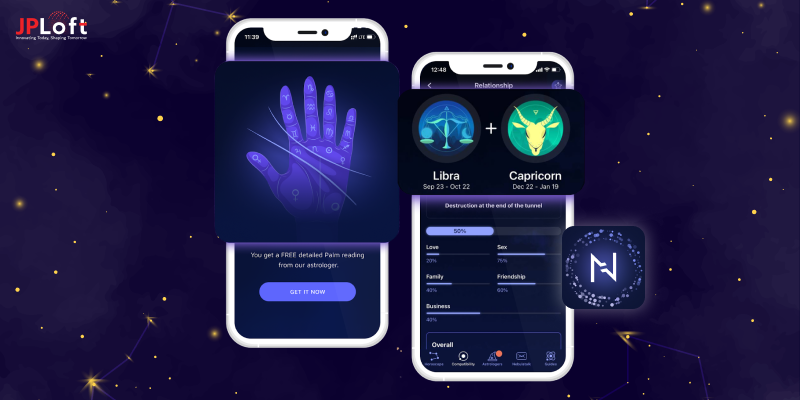
Co-Star is a popular astrology app for hyper-personalized horoscope insights based on the user’s birth chart and zodiac sign. It uses a minimalist, black-and-white interface with a distinctive visual identity.
The app focuses on providing users with a clear interface to read horoscope insights without distractions. It displays personalized charts to encourage daily engagement and uses easy-to-read fonts and visuals to explain astrology concepts.
► CHANI
Another interesting app to watch for inspiration is the CHANI astrology app. The app includes a calm and beautiful visual design with a soft natural color palette and clear navigation.
Its organized layout allows users to explore separate pages for horoscopes, birth charts, and wellness resources without confusion. Their design keeps college-inspired youth connected who value emotional resonance and wellness astrology insights.
► Sanctuary
The Sanctuary astrology app creates a personalized experience across its screens. Its fun and simple design uses a chat-style layout, GIFs, calming colors, and zodiac symbols to make interactions engaging.
The app also provides daily astrology and tarot card readings through an interactive interface. Sanctuary is a good example of how to engage users with trust and credibility by highlighting astrologers’ experience, specialties, ratings, and availability.
► The Pattern
The Pattern app’s design caters to users interested in relationship dynamics, personal growth, and personality-based traits.
Further, it goes beyond basic astrology by following best astrology app design practices to create a storytelling format. The app uses a highly readable design to explain complex planetary terms through behavioral and personality-based descriptions.
► TimePassages
TimePassages combines traditional astrology with a simple app and desktop interface. Its design is easy to use for beginner levels and experienced astrologers. It provides daily horoscopes and detailed descriptions of planets such as the Sun, Moon, and Rising sign.
The app UI focuses on presenting daily birth charts, horoscope reports, and planetary moments through interactive elements. Its simple layout and design make services easy to explore without adding modern layouts and visual complications.
Astrology App Design Trends
Keeping up with astrology app development trends helps businesses create an interface that aligns with the competitive market ideology. The way users interact with the app and its services is constantly evolving.
Here are the astrology app design trends to create an app that remains engaging, competitive, and future-ready.
1. AI for Personalization
Businesses must understand the role of AI in astrology apps before adding AI-powered capabilities in astrology app design.
How does this trend work:
-
If the user is more interested in relationship compatibility, AI can analyze their interest and personalize the app surface to suggest a session like that.
-
It can use the Sun, Moon, Rising sign, and current planetary positions to create astrology content that matches the user's interests and profile.
-
AI-powered chat can create a more interactive design by letting users ask questions and receive personalized responses in one place.
2. Seamless Subscription Journeys
This trend focuses on designing a smooth subscription journey that lets users explore the app and its premium options.
How does this trend work:
-
Design frictionless onboarding. When users create an account, ask for their birth chart, birth date, and location to generate a personalized horoscope, without distracting them with subscriptions or payments.
-
Place the paywall at a natural point in the user journey. Allow users to buy a personality report, relationship analysis, and other premium features at affordable pricing.
-
Present monthly or yearly subscription plans with a clear layout that give users access to premium solutions and allow plan comparison.
3. Community Experience
The design of the astrology application can integrate community interactions into the personalized user journey. Community services can make the app more unique from a generic horoscope reading app.
How does this trend work:
-
Integrate likes, comments, and sharing of horoscope posts. Allow users to interact without disrupting their astrology journey.
-
Organize social discussion forums where users can discuss zodiac signs, horoscopes, and predictions.
-
Allow users to interact regularly through compatibility discussions or group readings.
4. Immersive AR-Based Design
Adding AR in astrology apps helps to create a more engaging user experience. Technologies such as AR help convert static birth charts into interactive learning by using motion effects.
How does this trend work:
-
Design AR interactions that let users point their smartphones toward the sky and explore real-time zodiac signs through the camera view.
-
It allows users to zoom, rotate, and tap birth charts, signs, and planets for better interpretations and planetary moments.
-
Use 3D animations to explain astrology concepts, and add phone vibrations during astrology events, for an interactive experience without overwhelming the interface.
To enable these functions, many businesses partner with a custom mobile app development company in the USA to integrate these effective trends and improve the structure of the astrology app.

How Can JPLoft Help Design Your Astrology App?
Creating a successful astrology app requires more than attractive visuals. The design should simplify complex astrology insights, create personalized experiences, and encourage users to return to the app regularly.
At JPLoft, an astrology app development company, we help businesses transform astrology app ideas into engaging digital experiences.
Our team focuses on creating user-centric, custom astrology app design that aligns with your target audience, brand identity, and monetization strategy.
The role of AI in astrology platforms is what creates a unique identity in a competitive market. Therefore, we combine AI-powered birth chart analysis, smart daily horoscopes, voice AI astrology assistants, and sentiment-based recommendations to suggest perfect rituals and emotional remedies.
Whether you are building a horoscope platform, an AI-powered astrology app, or a consultation-based service, we help you design scalable, feature-rich solutions that support long-term growth and user engagement.
Conclusion
A successful astrology design can propel your app towards success and long-term profit.
By prioritizing thoughtful design, you can help users explore horoscopes, birth chart reports, download personalized reports, AI-powered consultations, and enjoy wellness services.
From understanding the components to understanding a structured process of astrology app design, every part plays a very important role.
As user expectations continue to evolve, a well-designed astrology app will remain a key factor for long-term business success.
Therefore, analyzing the latest astrology design app trends, such as AR and visually impressive elements, subscription-based tools, and integrating AI-powered personalization, increases engagement and helps users find their way back to the app.
Businesses that invest in user-centric design can build stronger customer relationships, improve subscription growth, and create a unique identity in a competitive market.
FAQs
A responsive astrology app is important to ensure that your app is user-friendly and works across multiple devices. It ensures that complex app functions, such as tarot card readings and natal charts, are easy to view and explore.
Designing an astrology app starts with defining the target audience and their needs. Plan the user flow, create a wireframe and prototype, test the final app design, and launch and monitor the app.
Some popular astrology apps for their design include Co-Star, The Pattern, and Sanctuary astrology app. These apps offer user-friendly design and mobile-responsive capabilities such as daily horoscopes or personalized readings.
The key components in the design of an astrology app include a simple and clean user interface, a personalized user experience, maintaining the security of user data, a creative visual identity, and trending design aesthetics.
AI can improve the design of astrology apps by providing personalized horoscopes, compatibility insights, automated birth charts, and constantly pushing notifications based on the user's interests.

Rahul Sukhwal is the CEO and Founder of JPLoft, with 18+ years of experience in software engineering, emerging technologies, and digital product development. His expertise spans artificial intelligence, including AI agents, generative AI, LLMs, chatbots, computer vision, and machine learning, as well as blockchain, IoT, AR/VR, mobile, web, and enterprise software. He focuses on applying these technologies to real business challenges across industries such as healthcare, education, mobility, finance, real estate, and on-demand services.


Share this blog