


Picture two customers checking out on your UAE e-commerce app. One chooses Apple Pay for a quick card payment, while the other selects Tabby or Tamara to split the purchase into installments.
Both expect a smooth checkout, but each payment method follows a different processing workflow, with its own authorization, confirmation, and settlement requirements.
For businesses, the challenge is not simply offering multiple payment options. It's ensuring that every transaction is accurately processed, payment statuses are verified, refunds are handled correctly, and financial records remain consistent.
This is where a well-planned payment architecture becomes essential. Rather than simply adding multiple payment options, UAE e-commerce businesses need a reliable system that connects different providers with their checkout, order management, and financial operations.
In this blog, we'll explore the best payment architectures for integrating Apple Pay, Tabby, and Tamara into UAE e-commerce apps. You'll learn how these payment methods work together, which architecture suits your business, how to implement the integrations, and what to consider before launching a secure and reliable checkout system.
How Does Payment Architecture Work in UAE E-commerce Apps?
Payment architecture describes how a store takes a customer's payment choice, sends the transaction to the appropriate provider, and confirms the outcome in its own systems.
It connects the customer-facing checkout with processing, order management, and financial records. The goal is not simply to accept a payment; it is to know exactly what happened to it.
1. Key Components of an E-commerce Payment System
A typical transaction passes through four connected components:
-
Checkout interface: Displays the purchase total and the customer's available methods.
-
Backend payment service: Creates an attempt and communicates with the selected provider.
-
Gateway or PSP: Processes supported payments and connects to financial networks.
-
Order management: Tracks fulfillment, cancellations, and refunds.
One order can have multiple attempts. For example, a shopper can abandon a BNPL checkout and opt to pay by card instead. Giving each attempt its own identifier and status prevents the app from confusing an abandoned attempt with a completed purchase.
2. How Digital Wallets, BNPL, and Payment Gateways Work Together?
Digital wallets, BNPL providers, and payment gateways each have a different role in the checkout process:
-
Digital wallets: Solutions such as Apple Pay allow customers to authorize payments using eligible cards stored on supported devices. These payments are processed through compatible payment processors rather than Apple Pay acting as an independent acquiring gateway.
-
Buy Now, Pay Later (BNPL): Providers such as Tabby and Tamara allow eligible customers to split purchases into installments. They have separate merchant approval requirements, eligibility criteria, and transaction workflows.
-
Payment Gateways and PSPs: Providers such as Stripe and Checkout.com facilitate supported payment processing and provide APIs, SDKs, and other tools for integrating payment methods into an e-commerce app.
Although these solutions serve different functions, they can be connected through a unified checkout experience. The payment architecture routes each transaction to the appropriate provider and records the outcome within the business's order management system.

3. Understanding the Payment Lifecycle from Checkout to Settlement
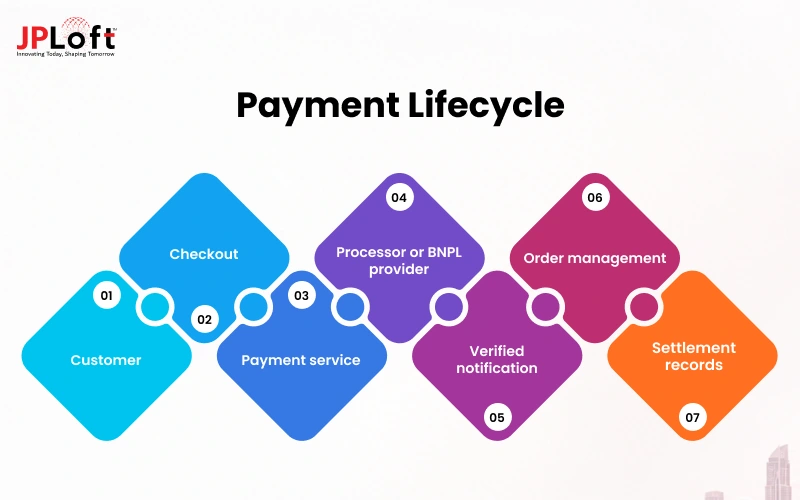
Although payment workflows vary by provider, most transactions involve these stages:
-
Checkout Initiation: The backend creates an order and unique payment attempt.
-
Authorization or Approval: The provider evaluates the payment and returns its status.
-
Capture and Confirmation: Where applicable, authorized funds are captured, and payment status is verified.
-
Settlement: Funds are transferred according to the provider's payout schedule.
-
Refunds and Cancellations: Reversals are processed through the original payment provider and recorded against the transaction.
A successful checkout redirect does not necessarily confirm payment. The application should verify the provider's response or authenticated notification before releasing an order for fulfillment, particularly when customers close the app, lose connectivity, or return before payment confirmation arrives.
Which Payment Architecture Is Best for UAE E-commerce Apps?
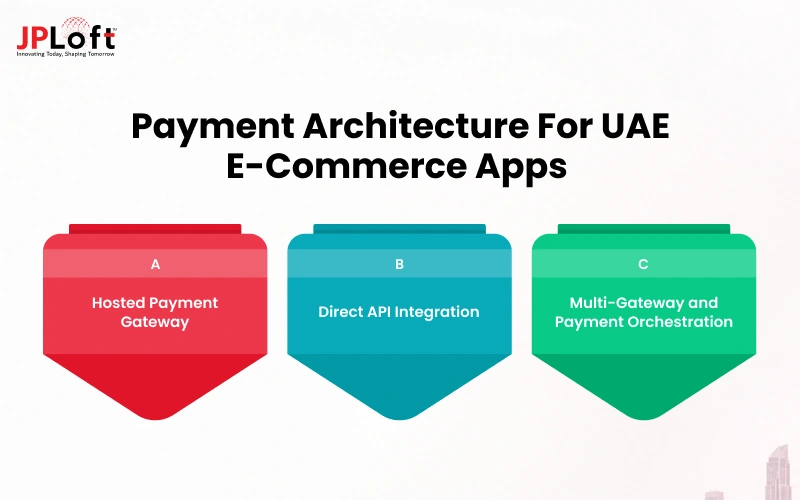
The right architecture depends on your checkout needs, available development resources, and expected growth. Three common models are worth comparing:
A] Hosted Payment Gateway Architecture
Hosted checkout redirects customers to a provider-managed payment page or uses a secure provider-controlled component. It is generally easier to launch and reduces sensitive card-data handling, but offers less customization.
B] Direct API Integration Architecture
Direct API integration connects your app to payment services through SDKs and backend APIs. It provides more control over checkout and order workflows, but requires ongoing security, monitoring, and API maintenance.
C] Multi-Gateway and Payment Orchestration Architecture
A multi-gateway setup can process Apple Pay through a compatible card processor while connecting Tabby and Tamara through their supported BNPL integrations. A shared backend then brings those transaction results into one order system; the extra connections still require separate monitoring and reconciliation.
Comparing Payment Architectures for Different Business Needs
|
Architecture |
Best Fit |
Integration Effort |
Main Trade-off |
|
Hosted checkout |
Startups and standard online stores |
Low to moderate |
Limited customization |
|
Direct API integration |
Custom e-commerce apps |
Moderate to high |
Greater development and maintenance needs |
|
Multi-provider integration and orchestration |
Businesses managing complex payment operations |
Moderate to high, depending on scope |
Additional operational complexity |
For a UAE startup using a standard e-commerce platform, hosted checkout with supported payment integrations can offer a simpler implementation. Businesses developing custom mobile apps may prefer API-based integrations for greater checkout control.
Larger e-commerce operations managing multiple payment providers may benefit from a centralized payment backend or orchestration layer, depending on transaction volume and operational complexity.
How Can You Integrate Payment Solutions into a UAE E-commerce App?
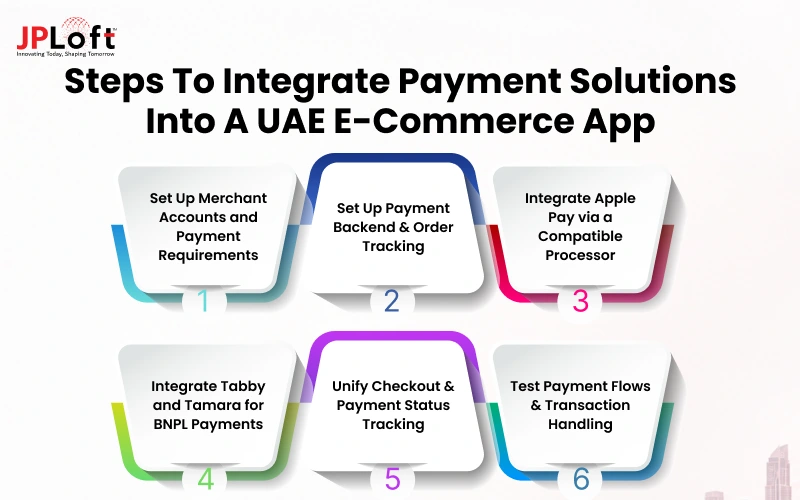
Once the payment architecture is decided, the implementation should follow one clear sequence: prepare the merchant setup, establish reliable transaction records, connect the payment methods, and test the complete checkout journey.
Step 1: Set Up Merchant Accounts and Payment Requirements
Start by identifying which payment methods your customers need and confirming their compatibility with your e-commerce platform, UAE business registration, and transaction currency.
For Apple Pay, select a compatible payment processor and complete the required wallet configuration. For Tabby and Tamara, apply for merchant approval separately and review their eligibility, supported product categories, and commercial terms.
Once approved, obtain the necessary API credentials and sandbox access. Also, confirm whether each solution supports direct API integration, an existing platform plugin, or integration through a payment partner.
Step 2: Build the Payment Backend and Order Records
Develop a centralized payment backend that communicates with different providers and maintains accurate transaction records.
Each payment attempt should have a unique identifier linked to the customer's order. Store essential information such as transaction amount, currency, selected method, provider reference, and current payment status.
Implement secure API authentication, verified webhooks, and idempotency controls to prevent duplicate charges or repeated order updates.
This backend becomes the central system for tracking payment outcomes, even when customers abandon checkout or switch between payment methods.
Step 3: Integrate Apple Pay Through a Compatible Payment Processor
Apple Pay integration requires configuring the appropriate merchant credentials and connecting the application to a supported payment processor.
For native iOS apps, configure the Apple Pay merchant identifier and capability, then use PassKit or the processor's SDK to display the payment sheet.
When customers authorize a purchase, the encrypted payment data is submitted through the approved processing flow. The backend must verify the processor's transaction result before marking the order as paid.
For website-based checkout, additional configuration may include domain verification and Apple Pay web integration requirements.
The implementation should also handle unavailable payment methods, declined transactions, and interrupted checkout sessions without creating duplicate orders.
Step 4: Integrate Tabby and Tamara for BNPL Payments
BNPL integration follows a different workflow because the provider evaluates the customer's eligibility and manages the installment arrangement.
For Tabby, connect through its supported API or platform integration and submit the required purchase information to initiate checkout. The customer then completes the applicable eligibility and payment approval process.
For Tamara, create a checkout session containing order details, amounts, and customer information. Use the returned checkout information to direct the customer through Tamara's payment process and handle subsequent order authorization or capture requirements.
Both integrations should account for provider-specific transaction statuses, order adjustments, cancellations, and refunds.
Importantly, a customer's return to the e-commerce app should not be treated as confirmation of payment. The backend must verify the transaction through the provider's supported notification or status API.
Step 5: Unify Checkout and Payment Statuses
Once the integrations are configured, bring the supported payment options together within a consistent checkout interface.
Display only the methods available for the customer's device, purchase amount, location, and applicable provider requirements.
Behind the scenes, route each transaction to its respective provider while maintaining standardized internal statuses such as pending, authorized, paid, failed, cancelled, and refunded.
Since providers may use different status definitions, map their responses carefully rather than assuming every authorization or approval means the same thing.
This allows the order management system to track transactions consistently while preserving the original provider-specific records for refunds, disputes, and reconciliation.
Step 6: Test the Complete Payment Journey
Before launching, thoroughly test the payment system to ensure every integration works correctly under different transaction scenarios. Use the respective providers' sandbox environments to validate successful Apple Pay transactions, BNPL approvals, declined payments, and customer eligibility failures.
Testing should also cover abandoned checkouts, interrupted mobile sessions, delayed or duplicate webhook notifications, and payment retries. Verify that customers switching between payment methods do not trigger duplicate charges or incorrect order updates.
Additionally, test full and partial refunds, cancellations, and settlement reconciliation to ensure transaction records remain consistent across payment providers and the order management system.
Once testing is complete, confirm that orders proceed to fulfillment only after the appropriate payment status has been verified. This helps prevent payment discrepancies and ensures a reliable checkout experience for UAE customers.
What Factors Matter When Launching a Payment System?
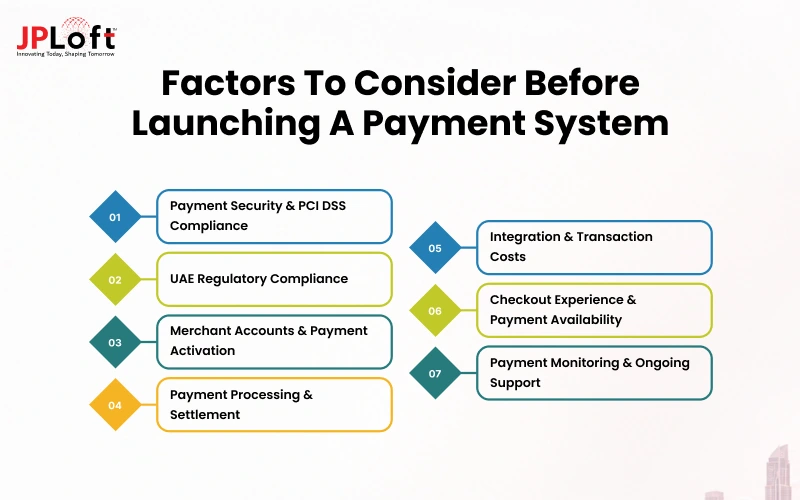
Before launching an e-commerce payment system in the UAE, businesses must evaluate several factors that influence security, regulatory compliance, transaction reliability, and long-term operating costs.
1. Payment Security and PCI DSS Compliance
Choose secure integration methods such as hosted payment fields or tokenized SDKs. Protect API credentials, implement access controls, and assess the PCI DSS requirements applicable to your payment environment.
2. UAE Regulatory Requirements
Review applicable Central Bank of the UAE regulations and payment service requirements. Businesses should determine whether they are simply accepting payments through licensed providers or performing activities that may require additional regulatory authorization.
3. Merchant and Payment Method Activation
Confirm that your selected processor supports Apple Pay for the intended checkout channel. Complete separate merchant approvals and activation requirements for Tabby and Tamara where applicable.
4. Payment Processing and Settlement
Evaluate supported currencies, AED settlement options, payout schedules, transaction limits, and reconciliation requirements across payment providers.
5. Integration and Transaction Costs
Consider development expenses, provider setup charges, transaction fees, BNPL commissions, refund costs, chargeback fees, and ongoing maintenance when calculating the total cost of payment acceptance.
6. Customer Experience and Payment Availability
Ensure that supported payment methods work across the intended devices and checkout channels. Display clear payment information and provide alternative methods when a particular option is unavailable.
7. Operational Monitoring and Support
Establish responsibilities for monitoring transactions, managing disputes, handling refunds, maintaining integrations, and responding to provider-related issues after launch.
What Challenges Can Arise During Payment Integration?
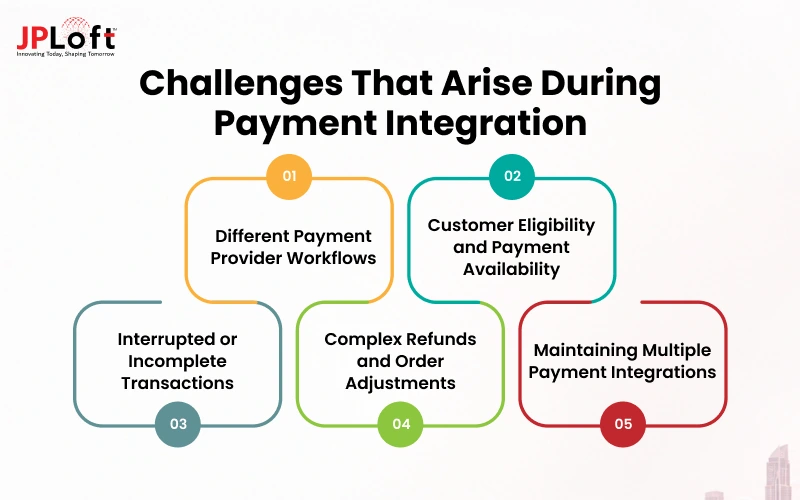
Integrating digital wallets, card processors, and BNPL services into one e-commerce application can introduce technical and operational challenges. Understanding these issues helps businesses maintain consistent checkout experiences and accurate transaction records.
Challenge 1: Different Payment Provider Workflows
Payment providers use different authorization, capture, confirmation, and settlement processes. Apple Pay transactions follow the connected card processor's workflow, while BNPL services may involve additional approval and order management stages.
Solution: Develop provider-specific integrations that translate different transaction responses into standardized internal payment statuses without losing provider-specific details.
Challenge 2: Customer Eligibility and Payment Availability
Not every payment method is available for every transaction. Apple Pay availability depends on factors such as device and card support, while Tabby and Tamara assess customers and purchases against their own eligibility criteria.
Solution: Check applicable payment method availability before checkout and provide suitable alternatives when a transaction is declined or a service is unavailable.
Challenge 3: Interrupted or Incomplete Transactions
Customers may close the application, lose internet connectivity, or return from an external payment page before the provider confirms the transaction. This can leave orders in an uncertain state.
Solution: Preserve payment references, use authenticated provider notifications, and verify unresolved transactions before updating order statuses or initiating another payment attempt.
Challenge 4: Complex Refunds and Order Adjustments
Partial refunds, cancellations, and order modifications may follow different processes across card payments and BNPL services. Incorrect handling can create inconsistencies between customer refunds, provider records, and merchant settlements.
Solution: Link each refund or adjustment to its original transaction and follow the respective provider's supported refund and order modification procedures.
Challenge 5: Maintaining Multiple Payment Integrations
Payment providers may update their APIs, authentication requirements, or supported features. Managing several tightly connected integrations can increase maintenance work and create unexpected checkout disruptions.
Solution: Use modular provider integrations, maintain version compatibility, and monitor transaction errors so individual payment connections can be updated without disrupting the entire checkout system.
How Can JPLoft Help UAE Businesses Build a Reliable Payment System?
Building a reliable payment system requires more than integrating different payment methods. UAE e-commerce businesses need a checkout experience that connects payment processing with order management, refunds, and financial operations.
As an experienced mobile app development company in the UAE, JPLoft helps businesses develop custom e-commerce applications with secure, scalable payment architectures tailored to their operational requirements.
Our payment integration capabilities include:
-
Payment Gateway Integration: Connect e-commerce applications with compatible payment processors and gateways for secure transaction processing.
-
Digital Wallet Integration: Enable Apple Pay through supported payment processors and device-specific integration requirements.
-
BNPL Payment Integration: Implement Tabby and Tamara checkout options through approved APIs or supported platform integrations.
-
Unified Payment Management: Connect multiple payment methods with centralized transaction tracking, order status synchronization, and payment reporting.
-
Refund and Settlement Management: Develop workflows for payment reversals, order adjustments, refunds, and settlement reconciliation.
-
Payment Security and Testing: Implement secure API connections, payment verification, and transaction testing based on applicable requirements.
JPLoft focuses on selecting an architecture that fits your business model, checkout requirements, and future expansion plans. Whether you're developing a new e-commerce app or upgrading an existing payment system, our team can help you build a reliable payment experience.
Planning to integrate Apple Pay, Tabby, or Tamara into your UAE e-commerce app? Connect with JPLoft to discuss your payment architecture and integration requirements.
Conclusion
Integrating Apple Pay, Tabby, and Tamara into a UAE e-commerce app requires an architecture that supports different payment workflows within a consistent checkout experience.
While Apple Pay enables convenient card payments, Tabby and Tamara provide installment payment options for eligible customers. Each has distinct integration, approval, and transaction management requirements.
The right approach is to select compatible providers, establish reliable payment verification, and maintain accurate order, refund, and settlement records.
Whether you choose hosted checkout, direct API integration, or payment orchestration, your architecture should meet current business needs while remaining flexible enough to support future growth.
FAQs
Yes. UAE e-commerce apps can offer all three within a unified checkout. Apple Pay uses compatible card processing, while Tabby and Tamara follow separate BNPL workflows. Each requires supported integrations, merchant configuration, and reliable transaction verification.
Not necessarily. Apple Pay can work through a compatible payment processor, while Tabby and Tamara may connect through supported payment partners, platform plugins, or direct APIs. Integration requirements depend on provider compatibility, merchant approval, and application architecture.
Yes. Tabby and Tamara offer integration options for supported Shopify and WooCommerce stores. Businesses must complete merchant onboarding, configure the appropriate plugins or integrations, and verify payment availability, checkout compatibility, and transaction handling before enabling live payments.
Configure an Apple merchant identifier, enable Apple Pay capabilities, and integrate PassKit or a compatible payment processor SDK. The application must securely submit payment data for processing and verify the transaction status before confirming customer orders.
The best approach depends on checkout complexity and business requirements. Hosted checkout suits standard implementations, while direct APIs offer greater customization. Multi-provider integrations or payment orchestration help businesses manage multiple payment connections and transaction workflows more efficiently.
Costs depend on your e-commerce platform, integration approach, provider requirements, and customization needs. Businesses should account for development, payment processing fees, BNPL commissions, security testing, maintenance, and potential refund or dispute charges when estimating the total budget.

Priyanka Sukhwal is the Managing Director and Business Head of JPLoft, with 10+ years of experience in technology, digital product strategy, and business growth. She has worked closely with businesses building mobile applications, custom software, marketplaces, and on-demand platforms across mobility, automotive, consumer services, and startup ecosystems. At JPLoft, she focuses on understanding business models, identifying product opportunities, and helping companies plan digital solutions that can scale with changing market needs.




Share this blog