


Key Takeaways:
The global stock trading app market is projected to grow from $76.59 billion in 2026 to $150.82 billion by 2030.
Retail investors are driving growth, with 60%+ preferring mobile trading apps and contributing 30% of U.S. daily equity trading volume.
North America leads the market, while Asia-Pacific is the fastest-growing region.
AI, algorithmic trading, and robo-advisors are transforming modern trading platforms.
Robinhood, Charles Schwab, Fidelity, Webull, Interactive Brokers, eToro, and SoFi remain the leading stock trading platforms.
Businesses should prioritize mobile-first, AI-powered, and scalable trading platforms to stay competitive.
Stock trading apps have become one of the fastest-growing segments of the fintech industry, attracting millions of investors and transforming how people access financial markets.
Rising retail participation, changing investor preferences, and continuous fintech innovation are further driving the growth of the global stock trading app market.
As the industry continues to expand, understanding its size, growth trajectory, and key trends has become increasingly important for businesses, investors, and market analysts.
In this blog, we'll explore the latest stock trading app market statistics, covering market growth, investor behavior, regional performance, AI adoption, and the leading trading platforms.
Whether you're evaluating market opportunities, tracking industry developments, or planning to launch a trading platform, these insights provide a comprehensive overview of the stock trading app market in 2026 and beyond.
Global Stock Trading App Market Overview
The stock trading and investing applications market has entered a phase of sustained expansion, reflecting the growing demand for digital investment platforms worldwide.
The following statistics highlight the market's current size, growth trajectory, regional distribution, and why you should plan to develop a stock trading app.
► Current Market & Growth Forecast
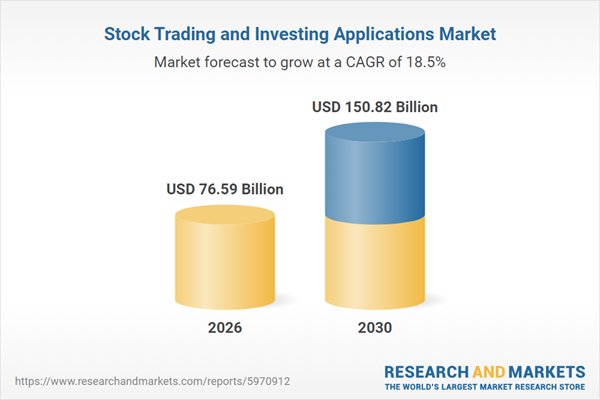
According to Research and Markets, the global stock trading app market size is valued at $76.59 billion in 2026, growing from $63.62 billion in 2025 at a historic 20.4% CAGR.
The market is projected to reach $150.82 billion by 2030, registering a forecast 18.5% CAGR between 2026 and 2030.
The continued growth highlights increasing digital adoption among investors and sustained innovation across brokerage and fintech platforms.
► Regional Market Distribution
North America remains the dominant market for online investment platforms, accounting for approximately 45% of the global market.
Asia-Pacific follows with around 30%, while Europe contributes approximately 20%, reflecting the strong adoption of digital trading platforms across these regions.
Top Stock Trading App Market Statistics of 2026
The stock trading app market is shaped by several key indicators, including investor participation, trading activity, platform preferences, and emerging investment trends.
The following statistics provide a snapshot of the industry's performance and user behavior in 2026.
1. Market Performance
Global equity markets continued their upward trajectory in 2026, supported by growing investor confidence and increasing trading activity.
-
The global stock market capitalization is projected to reach $154.45 trillion by the end of 2026 and is expected to grow to $158.56 trillion in 2027, reflecting a 2.66% growth rate.
-
The United States remains the world's largest equity market, with a total stock market capitalization of $68.8 trillion in 2026.
-
Retail trading demand reached a record high in early 2026, increasing 25% compared to the previous peak.
2. Investor Behavior
Retail investors continue to play a larger role in global equity markets as mobile investing becomes increasingly mainstream.
-
About 60% of retail investors prefer using mobile apps as their primary trading platform.
-
Retail investors now account for approximately 30% of daily U.S. equity trading volume.
-
Retail investors collectively own nearly 10% of the total U.S. corporate equity market value in 2026.
-
More than 156 million U.S. adults, representing approximately 58% of the population, own at least one stock.
3. Platform & Device Usage
While mobile trading dominates investor preferences, desktop platforms continue to play a significant role in the broader online trading ecosystem.
-
Desktop platforms continue to dominate the online trading platform market, accounting for approximately 48.64% of the global market share.
-
In the US market, mobile apps hold around 53.20% of the US online trading platform market size, and the rest is comprised of web and desktop.
4. Trader Demographics
Understanding who participates in the market provides valuable insights into the evolving profile of today's retail investor.
-
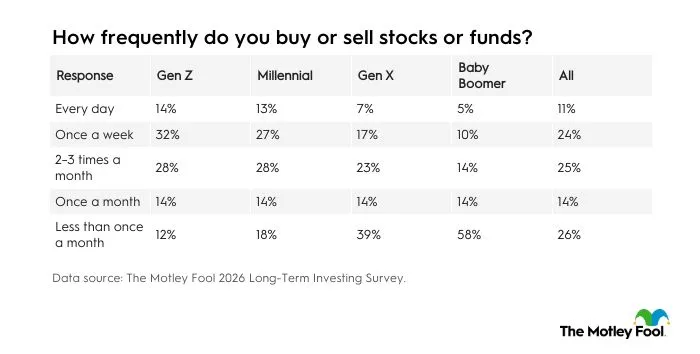
47% of Gen Z investors trade at least once a week, compared with 14% of Baby Boomers and 13% of Millennials, making Gen Z the most active trading generation
-
According to Deloitte's Consumer Survey, nearly half (49%) of Millennials and 40% of Gen Z use apps for investing. In comparison, only 12% of Baby Boomers and 10% of the Silent Generation use these platforms, demonstrating that younger generations are driving the adoption of digital investing.
5. Institutional Investment
Institutional asset managers continue to exert substantial influence over global equity markets through their scale and investment holdings.
-
The largest institutional investors, BlackRock, Vanguard, and State Street, collectively manage more than $30 trillion in assets.
-
Together, these firms control approximately 74% of the U.S. equity ETF market and hold ownership stakes in nearly 88% of S&P 500 companies.
6. Emerging Trends
New technologies and investment models continue to redefine how investors trade, analyze markets, and build portfolios.
-
The global AI trading market is valued at $16.2 billion in 2026 and is projected to reach $33.5 billion by 2030.
-
Prediction market trading volume surged from $5 billion in September 2025 to $24 billion in April 2026.
-
The social copy trading market is expected to reach $2.82 billion in 2026 and grow to $3.77 billion by 2030, at a 7.5% CAGR.
-
Forex trading is also among the key trends, and the current market forex trading platform market size is evaluated at $14.76 billion in 2026, projected to reach $22.22 billion by 2030.

Regional Stock Trading App Market Statistics
The stock trading app market is expanding across every major region, although growth rates and market maturity vary considerably.
The following statistics highlight the leading regional markets and their projected growth.
1. North America
North America continues to be the largest regional market for stock trading apps, supported by a well-established brokerage ecosystem and high retail investor participation.
-
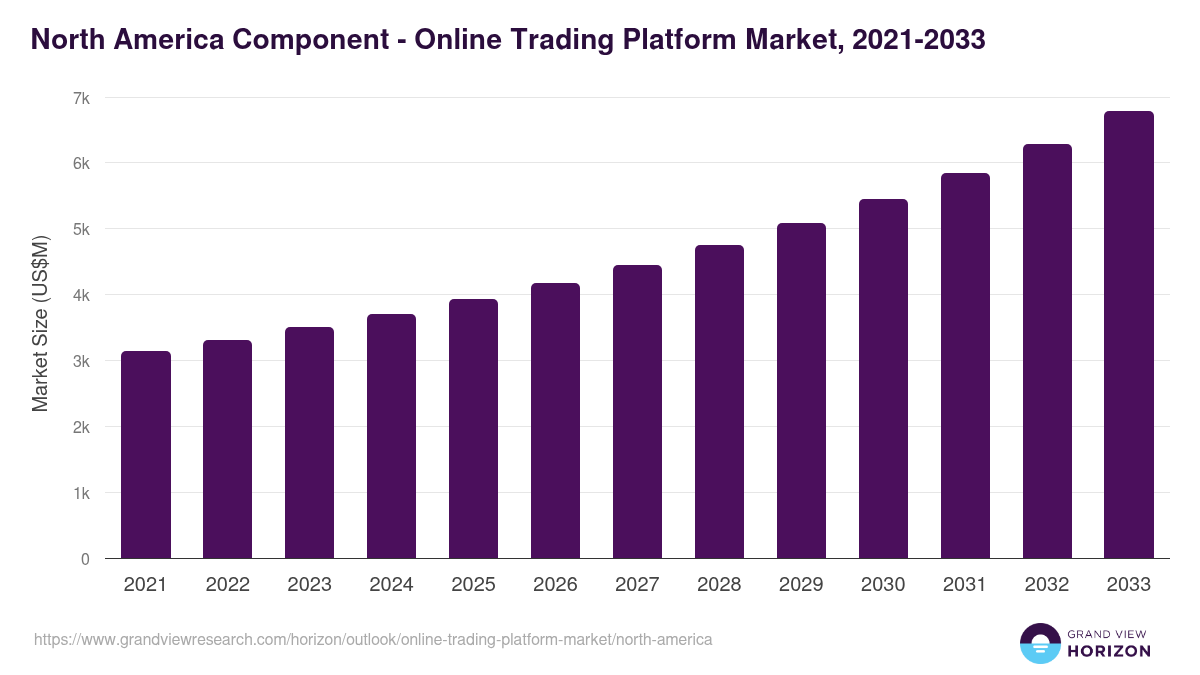
The North American online trading platform market is valued at $4,183.4 million in 2026 and is projected to reach $6,782.9 million by 2033, growing at a 7.1% CAGR.
-
Approximately 75% of retail trade orders in North America are executed through smartphone apps, reflecting the region's strong shift toward mobile-first investing.
2. United Kingdom
The UK remains one of Europe's leading markets for digital investing, driven by growing fintech adoption and increasing demand for self-directed investment platforms.
-
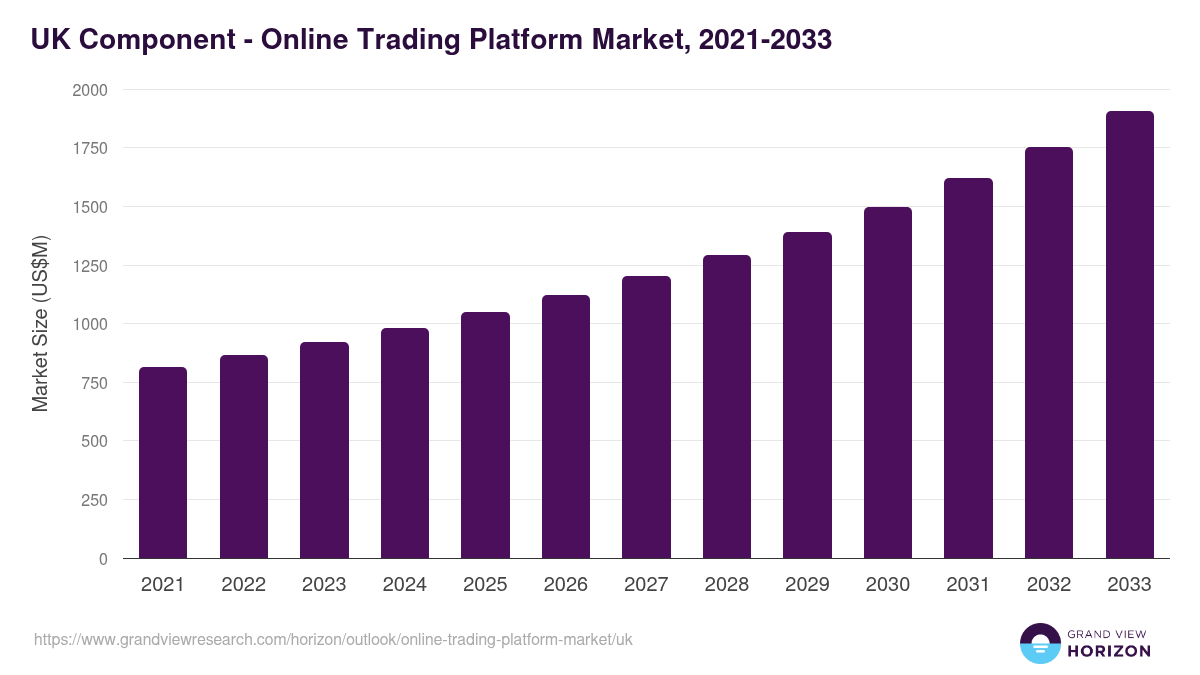
The UK online trading platform market is estimated at $1,122.3 million in 2026 and is forecast to reach $1,906.2 million by 2033, registering a 7.9% CAGR.
3. Asia-Pacific
Asia-Pacific is emerging as the fastest-growing regional market, supported by rising retail investor participation, expanding fintech ecosystems, and widespread smartphone adoption.
-
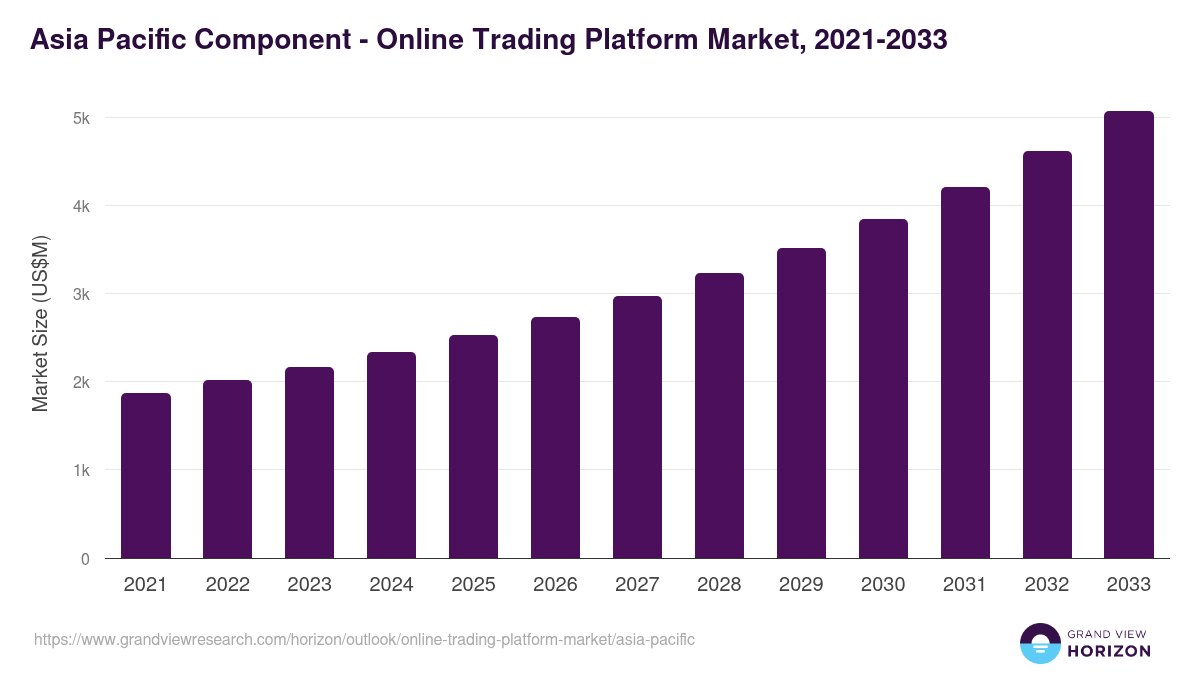
The Asia-Pacific online trading platform market is expected to reach $5,065.3 million by 2033 from$2,738.4 million in 2026, at a 9.2% CAGR, the highest growth rate among the regions covered.
4. UAE
The UAE continues to strengthen its position as a regional fintech hub, with growing investor interest and increasing adoption of digital trading platforms.
-
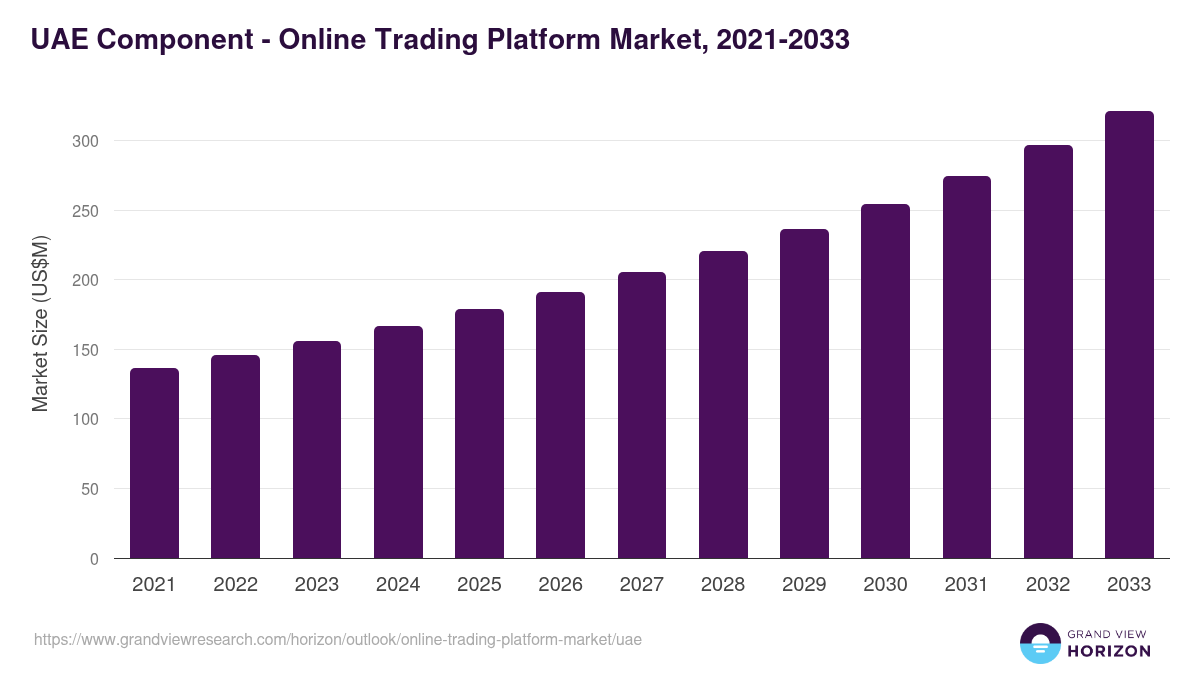
The UAE online trading platform market is valued at $191.4 million in 2026 and is projected to reach $320.9 million by 2033, expanding at a 7.7% CAGR.
AI and Technology Trends Shaping Stock Trading Apps
Technology continues to shape the future of stock trading apps, with artificial intelligence driving innovation across trading, portfolio management, and market analysis.
Below are the latest statistics highlighting these emerging trends.
1. AI Adoption in Stock Trading
AI is becoming a core component of modern trading app tech stack, enabling real-time analytics, investment research, and intelligent decision support.
-
The global AI trading platform market is valued at $16.2 billion in 2026 and is projected to reach $33.5 billion by 2030, growing at a 20.0% CAGR.
-
AI is estimated to execute 70% to 80% of U.S. equity trading volume, highlighting its growing influence across financial markets.
-
AI Agents are expected to handle more than 50% of orders on major brokerage platforms by 2027.
-
65% of investors believe that AI in stock trading apps has improved their investment performance. Among AI users, 62% rely on it for investment research, while 35% use it to analyze market news and generate investment ideas.
2. Algorithmic Trading & Automation
Automation continues to reshape trading strategies by improving execution speed, reducing manual intervention, and enabling data-driven decision-making.
-
The adoption of automated trading bots is growing at a 28% CAGR.
-
The automated algorithmic trading market is expected to grow from $27.17 billion in 2026 to $44.55 billion by 2030, at a 13.2% CAGR.
-
Algorithmic trading now accounts for approximately 60% to 75% of trading activity across major markets, including the United States, Europe, and Asia.
3. Growth of Robo-Advisors
Robo-advisors continue to gain popularity by making professional investment management more affordable and accessible to retail investors.
-
The global robo-advisory market is projected to grow from $14.08 billion in 2026 to $102.03 billion by 2034, registering a 28.1% CAGR.
-
The average robo-advisor management fee is approximately 0.25%, nearly four times lower than the typical 1% fee charged by traditional financial advisors.
-
As per reports, robo-advisors are managing approximately $2.70 trillion in assets while serving an estimated 110 million users worldwide in 2026.
-
Hybrid robo-advisors are expected to account for 56.53% of the global robo-advisory market in 2026, reflecting increasing demand for platforms that combine AI-driven portfolio management with access to human financial advisors.
Top Stock Trading Apps: Key Platform Statistics
Leading stock trading apps continue to strengthen their market presence through growing user bases, widespread app adoption, and expanding global reach.
The following statistics compare the industry's most popular stock trading platforms based on users, downloads, trading activity, and market coverage.
1. Robinhood
Robinhood remains one of the most widely used mobile-first trading platforms, particularly among retail investors in the United States.
-
4.34 million Robinhood Gold subscribers, representing a 36% YoY increase and a 15.8% adoption rate among funded customers
-
10M+ Android downloads on the Google Play Store
-
4.8 million ratings on the Apple App Store
-
Primarily operates across the United States and the United Kingdom
2. Webull
Webull has established itself as a leading global trading platform by expanding beyond North America into multiple international markets.
-
5.11 million funded accounts
-
10M+ Android downloads on the Google Play Store
-
339K ratings on the Apple App Store
-
Available in 14+ countries, including the United States, Canada, the United Kingdom, Japan, Singapore, Australia, Brazil, South Africa, and several Asian and European markets
3. Fidelity
Fidelity continues to be one of the largest brokerage firms, combining extensive market access with a highly rated mobile trading experience.
-
5M+ Android downloads on the Google Play Store
-
3.2 million ratings on the Apple App Store
-
Processes an average of 5.5 million daily trades
-
Primarily serves investors in the United States while providing access to 25+ global markets
4. Charles Schwab
Charles Schwab remains one of the world's largest brokerage platforms, offering comprehensive investment services for retail and institutional investors.
-
39.8 million active accounts (Q2 2026)
-
5M+ Android downloads on the Google Play Store
-
1.2 million ratings on the Apple App Store
-
Enables equity trading across 30+ international markets, including trading in 7 local currencies through the Schwab Global Account
5. Interactive Brokers
Interactive Brokers is widely recognized for its extensive global market coverage and advanced trading capabilities.
-
1M+ Android downloads on the Google Play Store
-
11K ratings on the Apple App Store
-
Provides access to 170+ global markets, making it one of the most internationally accessible trading platforms
6. eToro
eToro has built one of the world's largest social investing communities by combining traditional investing with social and copy trading features.
-
10M+ Android downloads on the Google Play Store
-
5.7K ratings on the Apple App Store
-
Available across 75 countries, making it one of the most globally accessible stock trading platforms
7. SoFi
SoFi has evolved from a digital lending platform into a comprehensive financial ecosystem, offering stock trading, ETFs, retirement investing, banking, and personal finance services through a single mobile app.
-
15.8 million total members as of Q2 2026
-
More than 24 million products adopted across investing, banking, lending, and financial services
-
5M+ Android downloads on the Google Play Store
-
386K ratings on the Apple App Store
-
Primarily operates in the United States, Canada, Latin America, and Hong Kong, offering commission-free stock and ETF trading alongside automated investing and retirement accounts.

What Do These Stock Trading App Statistics Mean for Businesses?
The latest stock trading app statistics reveal a market that is expanding rapidly, driven by rising retail participation, AI innovation, and increasing demand for mobile-first investing experiences.
For businesses, these stock trading app trends highlight where new opportunities exist and what it takes to build competitive trading platforms in an evolving fintech landscape.
1. Growing Market Creates New Business Opportunities
The continued growth of the global stock trading app market reflects increasing demand for custom stock trading app development.
As more users embrace self-directed investing, businesses have an opportunity to develop platforms that cater to diverse investor segments, from beginners to active traders.
2. AI Is Becoming a Competitive Advantage
Artificial intelligence is rapidly becoming a key differentiator for trading platforms. They also help investors make faster and more informed investment decisions.
Stock trading app features such as personalized investment recommendations, AI-powered research, automated trading, and predictive analytics are enhancing the overall user experience.
3. Mobile-First Experiences Drive User Adoption
With most retail investors preferring mobile trading, businesses should prioritize seamless, secure, and intuitive mobile experiences.
Fast trade execution, real-time market updates, biometric authentication, and simplified onboarding have become essential features for attracting and retaining users.
4. Global Expansion Creates New Growth Opportunities
Strong stock trading app market growth across North America, Asia-Pacific, Europe, and emerging fintech regions demonstrates that demand for digital trading platforms extends far beyond traditional financial hubs.
Building scalable solutions that support multiple markets, currencies, and regulatory requirements can unlock significant international growth opportunities.
5. Innovation Will Define Future Market Leaders
Leading trading platforms continue to differentiate themselves through AI-powered features, social investing, premium services, and personalized user experiences.
Businesses aiming to enter this competitive market should focus on delivering scalable, secure, and innovative platforms, often with the support of experienced developers.
Wrapping Up
The stock trading app market continues to evolve as digital investing becomes more accessible, AI transforms investment decision-making, and retail participation reaches new heights.
From steady stock trading app market growth and regional expansion to the rapid adoption of intelligent trading technologies, the latest statistics highlight a strong trajectory for the industry in the years ahead.
For businesses, investors, and fintech innovators, these insights offer a clear understanding of where the market stands today and where it is headed next.
By monitoring emerging trends, user behavior, and technological advancements, organizations can make informed decisions, identify new opportunities, and develop trading platforms that align with the changing expectations of modern investors.
FAQs
The global stock trading app market size is projected to reach $150.82 billion by 2030, reflecting strong long-term growth at 18.5% CAGR between 2026 and 2030. The growth is mainly driven by increasing retail investor participation, AI-powered trading tools, and mobile investing.
North America is the largest stock trading app market, supported by high retail investor participation, mature brokerage platforms, and widespread mobile trading adoption. Asia-Pacific is the fastest-growing region due to expanding fintech ecosystems, rising smartphone penetration, and increasing investment activity.
Some of the leading stock trading platforms in 2026 include Robinhood, Charles Schwab, Fidelity Investments, Webull, Interactive Brokers, and eToro. These platforms have attracted millions of users through mobile trading, global market access, advanced investment tools, and AI-powered features.
AI is enhancing stock trading apps by enabling automated trading, personalized investment recommendations, predictive market analysis, portfolio optimization, and real-time market insights. It also powers AI agents, robo-advisors, and algorithmic trading systems that help investors make faster and more informed decisions.
Key trends include the rapid adoption of AI and algorithmic trading, increasing mobile-first investing, growth of robo-advisors, expansion of social copy trading, and rising retail investor participation. These trends are driving innovation and reshaping how individuals and institutions engage with financial markets.

Savannah is a passionate tech enthusiast with a sharp understanding of client needs across diverse digital domains. With expertise spanning financial platforms, on-demand solutions, and emerging technologies, she brings a unique blend of analytical insight and interpersonal skills, helping businesses decode complexities and make informed decisions in today's rapidly evolving digital world.




Share this blog