


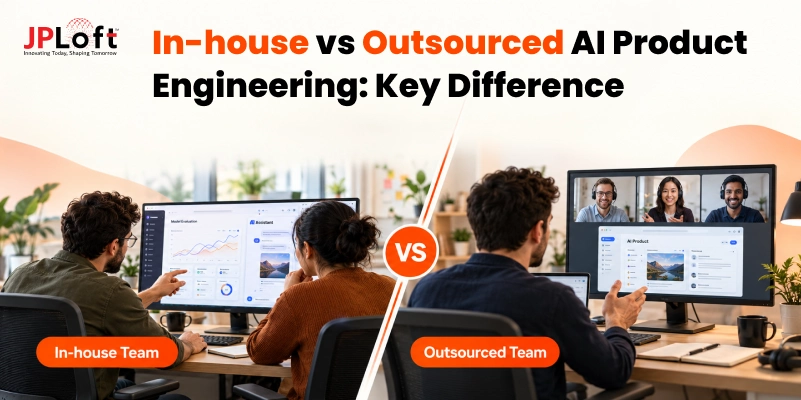
Should you build an in-house AI team or outsource to an AI product engineering partner? Many businesses are confused about this decision, as it can directly affect the development cost and launch timeline.
As Steve Jobs once said, “Great things in business are never done by one person. They’re done by a team of people.” But choosing the right team is never an easy task.
An in-house AI team offers greater control, but requires higher hiring costs and time. On the other hand, outsourcing provides immediate access to specialized AI engineers and faster launch, but less control over the business workflow.
Both models solve different AI product engineering problems at distinct stages. This blog will help you make the right choice for your business. In this guide, we will discuss:
-
What is outsourced AI engineering, and when should you choose it?
-
What is an in-house AI team, and when should you choose one?
-
Key comparison between in-house vs outsourced AI product engineering
-
How to choose the right model for your business?
What Is Outsourced AI Engineering and When Should You Choose It?
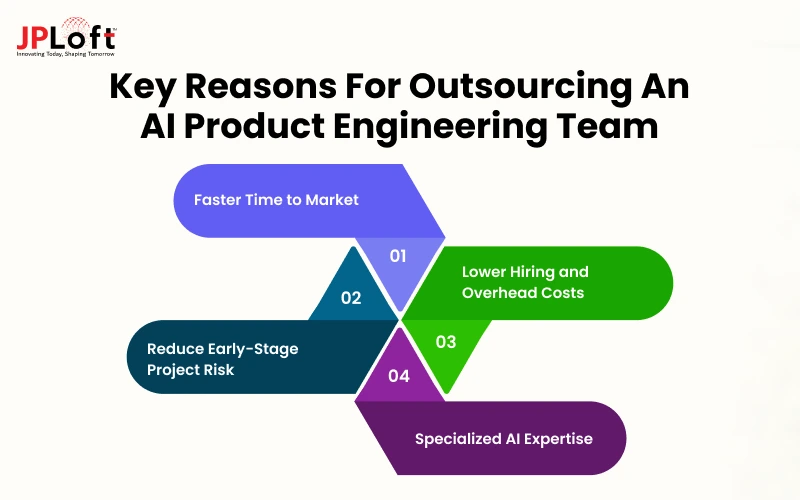 Outsourcing an AI product engineering team means partnering with external service providers. They help to plan, develop, test, and deploy AI-powered products for businesses. These partner agencies provide experienced developers and domain expertise across industries.
Businesses should also consider critical reasons when selecting an AI product engineering company.
1. Faster Time to Market
Partnering with an external AI engineering team saves 3-6 months of the recruitment process, allowing you to begin development sooner and launch the AI product faster.
2. Reduce Early-Stage Project Risk
Outsourcing a team can reduce early-stage project risk by access to a specialized AI team, developing an MVP faster, and reducing fixed project costs. An experienced team brings tested frameworks and past project experience to help you avoid costly mistakes.
3. Lower Hiring and Overhead Costs
A full-time AI engineer adds higher salaries, benefits, and equity overhead. In contrast, outsourcing offers flexible costs and payment only for the engineering capacity used. It helps save budget and complete the work on time.
4. Specialized AI Expertise
Building modern AI software demands specialized skills, such as Retrieval-Augmented Generation, MLOps, machine learning, and model testing. One of the benefits of outsourcing AI product development is access to these experts without the time, cost, and long-term commitment.
What Is an In-House AI Team and When Should You Choose One?
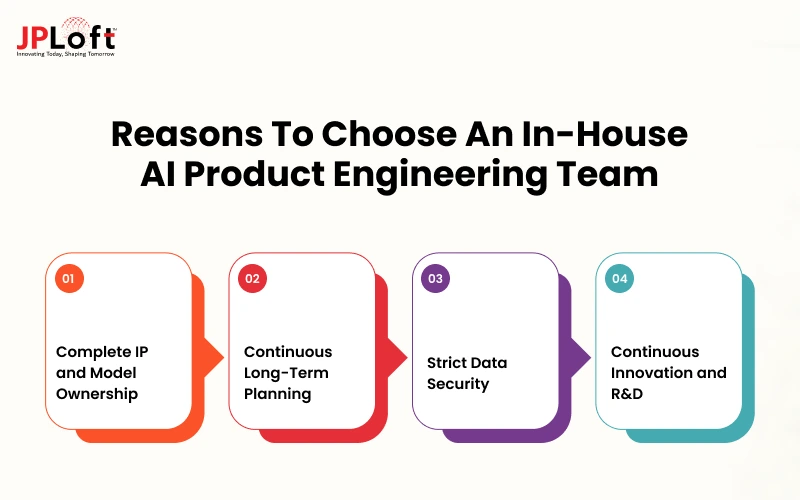
An in-house product engineering team consists of full-time data scientists, machine learning specialists, AI engineers, and software developers employed by the company. They work internally to develop, test, and improve AI-based products.
Here are the key reasons why you should choose an in-house AI team.
1. Complete IP and Model Ownership
For businesses looking for full control over their code, AI models, and product ownership, choosing an internal AI engineering team would be useful. When you are building proprietary AI models or integrating unique features, control over model ownership protects intellectual property.
2. Continuous Long-Term Planning
Over time, an internal team can align with the company’s goals, helping improve your AI product as your business grows.
3. Strict Data Security
An in-house team ensures sensitive business data, training sets, and proprietary models remain confidential within the organization. It reduces the risk of external exposure and helps you manage access and security directly.
4. Continuous Innovation and R&D
Hiring an in-house team benefits continuous testing of new models, improving pipelines, and experimenting with AI features as trends evolve. This allows the business to focus on the research part and make improvements directly.
In-House vs Outsourced AI Product Engineering: Key Differences
Choosing an in-house vs. outsourced AI product engineering team is an important decision for your business growth. Both teams offer different strengths and capabilities, so consider your business goals before making any decision.
Below is a detailed comparison between AI development outsourcing and an in-house team.
|
Comparison Factor |
In-house AI product team |
Outsourced AI product team |
|
Hiring Time |
Slow: Recruiting in-house takes time; it takes months to find, interview, and select the right team. |
Fast: Provides quick access to a specialized AI product team without hiring each specialist yourself. |
|
Initial Investment and Ongoing Costs |
High upfront cost: in-house AI development costs include salaries, benefits, bonuses, training, and tools. |
Lower upfront costs: pricing is based on the agreed project scope and pricing model. |
|
AI Expertise and Specialized Skills |
Limited: Knowledge is limited to domain-specific and requires training to build skills around the product. |
Broad: Access to broad AI skills instantly, such as machine learning, model testing, and AI product development experts. |
|
Scalability |
Slow and costly: growing your team requires more hiring, training, and budget allocation. |
Rapid: Scaling the team up or down is easier based on product requirements. |
|
Long-Term Business and Product Fit |
Best suited for core IP: ideal for long-term proprietary algorithms, core strategy, and long-term product needs. |
Best suited for MVPs: ideal for building an MVP, validating the product, and faster product innovations. |
|
Code Ownership, IP, and Data Control |
Full control: By default, ownership, access to code, models, and data is controlled by businesses. |
Contract-dependent: Ownership depends on the contract. Define code rights, model use, and data security before signing a contract. |
|
Prompt Engineering |
Deep domain knowledge: The team can refine the prompt using the company’s knowledge and internal data. |
Cross-domain knowledge: Access to qualified experts who have worked across multiple domains to help you design and finalize the prompt. |
|
Model Evaluation Maturity |
Internal framework: Builds internal testing processes to measure model accuracy, reliability, and performance. |
External framework: The team brings testing methods and tools, but you should check their process before hiring. |
How to Choose the Right AI Product Engineering Model for Your Business?
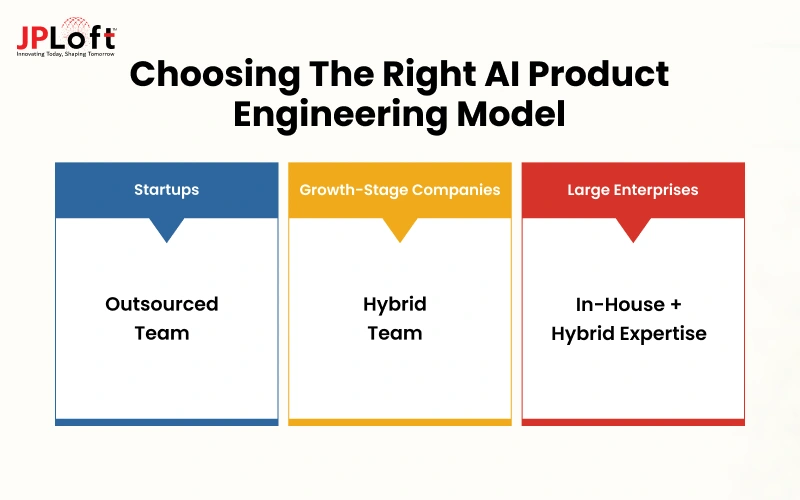
No single model fits every business. Your budget, control, and product needs all impact the right model choice. Choosing between AI development outsourcing, an in-house team, or a hybrid model depends on which stage you are currently in.
For Startups:
For early-stage startups, AI product engineering outsourcing is suitable when budgets and internal technical skills are limited. Explore the key advantages:
[A] Turn an MVP into a Product: When you are looking to improve a basic MVP version into a scalable and market-ready software, an outsourced engineering partner helps to build a refined version with a smoother user experience and reliable features.
[B] Access to Niche AI Skills: Outsourcing gives access to professional AI engineers with skills in computer vision, fine-tuning, vector databases, and MLOps that are different from hiring an in-house team.
[C] Cost Efficiency: An AI product development outsourcing team makes costs easier to predict before making a large investment. You can outsource the team with a dedicated pricing model and create a suitable budget.
[D] Faster Time to Market: Outsource a team if you want to build and launch an AI-powered product in {8-10 weeks} and check whether the core idea works before investing more money.
For Growth-Stage Companies:
A hybrid team suits growth-stage companies as a product scales, generates revenue, and requires continuous reliability for operations. This model combines internal strategic leadership with external team skills. Its core focus is maintaining software architecture, managing API integrations, and improving product performance.
Here are the key benefits of a hybrid engineering model for growth-stage companies.
[A] Smooth Phased Transition: Growth-stage companies can use a hybrid AI product engineering team to launch new features quickly while building in-house expertise.
[B] Dynamic Capacity Scaling: Growth-stage companies depend on fluctuating workloads. A hybrid model lets you scale the engineering team up or down as development needs change without hiring for permanent roles. It reduces the burden of layoffs or salary hikes.
[C] Adaptive Frameworks: A hybrid team uses adaptive frameworks, which help to update the platform and adjust the AI product development approach. It helps to modernize platform infrastructure according to business goals, customer needs, and product requirements.
[D] Expand Existing AI Features: External engineers in a hybrid setup can build or scale new AI features or capabilities without disrupting your core in-house team workflow.
For Large Enterprises:
For large enterprises, AI product engineering is important for core operations, long-term value, and maintaining control over sensitive data.
Therefore, combining in-house leadership with hybrid expertise gives access to specialized skills and greater control over the product. Here are the benefits of combining a hybrid and in-house AI team.
[A] Risk Mitigation: Choosing a hybrid team involves testing new features and architectures with an external specialist team before making long-term investments. This helps to make informed decisions and reduce investment risks.
[B] Intellectual Property & Control: Enterprises can maintain full control over codebases, intellectual property, business data, and pipelines through the combined models.
[C] Manage Large Development Workloads: Large enterprises often manage multiple AI engineering solutions alongside existing development projects. A hybrid team helps manage external workflows while the in-house team focuses on internal project management.
[D] Support Long-Term Product Development: Large enterprises need consistent product improvements to meet changing business goals and user needs. An in-house team develops deep knowledge of the AI product, business processes, and internal systems over time.
Why Choose JPLoft for AI Product Engineering?
Choosing the right AI engineering team helps your business manage costs and reduce early development risks.
JPLoft, a reliable AI product engineering company, helps businesses turn AI ideas into products that match their goals and market needs.
Our expert team works with technologies like machine learning, generative AI, and large language models (LLMs). We help you choose suitable models, prepare data, develop core AI features, and test product performance. Our team also helps improve AI outputs to make your product more useful and reliable.
Whether you are a startup testing an idea or an enterprise expanding an existing product, JPLoft tailors its approach to your needs.
We offer flexible engagement options, giving you access to skilled AI engineers. Our focus stays on product quality, clear communication, and your long-term business goals.
Conclusion
Choosing between in-house vs. outsourced AI product engineering depends on your business goals, budget, and product needs. The right approach should align with your business needs without creating unnecessary costs and technical risks.
- Startups: The benefits of outsourcing AI product development help launch an MVP without hiring a full AI product team.
- Growing Businesses: A hybrid model is suitable for combining internal product ownership with external AI expertise.
- Enterprises: An in-house team is suitable to offer greater control over AI models, data, security, and long-term ownership.
Before choosing your approach, assess your product goals, hiring resources, security needs, and development plans.
FAQs
Key skills include machine learning, data engineering, cloud computing, AI model deployment, and MLOps.
The main difference lies in cost, expertise, and control. An in-house team gives you direct control over product development. An AI product development outsourcing team provides instant access to expert AI engineers, saving recruitment time and cost.
An outsourced AI product engineering team helps startups hire expert AI engineers without incurring high hiring costs, enables faster software development, and ensures scalability.
A hybrid AI product engineering team combines internal business knowledge with external AI expertise. It helps businesses manage custom software, complex development, meet relevant government compliance, and move AI products from testing to real-world use.

Rahul Sukhwal is the CEO and Founder of JPLoft, with 18+ years of experience in software engineering, emerging technologies, and digital product development. His expertise spans artificial intelligence, including AI agents, generative AI, LLMs, chatbots, computer vision, and machine learning, as well as blockchain, IoT, AR/VR, mobile, web, and enterprise software. He focuses on applying these technologies to real business challenges across industries such as healthcare, education, mobility, finance, real estate, and on-demand services.


Share this blog