



Key Takeaways:
Choose an AI product engineering partner that can move beyond the demo by evaluating its live product experience, AI architecture, integration skills, testing methods, data security, and post-launch support.
Assess the company’s approach to AI product quality, regulatory compliance, and pricing before making a decision.
Ask important questions about AI model selection, RAG vs. fine-tuning, timelines, performance monitoring, and risks.
Partnering with JPLoft offers AI product engineering services and custom solutions designed around business needs and future growth.
Not every company that builds AI can build a strong AI product. A polished demo may show what is possible, but it does not reveal how a team handles product architecture, integrations, scalability, or post-launch.
The benefits of choosing the right AI product engineering company become clear when you consider how much the decision can affect the overall product journey.
When choosing a partner, businesses need to look beyond a company's experience. It is important to evaluate a team’s ability to work with data, understand business workflows, integrate AI into the product, and support the software beyond development.
To avoid confusion, this blog explains how to select an AI product engineering company, covering the company’s approach and the questions to ask when evaluating a potential partner.
How to Choose the Right Company for AI Product Engineering: 8 Key Criteria
AI product engineering team analyzes the right code, product-fit model, and creates a scalable working product instead of just deploying code into a demo. Choosing a partner requires more than comparing technical expertise or development experience.
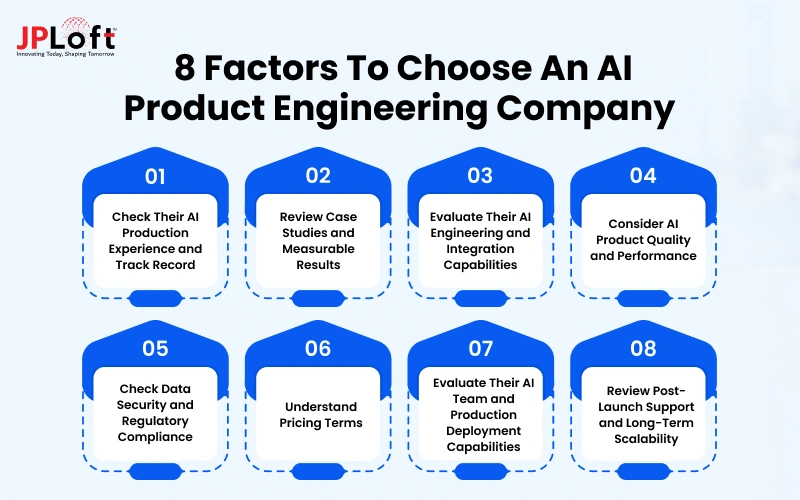
Here are the key factors to consider before hiring an AI product engineering company.
1. Check Their AI Production Experience and Track Record
A company may have AI development expertise and a long list of demos and products, but if it lacks experience with products currently used in real-life use cases, then reconsider. Building a demo is very different from operating and improving an AI product used by customers.
When deciding what to look for in an AI product engineering company, ask whether it has launched AI products beyond the testing stage. Its production experience should match the needs and complexity of your planned product.
Look for a company that has:
-
A live product managing growing numbers of users.
-
Maintained reliable and useful AI outputs.
-
Handled traffic and performance during peak times.
-
Monitored user feedback and product performance.
A company with reliable experience and a track record offers scalable solutions. Therefore, look for real deployment experience, ongoing product responsibilities, and relevant industry knowledge.
2. Review Case Studies and Measurable Results
Case studies help businesses uncover measurable results and client feedback for major discussions. However, do not rely only on attractive screenshots.
Look for case studies that explain the business problem, the product built, the AI model approach used, and what role each team plays. Relevant case studies should provide detailed real product development and its challenges.
Look for details such as:
-
Products similar to your industry.
-
How the product reached real users.
-
Evidence of the team working beyond the demos they have created.
-
Measurable changes in cost, performance, timelines, and user activity.
There is sensitive project information, such as confidential agreements or client data, so verify whether the company can handle details properly. This will help you understand how to evaluate an AI product engineering company.
3. Evaluate Their AI Engineering and Integration Capabilities
AI technology alone cannot do wonders; a product needs to integrate with the application, backend systems, databases, and business workflow to improve user experience.
If any business is using AI to predict customer behavior, it needs these system integration capabilities in an AI engineering company.
For instance, an AI product may need:
-
Adding APIs and backend systems for AI to work with existing software.
-
A clear workflow for the product to work automatically.
-
A dashboard system to review the results.
-
Integration with CRM, ERP, payment, and other business systems.
A good company should not be an expert in building an AI model; it should help to plan the software around the model, integrating reliable APIs and connecting with CRM tools to ensure everything works together and drives successful outcomes.

4. Consider AI Product Quality and Performance
Another important tip for selecting an AI product engineering team is to understand how the company handles quality and performance. An AI product should deliver useful and reliable results under real business conditions.
Ask how the company tests AI features before and after launch. Its process should cover both technical performance and the quality of results users receive.
Important areas to review include:
-
It is important to check that the AI product provides correct and relevant answers.
-
Its ability to perform across different business situations.
-
Team testing practices for unusual inputs and possible errors.
-
Ability to offer support for quality and performance problems after launch.
Ask whether the company uses real-world test cases before launch. Also, understand how it handles incorrect answers and user feedback. A clear testing and improvement plan provides more useful information.
5. Check Data Security and Regulatory Compliance
If you are building AI software or an application for different regions, you cannot rely on a company that is not aware of laws and privacy rules. The company you choose should understand each region's security and privacy requirements.
This is especially important in healthcare and fintech industries, where products may need to meet strict data protection and regulatory requirements.
Ask the company about:
-
Product and customer data storage information.
-
Who can access the data during development and support.
-
How third-party AI services and APIs are chosen based on security.
-
Which privacy rules and laws apply to your specific industry products.
The right partner should be able to explain its clear app security practices and show they apply them throughout the development, deployment, and post-launch support journey.
6. Understand Pricing Terms
Before choosing a partner, evaluate their pricing terms. A cheap option in this field can be one of the risk factors to consider before hiring an AI product engineering company. Suitable quality and security come with decent pricing. The total cost may include AI model usage, cloud services, maintenance, infrastructure, and future improvements.
Look for companies that offer an affordable pricing structure and define a clear AI app cost strategy, instead of vague estimates.
Review these things when considering budget:
-
Product features, integrations, and development cost.
-
AI model and API usage.
-
Cloud hosting, storage, and infrastructure.
-
Additional costs for changes or new feature updates.
There are two types of companies, one who offer fixed pricing model which includes fixed project requirements and no flexibility. Another company creates a pricing strategy with flexibility in mind. Therefore, clarity on whether the company uses a fixed pricing model or a time-based model based on product satisfaction is important.
7. Evaluate Their AI Team and Production Deployment Capabilities
Today, with coding tools, AI frameworks, and ready-made templates, building an AI model is more accessible than ever, but it is also leading to several AI infrastructure failures.
This is happening because the team builds a demo with a template but lacks the infrastructure, MLOps expertise, engineering depth, and compliance with real-world requirements.
AI products drift or update over time; a capable team must be able to handle failure mechanisms, ensure automated testing, and perform required checks to ensure the AI model is built successfully.
When understanding how to evaluate an AI product engineering company, look at the team behind the project.
A capable team must have access to:
-
Machine learning engineering
-
Data science
-
Backend and infrastructure engineering
-
Product management
-
UI/UX design
-
Quality assurance
Choose a team that can build, test, monitor, and maintain AI products as they evolve, rather than one that only knows how to create a working demo.
8. Review Post-Launch Support and Long-Term Scalability
Launching an AI product involves more than just deploying the code. After launch, the product requires updates or new model integration, bug fixes, data changes, or the AI model may need retraining for quality performance.
Beyond standard QA and bug testing, software also requires updates for generative AI models and retrieval-augmented technology to ensure it is reliable.
A good AI product engineering firm should be able to:
-
Monitor product and AI performance.
-
Fix issues, such as quality and misleading responses.
-
Improve performance with automated self-updates.
-
Update or replace models when business needs change.
In short, choose a company that can support your product before and after launch to ensure long-term software stability.
Questions To Ask An AI Product Engineering Team
Before you sign a contract with an AI product engineering team, ask questions to evaluate the partner’s AI approach, costs, and ability to handle and manage tasks. Explore these top important questions to ask an AI product engineering company.
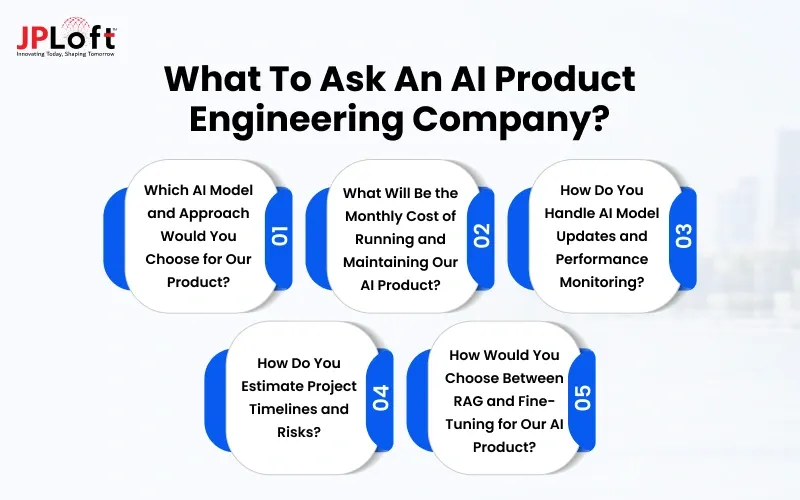
1. Which AI Model and Approach Would You Choose for Our Product?
This question helps you understand, from the different types of AI models available, which one the company prefers for your software. The choice should be based on the business goals, product requirements, data, and budget.
The company must confirm whether the existing models can meet your business needs, or your product may require customization or another approach. If you have any confusion, you can also connect with a reliable AI app development company to discuss doubts about the models.
2. What Will Be the Monthly Cost of Running and Maintaining Our AI Product?
The initial development quote does not represent the full cost of running an AI product. Ask the company about testing, growing user activity, maintenance, AI model, API usage, cloud hosting, infrastructure, and technical support team costs.
This is one of the best practices for choosing an AI product engineering partner. It will help you understand the overall spending and reduce hidden expenses after launch.
3. How Do You Handle AI Model Updates and Performance Monitoring?
The AI models and third-party services keep updating. Maintenance requires operational functions and strategies to keep the product reliable and maintain quality production.
Ask the company how they will manage new version updates, safety, and setting up automated human feedback to keep you aligned with the model's behavior. Question the team about AI product hallucination, wrong or misleading answers, and security challenges after launch.
4. How Do You Estimate Project Timelines and Risks?
The company should estimate timelines based on your product’s features, integrations, and custom requirements. Ask the team about how much time is expected for AI product development, integration, testing, deployment, and other major development stages.
The product is also involved in risks of data changes, compliance requirements, third-party API costs, model accuracy, and data updates. The company must be able to specify practices to handle such risks. It will help you understand what to expect from an AI product engineering partner.
5. How Would You Choose Between RAG and Fine-Tuning for Our AI Product?
Ask the company how it would decide between a RAG-based approach and fine-tuning. If the RAG-based model is recommended, which data will be used to provide relevant information to the AI, such as FAQ, company details, or client-specific reviews?
Moreover, if fine-tuning is recommended, ask what types of training data will be required and why it is perfect for the AI product. A good company should be able to clarify practical ways to explain why a particular model is suitable.

Why Choose JPLoft for AI Product Engineering Services?
Following the best practices for choosing an AI product engineering partner means finding a team that understands both technology and business goals. JPLoft, an AI product engineering company, builds AI that works inside the product and not around it.
Our focus remains on building useful products that can grow with your business needs. JPLoft can build,
-
AI product chatbots to handle customer questions, and AI agents to automate repetitive tasks.
-
RAG-based systems to retrieve knowledge-based information from company internal and external data.
-
Custom solutions by planning features based on user needs and product goals.
-
Ongoing development to upgrade products as business requirements and technology change.
Before starting a project, discuss your product idea, target users, budget, and expected outcomes. A clear scope helps establish development priorities and avoid unnecessary features.
Conclusion
Choosing an AI product engineering partner requires careful planning and clear expectations. Your decision should consider business goals, technical experience, product quality, and long-term costs.
To understand how to select an AI product engineering company, start by defining what your product needs to achieve. Then compare companies using their experience, case studies, security practices, and development processes.
Ask direct questions about pricing, ownership, testing, and ongoing support. Review the answers carefully before committing your budget.
The right development process should help you build a useful product while preparing for future growth. Take time to understand your options and choose a partner that fits your business requirements.
FAQs
AI product engineering companies plan, build, and scale software, using AI as the core experience from the beginning. It combines strategies for AI engineering, software development, and product design for scalable AI-powered products.
When hiring an AI product engineering team, consider its production, engineering, and integration capabilities, and whether it has the AI expertise to build scalable products rather than demos.
Ask about AI model selection, development cost, and timelines. Ask about data quality, security, privacy, and compliance, post-launch support, and whether it is included in the pricing model.
AI product engineering typically costs $25,000 to $500,000+ depending on the customization, team location, and integration requirements.
A good AI product engineering partner analyses the business problem, includes engineering depth, builds a product-ready system instead of showcasing demos, and offers reliable ongoing support.

Rahul Sukhwal is the CEO and Founder of JPLoft, with 18+ years of experience in software engineering, emerging technologies, and digital product development. His expertise spans artificial intelligence, including AI agents, generative AI, LLMs, chatbots, computer vision, and machine learning, as well as blockchain, IoT, AR/VR, mobile, web, and enterprise software. He focuses on applying these technologies to real business challenges across industries such as healthcare, education, mobility, finance, real estate, and on-demand services.



Share this blog