


Key Takeaways:
Businesses are investing in AI product engineering to launch faster, cut costs, improve user experiences, automate repetitive work, detect issues early, test ideas safely, and build scalable products.
AI product engineering solutions are transforming healthcare, e-commerce, and many other industries with smart solutions.
Businesses must consider factors such as system integration, data privacy, and team adoption before investing in AI product engineering solutions.
Multimodal AI, generative design, responsible AI, and smart AI-driven maintenance are shaping the future of AI product engineering.
JPLoft helps businesses build and scale AI products with AI integration, generative AI, RAG systems, copilots, and AI agents using modern AI technologies.
Do you know that the global AI engineering market is projected to reach $167.5 billion by 2033 at a CAGR of 30.1%? This growth reflects that AI is no longer just being tested. Businesses are now using it in products, daily operations, and customer experiences.
AI product engineering helps businesses make AI a core part of their products instead of treating it as a feature. It can automate repetitive work, analyze business data, improve decision-making, and ensure faster product development.
Earlier, building and launching a product could take more than two years. However, AI product engineering is changing this by making product development faster, smoother, and more efficient.
Thus, understanding the potential to invest in AI product engineering solutions is no longer optional. In this blog, we will explore the top reasons to invest in AI product engineering, use cases, the challenges, and emerging trends. 
Top Reasons Businesses Invest in AI Product Engineering Services
Businesses rarely invest in AI technology because it's new or trendy. They invest when AI can help solve business problems, improve products, reduce operational effort, and support business growth.
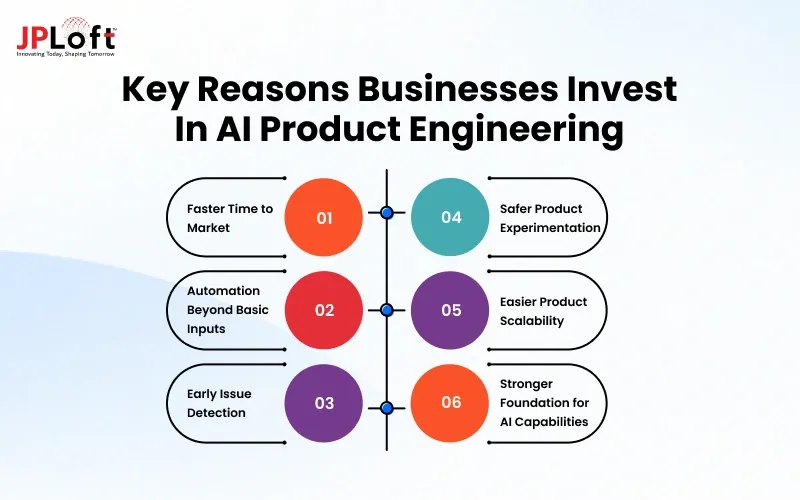
Here are the key reasons why several businesses need AI product engineering services.
1. Faster Time to Market
Businesses cannot afford to delay product launches through a slow and repetitive development process. AI product engineering solutions can automate repetitive tasks and help teams build and test features faster.
AI-assisted code generation, pattern recognition, independent checks, and predictive analysis can reduce development time and speed up product launches. It also gives businesses more time to test and improve the product before competitors catch up.
2. Automation Beyond Basic Inputs
Traditional AI tools often rely on predefined rules and training inputs, which can lead to outdated or rigid responses. AI product engineering analyzes, plans, and refines unstructured input.
With machine learning and other AI capabilities, the product can use data and feedback to improve performance over time. This allows businesses to move beyond basic input response and adapt to intelligent product experiences.
3. Early Issue Detection
AI product engineering helps businesses identify issues earlier during the product development stage. AI-powered development and testing tools can analyze code, identify potential bugs, and support continuous testing to catch design flaws.
This allows the development team to address problems before they affect users, improve quality, reduce rework, and launch a more stable product.
4. Safer Product Experimentation
One of the advantages of investing in AI product engineering is that it helps businesses test new ideas before making large investments or engineering efforts.
Teams can build MVPs, test features, analyze user feedback, validate assumptions, and inform major decisions. For businesses, this helps make product experimentation more controlled, measurable, and cost-effective.
5. Easier Product Scalability
Scaling a digital product can become complex as users, data, integrations, and business needs increase. AI product engineering helps businesses plan scalability while designing the product architecture and AI infrastructure. It focuses on building products that can support updates from the beginning.
Businesses can build systems that support new features, growing data volumes, changing user needs, and additional integrations.
6. Stronger Foundation for AI Capabilities
AI products depend on reliable data, infrastructure, integrations, and workflows. AI product engineering helps businesses build a solid foundation to collect, organize, store, and use data effectively.
This foundation helps improve predictive analytics, AI agents, personalization, and intelligent automation, and improve the product as per the business needs, data, and AI capabilities.
Real-World Applications of AI Product Engineering
The benefits of investing in AI product engineering are quite evident in digital product transformation solutions and businesses across several sectors. It improves existing systems, streamlines workflows, and supports better business decisions.
Here are some real-world applications of AI product engineering.
|
Industries |
AI Product Engineering Use Cases |
Benefits |
|
Healthcare |
Medical imaging, patient data analysis, AI screening, wearable devices. |
Faster screening, reduced manual effort, improved patient monitoring. |
|
Automotive |
Manufacturing, vehicle performance maintenance using data from cameras, sensors, and connected systems. |
Improved vehicle performance, reduced maintenance costs, better product reliability. |
|
E-commerce |
Product recommendations, intelligent search, demand forecasting, and inventory prediction. |
Improved customer engagement and better inventory planning. |
|
Fintech |
Real-time fraud prevention and security, automated regulatory compliance, spot anomalous behavior, and block fraudulent activities. |
Reduced fraud losses, improved security, and stronger regulatory compliance. |
|
Logistics |
Route Optimization, demand forecasting, and shipment tracking. |
Better delivery planning, reduced transportation costs, and resource utilization. |
|
EdTech |
Adaptive learning platforms, automated assessments, customized courses, and student performance analytics. |
Personalized learning, reduced assessment effort, and scalable learning experiences. |
Important Factors Businesses Should Consider Before Investing in AI Product Engineering
The benefits of AI Product engineering can create new business opportunities, but investing in it also comes with analyzing crucial factors. Businesses need to understand these factors before building or integrating AI into their products. Considering these factors early can help choose the right approach that aligns with goals.
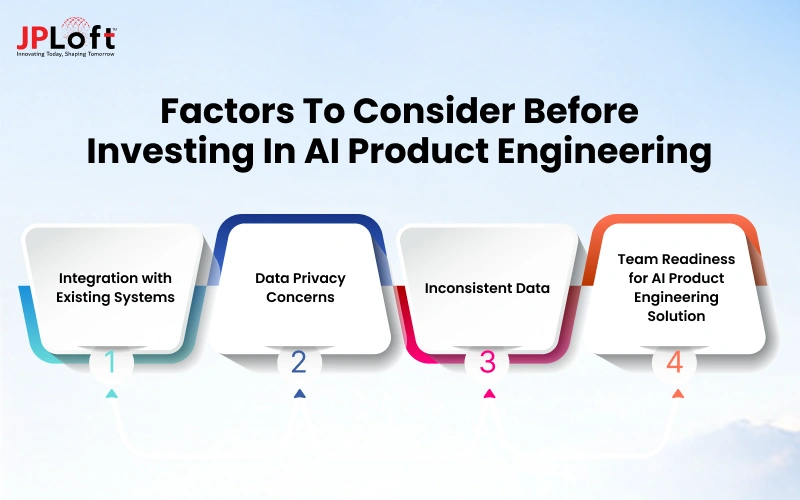
Here are some of the critical factors to consider to make a smart investment in AI product engineering.
Factor 1: Integration with Existing Systems
Businesses should consider how AI will connect with their existing systems, databases, and other internal tools. This is important because several businesses still rely on legacy software, internal tools, and databases.
The right AI product engineering approach should allow AI capabilities to work with existing systems without replacing older software systems.
Factor 2: Data Privacy Concerns
Businesses should consider how AI will collect, process, and store private and sensitive data. This is especially critical in healthcare, fintech, insurance, and regulated industries.
Data privacy and security should be considered from the beginning of product development, along with relevant compliance with GDPR, HIPAA, and industry-standard rules.
Factor 3: Inconsistent Data
Evaluating data quality is essential for accurate results. Businesses must check whether the available data is accurate, complete, relevant, and consistent enough to support AI product engineering solutions.
Outdated customer records, incomplete product information, and inconsistent data formats can affect AI performance and lead to poor-quality results.
Factor 4: Team Readiness for AI Product Engineering Solution
It is critical to consider whether the team is prepared to work with the AI-powered product. Employees need to understand how AI-powered products and workflows will integrate into their daily routines.
Connecting with an AI development company would be helpful for the team to gain clear knowledge and effective ways to use the AI product.
What are the Future Trends in AI Product Engineering?
The future of AI product engineering is expected to bring significant changes. As new approaches become easier and more practical to use, businesses are already excited to manage AI-powered products.
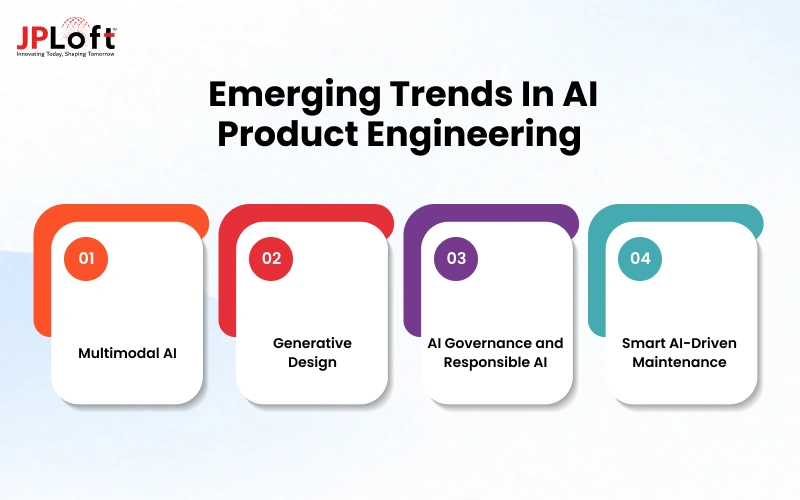
Here are a few important future trends shaping AI product engineering.
1. Multimodal AI
Multimodal AI is one of the popular trends in AI product engineering solutions; it can analyze, interpret, and collect requirements from multiple types of data.
Whether it is text, images, videos, audio, or PDFs, it combines information from multiple sources to understand user needs more effectively. For businesses, this can create richer and more natural product experiences.
2. Generative Design
Generative design is becoming an important trend in AI product engineering. It helps businesses create multiple possible product designs based on specific requirements. Businesses are already looking to reduce the time and cost involved in product development.
Generative design can help engineering teams save time by limiting unnecessary prototype cycles and exploring different design options, testing ideas, and customizing the design based on performance. AI can generate and compare multiple options, allowing teams to select the most suitable design for further development.
3. AI Governance and Responsible AI
As businesses use AI across more products and workflows, responsible AI security practices will become important.
AI governance includes a framework of policies, rules, technologies, and processes to develop, deploy, and monitor AI products and solutions. It turns ethical values into strict rules to ensure the product is safe and secure for users to use and share their details with.
This trend helps to ensure fairness, transparency, security, privacy, and accountability throughout the product lifecycle.
4. Smart AI-Driven Maintenance
AI-driven maintenance system helps businesses monitor product performance, identify unusual patterns, and detect potential issues before they become a major challenge.
Instead of relying on manual monitoring, AI can analyze system activity, error patterns, performance data, and user behaviour to identify potential issues early.
This helps reduce maintenance costs and time, and improve the speed and efficiency of engineers working behind the product.

How JPLoft Helps Businesses Build and Scale AI Products?
Building an AI product is easier when the engineering behind it is planned from the beginning. Businesses often struggle to connect AI models with their data, workflows, and product features.
This is where JPLoft, an AI product engineering company, helps. Our team covers the complete journey, from building the AI foundation to improving the product after launch. JPLoft helps to build:
-
AI Product Integration: Connects AI capabilities with existing products and workflows.
-
Generative AI Systems: Builds AI-powered product experiences for specific business needs.
-
RAG Systems: Connects AI with business data for more relevant responses.
-
AI Copilots & Agents: Automates tasks and supports users within products.
Our team works with technologies such as GPT, Gemini, Claude, Llama, LangGraph, and AWS Bedrock to help you leverage the advantages of investing in AI product engineering.
From the first AI concept to a product that keeps improving, JPLoft helps businesses turn AI into something users can actually use.
Conclusion
AI product engineering is becoming an important part of modern product development. There are many reasons to invest in AI product engineering, including improving products, reducing manual work, and understanding users better.
The biggest value comes when AI solves a clear business or customer problem. It should support measurable goals instead of being added only because it is popular.
Businesses should also consider data quality, security, integration, maintenance, and ongoing costs. These factors can strongly affect the long-term success of an AI product.
For business owners, the right AI strategy starts with business needs, as a focused approach can help turn AI investment into practical and lasting product value.
FAQs
Businesses are investing in AI product engineering to find early issues, launch products faster, build strong data infrastructure, improve product scalability, and develop user-centric software.
AI can help teams automate repetitive work and analyze information faster. It can also support testing, personalization, product decisions, and faster feature development.
AI product engineering is widely used in healthcare, automotive, manufacturing, e-commerce, fintech, and enterprise software.
Integrating AI into software includes data privacy issues, inconsistent data, lack of team expertise with AI models, regular model maintenance, and system integration challenges.
AI product engineering services are evolving massively with generative AI. AI is augmenting human creativity, enabling agent AI, driving hyper-personalisation, and enabling self-updating pipelines.

Rahul Sukhwal is the CEO and Founder of JPLoft, with 18+ years of experience in software engineering, emerging technologies, and digital product development. His expertise spans artificial intelligence, including AI agents, generative AI, LLMs, chatbots, computer vision, and machine learning, as well as blockchain, IoT, AR/VR, mobile, web, and enterprise software. He focuses on applying these technologies to real business challenges across industries such as healthcare, education, mobility, finance, real estate, and on-demand services.



Share this blog