


Key Takeaways
The Rover app connects pet owners with trusted pet sitters and walkers through a simple booking system.
Safety, trust, and up-to-date notifications play a key role in making a pet care application successful.
Features such as user profiles, bookings, location tracking, payments, and ratings drive user engagement.
Building a Rover-like app requires careful planning, the right development architecture, and trusted safety features.
Collaborating with an experienced development company like JPLoft minimizes risks and speeds up market launch.
Do you know millions of pet owners look for trustworthy care for their dogs, but often struggle to find the right one?
This gap shows increased demand for pet care services and encourages businesses to develop a dog walking app like Rover that connects pet owners with trusted pet sitters.
Rising pet ownership and growing pet humanization trends continue to fuel this demand.
The market opportunity is also rising; the global pet care market is projected to reach USD 283.67 billion by 2033, growing at a CAGR of 5.9% from 2026 to 2033.
So, if you’re planning to enter this space, how do you create an app like Rover that works in real world?
This blog explains how to build a dog walking app like Rover, covering the complete process from planning to launch.
What is the Rover App?
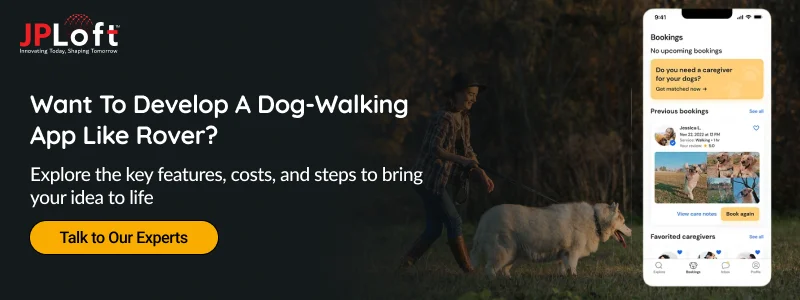
Founded in 2011, the Rover app is a popular pet care platform. It connects pet owners with pet care services like dog walking, dog sitting, and day care services.
With more than 5 million downloads on the Play Store and a 4.9-star rating from over 516K reviews on the App Store, Rover has established itself as a trusted name in the pet care industry.
Making use of it is usually easy for dog owners as well as dog sitters. The Rover app works by connecting pet owners with trusted sitters and walkers through a simple booking process.
Users browse options, compare profiles, and confirm services, while the app handles communication, tracking, updates, and secure payments in real time.
With built-in texting, 24/7 support, GPS tracking, and media sharing features, users can track the whereabouts of their dog.
Advantages of Creating an App Like Rover
Building an app like Rover comes with several benefits. The advantages are as follows:
-
High Demand in the Market: With a rise in number of dog lovers and pet owners, the requirement for trustworthy services is consistent and growing.
-
Generates Revenue: When you develop apps like Rover, you can earn revenue through various channels, such as service fees, subscriptions, and premium offerings.
-
Global Expansion: Pet ownership trends are rising globally. The app can be adapted to a new market, which opens the door for international growth and expansion in revenue.
-
Consumer Convenience: The app becomes a useful tool because it makes it easy for pet owners to locate and schedule services with ease.
-
Build Brand Loyalty: A well-designed app increases user trust, leading to an increase in retention and engagement. This can contribute to consistent business growth over time.
Essential Features for Building a Dog Walking Platform
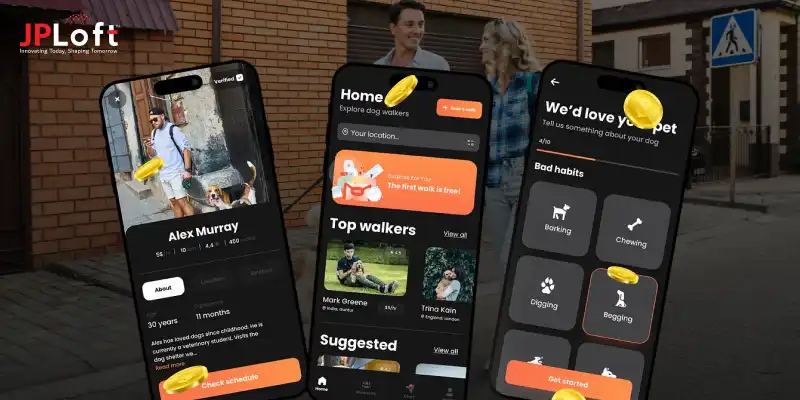
To build a dog walking app like Rover, various features play a key role. Let’s understand these dog walking app features in more detail.
|
Panel |
Feature |
Description |
|
User Panel |
User Registration & Profile Setup |
Allows users to create accounts, manage profiles, and securely access the platform. |
|
Search & Discovery |
Helps users find pet sitters and dog walkers based on location, ratings, pricing, and availability. |
|
|
Booking & Scheduling |
Enables users to book pet care services and manage appointments easily. |
|
|
In-App Messaging |
Supports direct communication between pet owners and pet sitters. |
|
|
Service Provider |
Booking Requests |
Allows pet sitters to receive, accept, or decline booking requests. |
|
Earnings Dashboard |
Helps sitters track completed bookings, earnings, and payment history. |
|
|
Schedule Management |
Enables sitters to manage availability, bookings, and working hours efficiently. |
|
|
Service Updates |
Allows sitters to share live updates, photos, and activity reports with pet owners. |
|
|
Admin Panel |
Commission Management |
Helps manage platform commissions, service fees, and earnings distribution. |
|
Content & Support Management |
Enables management of support requests, FAQs, and platform content. |
|
|
Booking & Transaction Monitoring |
Allows admins to track bookings, payments, cancellations, and disputes. |
|
|
Analytics & Reporting |
Offers insights into revenue, user growth, engagement, and platform performance. |
Advanced Features That Make a Dog Walking App Stand Out
Beyond the core mobile app features, advanced functionalities can improve user experience, increase engagement, and help your app stand out in a competitive market.
Here are some advanced features worth considering to make a dog walking app like Rover:
► GPS Tracking: Enables live location tracking during pet walks and activities.
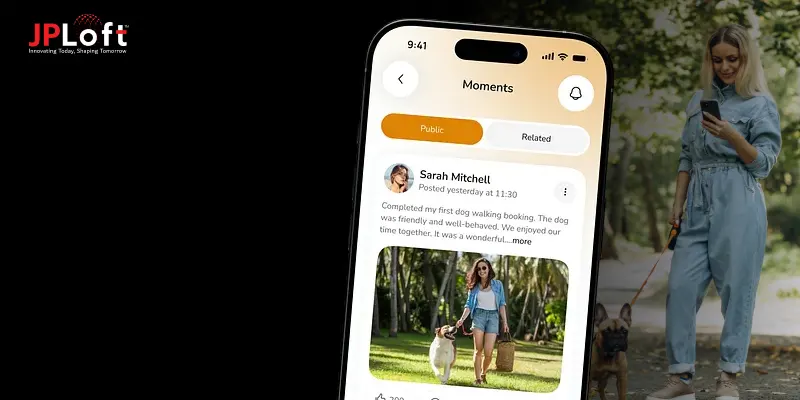
► Rover Card: Provides walk summaries, route tracking, photos, and activity updates in real time.
► AI-Based Recommendations: Suggests suitable pet sitters based on user behavior and preferences.
► Virtual Pet Training: Supports online pet training and consultation services.
► Multi-Language Support: Improves accessibility for users across different regions.
► eCommerce Integration: Allows users to purchase pet products and accessories within the app.
Step-by-Step Development Process to Build an App Like Rover
Building an app like Rover requires planning, the right tech stack, and smart features.
Below is a step-by-step process that brings your idea to execution.
Step 1: Conduct Deep Market Research
Before beginning the process, conduct thorough market research. This helps in understanding how to develop a dog walking app like Rover that meets real user requirements.
► Target Audience: Find out who will be using this app, namely the pet owner, pet sitters, and dog walkers.
► Competitor Research: Study apps like Rover and Wag to have a proper understanding of the market.
► Market Validation: Gather survey responses and opinions to confirm customer demand.
Step 2: Plan Your UX/UI Design
To make an app like Rover, plan your interaction design with the right UI/UX design services. Focus on a smooth, intuitive journey where pet owners can quickly find trusted sitters and book easily.
► Wireframing: Sketch the full user journey first. Map out every screen a pet owner sees, from login to booking confirmation. Do the same for service providers.
► Prototyping: Build a clickable prototype in Figma or Adobe XD. Test it with real people and watch where they get confused.
► UI Design: Design separate onboarding flows for pet owners and service providers. Use trust signals, such as verified badges and ratings, throughout.
Step 3: Choose the Right Tech Stack
The technology you build on determines how fast your app runs, scales, and how much maintenance it requires later.
► Mobile App: Use React Native or Flutter to build one codebase that works on both iOS and Android. This saves significant time and cost.
► Backend and Database: Use Node.js or Python for the backend. Use PostgreSQL for data like bookings and payments.
► Cloud and Security: Host your app on AWS or Google Cloud. This gives you automatic scaling, data security, and reliable performance.
Step 4: Development & API Integration
This is where your dog walking app development guide moves from a design file to a real working product.
► User Accounts and Walker Profiles: Users can add their dog's breed, size, and temperament. Service providers set up their profiles, availability, and service rates.
► Booking Process and Scheduling: Users can search nearby walkers, pick a time slot, and confirm a booking in a few taps.
► Third Party Integrations: Connect Google Maps for live walk tracking, Stripe or Razorpay for payments, and Firebase for instant push notifications.
Step 5: Test Thoroughly Before Launch
Mobile app testing is essential before launch to catch bugs early and ensure a smooth user experience.
► Functional Testing: Test all features end-to-end. Make sure booking, payments, and GPS tracking work correctly in real time.
► User Acceptance Testing: Let real users try the app and observe where they face confusion or drop-offs.
► Performance and Security Testing: Check how the app handles heavy traffic and ensure all data, location, and payment flows are secure before launch.
Step 6: Deploy, Monitor, & Optimize
The final stage of how to develop an app like Rover involves continuous monitoring, updates, and optimization to ensure long-term growth.
► App Release into App Stores: Successfully publish your app to the Play Store and submit it to the App Store.
► Monitoring Performance: Monitor bookings, engagement, retention, and app performance.
► Regular Feature Improvement: Use customer feedback and analytics to refine features, supported by ongoing mobile app maintenance services and performance optimization.
Cost to Develop a Dog Walking App Like Rover
In general, the cost to develop an app like Rover ranges between $10,000 and $120,000+.
However, the dog walking app development cost varies based on multiple factors, including features, platform choice, design complexity, and development region.
In cases of global scaling with high-level integrations, such as insurance, emergency support, and multilingual capabilities, a higher cost will be involved.
Server costs, maintenance, and upgrades are other aspects that will contribute to budget.
Key Challenges to Create an App Like Rover & Their Solutions
The real challenge to build apps like Rover is making people feel safe leaving their pets, confident in every booking, and comfortable coming back again.
Let’s break down what actually makes it complex and how to handle it.
Challenge 1: Building Trust Between Pet Owners & Sitters
The main app development challenges lie in getting pet owners to trust another person with their pets, especially when there is no prior connection.
When there are no trust triggers, clients are hesitant to use the platform's services.
Solutions:
-
Profile verification
-
Background checks
-
Other pet owner ratings & genuine reviews
-
Messaging for instant communication
Challenge 2: Ensuring Pets' Safety During Every Service
There is an emotional attachment in pet owners. Thus, small matters about safety can make the owner think twice when using the application.
During development, maintaining safety while walking, during stays, and during visits is among the most significant challenges.
Solutions:
-
Emergency support system
-
Vet access integration
-
GPS tracking during walks
-
Clear care guidelines for sitters
Challenge 3: Matching the Right Sitter with the Right Pet
Different pets have different temperaments, energy levels, and care needs, making random matching ineffective.
Ensuring the right match between sitter and pet directly impacts user satisfaction, which is essential when understanding how to make a dog walking app like Rover.
Solutions:
-
Smart matching based on pet behavior
-
Location-based matching
-
Sitter experience level
-
Past booking history analysis
Challenge 4: Managing Availability Without Confusion
Bookings for pet care are subject to regular changes, and scheduling issues can arise from even little delays or mismatches.
For operations to run well, availability must be precise and updated in real time.
Solutions:
-
Live calendar system
-
Instant booking updates
-
Automatic conflict checks
-
Real-time availability tracking
Challenge 5: Making Payments Simple & Transparent
Users expect clarity regarding pricing, and any kind of confusion about pricing may lower their trust in the application.
A seamless and transparent payment process is crucial to sustaining user trust in app development services.
Solutions:
-
Transparent pricing system
-
Secure payment gateways
-
Clear cancellation policies
-
Payment is released after service completion
Why Choose JPLoft to Build an App Like Rover?
It takes appropriate technology, smooth operations, and an excellent user experience to create a dog walking app.
With features like real-time booking, GPS monitoring, secure payments, sitter verification, and multi-user management, JPLoft assists businesses in creating scalable and feature-rich pet care applications.
As a trusted company for dog walking app development, JPLoft creates custom solutions that improve user engagement, simplify operations, and support long-term business growth.
If you are confused about how to build a dog walking app like Rover, our team provides end-to-end development services to help you build a reliable and competitive app.
Final Takeaway
The pet care market is developing fast, and applications such as Rover have already proved how technology can simplify the process of finding the right services among pet owners.
Understanding how to build an app like Rover requires creating a platform that delivers convenience, safety, transparency, and a smooth experience for both pet owners and sitters.
By focusing on the right business model, essential features, trust-building mechanisms, and scalability, businesses can build such an app that stands out in a competitive market.
If you are planning to enter this space, now is the right time to convert your vision into a solution that meets growing demand for pet care services.
FAQs
For building such an app, start by understanding your users and the market. Then add features like booking, payments, tracking, and reviews; test the app, and launch it with a clear growth strategy.
It works by enabling its users to search for pet sitters, review their profiles, book services, track pet activities, and make secure payments.
The cost to make an app like Rover generally falls between $10,000 and $120,000+. It depends on features, platform, design complexity, tech stack, and scalability requirements.
User registration, pet profiles, a booking system, real-time tracking, in-app conversation, safe payments, ratings, and reviews are among the essential features of an app like Rover.
Depending on features, complexity, and development strategy—such as MVP or full-scale launch- it can take three to eight months on average to build.

Rahul Sukhwal is the CEO and Founder of JPLoft, a visionary technologist with 18+ years at the forefront of emerging tech innovation and software engineering. He channels deep software engineering and AI expertise into building smarter, scalable solutions that shape how forward-thinking businesses worldwide harness the true power of AI.


Share this blog