



Key Takeaways:
A successful dog walking app needs more than booking features. It combines the right business model, user journeys, technology, GPS tracking, safety measures, testing, and a well-planned launch strategy for scalable growth.
Enabling real-time GPS tracking gives pet owners visibility through location updates, route tracking, and geofencing.
A strong trust and safety architecture combines walker verification, pet information, and SOS to ensure the platform's safety and reliability.
To build a dog walking app, the cost ranges between $8,000 and $90,000+, depending on complexity and approach.
JPLoft helps businesses build smart dog walking apps with custom development, UI/UX, GPS tracking, and scalable technology.
In a world where convenience is the new standard, the global dog walking service app market is projected to reach $3.66 billion by 2035 at a CAGR of 10.5%.
Dog walking services are gaining popularity among busy pet owners seeking reliable care. Managing regular dog walks can be challenging, especially for older people.
Businesses investing in dog walking platforms are changing how pet owners connect with walkers, reducing manual searches and making services easier to access.
These platforms help users find available walkers, schedule walks, track locations, and improve dog safety. With 62.8% of pet owners using pet services, the investment opportunity is clear.
In this guide, we’ll explore how to build a dog walking app, covering features, development, cost, monetization, and safety.
What is a Dog Walking App?
A dog walking app is a platform that allows pet owners to hire experienced dog walkers available in their area. There are two types of users: pet owners who need pet care and independent dog walkers who use the app to earn money by walking or sitting pets.
For instance, a pet owner working late can book a nearby walker for an evening walk. This solves the major problem of finding on-demand dog walkers when the owner is out of town or busy.
From a business perspective, it is a digital marketplace that brings pet owners and walkers onto a single platform to manage bookings, payments, and dog walking services.
How Does a Dog Walking App Work?
Here is a complete workflow on how a dog walking app works and ensures a smooth experience.
-
Owner Creates Pet Profile: Owners add information about the dog’s breed, special requirements, and allergies.
-
Searches/Matches With Walker: Owners search, compare different walkers’ profiles, and choose an available walker.
-
Selects Service/Time: Select the service, date, time, and location.
-
Walker Accepts: The walkers review the request and confirm the booking.
-
Walk Starts: The walker arrives at the owner's house and begins the scheduled walk.
-
GPS Tracking + Communication: Owners can monitor the dog’s location and receive break notifications.
-
Walk Report: Walker submits photos, videos, route, and activity details to the owner.
-
Payout: The walker completes the service and receives payment through the app.
-
Rating/Review: Owners can rate the dog walker service and share feedback.
Core Components of a Dog Walking Platform
A dog walking platform is a single platform with three core UI interfaces: pet owner, dog walker, and admin dashboard. Each supports a different user base and functions.
-
Pet Owner App: The pet owner app allows customers to find and compare available walkers and manage their bookings. Users can create a profile, select services, check availability, book walks, and track the walk in real time.
-
Dog Walker App: Dog walkers can create their profiles, accept or decline pet owners' booking requests, and manage their schedules accordingly in this component.
-
Admin Dashboard: The admin dashboard is a central management panel that allows businesses to manage the platform's overall functionality. It manages job allocation settings, ratings and reviews, payments, and user support.
Features Required for a Dog Walking App
To build a dog walking business app, focus on convenience, safety, and smooth interactions between pet owners and dog walkers.
With the right dog walking app features, you can improve the overall user experience and make the platform easier to book services. Here are the must-have features to explore.
|
Features |
Description |
|
Registration and Profile Management |
Simple registration to access platform services. Pet owners share details about their dog and special care needs. |
|
Search/Matching |
Search for nearby dog walkers, compare profiles, and schedule bookings. |
|
Booking |
Instantly book available walkers or schedule walks for later. |
|
GPS Tracking |
Real-time GPS tracking enables users to track their dog walk live on the map. |
|
In-App Communication |
It allows in-app communication for discussions, timing, or other details. |
|
Payments |
It allows safe and secure transactions via wallet, cards, or digital banking options. |
|
Notifications |
Notifies users about booking confirmation, walker arrivals, payment reminders, and completed walks. |
|
Ratings/Reviews |
Allows users to post reviews, helping other pet owners find reliable dog walkers. |
|
Admin Management |
Oversee user management, generate and handle payments, and monitor overall platform performance. |
|
Walker Profile and Verification |
Ensures safety and security by verifying dog walkers’ profiles and background checks. |
How to Develop a Dog Walking App? Step-by-Step Process
The on demand dog walking app has massive opportunities for businesses to double their investments. With increasing demand for dog care, this platform has massive growth potential.
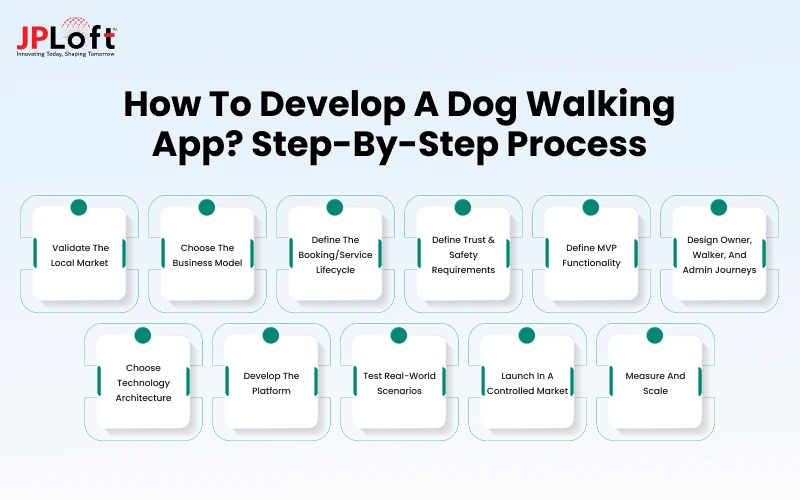
Here is a complete guide to dog walking app development, covering the key steps.
Step 1: Validate The Local Market
To create a dog walking app, you need to validate the demand for the platform.
Start by researching whether dog walkers are ready to provide services while pet owners need reliable pet-sitter help.
Without competitor analysis, your market research is incomplete. Explore the best dog walking apps and their strategies to identify gaps and get inspired for new ideas.
Step 2: Choose The Business Model
After conducting successful research, choose the final business model. Decide how your app will make money: through commissions, per-booking fees, subscription plans, premium listings, or an advertising model.
You can either choose one model or multiple ways to make money from a dog walking platform.
Step 3: Define The Booking/Service Lifecycle
Define the complete lifecycle of dog walking services before development. It should cover each stage, from requesting and scheduling the walk to acceptance or decline based on availability.
A clear lifecycle helps create a simplified workflow and makes the process easier for walkers and pet owners. It also helps you understand how each stage should work.
Step 4: Define Trust & Safety Requirements
Under this stage, you will define user trust requirements, such as walker verification to ensure the safety of the dog, house, and other personal items. Further, include animal verification, vaccination records, and behavioral profiles for dog walkers.
Safety is a non-negotiable part of the process, so define a clear scope for background verification and emergencies.
Step 5: Define MVP Functionality
Understanding how to develop a dog walking app can take significant time and money without guaranteeing success. Therefore, the best approach is to start with an MVP model; it includes only the must-have features.
You can then test the first version with your target audience and understand how they respond to the app functionality. Based on the feedback, decide which additional feature to introduce.
Step 6: Design Owner, Walker, And Admin Journeys
Design each user journey through role-based models. For dog owners, design a simplified onboarding process, user registration, booking, live tracking, and payment.
For dog walkers, allow them to submit background checks, view real-time visibility, and accept or decline service requests. Finally, for admins, create a dashboard to manage users, bookings, walker availability, and support without complex navigation. A role-based journey helps in developing a dog walking app like Rover.
Step 7: Choose Technology Architecture
Choosing the right technology is important for smooth functioning and app scalability. Pick the right tech stack based on the features, budget, and proper app functioning. The technology must support location tracking, payments, notifications, and secure data handling.
You can choose technologies such as react native or Flutter for the frontend, Django for the backend, and Google Maps APIs for real-time GPS tracking.
Step 8: Develop The Platform
Integrate the right set of features, including user registration, booking, payments, and notifications. The front end handles the main screen part users engage with, and the backend handles the data, server, and API interface.
To make a dog walking app successful, ensure the front and backend work together seamlessly. Build the core booking flow first, then connect payment and GPS, notification, and chat systems.
Step 9: Test Real-World Scenarios
Before launching the dog walking business app, check real-world scenario-based mobile app testing. This includes testing cancellation, missed walks, payment failures, poor GPS signal, late notifications, and emergencies.
Potential issues and any remaining security issues can be quickly resolved, and users can better enjoy the app.
Step 10: Launch In A Controlled Market
After testing and security checks, once you are satisfied with the app functions, launch the app on platforms like the App Store and Google Play Store. However, make sure to launch in a controlled market, one city or small area first.
This approach helps to understand the marketplace wording, demand, walker supply, and customer feedback before expanding.
Step 11: Measure And Scale
After launch, track the performance and metrics by conducting regular updates, bug fixes, and app maintenance.
If the app starts facing performance or scaling issues, working with a mobile app development company in the USA can help you scale with best practices.
How Does Real-Time GPS Tracking Work in a Dog Walking App?
Handing over the responsibility of a dog’s walk to someone requires trust. For many dog owners, the anxiety is not about the dog walker taking their dog, but about what happens during the walk. This is where GPS tracking, a dog walking app trend, helps, giving real-time visibility.
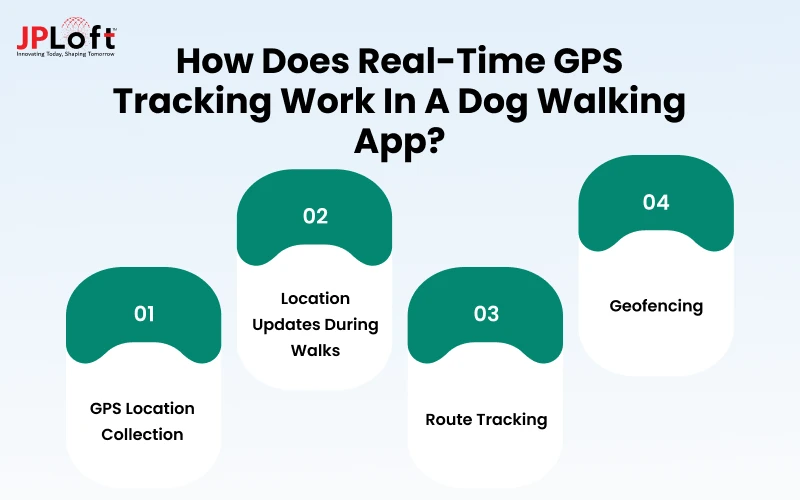
Here is the step-by-step process of how GPS tracking works.
[1] GPS Location Collection
Dog walking platforms use Google Maps to collect the walker’s location throughout the walk. This allows dog owners to view their current location in real time.
[2] Location Updates During Walks
Continuous GPS tracking keeps dog owners updated throughout the walk. The app sends location updates at planned intervals, allowing owners to monitor the dog's movement in real time.
[3] Route Tracking
Live route tracking eliminates the anxiety of waiting around for dogs to get back home. The walker’s devices are updated with live route maps. If you want to avoid an area for dog walking, you can update it and check if it is followed.
[4] Geofencing
Geofencing means that dog owners set a coordinated boundary around a selected area to restrict dog walks. The system alerts the owner if the walker moves outside those boundaries. In short, geofencing creates a virtual safe zone for dogs.
Trust & Safety Architecture for Dog Walking Apps
The first thing to prioritize when building a dog walking platform is the trust and safety of dog owners. Trust does not just rely on sharing GPS tracking reports; it's a multi-layered architecture.
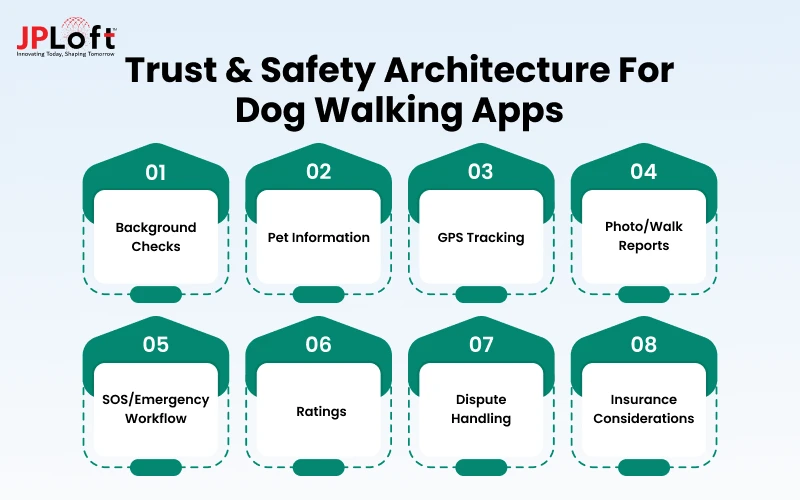
Here are the trust and safety factors for dog walking apps.
1. Background Checks
Ensure a complete background check report for dog walkers. It includes a government ID and any illegal activity check clearance. This helps improve user safety and maintains safety standards for dog walkers.
2. Pet Information
Pet owners should provide complete information about their pet, such as fear triggers or behavioral warnings, allergies, and medication schedules. Detailed pet information keeps dog walkers and surrounding people safe.
3. GPS Tracking
Integrating real-time GPS tracking helps monitor live routes and set up geofencing during active dog walks. This is one reason pet owners rely on dog walking apps because, even from a distance, they can check their dog's walk.
4. Photo/Walk Reports
After the walk, pet owners receive a digital walk report about their dog’s activity. The reports include photos, a GPS map with all the directions, and other dog activity and behavior data.
5. SOS/Emergency Workflow
The app should have a clear SOS [panic button] on the app screen. During emergencies or trigger situations, the walker can press the button to avoid any mishaps. Additionally, the pet owner receives an emergency notification if the dog is injured or falls during the walk.
6. Ratings
Ratings on the dog walking platform help pet owners choose reliable walkers. In the review section, owners can share any type of feedback; it can be positive or a complaint, helping other pet parents.
7. Dispute Handling
A clear process for complaints, refunds, or cancellations must be available on the platform. This helps protect dog owners’ payments and walkers' time, which can be wasted due to last-minute cancellations or late arrivals.
8. Insurance Considerations
Insurance considerations in a dog walking platform ensure that, in case of any disputes or accidents, the platform covers the costs of the loss. It includes general liability insurance, which protects against dog bites, third-party injuries, or property damage.
Technology Stack & Architecture
Once you understand the trust and safety factors, it's time to choose the mobile app tech stack for a dog walking platform. The technology stack should support core app functionality without making the app complicated for users.
Here are some common technology stacks to develop a dog walking app.
|
Components |
Technology Options |
|
Frontend |
Cross-platform: React Native, Flutter Admin dashboard: Next.js or React |
|
Backend |
Server: Node.js, Django API: TypeScript and Zod |
|
Database |
Primary database: PostgreSQL App data: MongoDB, MySQL |
|
APIs and integrations |
GPS tracking: Google Maps API, Mapbox Payment: Stripe, PayPal |
|
Cloud services |
AWS: Cloud hosting and scalable storage Google Cloud: App hosting and data management Microsoft Azure: Application scaling |
|
Security |
OAuth 2.0: Secure user authentication and account access JWT: Secure API authorization |
How Much Does It Cost to Build A Dog Walking App
The cost to develop a dog walking app is a rhetorical question that depends on the complexity, timeline, and customized features. On average, the cost ranges from $8,000 to $90,000+, with a development timeline of 2 to 8+ months.
Create a smart investment strategy by connecting with an experienced mobile app development company in the UK. With proper budget estimation and timeline, they will provide a clear estimate for your investment.
|
Development Phase |
Cost |
Timeline |
|
MVP/Basic Platform |
$8,000 - $ 25,000 |
2 to 3 Months |
|
Mid-Range Marketplace Platform |
$25,000 - $45,000 |
3 to 5 Months |
|
Advanced Platform |
$45,000 - $90,000+ |
4 to 8+ Months |
How Does a Dog Walking App Make Money?
Monetizing your dog walking business app will be as rewarding as launching dog walking app services. However, choosing the right revenue stream strategies is important for long-term business success.
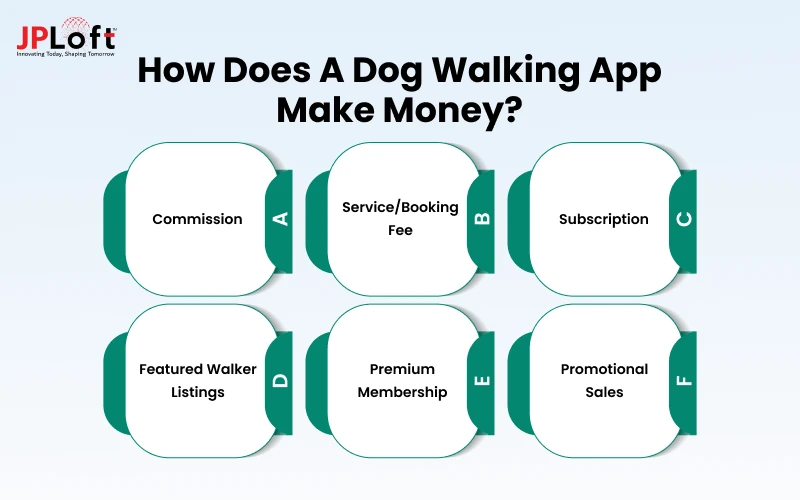
Here are the top monetization models to build a dog walking business app.
[A] Commission
This revenue strategy involves taking a percentage of transactions made through the app. The platform charges a commission on transactions completed between dog owners and walkers. Top dog walking apps, such as Rover, have been using this strategy for many years.
[B] Service/Booking Fee
Dog walking apps make money when a booking or service is made through the platform. These fees cover platform operation and usage charges. One of the top dog walking apps, such as Wag, uses this profitable strategy to make a profit.
[C] Subscription
Charging monthly or annual subscription fees allows users to access advanced platform features and functionality. It is a recurring payment plan that provides access to the regular dog walking platform for members, whether they are dog owners or walkers.
[D] Featured Walker Listings
Dog walkers can pay a reasonable fee to appear in higher search results. This prominent profile spot helps them stand out among pet owners searching for reliable dog walkers. This helps improve visibility and profitability for platforms.
[E] Premium Membership
Another effective revenue opportunity is premium membership fees. It allows users, whether dog owners or walkers, to unlock premium features. It includes discounted services, low booking fees, and 24/7 vet chat.
[F] Promotional Sales
When a dog walking app allows other businesses to promote their products or services through ads, the platform charges promotional fees. However, partner businesses should promote safe and beneficial products for animals that cause no harm.
Common Mistakes When Building a Dog Walking App
Planning a dog walking platform is never easy. Understanding common dog walking app development challenges helps identify mistakes early, avoid them, and build a smoother platform.
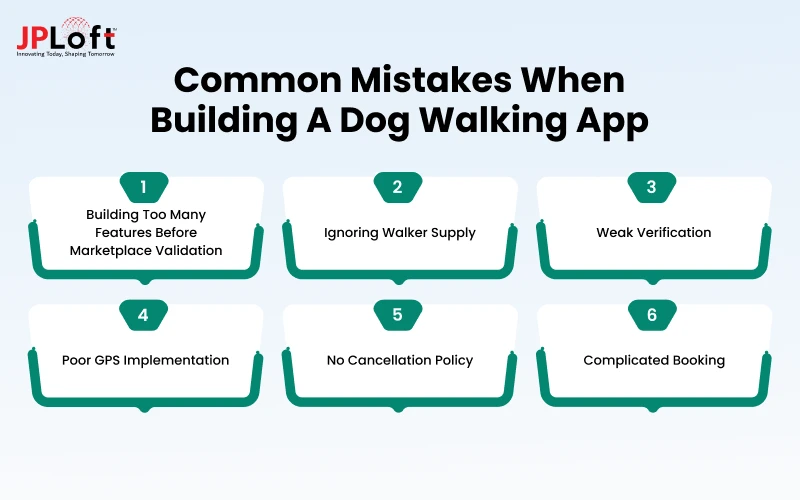
Here are some mistakes to avoid when building a sustainable dog walking app.
Mistake 1: Building Too Many Features Before Marketplace Validation
Spending time and money on features that you are unsure about before marketplace validation is a common mistake. From grooming and boarding to training and other services, this can increase costs.
Solution: Fix this mistake by creating an MVP version that helps validate the app’s market scope. This will help you add functionality around the business model.
Mistake 2: Ignoring Walker Supply
Creating a successful platform for dog owners to find reliable pet care, only to discover that there isn't enough dog walker supply, is a common mistake. If owners open the app and find no walker available at their preferred time, they may shift to a competitor platform.
Solution: If you want to build an on demand dog walking app, start in a focused neighborhood instead of launching city-wide.
Mistake 3: Weak Verification
A dog walking app allows walkers to access someone's pet, home, and other belongings. Weak verification can impact users’ trust and the safety of their belongings.
Solution: Ensure a proper background verification process, with identity checks, background screening, and verified status for a reliable user experience.
Mistake 4: Poor GPS Implementation
Integrating real-time GPS that offers accurate tracking updates without draining the battery is a real challenge. Inaccurate location or complete battery drain can worry pet owners.
Solution: Use reliable APIs, such as Google Maps, to allow accurate tracking and live updates to dog owners.
Mistake 5: No Cancellation Policy
A dog walking app depends on specific time slots, and last-minute changes can affect both dog owners and walkers. Without a clear cancellation policy, payment issues can arise, disrupting the whole plan and causing service disputes.
Solution: Set refund and cancellation policies clearly before launching the app. Use simple, easy-to-understand language in the terms for every user to follow.
Mistake 6: Complicated Booking
A complicated booking with too many steps can make it challenging for dog owners to choose the right walker and book a service at the right time. It often results in deleting the app or leaving without completing the booking process.
Solution: Keep the booking flow simple from walker selection to booking confirmation and payment. You can also allow repeat customers to rebook their preferred dog walker.
Why Choose JPLoft to Create a Dog Walking App?
A dog walking app is not just about booking and GPS features. It is about creating a platform that pet owners trust and walkers want to use.
JPLoft, a dog walking app development company, helps businesses turn this idea into a smart, scalable dog walking platform built around their business goals.
The development process can cover the owner app, walker app, admin dashboard, backend, and required integrations.
From customized platform planning and intuitive UI/UX to real-time GPS tracking, secure payment integration, AI-powered matching, and admin dashboard development, our team covers the technology that drives the business.
Our experienced team can help you build a platform with strong app performance and secure data handling needed to support daily operations.
Whether you are exploring how to create a dog walking app from scratch or upgrading to a full-scale marketplace platform, JPLoft can shape the product around your target market.

Conclusion
Is building a dog walking app the right move for your business?
It can be, when the platform is planned around a reliable service experience rather than features alone. Dog walking is about providing reliable care when pet owners cannot manage it themselves.
Starting with MVP development helps you understand both pet owners and walkers before expanding further.
A clear service flow, simple booking process, safety measures, and reliable GPS tracking can shape a better experience for everyone involved. At the same time, choosing the right revenue model keeps the initial product focused and practical.
Once the platform gains traction, you can build on what works and expand gradually. This controlled approach helps reduce unnecessary risk while giving your dog walking marketplace a stronger foundation for long-term growth.
FAQs
A dog walking app includes real-time GPS tracking and location updates for pet owners. Background verification and walker identity checks are also conducted to ensure safety and credibility.
To make a dog walking app, start with market research, business model planning, defining the right features, creating an MVP version, and mapping the right user journey. Integrate the right set of technologies, test, and launch the platform.
A dog walking app includes online registration, profile creation, booking, real-time GPS tracking, notifications, an admin panel, and secure payments.
A dog walking app costs between $8,000 and $90,000. The overall cost depends on the development team's approach, business model, and the complexity of features and design level.
Dog walking platforms make money through a fixed commission fee on bookings, in-app payments, and membership or premium feature upgrades. By promoting ads to available users, the platform makes good revenue.

Kris Jacobs brings 20+ years of experience solving complex digital product challenges through strategic thinking and user-centric design. With deep exposure to on-demand services, entertainment, travel, and interactive platforms, she collaborates across teams to shape scalable, engaging solutions that align business goals with intuitive user experiences across evolving digital landscapes.



Share this blog