


Key Takeaways:
Mahzooz permanently ceased operations and stopped selling tickets on January 1, 2024.
The weekly UAE draw, operated by EWINGS, held its final draw on December 30, 2023, in compliance with directives from the UAE’s General Commercial Gaming Regulatory Authority (GCGRA).
Key Details:
Status: Permanently closed (no active ticket sales or new draws).
Official Website: The Mahzooz website remains active solely for informational purposes and to view archives of past results and winners.
So Mahzooz is now closed. But if you want to build another compliant lottery or prize draw app, this blog is the perfect place to start. It walks you through the cost, features, legal rules, and steps you need.
Mahzooz made weekly prize draws famous in the UAE. A unique concept that hit the market hard: Buy one bottle of water, and get a chance to win big.
The draw has now closed. But the idea behind it still excites business owners.
Many want to build a similar app the right way, but with the right licence and with the right rules.
So the big question is simple. What will it cost?
The lottery app development cost can range from USD 40,000 to USD 300,000 (about AED 147,000 to AED 1.1 million) or more.
Features, design, and legal setup all determine the final number.
This guide to Mahzooz clone app development covers costs, features, tech, laws, and steps.
Let’s dive in:
What Is the Mahzooz Lottery App?
Mahzooz was a weekly prize draw app in the UAE. The name means “blessed” in Arabic. Players bought a bottle of water for AED 35.
That one purchase gave them an entry into a live Grand Draw and a weekly Raffle Draw. Every bottle was donated through community partners to people in need.
The app let users register, pick numbers, pay, watch live draws, and track winnings from one screen.
In three years, the operator, EWINGS, ran 161 live draws and created 66 millionaires. Then the story ended.
Mahzooz held its final draw on 30 December 2023 and stopped selling tickets on 1 January 2024. Its website now stays online only to show past results and winners.
Even so, its model still inspires Mahzooz clone app development today.
Why Founders Still Study This Model:
Mahzooz is closed now, but do you know why people still study their model? Because the app made users excited, and players did not just buy a ticket; they helped someone get drinking water.
The idea was amazing; what added more was that the charity angle built trust.
The app was also fast. You can do a quick sign-up, pick numbers easily, pay, and watch the draw. Founders love a clean flow like this.
So what does this mean for you?
You need the right licence or a licensed partner. Or you can build the same model for another market. Plan this before you spend a single dirham.
How Does a Lottery App Like Mahzooz Work?
Every great app idea starts with understanding the platform’s model.
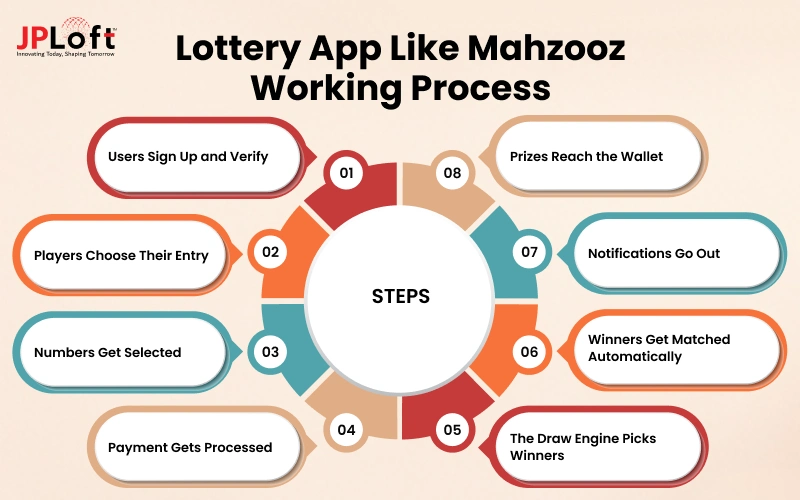
If you want to develop an app like Mahzooz, you must understand each step first. Here is the full journey from sign-up to prize payout:
Step 1: Users Sign Up and Verify
Players create an account with a phone number or email. The app then checks age and identity. Emirates ID or UAE Pass can speed this up. No verified profile means no entry into any draw.
Step 2: Players Choose Their Entry
Users pick a draw and a product. It could be a bottle, a ticket, or a bundle. Quantity selection stays simple. One tap adds more entries to the cart.
Step 3: Numbers Get Selected
Players type in their own lucky numbers. Or they tap quick pick for random ones. The app saves each line instantly. Every entry gets a unique ID for easy tracking later.
Step 4: Payment Gets Processed
Users pay by card or wallet through a secure gateway. The app confirms payment in seconds. Then the entry moves into the active draw pool. Failed payments never enter the draw.
Step 5: The Draw Engine Picks Winners
A certified random number generator picks the winning numbers. Many platforms also stream the draw live. This builds trust. People can see the result is fair and open.
Step 6: Winners Get Matched Automatically
The system compares every entry with the winning numbers. It sorts winners by prize tier. No manual checking is needed. This saves hours and removes human error.
Step 7: Notifications Go Out
Push alerts, emails, and SMS share the results. Winners get a personal message. Other players see a draw summary and a gentle nudge to play again next week.
Step 8: Prizes Reach the Wallet
Winnings land in the in-app wallet. Users can withdraw to a bank account after checks. Large prizes may need extra ID proof. Smooth payouts turn winners into loyal fans.
Key Features of a Lottery App Like Mahzooz
Features decide trust; they also decide your budget. Let’s see what players expect from a Mahzooz-style app.
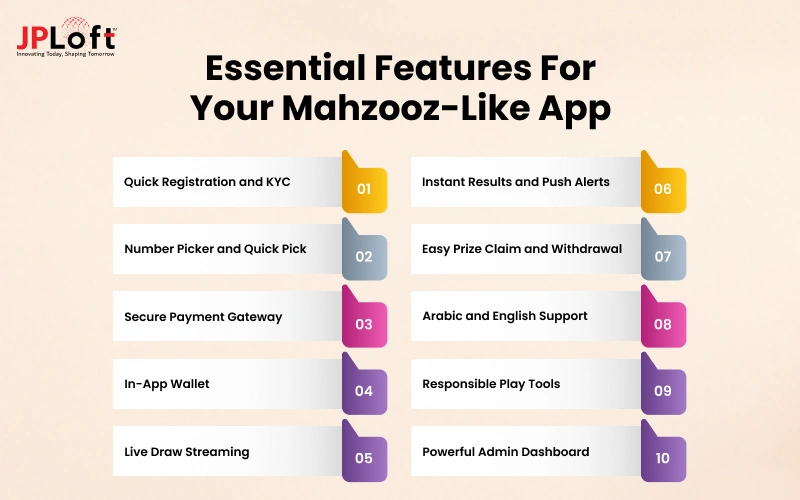
Each app feature below earns its place:
1. Quick Registration and KYC
Users should join in under two minutes. Phone OTP, Emirates ID scan, and UAE Pass login keep things smooth.
Age checks block minors. Strong verification also protects you from fraud and legal trouble.
2. Number Picker and Quick Pick
Let players choose their lucky numbers. Or let the app pick for them.
Show past picks and saved lines. Small touches like this bring users back every week for the next draw.
3. Secure Payment Gateway
Players must trust every dirham they spend. Support cards, Apple Pay, and local wallets.
Use tokenized payments and PCI DSS rules. Fast checkout means fewer drop-offs and more completed entries.
4. In-App Wallet
A wallet keeps money in one place. Users top up once and enter many draws.
Winnings drop in automatically. It also cuts your payment fees because you process fewer separate transactions.
5. Live Draw Streaming
Nothing builds trust like a live draw. Stream it inside the app with a countdown timer.
Users watch the numbers roll out in real time. It feels exciting and proves the draw is fair.
6. Instant Results and Push Alerts
Players hate waiting. Send alerts the moment results go live.
Show a clear win or loss screen. Add a reminder before each draw closes. These nudges lift weekly engagement more than most ads do.
7. Easy Prize Claim and Withdrawal
Winners should never hunt for the next step. Add a simple claim flow with ID checks.
Let them withdraw to a UAE bank account. Clear steps reduce support tickets and build word of mouth.
8. Arabic and English Support
The UAE is multilingual, so offer Arabic and English at a minimum. English-Arabic app development ensures a smoother experience for users across both languages.
Add Urdu or Tagalog if targeting expats. Test right-to-left (RTL) layouts carefully to make the app feel natural to Arabic-speaking users.
9. Responsible Play Tools
Add spending limits, cool-off periods, and self-exclusion. Show clear age warnings.
These tools protect users. They also match the responsible gaming rules that regulators expect from every operator.
10. Powerful Admin Dashboard
Your team needs full control. Manage draws, prizes, users, and payouts from one panel.
Track revenue and flag odd activity. Role-based access keeps sensitive data away from the wrong hands.
How Much Does It Cost to Develop a Lottery App Like Mahzooz?
Let’s talk numbers.
The lottery app development cost for a Mahzooz-style platform usually sits between USD 40,000 and USD 300,000+. In AED, that is about 147,000 to 1.1 million+. That is a wide range.
So why the gap? A basic MVP has sign-up, payments, and draws. An advanced build adds live streaming, AI fraud checks, and deep analytics.
The cost to develop an app in Dubai varies by features, team location, and compliance needs. Dubai-based development teams generally charge more than offshore teams.
But they know local rules better.
Your Mahzooz app development cost will also change if you build for both iOS and Android. Use the tables below as a planning guide. Treat them as estimates and not fixed quotes.
Cost by App Complexity
Understand the cost to develop a lottery app like Mahzooz by complexity. Pick the level that matches your goal:
|
App Type |
What You Get |
Cost (USD) |
Cost (AED) |
Timeline |
|
Basic MVP |
Sign-up, KYC, number picker, payments, simple draw engine |
USD 40,000 – 80,000 |
AED 147,000 – 294,000 |
4–6 months |
|
Mid-Level App |
Adds wallet, live draw, push alerts, admin panel, Arabic and English |
USD 80,000 – 150,000 |
AED 294,000 – 551,000 |
6–9 months |
|
Advanced App |
Adds AI fraud checks, deep analytics, multi-draw games, loyalty system |
USD 150,000 – 300,000+ |
AED 551,000 – 1.1 million+ |
9–12+ months |
Cost by Development Stage
Now, let's break down the Mahzooz clone app development cost at each stage:
|
Development Stage |
Cost (USD) |
Cost (AED) |
|
Market research and planning |
USD 2,000 – 10,000 |
AED 7,000 – 37,000 |
|
UI/UX design |
USD 4,000 – 25,000 |
AED 15,000 – 92,000 |
|
Frontend and backend development |
USD 18,000 – 150,000 |
AED 66,000 – 551,000 |
|
Payment gateway and API integration |
USD 3,000 – 20,000 |
AED 11,000 – 73,000 |
|
Admin panel and draw engine |
USD 5,000 – 45,000 |
AED 18,000 – 165,000 |
|
Security and compliance setup |
USD 4,000 – 30,000 |
AED 15,000 – 110,000 |
|
Testing and QA |
USD 4,000 – 20,000 |
AED 15,000 – 73,000 |
|
Total estimate |
USD 40,000 – 300,000+ |
AED 147,000 – 1,101,000 |
Hidden Costs to Plan For:
The build is only half the story. Many founders forget the extras.
-
Yearly upkeep: Expect 15–20% of the build cost every year. Good maintenance keeps bugs and downtime away.
-
Licence and legal fees: Gaming licences and legal advice can be a big line item.
-
Cloud and streaming: Draw day brings heavy traffic. Hosting bills rise with it.
-
KYC checks: Most providers charge per verification.
-
Marketing: Even the best app needs users. Set aside a real budget.
Factors Affecting Lottery App Development Costs
Two apps can look the same on screen. Yet their price tags can be miles apart.
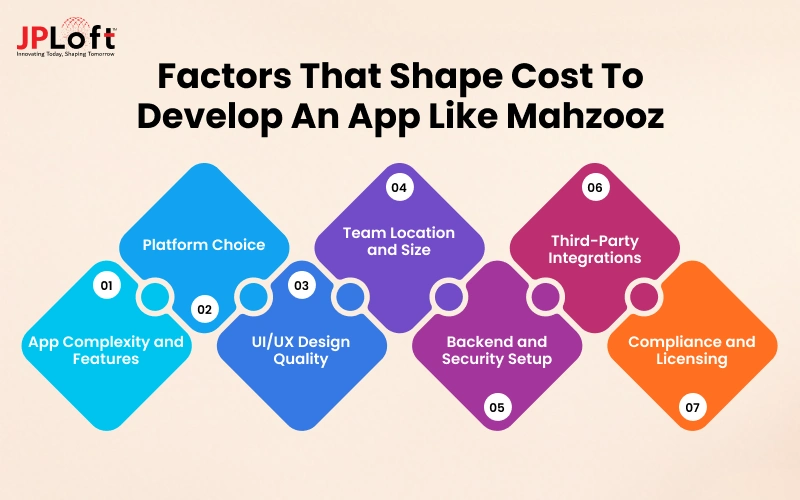
Here are the seven big things that move your Mahzooz app development cost up or down.
1. App Complexity and Features
More features mean more hours. A simple app with sign-up and payments costs less.
Add live draws, wallets, and fraud checks, and the budget climbs fast. Start lean. Then add more once real users show up and give feedback.
2. Platform Choice
What should be your preference:
-
Cross-Platform Development
You can also go for Native; these apps give top speed but cost more.
Cross-platform tools like Flutter let one codebase serve both stores. For most UAE startups, this is the smart way to save time and money.
3. UI/UX Design Quality
A lottery app must feel exciting and safe at once. Custom animations, smooth flows, and bilingual layouts take design time.
Professional UI/UX design services help create intuitive interfaces that build user trust and improve retention.
Cheap templates may save money today, but they often hurt user experience and long-term engagement.
4. Team Location and Size
A Dubai team costs more per hour than an offshore one. But a local team understands UAE users and rules.
Look for mature mobile app development services that blend both strengths in one package.
5. Backend and Security Setup
This is where lottery apps differ from normal apps. You need encrypted data, audit logs, a certified random number generator, and fraud monitoring.
Strong security adds cost. Weak security can cost you everything.
6. Third-Party Integrations
Payment gateways, KYC tools, SMS providers, and live streaming all charge fees.
Each one also needs integration hours. The more tools you connect, the more your setup and monthly running costs grow.
7. Compliance and Licensing
Gaming is tightly regulated in the UAE.
Legal advice, licence applications, and audits all add to your budget. Skipping this step looks cheap at first. It becomes the most expensive mistake later.
Technology Stack for Lottery App Development
The right app tech stack keeps your app fast and fair. A lottery app handles money. It also handles personal data. So speed and security matter equally.
Cross-platform tools like Flutter cut build time. Strong backends handle heavy traffic on draw day. Cloud hosting inside UAE regions helps with data rules.
Pick tools that scale as your user base grows. Here is a quick view of what most teams use:
|
Layer |
Recommended Tools |
|
Mobile app |
Flutter, React Native, Swift, Kotlin |
|
Backend |
Node.js, Python (Django) |
|
Database |
PostgreSQL, MongoDB, Redis |
|
Cloud hosting |
AWS, Google Cloud, Microsoft Azure |
|
Payments |
Checkout.com, Telr, PayTabs, Stripe |
|
KYC and identity |
UAE Pass, Sumsub, Onfido |
|
Draw engine |
Certified RNG with audit logs |
|
Live streaming |
WebRTC, Agora |
|
Notifications |
Firebase Cloud Messaging, Twilio |
|
Security |
SSL/TLS, AES-256 encryption, two-factor login |
Legal Requirements for Lottery App Development in the UAE
You know code comes first; compliance comes first.
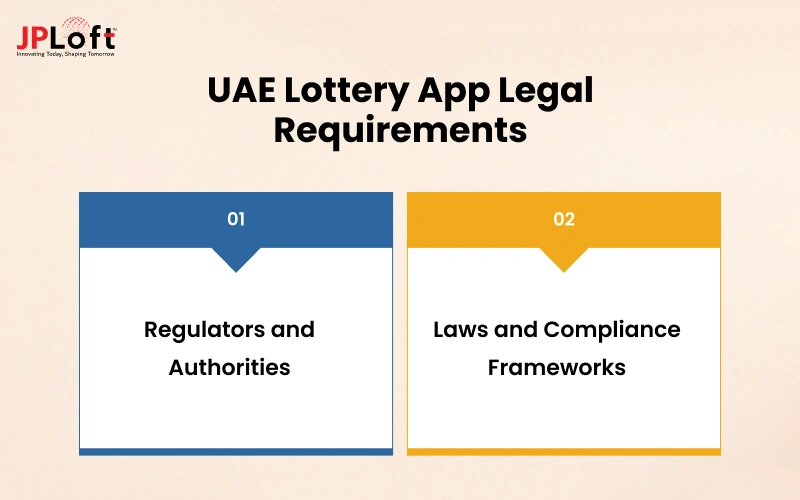
Unlicensed gaming in the UAE is illegal, and the penalties are serious. Right now, the Game LLC holds the only national lottery licence. Speak to a UAE gaming lawyer before you build. Here are the key names you need to know.
Regulators and Authorities
-
General Commercial Gaming Regulatory Authority (GCGRA)
-
Central Bank of the UAE (CBUAE)
-
Telecommunications and Digital Government Regulatory Authority (TDRA)
-
UAE Financial Intelligence Unit (UAE FIU)
-
Dubai Department of Economy and Tourism (DET)
-
UAE Data Office
Laws and Compliance Frameworks
-
UAE Commercial Gaming Licence (Lottery Operator category)
-
GCGRA Responsible Gaming Minimum Requirements
-
Federal Decree-Law No. 45 of 2021 (Personal Data Protection Law)
-
Federal Decree-Law No. 20 of 2018 (Anti-Money Laundering and Counter-Terrorism Financing)
-
Federal Decree-Law No. 34 of 2021 (Combatting Rumours and Cybercrimes)
Steps to Build a Lottery App Like Mahzooz
You want to save money on the overall lottery app development cost. Make sure that you follow a structured development roadmap.
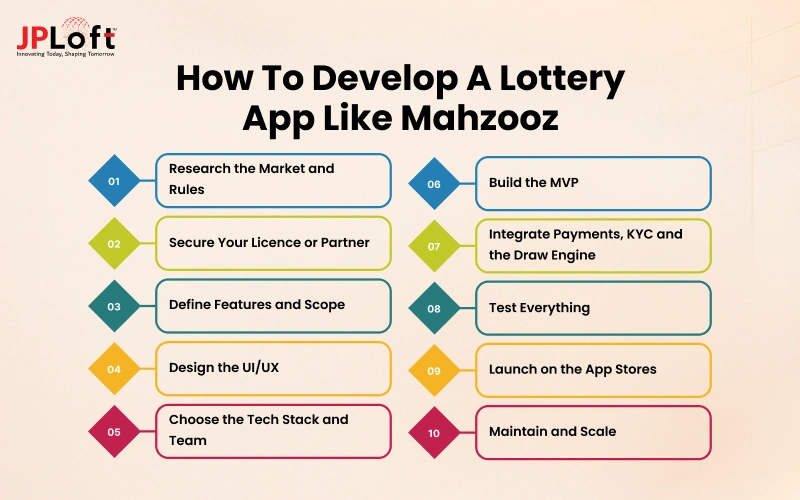
Here are ten steps to follow in order. If you want to know how to develop a lottery app like Mahzooz, this roadmap is the right place to start;
Step 1: Research the Market and Rules
Every strong app starts with homework. Study who plays prize draws in the UAE. Learn what they like and what they ignore. Look at the licensed UAE Lottery app and the airport draws.
Then list the gaps you can fill. Talk to real players if you can. Detailed research stops you from building features nobody wants.
-
Study competitor apps and user reviews
-
Survey 50 to 100 target users
-
List the legal limits of your target market
Step 2: Secure Your Licence or Partner
This step can make or break the project. In the UAE, only GCGRA-licensed operators can run lottery draws. Meet a gaming lawyer early. Then decide your path.
You can apply for a licence. You can partner with a licensed operator. Or you can build for another market where rules allow it. Skipping this step can lead to fines or a forced shutdown.
-
Hire a UAE gaming lawyer
-
Check GCGRA licence categories
-
Prepare company papers and financial records
Step 3: Define Features and Scope
Now turn ideas into a clear list. Split features into must-have and nice-to-have. Your MVP needs only the core. That means sign-up, payments, number selection, and draws.
Everything else can wait for version two. A tight scope keeps your timeline short. Write user stories so every developer sees the same picture.
-
Prepare a feature priority list
-
Create user flows and wireframes
-
Fix the scope in a written document
Step 4: Design the UI/UX
Design sets the mood. A lottery app should feel bright and trusted at the same time. Use clear buttons and bold numbers. Keep the flow short from home screen to payment. Test Arabic right-to-left layouts early. Build a clickable prototype and show it to real users. Fixing a design is far cheaper than fixing finished code.
-
Create wireframes and mockups
-
Design for both Arabic and English
-
Test a prototype with 10 users
Step 5: Choose the Tech Stack and Team
Your tech and your team go hand in hand. Pick tools that scale on busy draw days. Flutter or React Native can save time. Node.js or Django can power the backend. Then pick a team with proven gaming or fintech experience. Ask for case studies. Ask about security practices. Fit matters as much as price.
-
Compare three to five vendors
-
Review their past gaming or fintech work
-
Agree on milestones and payment terms
Step 6: Build the MVP
It is high time to code. Break the work into short sprints of two weeks. Each sprint ends with a working demo. You should start with sign-up and the wallet.
Then, add number selection and the draw engine.
The admin panel comes alongside. Avoid new ideas mid-sprint. Scope creep eats budgets. Regular demos help you spot problems early.
-
Run two-week agile sprints
-
Build the user app and admin panel together
-
Hold a demo after every sprint
Step 7: Integrate Payments, KYC and the Draw Engine
This is the heart of the app, and connect a UAE-friendly payment gateway first. Add identity checks through UAE Pass or a KYC provider. Then plug in a certified random number generator.
Every draw must leave an audit trail. Test each integration alone before you join them. One weak link can break user trust in a single night.
-
Connect the payment gateway and wallet
-
Add KYC and age verification
-
Integrate a certified RNG with audit logs
Step 8: Test Everything
App testing protects your name, so check every screen on many phones. You should run load tests that mimic draw day traffic; you should try to break payments on purpose.
Hire a third party to audit security and the random number engine. Fix every bug before launch.
Users forgive slow screens faster than missing money. A single failed payout can spread across social media in hours.
-
Functional and UI testing
-
Load and stress testing
-
Security and penetration testing
Step 9: Launch on the App Stores
Launch day needs a plan. Prepare store listings with clear screenshots and keywords. Follow the guidelines before submitting the app on the Play Store or publishing it on the App Store.
Some categories need extra approval. Start with a soft launch in one city. Watch crashes and feedback.
Early reviews shape your store ranking for months. Plan for them. A calm launch beats a loud one that crashes.
-
Write a store listing with target keywords
-
Check store policies for gaming apps
-
Run a soft launch first
Step 10: Maintain and Scale
Launching the app is just the beginning. Ongoing maintenance services keep it reliable and ready for growth.
Fix bugs fast and add features users ask for. Watch your analytics every week. Scale servers before big draws.
Plan for new draw formats and new payment options. Treat version one as a draft. Great apps are never finished. Steady upkeep keeps users loyal and your data safe.
-
Monitor performance and crashes
-
Release updates every month
-
Track retention and revenue
How to Monetize a Lottery App like Mahzooz?
A lottery app like Mahzooz needs a clear revenue strategy to support long-term growth.
Choosing the right app monetization models helps generate consistent revenue while keeping ticket purchases and user experiences simple.
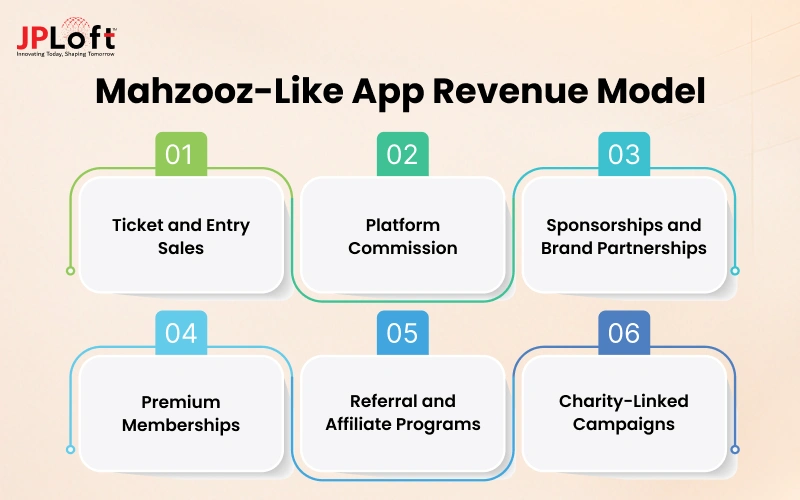
Here are some common ways to monetize a lottery app:
1. Ticket and Entry Sales
This is your core income. Every entry carries a price. Bundles and multi-draw passes raise the basket size, so keep pricing clear and fair.
Players should know exactly what they pay and what they can win. Simple pricing builds trust.
2. Platform Commission
Run a marketplace model. Partner draws pay you a share of each sale. You carry less prize risk, and you earn from volume instead.
This works well when you team up with licensed operators. It scales smoothly as more partners join.
3. Sponsorships and Brand Partnerships
Big draws attract big brands. So, offer title sponsorship for a weekly draw, and sell banner space or branded prizes.
Retail, travel, and auto brands love audiences that open apps often. Keep ads light so the experience stays clean. Always label sponsors clearly.
4. Premium Memberships
Offer a monthly pass where members get bonus entries and early access to special draws.
Subscribers bring steady income; they also stay longer than casual players. Price it low enough to feel like a bargain. Test two or three tiers.
5. Referral and Affiliate Programs
You should pay partners per verified sign-up.
You can pay partners per verified sign-up. Influencers and commodity pages can send real players.
You pay only when someone joins and plays.
It is performance marketing with low risk. Track every link with clear reports. Set firm rules to stop fake sign-ups.
6. Charity-Linked Campaigns
Charity-Linked Campaigns draw in new players. You should share part of each sale with a partner charity. Show the impact inside the app. This will help improve trust in your app.
Many brands also fund such campaigns as part of their CSR goals.
How to Choose the Right Lottery App Development Company?
Before finalizing a company for your business, you need to check a lot of things such as:
-
Look for gaming or fintech experience.
-
Ask for live apps and client reviews.
-
Check how they handle security and data privacy.
-
Confirm they offer post-launch support.
-
Review their process from idea to launch.
-
Ask who will actually work on your project.
A trusted mobile app development company in Dubai will also know local rules and user habits.
JPLoft has 16+ years of experience, with a team of 130+ experts. The company works with iOS, Android, Flutter, AI, and Blockchain.
With a Dubai presence, get support that matches your business hours. Get a clear roadmap and a transparent quote.
Conclusion
Building a lottery app like Mahzooz is exciting. It is also serious business.
The numbers are clear. Expect USD 40,000 to USD 300,000 depending on your goals. Add legal work and yearly upkeep to that figure.
Mahzooz clone app development works best when you start with the rules and not the code. Get your licence path clear. Then build a lean MVP. Then grow with real user data.
Pick a partner who understands both tech and compliance. Your players trust you with their money. Earn that trust from day one.
FAQs
Most estimates fall between USD 40,000 and USD 300,000+. That is about AED 147,000 to 1.1 million+. A basic MVP sits at the lower end. An advanced app with live streaming, AI fraud checks, and analytics sits at the top. The final price depends on features, platforms, team location, and compliance needs.
A basic MVP takes around four to six months. A mid-level app needs six to nine months. An advanced platform can take a year or more. Licence work often runs in parallel. Start legal steps early so the app is not waiting on paperwork at launch.
Only with the right approval. The GCGRA regulates all commercial gaming in the UAE. The Game LLC holds the national lottery licence. Mahzooz itself paused UAE draws in 2024. Talk to a gaming lawyer first. Then choose to apply for a licence, partner with a licensed operator, or target another market.
Start with market research and legal advice. Then define features, design the UI, pick a tech stack, and build an MVP. Add payments, KYC, and a certified random number generator. Test hard before launch. Work with an experienced team to avoid costly mistakes and delays.
Five things move the price most. These are features, platforms, security needs, third-party integrations, and compliance work. Team location also matters. A lean MVP built on a cross-platform stack costs far less than a fully native app with live streaming and AI tools.
Flutter or React Native work well for the app. Node.js or Django suit the backend. PostgreSQL stores data safely. AWS, Google Cloud, or Azure give you scale. Add a certified random number generator, strong encryption, and a trusted KYC provider. Your tech partner can fine-tune the mix.
Mostly from entry sales. Many also earn through partner commissions, sponsorships, memberships, and affiliate deals. Charity-linked campaigns can add reach as well. Pick two or three models at launch. Add more once your user base grows, and your data shows what works.
For most startups, cross-platform wins. One codebase serves both iOS and Android. That cuts cost and time. Native makes sense if you need heavy animations or deep device features. Start cross-platform. Move parts to native later if your numbers justify it.
Plan for 15 to 20 percent of the build cost each year. That covers bug fixes, updates, server costs, and security patches. Draw-day traffic can raise hosting bills too. Budget for it from day one so growth never catches you off guard.
Use a certified random number generator and audit it through a third party. Encrypt all data. Add KYC, age checks, and two-factor login. Keep full draw logs. Offer responsible play tools like spending limits. Fair draws and strong security build the trust your brand needs.
Kris Jacobs brings 20+ years of experience in digital product strategy, user-focused design, and solving complex product challenges. She has worked across on-demand services, travel, entertainment, sports, insurance, education, and service marketplaces, including handyman, dog-walking, courier, event-management, and equine platforms. Her focus is on shaping practical, scalable digital experiences that align user needs with business goals and long-term product growth.




Share this blog