



Running a small horse business means balancing animal care with the everyday demands of managing customers, staff, schedules, and payments.
Whether you operate a boarding stable, riding school, training facility, or horse farm, your working day rarely follows a simple routine.
A lesson cancellation can change the afternoon schedule. An owner may request an update while you are arranging a farrier visit. Meanwhile, invoices, feed records, and staff instructions still need attention.
When these tasks depend on paper diaries, spreadsheets, and scattered messages, keeping everything organized becomes harder as the business grows.
This is where custom equine apps can help. They bring essential information into one place and support workflows built around the way your business operates.
The right horse business management software can reduce repetitive administration, improve communication, and make it easier to manage more customers without losing track of individual horses.
This guide explores the challenges these apps address, the features that matter, and how to choose a solution that supports sustainable growth.
Visit: Equine App Development Company
What is a Horse Management App?
A horse management app is a digital tool that helps equine businesses organize horse records, daily care tasks, bookings, customer information, and business administration.
Depending on its scope, it may support activities such as:
-
Maintaining individual horse profiles.
-
Scheduling lessons, training sessions, and appointments.
-
Assigning daily stable tasks.
-
Recording care instructions and observations.
-
Managing invoices and tracking payments.
-
Sharing updates with horse owners.
For example, a riding school could use an app to coordinate instructors, riders, horses, and arena availability. A boarding stable might focus on care routines, owner communication, and monthly billing.
A horse management mobile app makes these records accessible through a smartphone or tablet, allowing staff to check instructions and record updates while working around the yard.
How is a Custom Equine App Different?
A ready-made app provides a predefined set of features. A custom app is designed around a business’s particular processes, service packages, user roles, and reporting needs.
For instance, a stable offering boarding, training, and paid exercise sessions may need all three services connected to the same horse profile and billing record.
Custom development can support that workflow. However, it also brings responsibilities for maintenance, updates, and ongoing support. The right choice depends on whether existing software can meet the business’s needs effectively.
Also Read: Reasons to Invest in Stable Management Software

Common Challenges Faced by Small Horse Businesses
Small equine businesses often operate with limited staff and closely connected responsibilities. The owner may handle horse care, customer service, scheduling, and accounts within the same day.
Several operational challenges can make growth difficult.

Challenge 1: Scattered Horse and Customer Records
Horse information may sit in folders, care instructions on a whiteboard, and customer requests in text messages.
This fragmentation makes it harder to find the latest information. A staff member may need to contact the owner simply to confirm an instruction that should already be accessible.
Challenge 2: Complicated Scheduling
Lessons, arena bookings, training sessions, turnout, and professional appointments compete for time and resources.
Without a shared schedule, a horse could be assigned to overlapping activities or an instructor booked when the required arena is unavailable. Resolving these conflicts creates extra work and can frustrate customers.
Challenge 3: Inconsistent Staff Handover
Verbal instructions are easy to forget during a busy shift. If task ownership is unclear, work may be duplicated or left incomplete.
Businesses need a dependable way to show what is planned, who is responsible, and what has been completed.
Challenge 4: Time-Consuming Billing
Boarding fees may be predictable, but additional services can vary each month. Exercise sessions, transport, training, or other agreed charges need to be recorded accurately.
When these services are tracked separately from invoices, charges can be overlooked or questioned later.
Challenge 5: Limited Visibility Into Performance
A full calendar does not automatically mean a profitable business. Owners need to understand service demand, outstanding payments, available capacity, and operating costs.
Without organized records, decisions about pricing, staffing, or expansion can rely too heavily on guesswork.
Well-designed equine business software can help address these problems by connecting daily activity with the information needed to manage the business.
Also Read: 15 Common Challenges in Equine App Development
What Can a Custom Equine App Do?
A custom app delivers value when it solves specific operational problems. Adding features alone does not improve a business; making everyday work easier does.
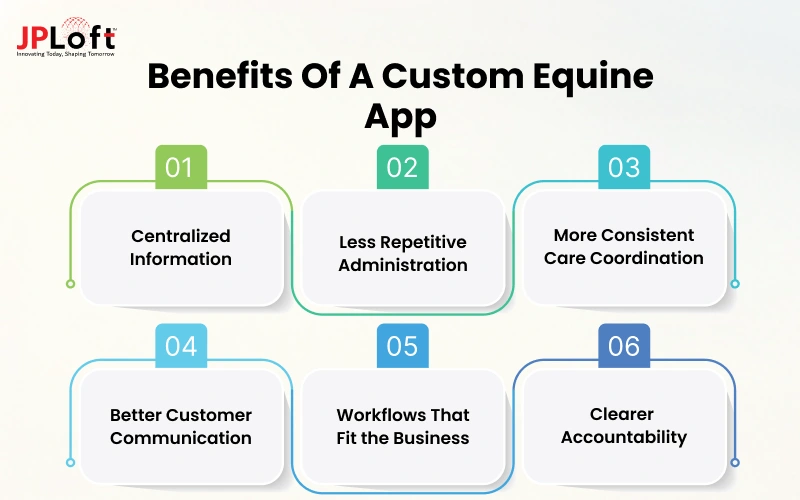
1. Centralized Information
A shared system gives authorized users access to horse profiles, customer details, schedules, and service records.
Instead of searching several tools, staff can open the relevant record and see the information needed for their role. Clear update histories can also help establish which instructions are current.
2. Less Repetitive Administration
Custom workflows can reduce repeated data entry.
For example, when a completed training session is recorded against a horse, the app could also add the agreed charge to a draft invoice.
Staff would still review the invoice before sending it, but they would not need to enter the same service twice.
3. More Consistent Care Coordination
A horse care management app can organize owner-approved instructions, scheduled tasks, appointment records, and staff observations.
Reminders and completion logs help teams coordinate routine work.
The app supports recordkeeping and communication; care decisions remain with the responsible people and qualified professionals.
4. Better Customer Communication
An owner portal can provide access to selected updates, bookings, documents, and invoices.
This gives customers a convenient way to find routine information and reduces the number of repeated status requests staff need to answer manually.
5. Workflows That Fit the Business
A horse stable management app can reflect the stable’s actual service structure.
For example, a boarding business might need different task lists and billing rules for full-board and part-board packages.
A custom system can present the relevant options without forcing staff through unrelated steps.
6. Clearer Accountability
Assigned tasks, timestamps, and activity histories make responsibilities easier to follow.
When a manager can see unfinished work, they can respond before the end of a shift instead of discovering the gap during the next handover.
Also Read: How to Create an Equine App: A Complete Guide
Essential Features of an Equine App
The most useful features depend on the business model. A small riding school and a breeding operation should not automatically receive the same feature set.
However, the following capabilities provide a practical starting point.
|
Feature |
What It Should Support |
|
Horse profiles |
Identification details, ownership, contacts, documents, and relevant instructions |
|
Care records |
Scheduled tasks, observations, appointment histories, and completion logs |
|
Shared calendar |
Lessons, training, appointments, and resource availability |
|
Staff task management |
Assignments, priorities, recurring tasks, and handover notes |
|
Customer management |
Contact details, service agreements, preferences, and communication records |
|
Billing |
Agreed charges, draft invoices, payment status, and service histories |
|
Owner portal |
Authorized access to updates, bookings, documents, and invoices |
|
Reporting |
Capacity, service demand, outstanding balances, and operational activity |
Also Read: Must-Have Equine App Features
How Equine Apps Support Business Growth?
Operational improvements support growth when they help a business serve customers reliably, use resources effectively, and understand where revenue comes from.
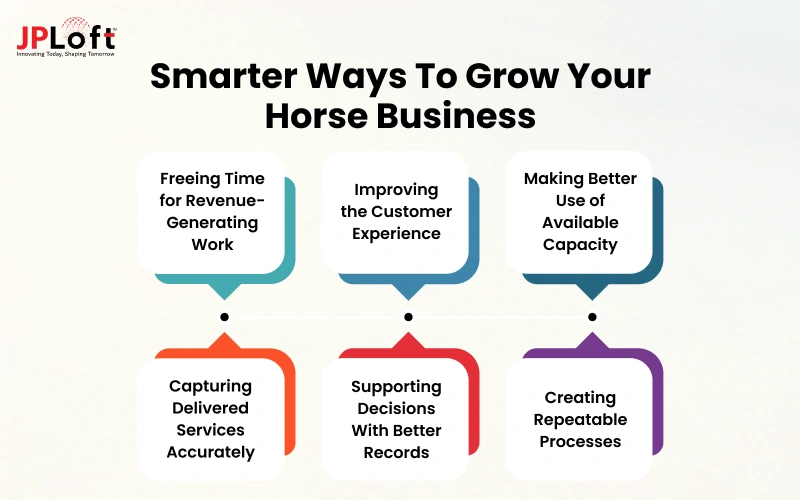
►Freeing Time for Revenue-Generating Work
Reducing repeated administration can give owners more time for lessons, training, customer enquiries, or business development.
Consider a hypothetical boarding stable that records extra exercise sessions on paper and enters them into invoices later. Connecting those records can shorten invoice preparation and make charges easier to verify.
The resulting time savings depend on the original process and how consistently the app is used.
►Improving the Customer Experience
Customers benefit when booking information is clear, updates are accessible, and invoices are understandable.
Reliable communication can support stronger relationships. Although software alone cannot guarantee retention, it can make professional service easier to deliver consistently.
►Making Better Use of Available Capacity
A connected schedule helps managers identify unused lesson slots, available boarding spaces, or underused facilities.
With that visibility, they can make more informed decisions about promotions, waiting lists, and service availability while respecting horse suitability and workload limits.
►Capturing Delivered Services Accurately
Small additional services can be easy to miss when records are informal.
By connecting service completion with billing review, an app can help ensure agreed work is included on the correct invoice. Itemized records also make customer queries easier to resolve.
►Supporting Decisions With Better Records
Equestrian business management software can bring bookings, service revenue, and payment information into a clearer view.
However, revenue reports alone do not show profitability. To compare services meaningfully, businesses also need reliable cost information, including relevant labor and operating expenses.
►Creating Repeatable Processes
Growth becomes harder when every routine decision depends on one person’s memory.
Documented workflows, recurring task lists, and accessible records make it easier to train staff and maintain consistent service as the business expands.
The strongest equine software solutions support these repeatable processes while keeping the daily workload manageable.
Also Read: How to Start an Online Equine Business?

Tips for Choosing the Right Equine App
Every barn runs a little differently. Some focus on lessons. Others on boarding or shows. List the two or three tasks that eat the most time. Then pick the tool that fixes those first:

1. Identify Your Biggest Operational Problems
List the tasks that cause delays, errors, or repeated questions.
Choose a small number of priorities, such as scheduling conflicts, missed service charges, or difficult staff handovers. These priorities should guide your evaluation.
2. Compare Ready-Made and Custom Options
Ready-made software may be suitable when its workflows already match your needs.
Custom horse app development becomes worth considering when important processes cannot be handled well by available products or when disconnected systems create substantial ongoing work.
Compare the full cost of each option, including setup, migration, training, integrations, maintenance, and support.
3. Test Real Working Scenarios
A demonstration should reflect the actual situations your team handles every day.
Test tasks such as rescheduling a lesson, updating care instructions, recording an extra service, and correcting an invoice.
These practical checks help reveal workflow gaps, usability issues, and missing features that a standard feature checklist might overlook.
4. Include Staff in the Evaluation
Staff members who use the app daily should participate in the evaluation process.
Ask them to find instructions, complete routine tasks, and understand updates to existing information.
Their feedback can highlight confusing screens, unnecessary steps, and usability problems. This helps ensure the software fits daily operations.
5. Confirm Data Ownership and Portability
Before choosing a solution, clarify who owns the records and how they can be exported.
For custom software, review code ownership, licensing terms, technical documentation, and future maintenance arrangements.
Confirm that your team can access essential data and transfer it to another system without unnecessary restrictions or additional costs.
6. Start With a Focused Release
A small business rarely needs every possible feature at launch.
Begin with the workflows most likely to deliver measurable value. Track results such as invoice preparation time, booking conflicts, overdue balances, or administrative hours before deciding what to add next.
Visit: Equine App Development Services
Conclusion
Small horse businesses grow more sustainably when daily operations are organized, customer communication is dependable, and owners can make decisions using clear records.
A custom equine app can support these goals by connecting horse information, staff tasks, schedules, and billing around the business’s actual workflows.
The best solution is the one your team can use consistently and your business can maintain affordably. Start with clear problems, prioritize essential features, and measure whether the app improves day-to-day work.
With the right approach, horse management technology can give small equine businesses more room to grow while keeping attention on the horses and customers at the center of their work.
FAQs
Custom equine apps help small horse businesses organize bookings, horse records, staff tasks, and billing, reducing administrative work and supporting more consistent daily customer service.
An equine app should include horse profiles, care records, scheduling, staff assignments, invoicing, payment tracking, owner communication, reporting, secure access, and reliable data backups.
Equine apps can improve customer satisfaction by providing accessible updates, convenient bookings, clear invoices, and timely reminders, helping owners stay informed about their horses.
Equine apps can improve customer satisfaction by providing accessible updates, convenient bookings, clear invoices, and timely reminders, helping owners stay informed about their horses.
Horse business management software supports growth by reducing repetitive administration, improving scheduling, capturing service charges, and providing clearer records for staffing, pricing, and expansion decisions.

Kris Jacobs brings 20+ years of experience in digital product strategy, user-focused design, and solving complex product challenges. She has worked across on-demand services, travel, entertainment, sports, insurance, education, and service marketplaces, including handyman, dog-walking, courier, event-management, and equine platforms. Her focus is on shaping practical, scalable digital experiences that align user needs with business goals and long-term product growth.




Share this blog