


Saudi Arabia is advancing its digital healthcare ecosystem, with platforms like Sehhaty making medical services more accessible through a unified digital experience. The country’s healthcare market is projected to exceed SAR 259 billion by 2032, creating opportunities for businesses to invest in digital health solutions.
For healthcare startups, hospitals, and businesses planning to enter this market, developing an app like Sehhaty can help address the growing demand for accessible and connected healthcare services. However, turning this opportunity into a viable digital product requires a clear understanding of “How much does it cost to build an app like Sehhaty?”
In 2026, the cost to build a healthcare app like Sehhaty typically ranges from $25,000 to $150,000+ (approximately SAR 90,000 to SAR 550,000+). The final cost depends on the features, platform complexity, technology stack, third-party integrations, and Saudi healthcare regulations the app must address.
This guide explores the estimated development costs, factors that influence your budget, essential features, development stages, and ongoing expenses to help you plan your investment more effectively.
What Is Sehhaty and How Does It Work?
Sehhaty is a digital health platform launched by Saudi Arabia's Ministry of Health (MOH) to help individuals access and manage healthcare services through a single application.
Its capabilities include appointment management, medical reports, virtual consultations, medication-related services, family health information, and selected health indicators. The platform also offers a digital health wallet and preventive healthcare services.
The app has crossed 10M downloads on the Google Play Store and has more than 2M+ positive reviews on the iOS App Store.
How Do Sehhaty-Like Apps Work?
Sehhaty-like apps connect users with healthcare services through a centralized digital platform.
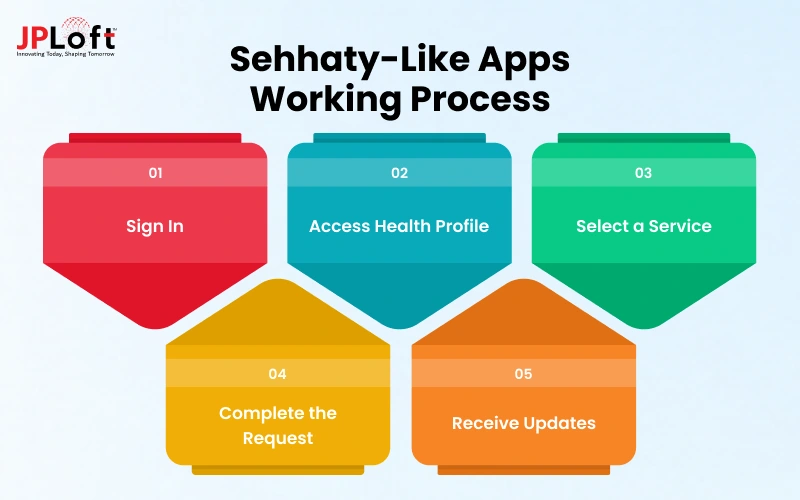
Users sign in, access their health profiles, and choose services such as appointment booking, medical reports, or virtual consultations. The app processes these requests and displays relevant health information based on available services and user access.
Cost Breakdown To Develop A Healthcare App Like Sehhaty
The cost to build an app like Sehhaty typically ranges from $25,000 to $150,000+ (SAR 90,000 to SAR 550,000+), depending on the healthcare services, platform features, integrations, and security requirements.
Building a healthcare app for appointment booking and patient profiles requires less development effort than a platform that offers virtual consultations, medical records, family health services, and multiple healthcare integrations.
|
App Complexity |
Estimated Cost |
Estimated Timeline |
Key Features |
|
|
Sehhaty-Like MVP |
$25,000 – $40,000 |
SAR 90,000 – SAR 150,000 |
2 – 4 months |
Patient registration, basic profiles, appointment booking, and notifications |
|
Standard Sehhaty-Like App |
$40,000 – $100,000 |
SAR 150,000 – SAR 375,000 |
4 – 6 months |
Virtual consultations, medical reports, prescription-related services, and provider dashboards |
|
Advanced Sehhaty-Like Platform |
$100,000 – $150,000+ |
SAR 375,000 – SAR 550,000+ |
6 – 9+ months |
Multiple healthcare services, advanced integrations, digital health records, family profiles, and expanded administration controls |
These estimates cover the development of a custom Sehhaty-inspired healthcare application, not the replication of Saudi Arabia's national healthcare infrastructure. Government system integrations, third-party licensing, regulatory assessments, and ongoing operational expenses may require separate budgets.
For better budget control, start with the services your target users need most, then introduce more complex capabilities as the platform grows.
Cost Breakdown by Sehhaty-Like App Development Stages
The cost of developing an app like Sehhaty depends on the work involved at each stage, from defining healthcare workflows to preparing the platform for launch.
The following breakdown provides indicative estimates for planning a platform within the previously outlined budget to develop a healthcare app.
|
Development Stage |
Estimated Cost |
Key Activities |
|
|
Requirements and Healthcare Workflow Planning |
$2,000 – $8,000+ |
SAR 7,500 – SAR 30,000+ |
Define Sehhaty-inspired services, map patient journeys, prioritize features, and identify integration requirements. |
|
UI/UX Design and Arabic Localization |
$3,000 – $12,000+ |
SAR 11,250 – SAR 45,000+ |
Design patient journeys, Arabic right-to-left layouts, English interfaces, and healthcare service screens. |
|
Frontend and Backend Development |
$10,000 – $65,000+ |
SAR 37,500 – SAR 243,750+ |
Develop patient profiles, appointment management, notifications, dashboards, and core backend functionality. |
|
Healthcare Integrations and Data Security |
$5,000 – $40,000+ |
SAR 18,750 – SAR 150,000+ |
Connect authorized provider systems, configure access controls, and implement secure health data handling. |
|
Testing and Quality Assurance |
$3,000 – $15,000+ |
SAR 11,250 – SAR 56,250+ |
Test patient workflows, Arabic interfaces, security controls, performance, and integration reliability. |
|
Deployment and Launch Preparation |
$2,000 – $10,000+ |
SAR 7,500 – SAR 37,500+ |
Configure production infrastructure, prepare app releases, set up monitoring, and resolve launch issues. |
Key Features to Include in an App Like Sehhaty
A Sehhaty-inspired app can bring essential healthcare services into one platform. The mobile app features you choose will depend on your target users, available healthcare integrations, and the scope of your initial release.
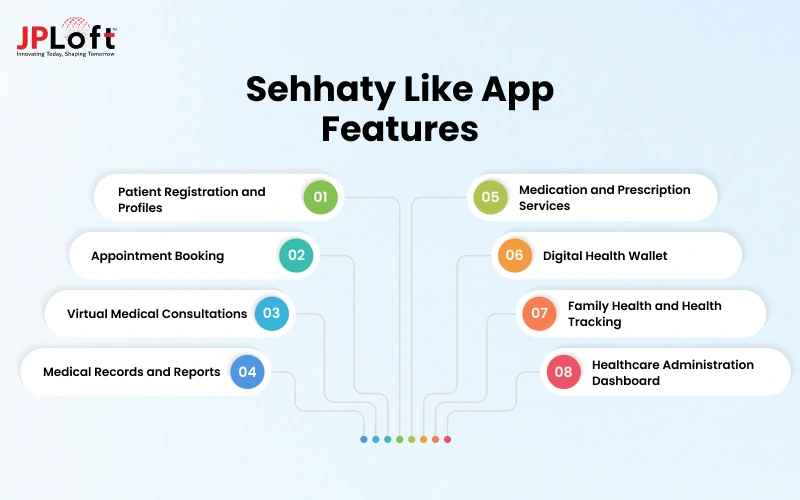
1. Patient Registration and Profiles
Allow users to create secure accounts, manage personal details, and access authorized health information. Family profiles can support dependent healthcare access where permissions and consent requirements are met.
2. Appointment Booking
Let users find available services, schedule appointments, and receive reminders. Integration with authorized provider systems can help synchronize appointment availability and booking updates.
3. Virtual Medical Consultations
Enable remote consultations through video or other communication channels. Include consultation scheduling, secure sessions, and notifications based on the services your platform supports.
4. Medical Records and Reports
Allow users to view medical reports, test results, and relevant health records. Access to external records depends on provider authorization and technical integration requirements.
5. Medication and Prescription Services
Provide medication information and supported prescription-related functions. The available capabilities must align with relevant healthcare regulations and authorized provider workflows.
6. Digital Health Wallet
Give users a central place to access selected health documents, certificates, and other relevant records, with appropriate permissions and access controls.
7. Family Health and Health Tracking
Support authorized access to dependent health information, preventive care resources, reminders, and selected health indicators.
8. Healthcare Administration Dashboard
Provide authorized staff with tools to manage appointments, user access, service information, and operational reports.
How to Build an App Like Sehhaty: Step-By-Step Process
To create an app like Sehhaty, businesses need a structured development plan covering healthcare workflows, user experience, technical development, data protection, and launch preparation.
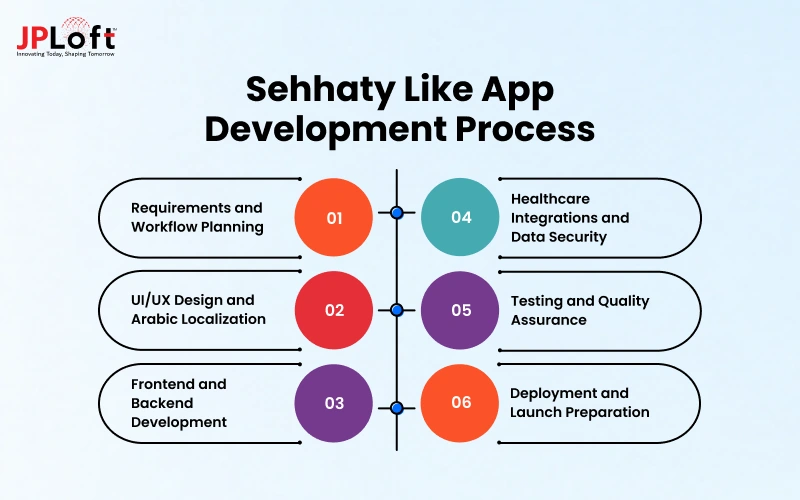
The following stages help organize development activities and align the platform with Saudi market requirements.
Step 1. Requirements and Healthcare Workflow Planning
Start by defining the app’s target users, business objectives, and healthcare services. Identify essential features such as appointment booking, medical records, virtual consultations, and patient profiles.
Map user journeys, establish project scope, and assess applicable Saudi healthcare requirements and integration dependencies before development begins.
Step 2. UI/UX Design and Arabic Localization
Design accessible interfaces for patients, healthcare providers, and administrators. Create app wireframes and interactive app prototypes to map navigation and key user journeys.
Include Arabic and English language support, right-to-left layouts, and culturally appropriate design elements. Validate the proposed interfaces to ensure users can access healthcare services with minimal friction.
Step 3. Frontend and Backend Development
Develop the mobile app interfaces, backend systems, and administrative dashboards. Implement core features such as user registration, appointment management, health records, notifications, and service requests.
Select suitable programming framework for app development based on performance, scalability, and integration needs. Building the platform in phases helps prioritize essential functionality before introducing advanced features.
Step 4. Healthcare Integrations and Data Security
Integrate the app with authorized healthcare providers, external services, and available APIs where access is permitted. Implement secure authentication, data encryption, role-based access controls, and audit logs to protect sensitive patient information.
Assess applicable Saudi data protection and cybersecurity requirements, and confirm integration permissions before connecting to healthcare or government systems.
Step 5. Testing and Quality Assurance
Test the application across supported devices, operating systems, and languages. App testing helps validate appointment booking, medical information access, notifications, user permissions, and healthcare integrations.
Conduct security, usability, and performance testing to identify issues before release. Resolve critical defects and verify that essential workflows function reliably under expected usage conditions.
Step 6. Deployment and Launch Preparation
Prepare the production environment, finalize app store submissions, and configure monitoring and support processes. Verify security settings, backup procedures, and deployment readiness before launching the application.
After release, monitor app performance, address reported issues, and collect user feedback to guide maintenance, feature improvements, and future platform expansion.
Technology Stack for Building an App Like Sehhaty
The technology stack for a Sehhaty-like app should support secure health data access, reliable healthcare integrations, and bilingual user experiences.
The final selection of the app tech stack depends on the required features, target platforms, integration needs, and expected user volume.
|
Technology Layer |
Suitable Technologies |
Purpose |
|
Mobile App |
Flutter, React Native, Swift, Kotlin |
Develop patient-facing apps for Android and iOS with Arabic and English interfaces. |
|
Frontend development |
React.js, Next.js |
Build web portals for healthcare providers and administrators. |
|
Backend |
Node.js, Python, Java, .NET |
Manage user accounts, appointment workflows, business logic, and communication between services. |
|
Database Management |
PostgreSQL, MySQL, MongoDB |
Store user profiles, appointment details, and other application data according to data structure requirements. |
|
Cloud Infrastructure |
AWS, Microsoft Azure, Google Cloud |
Support application hosting, storage, scaling, backups, and monitoring, subject to applicable data residency and compliance requirements. |
|
Healthcare Integrations |
REST APIs, FHIR-compatible interfaces, HL7 interfaces |
Exchange relevant healthcare information with external systems when access and technical compatibility permit. |
|
Video Consultations |
WebRTC, approved video communication SDKs |
Enable remote consultations and secure communication between patients and providers. |
|
Security and Authentication |
OAuth 2.0, OpenID Connect, encryption, role-based access control |
Protect accounts, manage permissions, and secure sensitive information. |
|
Testing and monitoring |
Automated testing tools, application performance monitoring, centralized logging |
Identify defects, monitor reliability, and support ongoing maintenance. |
|
Notifications |
Firebase Cloud Messaging, Apple Push Notification service, SMS gateways |
Send appointment reminders, service updates, and relevant alerts. |
How to Choose the Right Technology Stack for a Sehhaty-Like App?
Not every Sehhaty-inspired platform needs every technology listed above. A focused MVP may require appointment management, patient profiles, notifications, and a straightforward backend. A more advanced platform may need virtual consultation infrastructure, medical record integrations, and additional controls for different user roles.
Security and Compliance Requirements for a Sehhaty-Like App in Saudi Arabia
A Sehhaty-like healthcare app must protect sensitive patient information and comply with applicable Saudi data protection and cybersecurity requirements. These considerations should be included in the app’s architecture and development plan from the beginning.
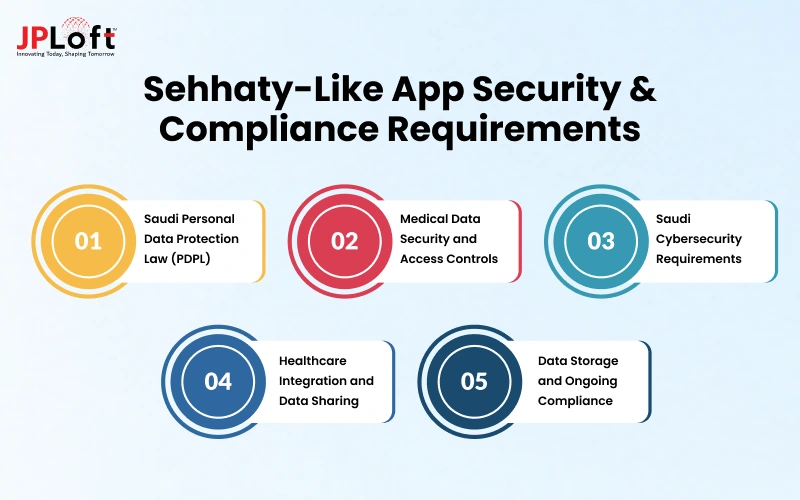
1. Saudi Personal Data Protection Law (PDPL)
The PDPL governs personal data processing, including health information. The platform should implement appropriate privacy notices, consent mechanisms, data retention policies, and controls for sharing patient information with authorized third parties. Experienced providers offering software development services in Saudi Arabia can help incorporate these privacy requirements into the platform’s architecture from the initial development stage.
2. Medical Data Security and Access Controls
Protect medical reports, patient profiles, and consultation details using encryption, secure authentication, role-based access control (RBAC), and audit logs. Restrict access to authorized users based on their roles and responsibilities.
3. Saudi Cybersecurity Requirements
Assess applicable National Cybersecurity Authority (NCA) controls based on the platform’s operating model and obligations. Security measures may include vulnerability testing, activity monitoring, secure infrastructure configuration, and incident response procedures.
4. Healthcare Integration and Data Sharing
Integrations with Saudi healthcare providers require appropriate authorization, secure data exchange, and compatibility with relevant interoperability standards. Confirm API access, data-sharing permissions, and technical requirements before development. Access to Sehhaty or government systems should never be assumed.
5. Data Storage and Ongoing Compliance
Evaluate applicable requirements for health data storage, cloud hosting, and cross-border transfers. After launch, maintain security through regular assessments, software updates, access reviews, and incident response procedures.
Key Factors That Influence Sehhaty-Like App Development Costs
The cost of developing an app like Sehhaty depends on its healthcare features, integration requirements, language support, and security needs. The impact of each factor varies depending on the platform's scope, complexity, and technical requirements.
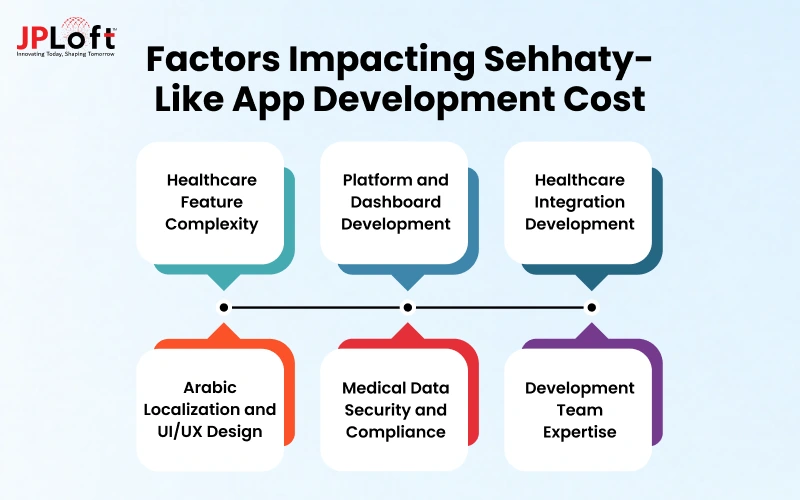
1. Healthcare Feature Complexity
An app with patient profiles and appointment booking requires less development effort than one offering virtual consultations, medical reports, family health services, and digital health records. Each additional feature adds design, coding, and testing requirements.
Cost impact: More complex features can increase development costs by approximately 15–30%, depending on the number of services and their technical requirements.
2. Platform and Dashboard Development
Supporting Android, iOS, and a separate administrative dashboard requires additional interface development, backend coordination, and testing. The budget also depends on whether the platforms share a codebase or require separate implementations.
Cost impact: Supporting multiple platforms can increase development effort by approximately 15–30% compared with a simpler, single-platform implementation.
3. Healthcare Integration Development
A Sehhaty-inspired platform may need to exchange appointment details, medical reports, or other authorized health information with provider systems. Building these connections involves API development, data mapping, and integration testing.
Cost impact: Integration complexity can add approximately 15–25% to development costs when several systems or complex data exchanges are involved.
4. Arabic Localization and UI/UX Design
The platform may need Arabic right-to-left layouts alongside English interfaces. Designing localized patient journeys, healthcare terminology, and consistent navigation requires additional design and testing work.
Cost impact: Bilingual design and localization may add approximately 5–10% to the relevant development budget, depending on the number of screens and localization scope.
5. Medical Data Security and Compliance Implementation
Patient profiles, medical reports, and consultation information require appropriate security architecture. Development may include encryption, role-based access controls, audit logging, and controls aligned with applicable Saudi data protection and cybersecurity requirements.
Cost impact: Security and compliance implementation can account for approximately 10–20% of development expenditure, depending on the platform's data sensitivity and regulatory obligations.
6. Development Team Expertise
A Sehhaty-like platform may require mobile developers, backend engineers, UI/UX designers, integration specialists, and quality assurance professionals. Team size, experience, location, and project duration all affect the initial budget.
Cost impact: The choice of team and delivery model can cause estimates to vary by approximately 10–25%, depending on rates, expertise, and project complexity.
Hidden Costs of Developing an App Like Sehhaty
Some expenses only become clear once development begins. For a Sehhaty-like platform in Saudi Arabia, integration restrictions, medical data preparation, and additional validation requirements can increase the original budget or delay launch.
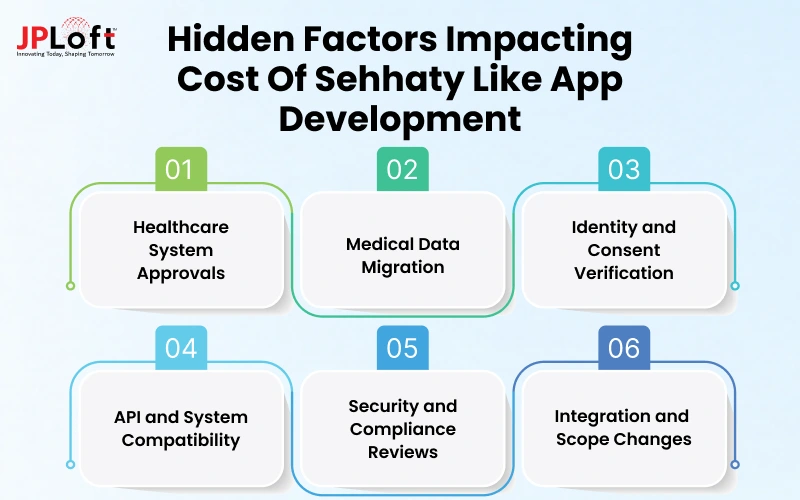
Planning for these risks early helps reduce unexpected development costs.
1. Approval and Access Requirements for Healthcare Systems
Connecting an app to healthcare providers or external medical systems may require approvals, technical assessments, and authorized access. If access takes longer than expected, the development team may need to adjust the integration plan or use temporary alternatives.
Potential cost impact: Additional coordination, integration changes, and development delays.
2. Medical Data Migration and Validation
If the platform must import existing patient records, medical reports, or appointment histories, the data may need cleaning, mapping, and validation before use. Inconsistent formats or incomplete records can require additional development and testing.
Potential cost impact: Extra data preparation, migration work, and validation cycles.
3. Identity Verification and Family Consent Workflows
A Sehhaty-inspired platform may support family profiles or access to health information for dependents. Implementing these workflows can become more complex when identity verification, consent, and permission requirements differ across user groups.
Potential cost impact: Additional authentication logic, permission controls, and testing.
4. Unexpected API Limitations and Legacy System Compatibility
An external healthcare system may have limited API functionality, outdated interfaces, or restrictions on the data it can share. These limitations can require custom integration logic or changes to the original technical design.
Potential cost impact: Rework, additional integration development, and expanded testing.
5. Additional Security Assessments and Compliance Remediation
Security reviews may uncover gaps in access controls, audit logging, data handling, or system configuration. Addressing these findings before launch can require changes beyond the original development scope.
Potential cost impact: Remediation work, repeat assessments, and further security testing.
6. Changing Integration Requirements and Project Scope
Healthcare providers may revise technical requirements during implementation. New data fields, modified workflows, or additional approval conditions can affect features that the team has already developed.
Potential cost impact: Scope changes, rework, and timeline extensions.
What Are the Ongoing Costs of Operating a Sehhaty-Like App?
Operating a Sehhaty-like app involves ongoing expenses beyond initial development. These costs depend on infrastructure requirements, healthcare integrations, security measures, and the level of support needed to keep the platform running reliably.
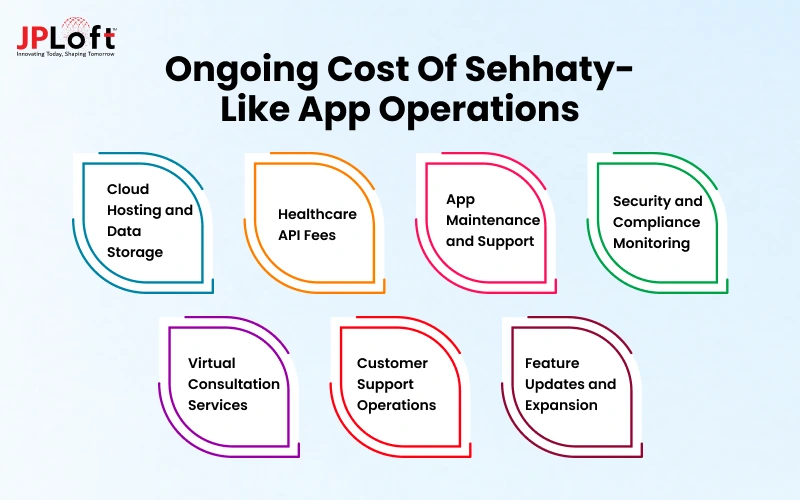
1. Cloud Hosting and Medical Data Storage
A Sehhaty-inspired platform needs infrastructure to manage patient profiles, appointment records, medical documents, and application traffic. As usage grows, the platform may require additional computing capacity, database resources, backups, and secure document storage.
Ongoing cost drivers: Cloud infrastructure, database management, backup storage, data transfer, and capacity scaling.
2. Healthcare API and Integration Fees
Integrations with healthcare providers, appointment systems, identity verification services, and other external platforms may involve recurring subscription or usage-based charges. API changes can also require technical updates to keep data exchanges working correctly.
Ongoing cost drivers: API subscriptions, transaction fees, integration monitoring, and compatibility updates.
3. App Maintenance and Technical Support
Mobile operating systems change over time, and users may encounter bugs or performance issues. Regular app maintenance solutions keep appointment booking, patient profiles, medical reports, and other Sehhaty-like features functioning as intended.
Ongoing cost drivers: Bug fixes, operating system compatibility updates, backend maintenance, technical support, and performance optimization.
4. Security Monitoring and Compliance Reviews
Platforms handling sensitive health information need continuous attention to access permissions, suspicious activity, vulnerabilities, and data protection controls. Depending on the applicable Saudi requirements and the platform's operating model, periodic assessments and compliance reviews may also be necessary.
Ongoing cost drivers: Mobile app security monitoring, vulnerability assessments, access-log reviews, security audits, and remediation of newly identified issues.
5. Virtual Consultation and Notification Services
If the app offers remote consultations, appointment reminders, or service notifications, usage can affect operating expenses. Video consultations may require communication infrastructure, while SMS and third-party messaging services may charge according to usage.
Ongoing cost drivers: Video or audio services, SMS delivery, notification APIs, and communication usage fees.
6. Customer Support and Platform Operations
Patients may need help with account access, appointments, medical documents, and technical issues. The platform may also require operational staff to monitor integrations, investigate errors, and coordinate with healthcare providers.
Ongoing cost drivers: Customer support, technical operations, incident response, and provider coordination.
7. Feature Updates and Platform Expansion
As healthcare needs change, the platform may require new features, improved patient journeys, additional provider integrations, or expanded family health services. These enhancements are ongoing product investments rather than routine maintenance.
Ongoing cost drivers: Feature development, interface improvements, new integrations, and infrastructure upgrades.
How to Reduce the Cost of Developing an App Like Sehhaty?
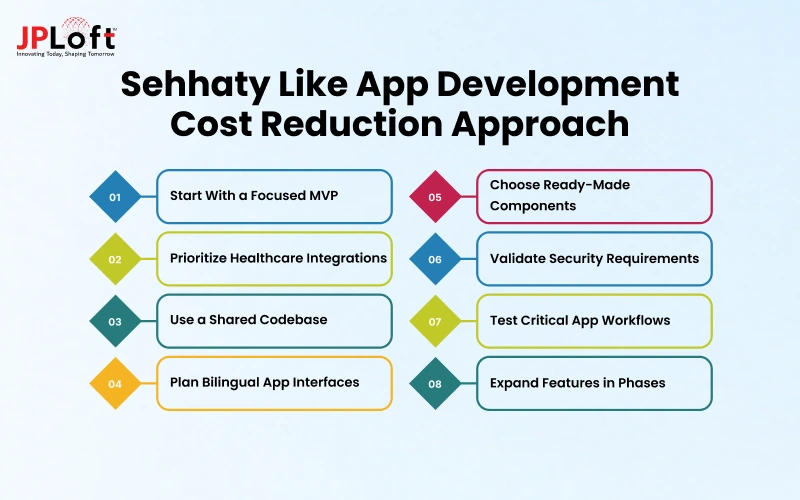
Reducing the cost of building an app like Sehhaty starts with prioritizing the healthcare services users need most. Instead of replicating every feature at launch, businesses can control spending by carefully planning integrations, validating requirements early, and expanding the platform in phases.
1. Start With a Focused MVP
Launch with essential Sehhaty-inspired features such as patient registration, appointment booking, notifications, and access to basic health information. Add virtual consultations, family health services, and advanced medical records when the initial platform is stable and user needs are clear.
Prioritize features by user value and technical complexity to avoid spending on nonessential functionality.
2. Prioritize Healthcare Integrations
Identify which Saudi healthcare providers and external systems the app must connect with before development begins. Hire mobile app developers who can confirm API availability, access permissions, documentation, and technical requirements to avoid building integrations that cannot be used as planned.
Implement essential integrations first and schedule additional connections for later releases.
3. Use a Shared Codebase Where Practical
If the platform needs Android and iOS apps, evaluate cross-platform development using frameworks such as Flutter or React Native. A shared codebase can reduce duplicated development work, although native development may still be appropriate for certain device-specific or security-sensitive requirements.
Select the technology stack based on the required features, integration needs, and long-term maintenance plans.
4. Plan Arabic and English Interfaces From the Start
Consider the challenges involved in building English left-to-right interfaces or Arabic right-to-left layouts during the initial UI/UX phase. Retrofitting Arabic support later can require changes to navigation, screen layouts, forms, and testing.
Build localization into the original design system instead of treating it as a post-launch addition.
5. Choose Ready-Made Components Carefully
Use established components for suitable functions such as notifications, video consultations, authentication, and analytics when they meet the platform's technical and regulatory requirements. Avoid developing standard capabilities from scratch without a clear reason.
Compare licensing and usage fees with custom development and maintenance costs before selecting third-party services.
6. Validate Security and Data Requirements Early
Define patient access permissions, consent workflows, data retention rules, audit logging, and applicable Saudi compliance requirements before implementation. Late changes to medical data architecture can affect the backend, interfaces, integrations, and testing.
Include security and compliance requirements in the initial technical plan to reduce expensive rework.
7. Test Critical Workflows Before Expanding
Test appointment scheduling, medical document access, identity verification, and healthcare integrations throughout development. Early testing can reveal issues before they affect multiple features or require extensive changes.
Prioritize automated tests for repeatable workflows and conduct security and integration testing before release.
8. Expand the Platform in Phases
Use actual user feedback, service demand, and operational data to decide which capabilities to add next. Advanced analytics, additional provider integrations, and expanded digital health services can be introduced as the platform's requirements grow.
Maintain a phased roadmap with clear priorities instead of committing the full budget to every planned feature upfront.
How Sehhaty-like Apps Make Money?
A Sehhaty-like healthcare app can generate revenue through different business models based on its target audience, services, and partnerships.
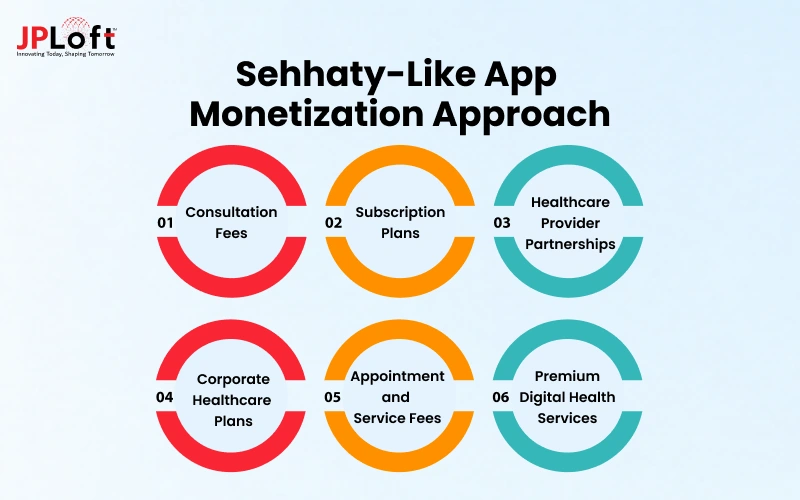
Common mobile app monetization options include:
1. Consultation Fees
Charge users for virtual consultations with licensed healthcare professionals. The platform can earn a fee per consultation or retain an agreed share of the payment.
2. Subscription Plans
Offer monthly or annual memberships for premium features such as personalized wellness plans, ongoing health support, and advanced health tracking.
3. Healthcare Provider Partnerships
Partner with hospitals, clinics, and medical networks to provide appointment booking, patient engagement, or digital care management services under commercial agreements.
4. Corporate Healthcare Plans
Offer digital health services to employers and organizations through recurring contracts. Features may include employee wellness programs, appointment access, and health management tools.
5. Appointment and Service Fees
Charge participating healthcare providers for bookings, platform access, or value-added services, where permitted by applicable regulations.
6. Premium Digital Health Services
Generate additional revenue through optional services such as health assessments, wellness programs, or specialized care management, subject to relevant licensing and regulatory requirements.
Why Choose JPLoft to Develop an App Like Sehhaty?
JPLoft helps businesses turn healthcare ideas into digital platforms designed around patient needs, secure data access, and reliable service delivery. From planning Sehhaty-inspired features to developing a fully functional mobile app, backend systems, and healthcare integrations, our team aligns development with your business goals and technical requirements.
Our approach as an experienced healthcare app development company focuses on building a practical foundation that supports essential healthcare services at launch and allows the platform to expand as requirements grow.
-
Healthcare-Focused Planning: Define patient journeys, core features, and integration requirements before development begins.
-
Custom App Development: Develop Android and iOS applications with patient profiles, appointment booking, medical information, and other required capabilities.
-
Secure Architecture: Implement access controls, data protection measures, and audit trails based on applicable requirements.
-
Arabic and English Experiences: Design bilingual interfaces with Arabic right-to-left support for Saudi users.
-
Scalable Integrations: Connect the platform with authorized healthcare providers and external systems based on available access and technical requirements.
-
Ongoing Technical Support: Maintain application performance, address issues, and support future feature updates after launch.
Whether you plan to launch a focused healthcare MVP or a broader Sehhaty-inspired platform, JPLoft can help define the scope, estimate development requirements, and plan a phased implementation.
Conclusion
Developing an app like Sehhaty requires more than replicating healthcare features. It involves understanding Saudi Arabia’s digital health ecosystem, planning authorized healthcare integrations, protecting sensitive medical data, and creating accessible Arabic and English experiences.
A clear feature roadmap and phased development strategy can help control the initial investment while leaving room for future expansion. By assessing your requirements, integration needs, and long-term operating costs early, you can make informed decisions about the platform’s scope and budget.
JPLoft can help you plan and develop a Sehhaty-inspired healthcare platform aligned with your business objectives and Saudi market requirements.
FAQs
Developing an app like Sehhaty can cost between $25,000 and $150,000 or more (SAR 90,000 and SAR 550,000+). The final budget depends on feature complexity, platform requirements, healthcare integrations, security measures, and the level of customization required.
A basic Sehhaty-like MVP may take 2–4 months, while a platform with virtual consultations and additional integrations may require 4–6 months. Advanced platforms can take 6–9 months or longer.
Essential features include patient registration, appointment booking, medical reports, medication information, and notifications. Depending on the platform's scope, you can also include virtual consultations, digital health records, family health services, and health tracking.
Start by defining healthcare services and prioritizing features. Design Arabic and English interfaces, develop the patient app and backend, and plan authorized healthcare integrations. Test security, patient workflows, and integration reliability before launching the platform.
Requirements depend on the platform's services and data processing activities. Developers should assess Saudi Arabia's Personal Data Protection Law (PDPL), applicable health data requirements, cybersecurity controls, and any additional rules governing regulated healthcare services.

Rahul Sukhwal is the CEO and Founder of JPLoft, with 18+ years of experience in software engineering, emerging technologies, and digital product development. His expertise spans artificial intelligence, including AI agents, generative AI, LLMs, chatbots, computer vision, and machine learning, as well as blockchain, IoT, AR/VR, mobile, web, and enterprise software. He focuses on applying these technologies to real business challenges across industries such as healthcare, education, mobility, finance, real estate, and on-demand services.



Share this blog