


Saudi Arabia's rental market is going digital fast. Before you pick a developer, you need a clear budget.
Picture a visitor landing in Riyadh or Jeddah. They want a car in minutes. They do not want to call three offices and wait for replies. They open an app, pick a car and pay. That simple flow is why so many rental owners now plan their own app.
The market backs this move. Current industry reports value the Saudi car rental and leasing market at around USD 3.07 billion in 2026.
This shows your customers are already online, and they only need a car rental app that works the way they live.
So, what is it cost to develop a car rental app in Saudi Arabia?
The car rental app development system Saudi Arabia can cost around SAR 37,500 to SAR 300,000+. That is about $10,000 to $80,000+.
The range is wide because every rental business is different.
Our experts curated a complete guide to car rental app development costs, which we are sharing with you. This includes costs, factors affecting them, and tips to reduce the overall cost.
So, let’s get to know all about it.
What is a Car Rental App & How Does It Work?
A car rental app puts your rental counter inside a phone. Here is what that means in simple terms.
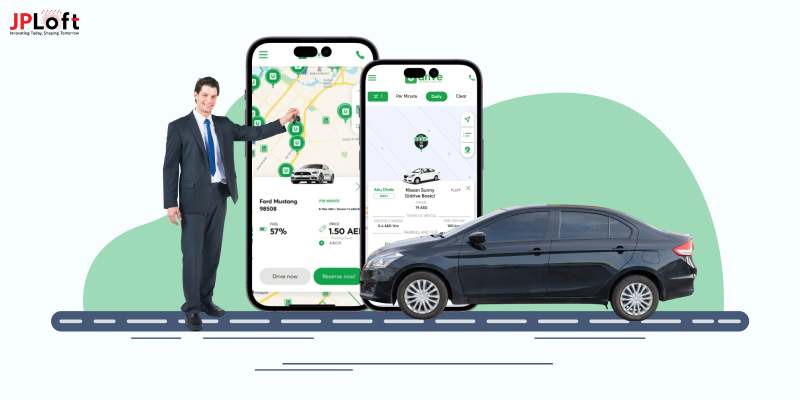
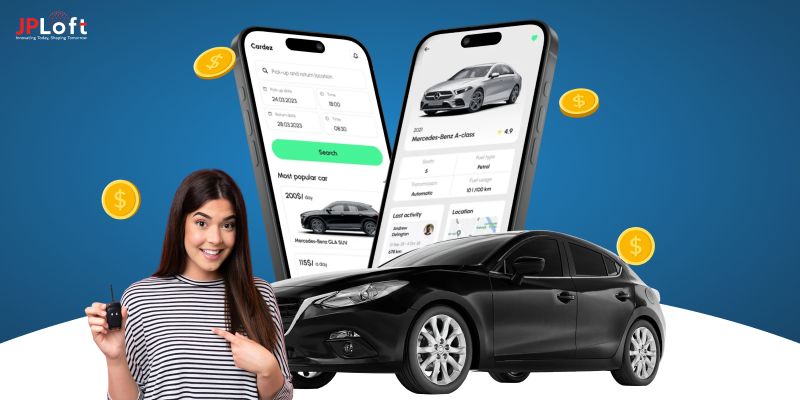
A car rental app lets customers search, book and pay for a car online. It also gives your team a dashboard to manage bookings, cars and payments.
Most Saudi businesses build three parts together. These are a customer app, a branch panel for staff and a super admin panel for owners.
As of right now, there are so many car rental apps in Saudi Arabia, such as Telgani, Rumi, Go Steer, and many more.
A. How the Booking Flow Works
The journey is short for the customer. Behind the scenes, a lot happens.
-
Search: The customer enters the city, pickup point and dates.
-
Choose: The app shows live availability, price, mileage limits and insurance details.
-
Verify: The customer uploads an ID or Iqama and a driving licence.
-
Pay: The customer pays with Mada, Apple Pay, STC Pay or a card. A deposit may be held.
-
Sign: The app shows the rental contract and records the acceptance.
-
Pick up: The customer collects the car or gets it delivered.
-
Return: Staff check the car, record fuel and mileage and close the booking.
Every step updates one shared system. When a car is booked in Riyadh, nobody can book that same car for those dates in Jeddah. This is how the app stops double bookings.
B. Car Rental App vs Full Rental Platform: What to Choose in Saudi Arabia
Both options work well. The right pick depends on the size of your fleet and your plans for growth.
A basic app is the faster start. It handles bookings, payments and customer profiles. Customers pick a car, pay online and collect it. This suits new rental businesses. Launch takes around 3 to 4 months.
A full platform goes much deeper. It also manages fleet records, maintenance, contracts, GPS and reports. Your team sees every car in one place. Nothing stays on paper or WhatsApp. Expect around 4 to 6 months.
This choice shapes your car rental app cost KSA more than anything else. A basic app keeps the upfront budget low. A full platform costs more but saves hours of daily work.
If your fleet is small, start with the basic app. If you have many cars or branches, a full platform makes more sense.
You can also begin small and add modules later. Plan your car rental app development in stages so the base can grow with your business.
Keep it in mind as we move to the features.

Types of Car Rental Apps You Can Build
Not every rental business needs the same app. Your model decides your features and your budget. Here are the main types seen in the Saudi market.
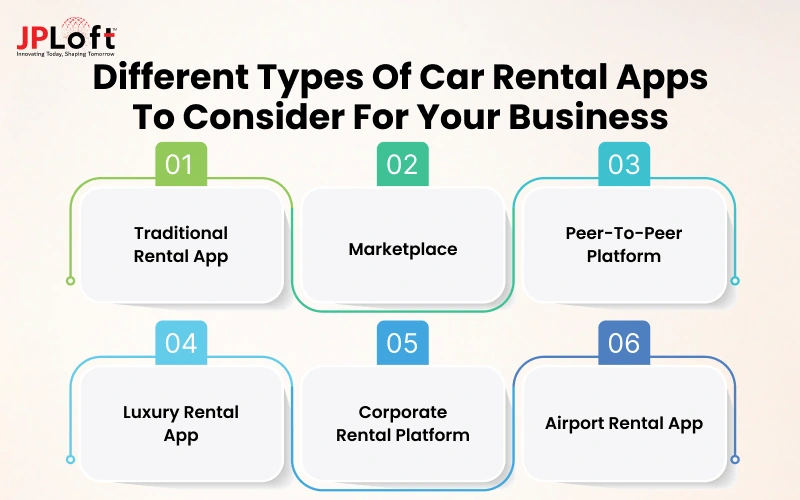
1. Traditional Rental App
Built for companies that own their cars. Customers browse your fleet and choose dates. They pay online and pick up the car at your branch. Simple to run.
Examples: Lumi, Theeb, Budget Saudi
Approx cost: SAR 37,500 – SAR 112,500 (USD 10,000 – USD 30,000)
2. Marketplace
Many rental companies list their cars on one platform. Customers compare prices and book in minutes. You earn a commission on every booking. No fleet needed.
Examples: Rentalcars.com, Discover Cars
Approx cost: SAR 93,750 – SAR 225,000 (USD 25,000 – USD 60,000)
3. Peer-To-Peer Platform
Car owners rent out their own vehicles through your platform. Owners earn extra income. You handle trust, insurance and payments. This model needs a careful rule check before launch.
Examples: Ejaro, ekar P2P, Turo
Approx cost: SAR 112,500 – SAR 262,500 (USD 30,000 – USD 70,000)
4. Luxury Rental App
Premium cars like Mercedes, BMW and Range Rover. Customers get chauffeur options and hotel delivery. Deposits are higher, so secure payment and strong verification matter.
Examples: Sixt, Lumi’s premium range
Approx cost: SAR 75,000 – SAR 187,500 (USD 20,000 – USD 50,000)
5. Corporate Rental Platform
Companies manage staff rentals from one account. Managers approve requests, track usage and get one monthly invoice. This is a steady, high-value segment for long-term revenue.
Examples: Hertz, Theeb corporate plans
Approx cost: SAR 112,500 – SAR 300,000+ (USD 30,000 – USD 80,000+)
6. Airport Rental App
Customers book before they land. Your staff track flight times and plan handovers so the car is ready on arrival. Perfect for tourists, pilgrims and business travellers.
Examples: Yelo, Budget Saudi, Hertz
Approx cost: SAR 56,250 – SAR 150,000 (USD 15,000 – USD 40,000)
Corporate customers matter here. One market report puts their share at over 56% of Saudi rental revenue in 2025. Short-term rentals made up about half of the market.
A well-planned car rental app development Saudi Arabia project should serve both groups. Your choice of model sets the base price. Let us now see what that price looks like.
How Much Does It Cost to Develop a Car Rental App in Saudi Arabia?
Let us start with the number most owners ask for. Then we will explain what sits behind it.
The car rental app development cost in Saudi Arabia usually falls between SAR 37,500 and SAR 300,000+, that is $10,000 to $80,000+. A simple booking app sits near the bottom. A multi-branch platform with GPS, corporate accounts and AI sits near the top.
Why is the overall cost to build an app in Saudi Arabia so wide? Because you are not buying one thing. You are buying design, apps, a backend, an admin panel and several integrations. Each part has its own effort and its own price.
Most quotes for car rental mobile app development Saudi Arabia cover these items:
-
UI and UX design in Arabic and English
-
Customer app for Android and iOS
-
Admin dashboard for bookings and fleet
-
Backend, database and APIs
-
Payment gateway and notifications
-
Testing, launch and early support
Some costs sit outside the build price. App store accounts, hosting, SMS charges, map usage and GPS hardware are billed separately. Yearly maintenance usually adds 15% to 20% of the build cost. Plan for it from day one.
Why the Saudi Market Needs a Local Approach?
A global template rarely works here. Saudi users expect Arabic first. They pay with Mada. Rental demand also swings with seasons.
Hajj, Umrah, school holidays and big events can lift bookings overnight. Your app must handle those peaks without slowing down.
Rules matter too. The Transport General Authority oversees car rental activity. The Personal Data Protection Law covers customer documents and location data.
A partner with local knowledge builds these needs into the plan early. This is also why a Saudi quote can differ from a global one. When you compare car rental app development cost Saudi Arabia quotes, check what each one includes.
Car Rental App Development Cost by Complexity
The car rental app development cost in Saudi Arabia varies based on the app’s complexity and business requirements.
Let’s look at how costs change with app complexity:
A. Basic App: SAR 37,500 to SAR 93,750 ($10,000 to $25,000)
This level suits startups and small fleets. Think of a single city launch with 20 to 50 cars. The timeline is about 2 to 3 months.
-
User sign-up with OTP login
-
Vehicle search and filters
-
Real-time availability
-
Online booking and payment with MADA and cards
-
Arabic and English interface
-
Basic admin panel
-
Push notifications and booking history
-
Simple document upload
B. Mid-Level App: SAR 93,750 to SAR 187,500 ($25,000 to $50,000)
This level suits growing companies with several branches. The timeline is about 4 to 6 months.
-
Everything in the basic app
-
Fleet management with maintenance alerts
-
Branch panels with role-based access
-
Digital contracts and deposit handling
-
Identity checks with Nafath or a similar service
-
Basic GPS integration
-
Promo codes and loyalty points
-
Reports on revenue and fleet use
C. Advanced Platform: SAR 187,500 to SAR 300,000+ ($50,000 to $80,000+)
This level suits large fleets, marketplaces and corporate rental providers. The timeline is 6 to 9 months or more.
-
Multi-vendor marketplace with commissions and payouts
-
Live GPS tracking and geofencing
-
Corporate accounts, approvals and monthly invoices
-
Airport pickup with flight tracking
-
AI pricing, demand forecasts and car suggestions
-
Advanced analytics and reports
-
High-security setup with audit logs
-
Links with ERP, insurance and e-invoicing tools
Many owners begin with the basic or mid-level build. They grow into the advanced one after launch. That path is safer than building everything at once.
D. How the Budget Usually Splits
Knowing where money goes helps you read any quote. Most projects follow a pattern like this.
-
UI and UX design: 10% to 15%
-
Mobile app development: 25% to 30%
-
Backend and admin panel: 30% to 40%
-
Integrations: 10% to 20%
-
Testing and launch: 10% to 15%
These shares overlap a little in real projects. Treat them as a guide. If a quote for a car rental app costs KSA shows almost nothing for backend or testing, ask questions. Missing pieces usually return as extra charges later.
E. How Long Does it Take to Develop a Car Rental App in Saudi Arabia?
Most car rental apps take 3 to 6 months to build. The exact time depends on your features and your launch plan.
The cost to build a car rental app MVP in Saudi Arabia can be around 1 to 3 months, Whereas, a full-fledged car rental app can take 4 to 6+ months. Saudi projects often need a little extra time for Arabic support and local integrations.
Here is a simple phase-wise app development timeline view:
Note: Timelines are presented in weeks for better clarity, as several development phases take less than a month to complete.
|
Phase |
What Happens |
MVP Timeline |
Full App Timeline |
|
Discovery and planning |
Define features, study the Saudi rules and finalize the scope |
1–2 weeks |
2–3 weeks |
|
UI/UX design |
Wireframes and screens in Arabic (RTL) and English |
2 weeks |
3 weeks |
|
App development |
Customer app for iOS and Android, admin panel and backend |
4–5 weeks |
7–9 weeks |
|
Integrations |
mada payments, maps, SMS, ID checks and rental authority links |
1–2 weeks |
2–3 weeks |
|
Testing |
Bug fixes, security checks and testing on many devices |
1–2 weeks |
2–3 weeks |
|
Launch |
App Store and Google Play release |
1 week |
1 week |
|
Total |
10–14 weeks |
17–22 weeks |
Many of these phases run side by side. That is why the total is not a simple sum of each row.
A few things can stretch the timeline:
-
Extra features like dynamic pricing or damage inspection
-
Late changes in the scope
-
Slow approvals from payment or government systems
Time is only one part of the plan. Next, let us look at the features that shape both your timeline and your budget.
Key Factors Affecting Car Rental App Development Costs in Saudi Arabia
The car rental app development costs in Saudi Arabia depend on different factors. Knowing them will help you make better decisions in the future.
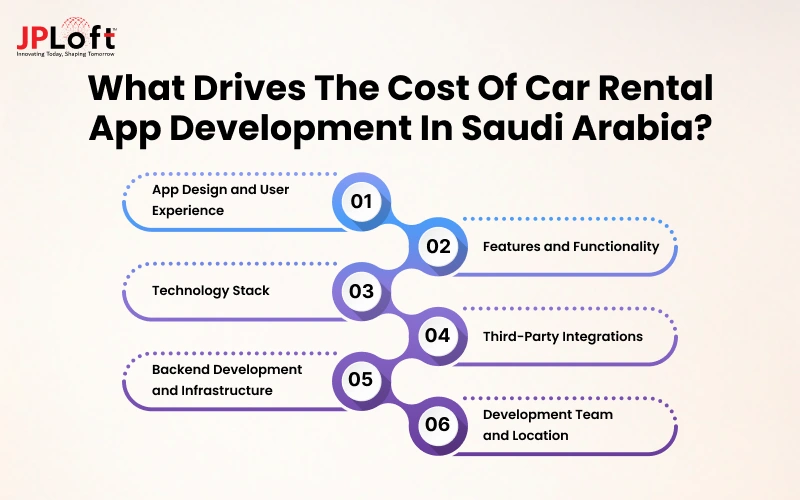
Let’s look at the key factors that can increase or reduce your overall car rental app development cost Saudi Arabia:
►App Design and User Experience
UI/UX Design is the first thing your customers judge. A clean booking flow builds trust. A messy one sends people to a rival. In Saudi Arabia, good design also means building for Arabic first.
Users also expect smooth Arabic search and clear prices in riyals.
-
Right-to-left layouts, not just translated text
-
Arabic fonts and icons that read well on small screens
-
Bilingual notifications and contracts
-
Custom screens versus ready-made templates
-
Separate designs for the customer app, branch panel and admin panel
Cost impact: Medium. Design usually takes 10% to 15% of the total budget. Full RTL support and custom branding push it to the higher end. A template-based design keeps it low.
►Features and Functionality
App features are the biggest cost driver. Each one needs design, coding and testing. A feature that looks small on screen can need weeks of backend work. Start with what customers need on day one. Everything else can wait for version two.
-
Core: Search, Booking, Payment And Booking History
-
Fleet: Availability Calendar, Maintenance And Vehicle Status
-
Control: Contracts, Deposits, Extensions And Fines
-
Growth: Loyalty Points, Referral Codes And Corporate Accounts
-
Smart: AI Pricing And Demand Forecasts
Cost impact: Very high. Moving from a core feature set to a full platform can double the budget. This is the main reason a project shifts from the basic range to the advanced range.
►Technology Stack
Your tech stack choices decide speed, security and future growth. Cross-platform tools like Flutter or React Native let one team build for Android and iOS together.
Native apps cost more but suit heavy GPS or high-traffic needs. For car rental mobile app development Saudi Arabia projects, cross-platform is a popular choice for a first launch.
-
Mobile: Flutter, React Native or native Swift and Kotlin
-
Backend: Node.js or Python
-
Database: PostgreSQL with Redis for speed
-
Cloud: AWS, Azure or Google Cloud
-
Admin web panel: React
Cost impact: Medium. Cross-platform development can often cut mobile costs by 20% to 30% compared with two native apps. Native builds raise the budget but suit large platforms. Check where your data will be hosted too. Saudi data rules may affect that choice.
►Third-Party Integrations
Few rental apps run alone. They connect to payments, maps, SMS, identity checks and more. Each link needs setup, testing and sometimes a monthly fee.
Always ask which integrations sit inside the quote and which do not.
-
Payment gateways
-
Maps and navigation
-
SMS and WhatsApp alerts
-
Identity and licence checks
-
GPS and telematics
-
Accounting and e-invoicing
Cost impact: Medium to high. Each major integration adds about 5% to 15% to the build. Live data services also carry monthly usage fees. The next section covers the four key ones in detail.
►Backend Development and Infrastructure
The backend is the engine of your app. It checks availability, calculates prices, stores contracts and syncs every panel. Users never see it.
But it decides whether the app stays fast on a busy Umrah weekend. Weak architecture is hard and costly to fix later.
-
Real-time availability engine to stop double bookings
-
Pricing rules for daily, weekly and monthly rates
-
Role-based access and audit logs
-
Cloud servers that scale with demand
-
Data protection under the Saudi PDPL
Cost impact: High. Backend work often takes 30% to 40% of the total budget. Multi-branch and multi-vendor systems need heavier architecture and cost more. Hosting and monitoring also add yearly running costs.
►Development Team and Location
Who builds your app matters as much as what you build. An experienced mobile app development company includes a project manager, designers, developers, testers and a DevOps engineer.
Rates change by country and by experience. Ask for case studies and check how the team handles Arabic projects.
-
Local Saudi agency: strong market knowledge but higher hourly rates
-
Offshore team: lower rates but needs clear communication
-
Hybrid model: local consultants with offshore developers
-
Freelancers: cheaper at first but risky for large builds
Cost impact: High. Team rates can swing the total by 25% to 40% for the same scope. The cheapest quote is not always the lowest real cost. Weak code often leads to costly fixes later.
Those are the general drivers. Now let us look at the integrations that matter most in the Saudi market.
Essential Integrations for Car Rental Apps in Saudi Arabia & Cost
A car rental app needs more than a booking button to keep business moving.
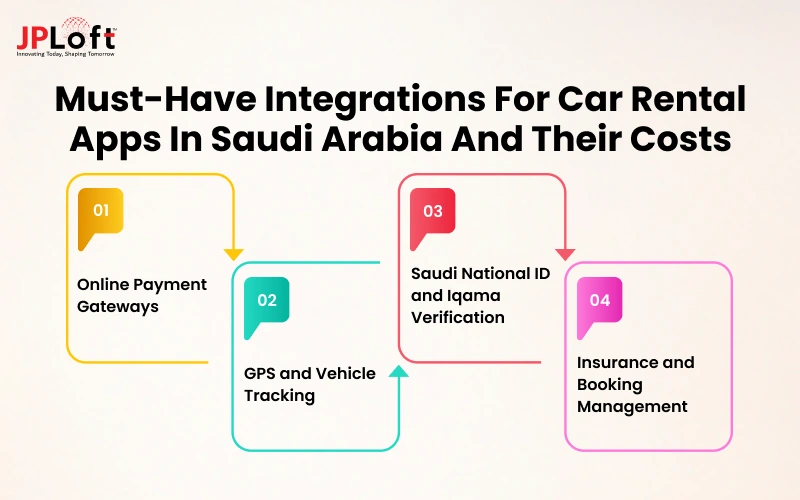
The car rental app cost in Saudi Arabia also changes with each integration you add. Let’s explore which ones matter and how much each can affect the cost:
►Online Payment Gateways
Customers in the Kingdom expect to pay with mada first. Cards, Apple Pay and STC Pay follow. Your gateway should also handle security deposits, refunds and cancellation fees.
Popular providers in the region include HyperPay, Moyasar, PayTabs and Tap Payments. Check the exact services each one supports before you choose.
-
mada, Visa, Mastercard, Apple Pay and STC Pay
-
Deposit hold and release
-
Refunds and partial charges
-
Webhooks that update the booking status
-
SADAD for corporate invoices
Cost impact: Low to medium. One gateway adds about 5% to 8% to the build. Extra payment methods and deposit flows raise it. Gateways also charge a small fee on every transaction.
►GPS and Vehicle Tracking
GPS shows you where your cars are. It also supports geofencing, mileage tracking and overdue alerts. The app connects to a tracker through a telematics API. The tracking devices themselves are bought separately.
-
Live vehicle location on a map
-
Geofence alerts for restricted zones
-
Mileage and overuse tracking
-
Unauthorized movement alerts
-
Route history with limited access
Location data counts as personal data under the Saudi PDPL. Tell customers about tracking. Limit who can view it.
Cost impact: High. GPS adds about 10% to 20% to the build. Live data feeds also bring monthly service fees.
►Saudi National ID and Iqama Verification
Renters must be checked before they drive away. Saudi citizens use a National ID.
Residents use an Iqama. Visitors may show a passport and an international licence. Your app should handle all three.
The Nafath service is a common route for digital identity. Providers such as Elm also offer identity checks. Confirm access and approval rules before you plan the build.
-
ID, Iqama or passport capture
-
Driving licence check
-
Selfie match where allowed
-
Staff approval queue
-
Encrypted document storage with access logs
Cost impact: Medium to high. This adds about 8% to 15% to the build. Simple photo upload with manual review costs less. Digital checks through approved services cost more and may need approvals.
►Insurance and Booking Management
Insurance and booking logic hold the rental together. Customers must see coverage before they pay.
Staff must see the same terms during returns and disputes. The booking engine also handles extensions, late returns, damage reports and fines.
-
Coverage details shown for each car
-
Policy and registration expiry alerts
-
Digital contract with time-stamped acceptance
-
Photo inspection at pickup and return
-
Extension and late fee rules
-
A link with the electronic contract channel approved by the Transport General Authority
Cost impact: Medium to high. This adds about 10% to 18% to the build. A deeper link with insurers or approved contract services pushes it to the top of that range.
Put these four together, and you have the core of any car rental software development Saudi Arabia project.
Corporate clients may also need e-invoicing that follows ZATCA rules. Add that early if you plan to serve companies.
With the parts clear, one big question remains. Should you build custom or buy ready-made?
Custom Car Rental App vs Ready-Made Solutions: Cost Difference
Should you build your rental app from scratch or buy a ready product? Both paths work, but they suit different Saudi rental businesses.
Ready-made car rental software costs less upfront. You can launch in under 1 month. But the booking flow and design are mostly fixed. You rarely own the code.
Many ready-made tools are also weak on Saudi needs. Arabic RTL, ZATCA e-invoicing, local gateways like mada and data hosting rules can all affect the build.
A custom car rental app costs more. In return, it fits your fleet, your branches and your brand.
You can add features like airport handover, corporate billing or delivery to hotels as you grow. You own the code and the customer data.
When you compare car rental software development Saudi Arabia options, look past the price tag. Ask about Arabic support, mada payments, e-invoicing and where your data is hosted. Also ask what happens if the vendor raises fees or shuts down.
These answers show the real long-term cost to build a car rental app in Saudi Arabia:
|
Factor |
Ready-Made Car Rental App |
Custom Car Rental App |
|
Time to launch |
Under 1 month |
3 to 6 months |
|
Upfront cost |
Lower |
SAR 37,500 – SAR 300,000+ (USD 10,000 – USD 80,000+) |
|
Customization |
Limited changes to booking and design |
Built around your exact rental process |
|
Saudi readiness |
May lack full Arabic RTL, mada and e-invoicing |
Can include all of these from day one |
|
Ownership |
Usually a licence only |
You get the source code |
|
Data hosting |
Set by the vendor |
You choose, based on Saudi rules |
|
Long-term cost |
Licence fees every month or year |
Maintenance of 15% to 20% a year |
There is also a middle path. You can start from a proven rental app base and customise it for the Saudi market. This cuts time and keeps ownership clearer.
Whatever you choose, ask who owns the source code before you sign.
How to Reduce Car Rental App Development Costs in Saudi Arabia?
A smaller budget does not have to mean a weak app. Smart choices save money without hurting quality. Use this checklist before you sign with any vendor.
-
Start with an MVP: Launch with search, booking, payment and a simple admin panel. Add the rest after real customers use it.
-
Use cross-platform development: One codebase for Android and iOS reduces effort.
-
Launch in one city first: Test demand in Riyadh or Jeddah before you go national.
-
Add GPS and AI later: These features raise the budget fast. Add them once your fleet and bookings grow.
-
Pick one payment gateway: Support mada and cards at launch. Add more methods later.
-
Fix the scope before coding: Changes in the middle of a build are the top cause of overspend.
-
Reuse proven modules: Login, chat and notifications do not need to be built from zero.
-
Pay in milestones: Link each payment to a delivered feature.
One warning. Do not cut Arabic support or security to save money. Fixing them later costs more than building them right the first time.

Why Choose JPLoft for Car Rental App Development in Saudi Arabia?
The right partner saves you money twice. Once during the build and again after launch.
JPLoft is a web and mobile app development company in Saudi Arabia, the USA, the UK, India and Australia. The team builds custom apps, AI solutions, IoT systems, and enterprise software.
That range matters for car rental app development Saudi Arabia. A rental platform needs booking logic, payments, tracking and analytics to work as one.
-
Custom builds: Your app is planned around your fleet, branches and revenue model.
-
Bilingual design: Arabic and English screens with proper RTL layouts.
-
Local payments: Planning for mada, STC Pay, Apple Pay and card payments.
-
Fleet and GPS ready: Availability, maintenance and tracking connected in one system.
-
Scalable setup: Start with an MVP and grow to a full platform.
-
Clear estimates: Feature-based pricing so you know where each riyal goes.
-
Post-launch support: Updates, fixes and monitoring after your app goes live.
Planning your launch? Share your fleet size and feature list with JPLoft. You will get a clear, feature-based estimate for your car rental app.
Conclusion
The cost of building a car rental app in Saudi Arabia comes down to the experience you want to offer and the business goals you want to achieve.
With an estimated investment of SAR 37,500 to SAR 300,000+, you have different development options to explore. The right budget should cover essential features, smooth booking flows, local payment methods, and Saudi compliance needs.
Arabic RTL support, mada payments, Nafath verification, and PDPL requirements also deserve attention during planning.
Ultimately, a successful car rental app is not just about keeping development costs low. It's about creating a platform that customers enjoy using and that makes rental operations easier. Choose your features wisely, invest in the right technology, and build with long-term business growth in mind.
FAQs
Car rental app development cost in Saudi Arabia ranges from SAR 37,500 to SAR 300,000+. That is about $10,000 to $80,000+. The final price depends on features, platforms, integrations and the team you choose.
A basic app costs about SAR 37,500 to SAR 93,750. It covers search, booking, payments, an Arabic and English interface and a simple admin panel. It suits a small fleet in one city.
A basic app takes 2 to 3 months. A mid-level app takes 4 to 6 months. An advanced platform can take 6 to 9 months or more.
GPS tracking, multi-vendor marketplaces, corporate accounts, AI pricing and deep integrations raise the cost most. Each needs heavy backend work and more testing.
Yes. You can add them through a compatible Saudi payment gateway. Check that your provider also supports deposits and refunds for rentals.
Car rental is a regulated activity in Saudi Arabia. Check licence and electronic contract rules with the Transport General Authority or a legal adviser before launch. Your developer can then build the app around those rules.
For most startups, yes. An MVP keeps your first budget low and lets you test demand. You can add GPS, AI and corporate tools after launch.
Yes. Plan for maintenance of 15% to 20% of the build cost each year. Hosting, SMS, maps and payment fees are extra and grow with usage.
A rental app handles customer bookings and payments. Fleet software tracks cars, maintenance and availability. A full rental platform combines both in one system.
Most businesses do, because customers use both. A cross-platform build lets you launch on both with one team. That keeps the cost lower than two separate native apps.

Rahul Sukhwal is the CEO and Founder of JPLoft, with 18+ years of experience in software engineering, emerging technologies, and digital product development. His expertise spans artificial intelligence, including AI agents, generative AI, LLMs, chatbots, computer vision, and machine learning, as well as blockchain, IoT, AR/VR, mobile, web, and enterprise software. He focuses on applying these technologies to real business challenges across industries such as healthcare, education, mobility, finance, real estate, and on-demand services.



Share this blog