


Key Takeaways:
Privacy builds trust in astrology apps. It protects sensitive birth details, personal profiles, payment integrations, and private conversations with astrologers. This helps businesses minimize the risk of data leaks and improve user trust.
Major privacy risks include unencrypted data, weak authentication, unsafe third-party integrations, and sensitive user information.
Building a privacy-first astrology app starts with data collection, strong authentication, encryption, and regular privacy testing.
JPLoft helps businesses build privacy-focused astrology apps with secure data handling and ensures ongoing support.
When life feels uncertain, many people turn to astrology apps for guidance and predictions. Finding what planets say about the future takes no time, but downloading such an application can create risks for users’ privacy.
For users, sharing birth details, location, transaction information, or other personal details may feel normal. However, if private information is stored or handled without proper security, it can put user data at risk and affect their trust.
Third-party data leaks, unclear privacy policies, and a lack of two-factor authentication can further increase these privacy risks.
Therefore, businesses must prioritize privacy in astrology apps to create a secure user experience. Strong privacy practices can help build user trust while reducing security and compliance risks.
In this guide, we will explore practical ways to ensure privacy in astrology apps, along with the key practices businesses should adopt to protect user data and reduce privacy risks.
Why Privacy Matters in Astrology Apps?
Astrology apps have evolved from general horoscopes to personalized user experiences. These changing expectations are influencing how apps collect users’ personal information.
While collecting details, it is necessary to ensure privacy, or else it can damage an app’s reputation and user confidence
Here are the reasons why astrology app data privacy should be a priority.
1. Protects User Data
The first reason why astrology app privacy matters is that it helps protect user data. Using strong encryption, two-factor authentication, and regularly updating the platform with privacy and security measures helps keep user data safe.
2. Maintains User Trust
Users are more likely to share information once they understand how the app works. Therefore, providing a clear privacy policy allows users to understand how their data is handled, helping maintain long-term credibility and trust.
3. Protection Against Scams
Stronger privacy measures help prevent unauthorised access and scams involving the creation of multiple user profiles. It helps to improve the brand’s position as secure and credible. Further, it also reduces the risk of stolen credentials and fake accounts.
4. Ensures Data Security
An astrology app relies on third-party astrology APIs to generate calculations. These integrations should follow secure data practices to protect user information and reduce the risk of unauthorized access or data leaks.
5. Comply With Regulations
Privacy measures help businesses comply with GDPR and other strict data protection requirements. It helps ensure that the platform collects, stores, and handles users’ information securely by following the applicable rules and regulations.
What Personal Data Do Astrology Apps Collect?
Astrology platforms collect various types of information from the user. The data depends on the app’s model and features it offers. Businesses planning to start an online astrology business should understand the core data requirements during the account creation process.
|
Data |
Description |
Purpose |
|
Birth Details |
Basic birth details, such as time and location, are required for data calculations. |
Planetary position, natal chart generation, behavioral analysis, and compatibility. |
|
User Identity Details |
Name, email, contact, gender, and place of birth. |
Birth chart calculation and personalized horoscope. |
|
Contact Lists |
Contact information, saved addresses, phone numbers, and device-related identifiers are collected. |
Proper birth data sharing, social media connectivity, and account setup. |
|
Payment Details |
Transaction references are collected. |
Verify transactions, track purchases, and manage refunds. |
Major Privacy Risks in Astrology Apps
As astrology apps become more popular, users are increasingly trusting these platforms with personal information. Businesses must ensure that users’ data is stored and protected properly.
Failure to protect it can create several privacy risks.
Here are the common privacy risks businesses should consider in astrology platforms.
[A] Unencrypted Data Storage and Transmission
One of the major astrology app data privacy risks is when a platform collects and stores data without any security or encryption. Unencrypted data storage can result in a higher risk of data leaks to third-party platforms.
[B] Weak Authentication
Weak authentication can allow access to fake user profiles and miscellaneous activities involving sensitive user data. For example, if an astrology app relies on weak passwords, attackers may gain access to user accounts and misuse the information. This is one of the common challenges in developing an astrology app.
[C] Weak Third-Party Integrations
The astrology app includes third-party integrations for payment, analytics, video chat, and planet APIs. These services may need access to certain user data to work properly. However, weak security protocols can expose sensitive information and affect mobile app security.
[D] Risk of Data Maximization
Data maximization occurs when unnecessary data collection is conducted beyond what the app actually needs. This creates difficulty for businesses to store, protect, and manage data from misuse or exposure.
[E] Ignoring Regulations
Legal regulations highly affect how astrology apps collect, store, and share user information. Failing to comply with GDPR and other regulations can lead to financial penalties, legal liabilities, and reputational damage.
How to Build a Privacy-First Astrology App
A privacy-first astrology app ensures a better customer experience. To create a successful astrology app, it is necessary to follow a structured process.
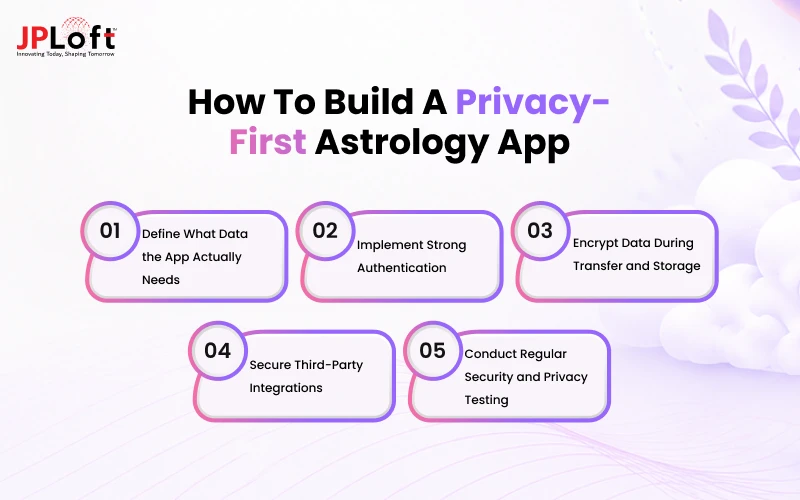
Here are the steps to build a privacy-first astrology app.
Step 1: Define What Data the App Actually Needs
Start the process by defining the information you need from users. It includes birth dates, times, location, profiles, and payment details for basic horoscopes. Once you understand the details, it becomes easier to support specific app functions.
For instance, a consultation feature needs profile details, chat history, and user preferences on what they need a consultation for. This helps to reduce unnecessary data collection and reduce privacy risks.
Step 2: Implement Strong Authentication
The next step is to implement strong authentication. An astrology account may contain a lot of users’ information, including private consultations, payment history, and relationship questions.
Adding smart layers of security helps protect sensitive account actions. Use an OTP-based login system or two-factor authentication. Further, using social logins and biometric authentication, such as fingerprint or Face ID, reduces fake profile creation.
Step 3: Encrypt Data During Transfer and Storage
Strong encryption and verified passwords allow app owners to prevent explosion of sensitive user data. Whenever any user uses the platform for a personalized horoscope report or relationship consultations, they leave behind private chats, birth information, and readings.
This data can be exploited or shared with any unprotected third party if the platform uses weak login protection. Therefore, using strong passwords and verification protects user trust. Protecting accounts from account recovery is necessary, as fraudsters can take information from recovery links.
Step 4: Secure Third-Party Integrations
Astrology API Integration includes online payments, downloading personalised reports, analytics, and regulatory notifications. When your platform connects with third-party services, check their security and protections.
Add limitations on using the particular API or double-check anything users type into these services. It helps prevent hacking and misuse of user data and improves astrology app data protection.
Step 5: Conduct Regular Security and Privacy Testing
For an astrology platform, you can only check if something is wrong or identify privacy or security threats with rigorous astrology app testing. The privacy testing should focus on real-world astrology app scenarios and not just technical systems.
Connecting with a mobile app development company in the USA will help check for real-world security attacks and uncover privacy weaknesses.
Best Practices To Ensure Privacy in Astrology Apps
A successful platform requires more than just an astrology app tech stack. Protecting birth data and user profiles should be a key priority for astrology app businesses.
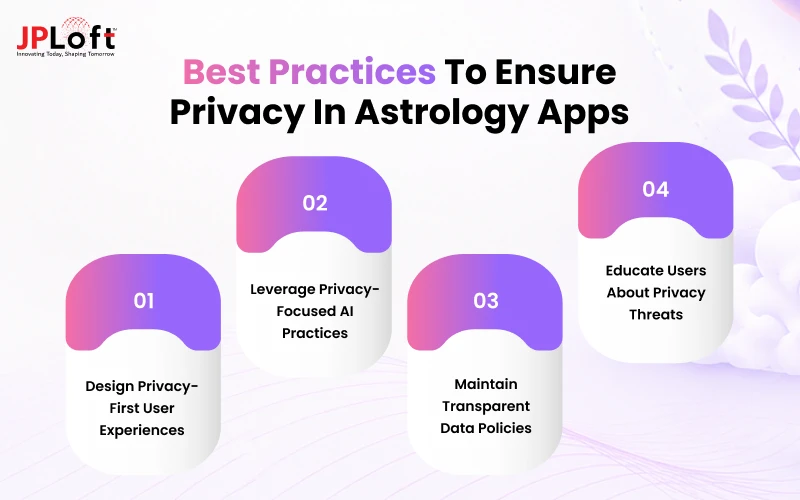
Here are the best privacy-focused practices businesses should follow to protect user profiles and birth data.
1. Design Privacy-First User Experiences
Every astrology platform idea must begin by prioritising astrology app user privacy. Build privacy into every stage of development and run rigorous testing checks throughout.
When designing the astrology app features, collect only the data required for specific app functions. Give users clear control over their permissions, personal information, and account settings.
2. Leverage Privacy-Focused AI Practices
The role of AI in astrology apps is no doubt improving user experience with more relevant guidance. At the same time, businesses combining AI capabilities with secure data practices help with data minimization and flag unusual queries or data breaches.
Blend traditional horoscopes or astrology with secure AI astrology app privacy practices to deliver a personalized experience to users.
3. Maintain Transparent Data Policies
Businesses should maintain clear and transparent data policies when building top astrology apps. Explain how the platform collects, stores, uses, and shares users’ information.
Clearly explain why user consent is needed before processing their data. Also, provide information about payment processing to help users understand how their information stays protected.
4. Educate Users About Privacy Threats
Astrology apps must educate users about protecting their accounts and personal information. Hire app developers to help integrate simple reminders on how to change passwords, add educational tips on suspicious links and account security.
These tips can improve users’ understanding of app privacy and avoid the risk of data loss or fraudulent transactions.
User Privacy Controls Every Astrology App Should Have
Astrology app user privacy controls give users greater control over their private data and account activity. It also helps businesses take appropriate measures, implement strict privacy policies, and secure sensitive data collection.
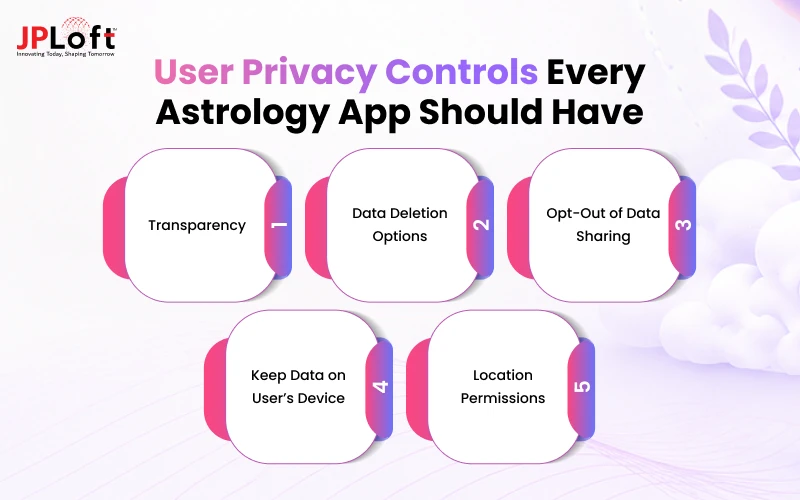
Here are the users' privacy control measures every astrology platform should consider.
1. Transparency
Building user confidence is an important part of astrology app security. Give users clear information about how their data is stored, collected, and processed. Implement transparent policies, display security seals, and explain why specific permissions, such as location or birth details, are required.
2. Data Deletion Options
Sometimes, users may want to leave the app and delete their personal data. Create a clear and simplified data deletion process. Provide easy-to-follow instructions that explain how users can request complete data deletion.
3. Opt-Out of Data Sharing
Giving users the option to stop sharing their information with third parties helps improve reliability and platform trust. Ensure users can block advertising networks and behavioral tracking from accessing their birth details, location, and other data.
4. Keep Data on User’s Device
Astrology platforms can increase user control by enabling them to store their birth details, astrology charts, and personal notes on their phones. Through this, the data that is automatically uploaded to cloud servers can instead be stored on personal devices.
5. Location Permissions
Astrology apps may request location access to provide location-based features. However, privacy controls allow individuals to manage this access. Instead of sharing live GPS tracking, they can manually enter their city or location details. This reduces continuous location access and helps maintain privacy.
How JPLoft Builds Privacy-Focused Astrology Apps
Building an astrology app is not just about creating accurate charts or personalized readings. It also needs to ensure users know their personal information is safe.
At JPLoft, a reliable astrology app development company, we focus on building privacy-focused astrology apps from the early stages of development.
Our team builds secure systems to protect birth details, user profiles, consultation chats, payment information, and location data.
Strong authentication and data encryption help keep sensitive information protected. Third-party APIs and AI astrology app privacy are also reviewed to limit unnecessary data access.
JPLoft also focuses on clear privacy controls, secure data storage, and regular security testing. This helps businesses reduce privacy risks as their apps grow.
Whether you are launching a new astrology platform or improving an existing one, JPLoft can help you build a secure, privacy-focused astrology app that users can trust.
Conclusion
Privacy in astrology apps is no longer an optional feature. Users share birth details, personal preferences, locations, and private conversations to receive personalized experiences. They expect businesses to handle this information responsibly.
A single privacy mistake can affect user trust, brand reputation, and business growth. Therefore, founders should consider privacy during every stage of app development.
From collecting only necessary data to securing chats, AI features, APIs, and user profiles, every part of the astrology platform needs careful attention. A privacy-first approach helps create a safer experience while supporting long-term business growth.
If you are planning to build an astrology app, prioritize platform privacy from the start. The right development approach can help you create an app users feel confident using and returning to.
FAQs
Astrology app privacy refers to how the platform collects, stores, and utilises users’ private information. It includes birth details, location, contact and payment information, and private astrology chat queries.
Astrology app privacy is necessary, as users share highly sensitive and personal details with the platforms. If the data is not secured properly, the risk of data being leaked to third parties increases, and the creation of unknown digital profiles can affect users’ trust.
Astrology apps include various privacy risks. These include sensitive user data collection, third-party data sharing, data leaks, controversial private chat leaks, and mass private data collection if the app changes ownership to another company.
To build a privacy-first astrology app, collect only the data required for app functionality, implement data encryption, use two-factor authentication, obtain user consent before collecting data, and conduct regular testing for privacy gaps.
The common astrology app privacy mistakes include avoiding strong security encryption, sharing data with unidentified third parties, and using unclear astrology app privacy policy terms.

Kris Jacobs brings 20+ years of experience in digital product strategy, user-focused design, and solving complex product challenges. She has worked across on-demand services, travel, entertainment, sports, insurance, education, and service marketplaces, including handyman, dog-walking, courier, event-management, and equine platforms. Her focus is on shaping practical, scalable digital experiences that align user needs with business goals and long-term product growth.


Share this blog