


Every dating app starts with one question. Do you build fast or build different?
Some founders want to go live in weeks. Others want a product nobody can copy. Both goals are valid. But they need different paths.
The dating space is crowded. Still, niche communities keep finding room. Faith-based, senior, and interest-based apps are all winning loyal users. So timing and positioning matter more than ever.
That is why white-label vs custom dating app development is the first big decision you will make. Pick right, and you save months. Pick wrong, and you burn money.
In this guide, we compare both routes on cost, speed, control, and growth. Let’s break it down in simple words.
What Is White Label Dating App Development?
Think of it as a ready-to-launch app. You do not start from zero.
White-label dating app development means a provider gives you a pre-built dating platform. You add your logo, colors, and name. Then you launch it as your own.
The core is already there. Profiles, swiping, chat, matching, and an admin panel usually come in the box.
That is why it is so popular with first-time founders who want to start an online dating business. It is quick. It is predictable. And it lets you test your idea without a huge bill.
But there is a catch. Many other brands may run on the same base. So standing out takes extra effort.

What Is Custom Dating App Development?
Custom means built from scratch. Every screen and every feature is made for you.
Your team plans the idea, designs the experience, and writes code around your goals. Nothing is borrowed. Nothing is shared.
This route gives you full control. You decide how matching works. You decide how users pay. You decide what makes your app special.
If you want to develop a dating app that nobody can copy, this is the path. It takes longer and costs more. But you own something truly unique.
White Label vs Custom Dating App Development: Quick Comparison
White label vs custom dating app development depends on your budget, business goals, feature needs, and long-term plans.
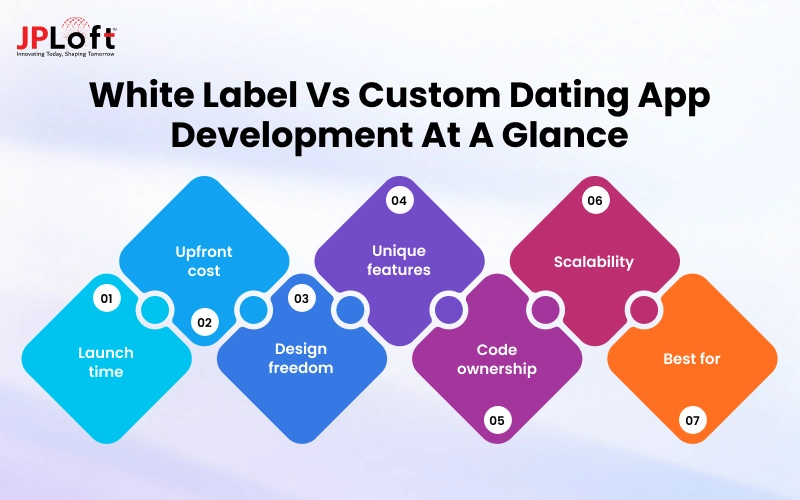
Understanding these differences helps you choose the right development approach for your dating platform:
|
Factor |
White Label Dating App |
Custom Dating App |
|
Launch time |
Roughly 2-3 months |
Roughly 3–12+ months |
|
Upfront cost |
Lower ($10,000–$50,000+) |
Higher($50,000–$200,000+) |
|
Design freedom |
Limited to branding and set features |
Complete freedom |
|
Unique features |
Hard to add |
Built around your idea |
|
Code ownership |
Often shared or licensed |
Fully yours |
|
Scalability |
Depends on the provider |
Planned for your growth |
|
Best for |
Quick validation |
Long-term brand building |
Numbers are only part of the story. So let’s look closer at the money.
Cost Breakdown: White Label vs Custom Dating App
Money decides most of these choices. Let’s see where your budget actually goes.
Founders often ask about the cost to build a dating app before anything else. The honest answer is that it depends on the route you take.
White label: You usually pay a setup or license fee. Branding and small changes cost extra. Some providers also charge monthly or yearly fees. The typical upfront range is 5K–50K.
Custom: Your budget covers planning, design, development, backend, testing, and launch. The typical range is 30K–200K+. More features mean more hours.
Both routes have running costs too. Think cloud servers, app store fees, moderation, and marketing. Plan for these from day one. A cheap launch turns costly if you ignore them.
Now let’s look at the real pros and cons behind these numbers.
Pros and Cons of White Label Dating Apps
Pros
-
Fast launch: You can go live in weeks, not months.
-
Lower cost: Shared development keeps the price down.
-
Proven base: Core features are already tested.
-
Easy market testing: You learn what users want before spending big.
Cons
-
Limited uniqueness: Your app may feel like others on the same platform.
-
Restricted changes: Big feature ideas may not fit the base.
-
Provider dependency: Updates and fixes often depend on one vendor.
-
Licensing fees: Some providers charge ongoing fees.
Pros and Cons of Custom Dating Apps
Pros
-
True differentiation: Build a niche your rivals cannot copy easily.
-
Full ownership: The code and product belong to you.
-
Flexible growth: Add AI matching, video dates, or new payment models anytime.
-
Stronger brand value: A unique product is worth more to investors.
-
Unique dating app design: Create a look and flow that matches your brand and your audience.
Cons
-
Higher budget: You need more money upfront.
-
Longer wait: Months pass before real users arrive.
-
More risk: A wrong feature choice costs real time.
-
Needs a strong team: Poor planning leads to delays.
Must-Have Features Every Dating App Needs
Whichever route you choose, some features are not optional. Users expect them from day one.
-
Profile creation and verification: Real profiles build trust.
-
Smart matching: Match users by interests, location, and behavior.
-
Chat and video calls: Easy conversations keep users active.
-
Safety tools: Block, report, and photo checks protect your community.
-
Push notifications: Remind users about matches and messages.
-
Subscriptions and in-app purchases: Give your app a way to earn.
-
Admin panel: Manage users, reports, and payments in one place.
White label usually bundles many of these. Custom lets you shape each one around your niche.
Ready-Made Dating App vs Custom App: Which One Should You Choose?
There is no single winner. The right answer depends on your stage.
If you plan to develop a dating app on a fixed budget, the ready-made dating app vs custom app choice becomes easy when you ask three things. How much money do you have? How fast must you launch? How unique must your idea be?
Choose white label if:
-
You have a tight budget.
-
You want to test the market quickly.
-
Your idea is a simple dating app with standard features.
-
You plan to learn first and upgrade later.
Choose custom if:
-
You are targeting a special niche, like senior dating or faith-based matching.
-
Your app needs a unique dating app matchmaking algorithm or special safety tools.
-
You have funding and a long-term plan.
-
Investors will ask who owns the technology.
Still unsure? There is a smart middle path.
The Smart Middle Path: Start White Label, Grow Custom
Many founders do not pick one forever. They do both in order.
First, launch a white-label app. Get real users. See which features they love. Collect feedback and early revenue.
Then, build a custom version using what you learned. Now you are not guessing. You are building with proof.
This path lowers risk. It also keeps your money safe until your idea is validated.
One tip. Before signing with any provider, ask how easily you can move your data and users later. A smooth exit saves a lot of pain.
Questions to Ask Before You Choose a Provider
Whether you pick white label or custom, the provider matters. A few smart questions can save you months.
-
Which dating app tech stack do you use? Make sure it is modern and easy to scale.
-
Who owns the code? Get this in writing.
-
How much can I customize? Ask what is included and what costs extra.
-
Can I export my data? You should be able to take your users with you.
-
How do you handle security and moderation? Dating apps hold sensitive data.
-
What support do I get after launch? Bugs and updates never stop.
Ask these before you sign anything.

Why Choose JPLoft for Dating App Development?
The right dating app development company matters as much as the right model. A good team does not just build. It guides.
JPLoft brings 16+ years of experience. The team has delivered 1250+ projects and served clients in 70+ countries. That depth helps founders see the full picture before spending a single dollar.
Whether you lean toward white label or custom, you get honest guidance. You learn what to build first and what can wait. You also get clear estimates, realistic timelines, and a plan that fits your budget.
No wasted features. No guesswork. Just a clear path from idea to launch. And if you start small, JPLoft can help you scale into a custom product when the time is right.
Final Thoughts
So, which is better? It depends on where you stand.
White label gives you speed and a lower cost. Custom gives you freedom and a product that is truly yours. Neither is wrong. Each fits a different goal.
If you want to test fast, start with white label. If you want to stand out for years, go custom. And if you want both, start small and scale smart.
Ready to launch your dating app the right way? Talk to JPLoft today and get a clear plan, timeline, and estimate for your idea.
FAQs
It depends on your goals. White label suits founders who want a fast, low-cost launch and quick market testing. Custom suits those who want a unique product, full control, and long-term growth. Many startups begin with white label and move to custom later.
A white label dating app can go live in roughly 4 to 8 weeks. A custom dating app usually takes 4 to 12 months. The exact time depends on features, design work, testing, and how quickly your team approves each stage.
Yes, but plan for it early. Ask your provider about data export, user migration, and code access before you sign. A smooth handover lets you keep your users and features while you build a custom version. Without this, moving later can be slow and costly.
Yes, to a limit. Most providers let you change branding, colors, and some modules. Big changes like a new matching algorithm or special safety tools are harder. Ask the provider what can be customized and what costs extra before you sign.
It depends on the agreement. With white label, the provider often keeps the core code and you get a license. With custom development, the code usually belongs to you. Always confirm ownership of code and user data in the contract.

Savannah Bustos is a technology professional with experience across financial platforms, mobility solutions, and on-demand digital products. Her areas of expertise include FinTech, digital banking, eWallets, lending, BNPL, stock trading, fuel delivery, and taxi-booking platforms. She combines a strong understanding of business requirements with practical technology insight, helping companies evaluate challenges, define product needs, and make informed decisions about scalable digital solutions.


Share this blog