


Key Takeaways:
Choosing an AI agent development company requires evaluating technical expertise, industry experience, security, integration capabilities, pricing, communication, and ongoing support.
The right development partner improves automation, reliability, security, scalability, integration, and ROI while supporting long-term adoption of AI agents.
Avoid vendors based solely on price, promises, or portfolios; verify experience, scope, security, ownership, scalability, and post-launch support before signing.
JPLoft is an AI agent development service provider that analyzes requirements, designs AI architectures, develops, integrates, tests, and provides ongoing support aligned with business goals.
Businesses are moving beyond basic automation to AI agents that can make decisions, manage workflows, and complete tasks with minimal human intervention. However, building these solutions requires the right technical expertise and a clear understanding of business goals.
An AI agent development company helps businesses design, build, integrate, and deploy intelligent AI agents that automate tasks, analyze information, and support decision-making. They combine artificial intelligence, machine learning, and large language models to develop solutions for specific business needs.
Choosing the right development partner can determine how effectively these agents perform and integrate with existing systems. With so many providers offering different capabilities, businesses should compare technical expertise, industry experience, security practices, and ongoing support before making a decision.
In this blog, we will explain how to choose an AI agent development company, evaluate potential partners, and make a confident decision that supports your business objectives.
How Do You Choose the Best AI Agent Development Company?
Choosing the right AI agent development company requires a clear understanding of your business goals, technical requirements, and long-term plans. The right partner can help you automate workflows, improve decision-making, reduce manual work, and build AI solutions that support business growth.
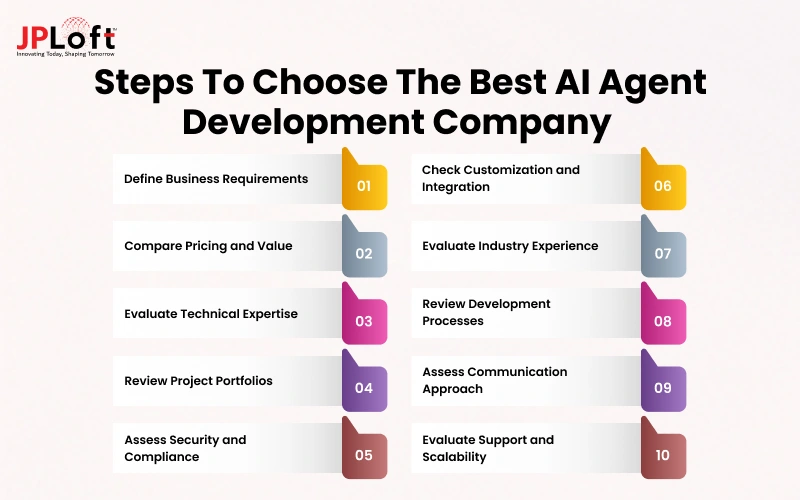
Here are the ten important factors to evaluate before selecting a custom AI agent development partner:
1. Define Your Business Requirements
Start by identifying the business challenges you want to solve. Determine which tasks need automation, such as customer support, lead qualification, data processing, or workflow management.
Set measurable goals, including reduced operational costs, faster response times, or improved employee productivity. Also, decide whether you need a single AI agent or a multi-agent system that handles connected tasks.
Clear requirements help potential enterprise AI agent development partners recommend suitable solutions, estimate development costs, and establish realistic project timelines.
2. Compare Pricing and Overall Value
AI agent development costs depend on project complexity, integrations, model selection, security requirements, and ongoing maintenance.
Avoid choosing a company based only on the lowest quote. Compare technical quality, deliverables, scalability, and long-term operating costs to determine which partner offers the best value.
Ask vendors for a 12-month total cost of ownership (build, model tokens/API usage, cloud/vector storage, orchestration/observability, evaluations, human review, and support), with usage assumptions. Comparing only project quotes can hide substantial ongoing agent costs.
3. Evaluate Technical Expertise
Developing reliable AI agent solutions requires expertise in large language models (LLMs), machine learning, APIs, and agent orchestration frameworks. Evaluate whether the company has experience with technologies that match your project requirements.
Look for expertise in GPT, Claude, LangChain, LangGraph, and Retrieval-Augmented Generation (RAG). The team should also understand tool calling, memory management, and integration with external systems.
Ask vendors to demonstrate how they evaluate agent accuracy, tool-call success, task completion, latency, and failure recovery using representative business workflows. Request documented test results and a pilot using your own requirements, rather than relying solely on a product demo.
4. Review Their Development Portfolio
Previous projects of the AI agent development partner can demonstrate its ability to turn AI concepts into practical business solutions. Review its portfolio for relevant experience in workflow automation, intelligent assistants, AI analytics, or autonomous task execution.
Ask for examples of completed projects, the challenges they addressed, and the results they achieved. Look for measurable outcomes rather than broad claims about AI capabilities.
If the AI agent consulting company has limited experience in your industry, assess whether its technical knowledge and problem-solving approach can meet your specific requirements.
5. Prioritize Security and Compliance
AI agents may access confidential business information, customer records, and internal systems. Your development partner must build security controls into the solution from the beginning.
Check its approach to encryption, access permissions, audit logs, data retention, and vulnerability testing. Depending on your industry, consider relevant requirements such as GDPR, HIPAA, or applicable financial regulations.
Ask how the company prevents prompt injection, restricts tool access through least-privilege permissions, manages secrets, and requires human approval for sensitive or irreversible actions. It should also test these safeguards and document how incidents are detected and handled.
6. Assess Customization and Integration Capabilities
Your AI agent solution should integrate with your existing software, databases, and business processes. Evaluate the company's ability to integrate AI solutions with CRM, ERP, HRM, and customer support platforms.
Ask whether it can customize workflows, connect multiple data sources, and support human approval for sensitive actions. These capabilities help AI agents operate within your existing technology environment.
A company that offers flexible architecture can also adapt the solution as your business expands or introduces new requirements.
7. Check Industry Experience
Your AI agent developers should understand your industry's workflows, customer expectations, and regulatory requirements. This knowledge helps the team design AI agents that fit your business operations.
For example, healthcare companies may need strict patient data protection, while financial services businesses may require audit trails and risk controls. Retail businesses may focus on inventory management and personalized customer experiences.
Choose a company that can connect your business objectives with relevant AI use cases instead of recommending technology without a clear purpose.
8. Understand the Development Process
A structured development process helps you track progress and identify potential issues early. Ask the custom AI agent development company to explain its approach to planning, design, development, testing, and deployment.
The process should include requirements analysis, architecture planning, prototype development, system integration, and performance evaluation. Before launch, the team should test accuracy, reliability, security, and edge cases.
Look for clear milestones, regular progress updates, and realistic delivery timelines. Start with a proof of concept or limited pilot built around one defined workflow. Agree on test cases, success criteria, escalation rules, response times, and budget limits before testing. A proof of concept can establish feasibility, but further testing is needed before production deployment.
9. Evaluate Communication and Project Management
Effective communication keeps your AI project aligned with business expectations. Assess how the company manages feedback, technical discussions, scope changes, and progress reporting.
Look for a dedicated project manager, documented milestones, regular meetings, and clear communication channels. The team should explain technical decisions in language your stakeholders can understand.
A collaborative development partner can address changing requirements while keeping the project focused on its objectives.
10. Check Post-Launch Support and Scalability
AI agents require ongoing monitoring to maintain performance as business data, models, and workflows change. Confirm that the AI agent consulting company provides bug fixes, security updates, performance monitoring, and technical support.
Discuss service-level agreements, incident response times, source code ownership, and documentation before signing a contract.
Also, check whether the solution can support higher workloads, additional integrations, and new business use cases. A scalable system with reliable maintenance can protect your investment and support future growth.
Also Read: How to build an AI Agent
Use Cases of AI Agents for Businesses
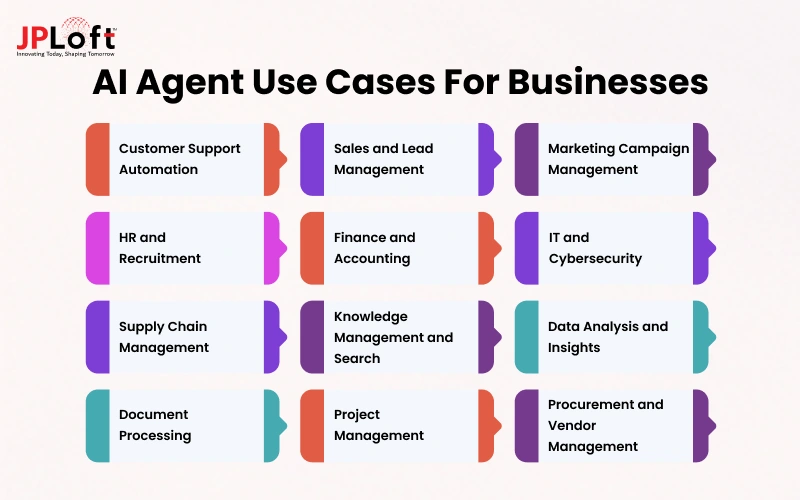
AI agents help businesses automate repetitive tasks, manage complex workflows, and make faster decisions using business data. The following use cases can help you identify the experience and capabilities to look for in an AI agent development partner. When reviewing vendors, ask for examples of relevant workflows, integrations, and safeguards:
1. Customer Support Automation
AI agents answer customer questions, track orders, and resolve common issues using approved information. They can escalate complex requests to human representatives, improving response times and customer satisfaction.
2. Sales and Lead Qualification
AI agents evaluate incoming leads, update CRM records, prioritize prospects, and schedule follow-ups. This helps sales teams reduce manual work and focus on promising opportunities.
3. Marketing Campaign Management
Marketing agents analyze campaign performance, segment audiences, and recommend improvements. They can also support content planning and reporting, helping teams spot opportunities and reduce manual analysis.
4. Human Resources and Recruitment
AI agents organize applications, schedule interviews, answer employee questions, and coordinate onboarding tasks. Human oversight remains essential for fair hiring decisions.
5. Finance and Accounting
AI agents process invoices, categorize expenses, reconcile records, and flag unusual transactions. These capabilities help finance teams reduce manual errors and improve reporting.
6. IT Operations and Cybersecurity
AI agents in cybersecurity can monitor system alerts, investigate suspicious activity, troubleshoot technical issues, and recommend corrective actions. Restricting agent permissions and requiring approval for high-impact actions helps protect critical systems.
7. Supply Chain Management
AI agents monitor inventory, track shipments, analyze supplier updates, and identify potential stock shortages. They help businesses improve procurement planning and supply chain visibility.
8. Knowledge Management and Enterprise Search
AI agents help employees find information across internal documents, knowledge bases, and connected business systems. They can answer questions using approved sources, summarize relevant policies, and direct employees to the information they need, reducing time spent searching.
9. Data Analysis and Business Intelligence
AI agents can analyze business data, identify anomalies, and generate reports. They help decision-makers access relevant insights without manually reviewing multiple systems.
10. Document Processing
AI agents extract information from invoices, contracts, and reports. Enterprise AI agents can summarize documents, identify missing details, and route records to relevant teams.
11. Project Management
AI agents track deadlines, summarize meetings, monitor tasks, and flag project delays. They help teams coordinate activities and maintain project visibility.
12. Procurement and Vendor Management
AI agents can organize purchase requests, compare supplier information, follow up on orders, and track procurement approvals. They help teams reduce routine administrative work and coordinate with vendors, while keeping people responsible for purchasing decisions.
Also read: Best AI Agent Features in 2026
Why Choosing the Right AI Agent Development Company Matters?
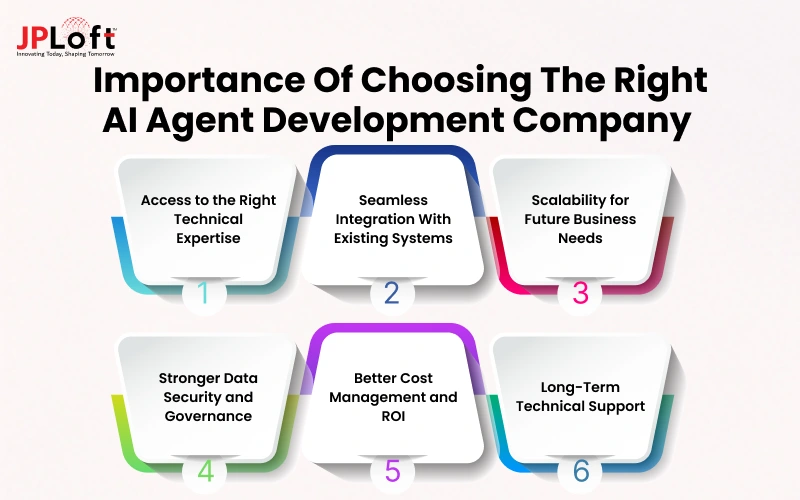
The best AI agent development company helps identify suitable use cases, choose the right technologies, and build solutions that work with existing systems. An incompatible development partner can lead to poor agent performance, integration issues, security risks, and higher maintenance costs.
Here are the key reasons why selecting the right development partner matters:
1. Access to the Right Technical Expertise
AI agent development requires expertise in LLMs, machine learning, APIs, and agent orchestration frameworks. Experienced AI agent developers select suitable technologies and build solutions that handle complex workflows, support business requirements, and deliver reliable performance.
2. Seamless Integration With Existing Systems
AI agents need access to business applications, databases, and internal tools to perform tasks. An experienced company integrates agents with CRM, ERP, HRM, and other platforms, helping businesses automate workflows without replacing their existing technology infrastructure.
3. Scalability for Future Business Needs
Business requirements change as companies expand their operations. The right partner builds flexible architectures that support additional workflows, integrations, and growing data volumes. It also allows businesses to expand their automation capabilities without rebuilding existing systems.
4. Stronger Data Security and Governance
AI agents may access sensitive business information and perform actions across connected applications. A reliable development partner implements encryption, access controls, audit logs, approval workflows, and human oversight to reduce the risk of data leaks and unauthorized activities.
5. Better Cost Management and ROI
AI agent development involves expenses beyond initial development, including cloud infrastructure and maintenance. The best AI agent development company selects cost-effective technologies, prioritizes valuable use cases, and tracks measurable outcomes to improve operational efficiency and long-term ROI.
6. Long-Term Technical Support
AI agents require continuous monitoring and improvements after deployment. The right development partner provides maintenance, troubleshooting, security updates, and performance optimization to address changing business requirements and ensure agents continue delivering consistent results.
Also Read: Best AI Agent Frameworks
Common Mistakes to Avoid When Hiring an AI Agent Development Company
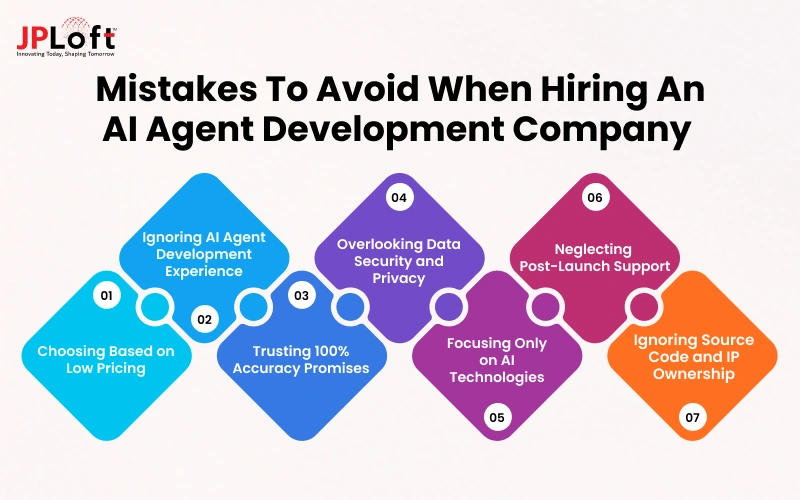
Choosing a partner without checking its experience, development process, security practices, or integration capabilities can lead to poor results. Common AI agent development challenges also include additional expenses and delays in implementation.
Here are some common mistakes businesses should avoid when choosing an AI agent development partner:
1. Choosing a Company Based Only on Low Pricing
Low-cost proposals may overlook important requirements such as integrations, security testing, performance monitoring, and post-launch maintenance. A poorly developed AI agent can create additional expenses through frequent fixes and system upgrades.
Avoid this mistake: Compare pricing based on project scope, technical expertise, deliverables, and long-term support rather than choosing the lowest quote.
2. Ignoring Previous AI Agent Development Experience
Some companies showcase general software development projects but have limited experience building AI agents. Traditional application development experience does not automatically translate into expertise in autonomous workflows, tool calling, or multi-agent orchestration.
Avoid this mistake: Review relevant case studies, production deployments, client feedback, and examples of AI agents the custom AI agent development company has developed.
3. Trusting Promises of 100% Accuracy
AI agents can misunderstand instructions, generate incorrect responses, or take unintended actions. Companies promising perfect accuracy without explaining their testing methods may not understand the limitations of AI systems.
Avoid this mistake: Ask how the company evaluates agent performance, handles failures, manages hallucinations, and introduces human approval for sensitive actions.
4. Overlooking Data Security and Privacy
AI agents often interact with business databases, customer information, internal documents, and third-party applications. Ignoring security requirements during vendor selection can expose sensitive information to unauthorized access.
Avoid this mistake: Evaluate the company's encryption practices, access controls, data handling policies, audit logs, and compliance capabilities before signing an agreement.
5. Focusing Only on AI Models and Technologies
Choosing an AI agent development services provider because it works with popular AI models or frameworks is not enough. Technology selection should depend on your business requirements, data environment, performance expectations, and budget.
Avoid this mistake: Evaluate the company's ability to design complete AI agent architectures, manage workflows, implement security controls, and support future upgrades.
6. Neglecting Post-Launch Support
AI agents need regular monitoring, performance evaluations, security updates, and improvements to handle changing business requirements. Companies that do not offer ongoing support can leave businesses responsible for resolving technical issues themselves.
Avoid this mistake: Confirm maintenance services, support availability, response times, performance monitoring, and service-level agreements before finalizing the partnership.
7. Overlooking Source Code and Intellectual Property Ownership
Some businesses fail to discuss ownership rights before signing a development agreement. This can create problems when they want to modify their AI agents, change vendors, or move to another technology platform.
Avoid this mistake: Clearly define ownership of source code, custom workflows, prompts, documentation, and other project assets in the contract. Also clarify third-party licensing restrictions and access to deployment environments.
Also read: AI Agent Vs Agentic AI
Why JPLoft Is the Right AI Agent Development Partner for You?
AI agents deliver value when they solve a defined business problem and work reliably within existing processes. As a trusted partner, JPLoft begins by understanding your workflows, connected systems, data requirements, and the outcomes you want to achieve.
Our team translates those requirements into an AI agent architecture suited to your use case. Whether you need a customer support agent, an internal workflow assistant, or a multi-agent system, we focus on how agents will access information, interact with business tools, and hand over tasks when human input is needed.
JPLoft's AI agent development services cover solution design, development, system integration, testing, and deployment. We consider agent permissions, approval steps for sensitive actions, and testing against realistic workflows so the solution is designed for practical use rather than just a demonstration.
Post-launch monitoring and improvements are part of planning for long-term adoption. As requirements change, agents may need updated integrations, performance evaluations, and additional safeguards to remain useful and manageable.
Discuss your AI agent idea with JPLoft to identify the right starting workflow, key integrations, technical priorities, and next steps for development.
Conclusion
Choosing the right development partner requires careful evaluation of technical expertise, industry experience, security practices, integration capabilities, and long-term support. The right service provider does more than just build an AI solution.
They understand your business challenges and create intelligent systems that support your operational goals. Before deciding, review the company’s portfolio, compare pricing, discuss project requirements, and evaluate its development approach.
Ensure that the team can build scalable AI agents that adapt to changing needs while maintaining accuracy, security, and control. Avoid rushing into a partnership based on an attractive price. Instead, focus on the ability of the best AI agent development company to deliver measurable business value.
With the right development partner, you can automate complex workflows, improve productivity, reduce operational costs, and build a strong foundation for future adoption.
FAQs
Choose a company with proven AI expertise, relevant industry experience, and strong security practices. Also evaluate integration capabilities, transparent pricing, and reliable post-launch support.
Ask for relevant production examples, integration experience, agent evaluation methods, security controls, source code ownership terms, and post-launch support commitments. Request a pilot with clear success criteria before committing to a full deployment.
Compare both proposals against the same requirements, including workflow scope, measurable performance targets, security safeguards, integrations, ownership terms, ongoing model and infrastructure costs, and support commitments. A proposal with a lower initial quote may result in higher long-term operating costs.
Avoid choosing vendors based only on pricing or promises. Verify technical experience, project scope, security practices, ownership agreements, scalability, and post-launch maintenance.

Rahul Sukhwal is the CEO and Founder of JPLoft, with 18+ years of experience in software engineering, emerging technologies, and digital product development. His expertise spans artificial intelligence, including AI agents, generative AI, LLMs, chatbots, computer vision, and machine learning, as well as blockchain, IoT, AR/VR, mobile, web, and enterprise software. He focuses on applying these technologies to real business challenges across industries such as healthcare, education, mobility, finance, real estate, and on-demand services.



Share this blog