


Did you know that only 31% of software projects are delivered on time, on budget, and with the full intended features?
According to Standish Group’s CHAOS Report, nearly 1 in 5 projects fail completely, while the average project overruns its budget by 66%.
In a world where the global software market is racing toward the trillion-dollar mark, these numbers reveal a hard truth: building great software is still one of the hardest things companies do.
Software product development isn’t just about writing code. It’s the art and science of turning ideas into products people love, and businesses depend on.
So, if you are an aspiring entrepreneur looking forward to software product development, every decision shapes success or failure.
This guide breaks down the real process, proven practices, and hard-won lessons so you can beat the odds and build products that actually win.
Key Takeaways:
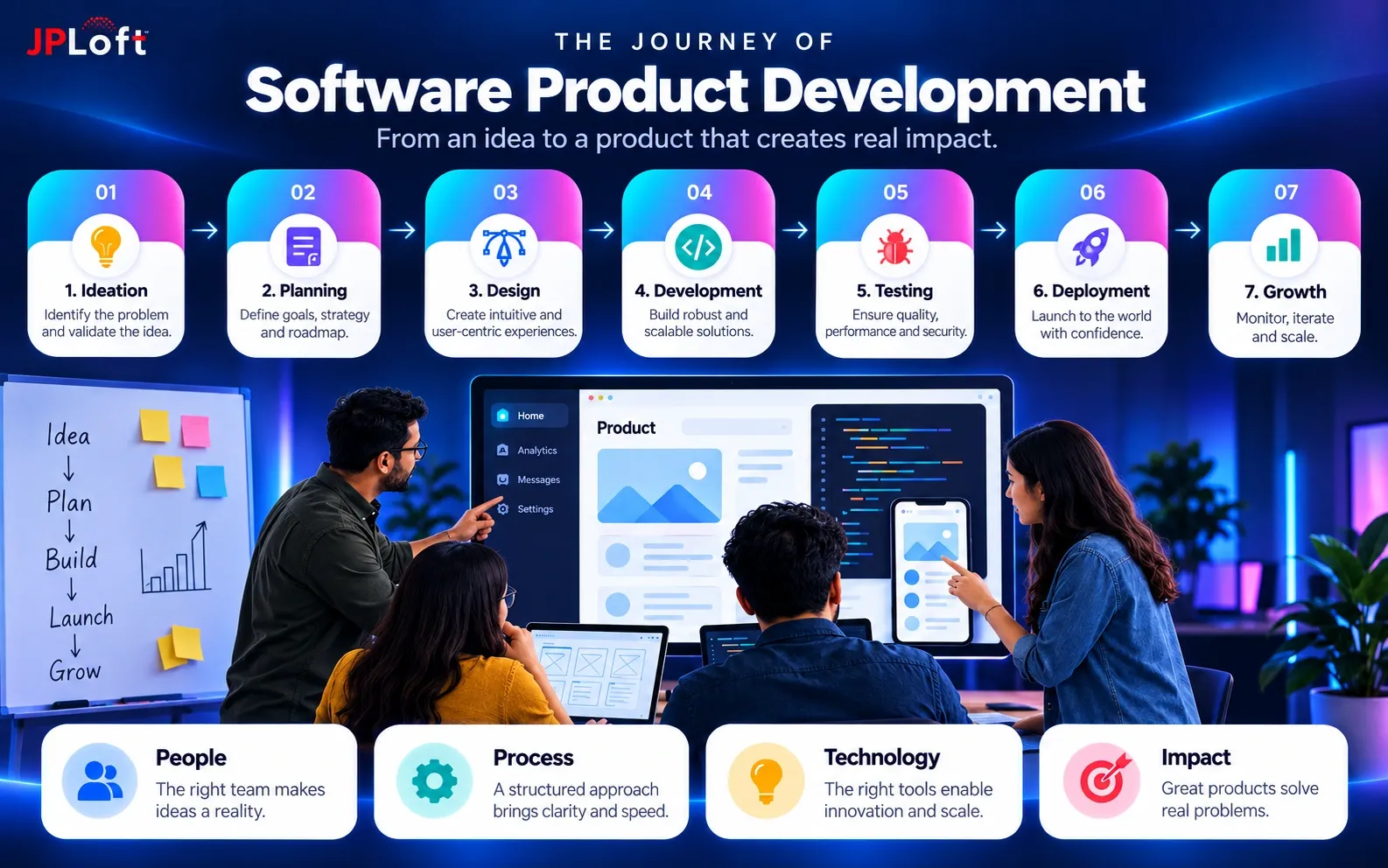
Here’s a visual overview of the software product development journey, from ideation to growth:
What Is Software Product Development?
Software product development is the complete process of creating a digital product that solves a real problem for many users and can grow over time.
It includes research, design, building, testing, launching, and continuously improving the product based on feedback.
The key differences lie in the goal.
A software product is built for a broad market; think of Slack, Notion, or Spotify. These products are designed to serve thousands or millions of users, with features that can scale, evolve, and generate recurring revenue.
In contrast, custom software is tailored for one specific client or company. It solves a unique internal need and is rarely sold to others.
Software Product Development vs Software Development
Software product development focuses on building a product for a specific market, user group, or business need. It covers planning, design, development, testing, launch, and ongoing updates.
Developing a software can refer to a broader process of creating software for a specific client, workflow, or internal use.
The main difference lies in the target users, business goals, product strategy, and development approach.
|
Factor |
Software Product Development |
Software Development |
|
Main Goal |
Build a market-ready software product |
Build software for a specific requirement |
|
Target Users |
A defined customer or user segment |
A business, client, or internal team |
|
Focus |
Product growth and user needs |
Business needs and project requirements |
|
Development |
Often continuous with regular updates |
Usually based on defined project scope |
|
Examples |
SaaS platforms, mobile apps, marketplaces |
Business tools, internal systems, custom applications |
Why Is Software Product Development Important?
Key Benefits of Software Product Development for Businesses
In today's competitive digital landscape, businesses can't afford to build blindly.
The right new product development software turns raw ideas into scalable, market-ready products, reducing guesswork, cutting costs, and giving teams the structure to innovate faster while staying aligned with real user needs.
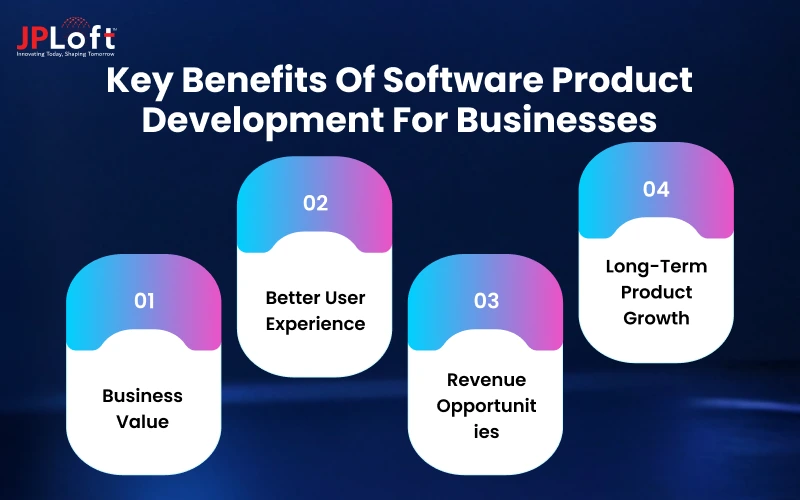
Here are some reasons showing the importance of software product development:
1. Business Value
Software product development transforms abstract ideas into tangible business assets.
It helps companies validate concepts early, avoid costly missteps, and build solutions that directly support strategic goals, turning development from a cost center into a genuine driver of competitive advantage and measurable ROI.
2. Better User Experience
A well-engineered product puts users first. Thoughtful design, intuitive workflows, and reliable performance keep people engaged rather than frustrated.
When development prioritizes usability from day one, the result is a product people actually enjoy using and come back to.
3. Revenue Opportunities
Every feature, integration, and update is a chance to unlock new income streams.
Smart product development opens doors to subscriptions, premium tiers, and cross-sell opportunities, turning a functional product into a growth engine that compounds value over time.
4. Long-Term Product Growth
Products built on solid foundations scale gracefully.
A strong development process anticipates future needs, making it easier to add features, handle growing user bases, and adapt to market shifts — ensuring the product evolves instead of becoming obsolete.

What to Consider Before Software Product Development?
Before starting software product development, businesses should define the product’s purpose, users, and technical needs.
Clear planning can reduce development issues and keep the product aligned with market demand.
-
Target Audience: Identify who will use the product and understand their needs, habits, and pain points.
-
Market Research: Study competitors, market demand, pricing, and existing solutions to identify opportunities.
-
Product Requirements: Define core features, user flows, integrations, and business goals before development begins.
-
Budget: Set a realistic budget covering development, testing, launch, maintenance, and future updates.
-
Technical Feasibility: Check the required technology, integrations, infrastructure, security needs, and development resources.
Software Product Development Process: A Step-by-Step Guide
Stages of the Software Product Development Process
So, you are wondering, ‘How to get started with the software product design & development process?’
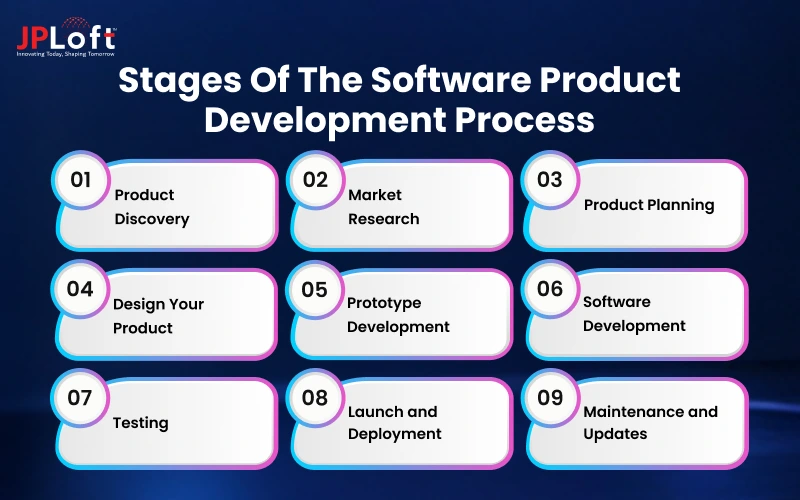
Here is a step-by-step breakdown to help you understand better:
Step 1. Product Discovery
Every great product starts with clarity, not code. In this stage, we dig into your business goals, target audience, and the core problem you're solving.
Through stakeholder workshops and competitive analysis, we define what success actually looks like before committing a single resource.
This phase separates products with genuine market fit from ideas that sound good on paper.
The outcome is a clear scope, defined objectives, and a roadmap that keeps everyone — from founders to developers — aligned on the same vision.
Step 2. Market Research
Understanding the market isn't optional — it's insurance against building something nobody wants.
We analyze industry trends, study competitor offerings, and identify gaps your product can uniquely fill.
User surveys, persona mapping, and demand validation help us understand real customer pain points rather than assumptions.
This market research shapes pricing strategy, feature prioritization, and positioning, ensuring your product enters the market with a genuine advantage instead of guesswork disguised as strategy.
Step 3. Product Planning
With research in hand, we translate insights into an actionable plan.
This includes defining the technical architecture, choosing the right tech stack, setting realistic timelines, and mapping out feature releases in priority order.
We break the build into manageable sprints, allocate resources efficiently, and identify potential risks early.
Good planning here prevents scope creep later, keeping the project on budget and on schedule while leaving room for iteration as real user feedback starts coming in.
Step 4. Design Your Product
UI/UX Design is where strategy becomes something people can actually touch and feel.
Our designers craft wireframes and interactive prototypes that prioritize intuitive navigation, accessibility, and visual appeal.
Every screen, button, and flow is tested against real user behavior, not just aesthetic preference.
The goal is a seamless experience that reduces friction and keeps users engaged.
Strong UI/UX design isn't decoration; it's what separates a product users tolerate from one they genuinely enjoy returning to.
Step 5. Prototype Development
Before full-scale development begins, we build a working prototype to validate core functionality and gather early feedback.
This low-risk version lets stakeholders and test users interact with the product's key features, revealing usability issues or misaligned assumptions before major resources are committed.
Prototyping saves significant time and cost down the line by catching problems early.
It also gives your team the confidence that the direction is right before development ramps up to full speed.
Step 6. Software Development
This is where the product truly comes to life.
Our engineers write clean, scalable code following agile methodology, building features in iterative sprints with regular check-ins and demos.
We maintain close collaboration between developers, designers, and product managers to ensure nothing gets lost in translation.
Version control, code reviews, and continuous integration keep quality high throughout.
The result is a robust, maintainable product built not just to launch, but to scale as your user base grows.
Step 7. Testing
A product is only as good as its reliability. Our QA team runs rigorous functional, performance, security, and compatibility testing across devices and platforms.
We hunt for bugs, edge cases, and usability gaps before your users ever encounter them. Automated and manual testing work together to catch issues early, reducing costly post-launch fixes.
This stage isn't just about finding what's broken; it's about building genuine confidence that the product performs exactly as promised.
Step 8. Launch and Deployment
Deployment day is the culmination of everything built so far, but it's carefully engineered rather than left to chance.
We handle deployment infrastructure, server configuration, and app store submissions, while monitoring performance in real time to catch any last-minute issues.
A phased rollout or soft launch often precedes the full release, letting us gather early user feedback and fix problems before scaling up traffic and exposure to the broader market.
Step 9. Maintenance and Updates
Launch isn't the finish line. It's the beginning of the product's real life, where software maintenance keeps it updated, reliable, and ready for changing user needs.
We monitor performance, fix bugs, patch security vulnerabilities, and roll out updates based on user feedback and evolving needs.
Regular maintenance keeps the product stable, secure, and relevant as technology and user expectations shift.
This ongoing partnership ensures your product doesn't just survive after launch; it continues growing, improving, and delivering value long into the future.
Software Product Development Methodologies
Popular Software Product Development Methodologies
A software product development approach helps teams plan, build, test, and improve products based on business goals and user needs.
For startups, software product development for startup teams can also help validate ideas early and adapt to changing market needs.
Let’s explore some methodologies worth exploring:
1. Agile
Agile focuses on building software in small, manageable cycles.
Teams release working features regularly, gather feedback, and make changes throughout development. This approach helps adapt to changing user needs and business goals without waiting until the entire product is complete.
It also encourages close teamwork between developers, designers, testers, and stakeholders.
2. Scrum
Scrum is an Agile framework that organizes development into short sprints, usually lasting two to four weeks.
Each sprint has clear goals, tasks, and reviews.
Daily stand-ups help teams track progress and address blockers. Sprint reviews and retrospectives allow teams to gather feedback and improve the development process with each cycle.
3. Lean
Lean software development focuses on delivering value while reducing unnecessary work, delays, and resource use.
Teams prioritize essential features, identify waste, and improve processes continuously.
This approach can help businesses validate product ideas sooner and avoid spending time and money on features that may not provide meaningful value to users.
4. DevOps
DevOps brings development and operations teams together to streamline software delivery.
It uses automation, continuous integration, continuous delivery, testing, and monitoring to support frequent and reliable releases.
By connecting development with deployment and maintenance, DevOps helps teams identify issues earlier and maintain a smoother process from coding through production.
Types of Software Products You Should Know
Major Types of Software Products Businesses Can Build
Software products can serve different business needs.
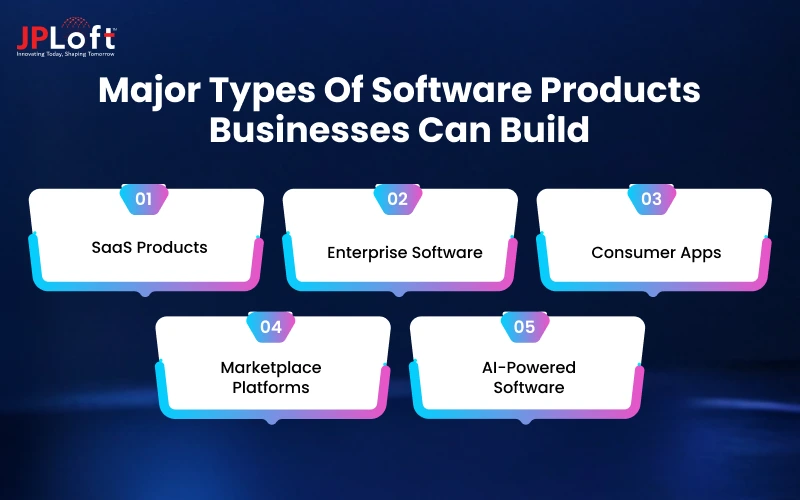
Understanding these types can help businesses choose the right product approach when developing a software product for their target users and goals:
Type 1. SaaS Products
Cloud-based software that users access through subscriptions.
SaaS products support recurring revenue models and can serve businesses or individuals without requiring local software installation.
Type 2. Enterprise Software
Solutions built for large organizations to manage complex operations, workflows, data, and internal processes.
These products often support multiple teams, departments, and user roles.
Type 3. Consumer Apps
Software designed for individual users, covering areas such as entertainment, finance, fitness, education, shopping, and communication.
Simple interfaces and smooth user experiences are often key.
Type 4. Marketplace Platforms
Digital platforms that connect buyers and sellers or service providers in one place.
It typically include profiles, search, listings, payments, reviews, and communication features. They help businesses manage transactions, build user trust, and support ongoing interactions between different user groups.
Type 5. AI-Powered Software
Products that use artificial intelligence to automate tasks, analyze data, generate content,
personalize experiences, or support decisions based on user inputs and business needs.
Technology Stack for Software Product Development
The right technology stack shapes how fast your software launches, how well it performs, and how easily it scales.
We choose tools based on your product goals, user volume, and security needs, rather than trends, so every layer works together reliably.
|
Layer |
Purpose |
Examples |
|
Frontend |
Builds fast, responsive interfaces that users enjoy across web and devices |
React, Angular, Vue.js |
|
Backend |
Powers business logic, data processing, and secure communication between systems |
Node.js, Python, Java, .NET |
|
Database |
Stores and manages data with speed, accuracy, and reliability |
PostgreSQL, MySQL, MongoDB |
|
Cloud |
Provides scalable, secure hosting with high availability and easy deployment |
AWS, Microsoft Azure, Google Cloud |
|
APIs |
Connects your software with payment gateways, third-party tools, and internal systems |
REST, GraphQL, Stripe, Twilio |
|
AI/ML (if needed) |
Adds smart automation, predictions, and personalization to your product |
TensorFlow, PyTorch, OpenAI APIs |
Every stack is finalized after discovery, so your product gets the right balance of performance, security, and long-term flexibility.
How Much Does Software Product Development Cost?
Software Product Development Cost Breakdown
Software product development cost varies widely depending on scope, complexity, and who builds it. There is no single price, but most projects fall into three tiers.
Typical Cost Ranges:
-
Basic/MVP Product: $15,000- $50,000
An MVP includes only the core features needed to test your idea with real users, such as sign-up, one main workflow, and a simple dashboard.
It usually takes 2-4 months to build and is the smartest way to keep early software product development costs under control.
-
Mid-Level Product: $50,000- $150,000
This tier adds multiple user roles, payment gateways, an admin panel, analytics, and a more polished UI/UX. Development typically takes 4-8 months.
-
Complex Product: $150,000- $500,000+
Enterprise-grade platforms with AI/ML, real-time data, advanced security, and high scalability fall here. Timelines often run 8-12 months or more.
Key Factors That Affect Software Product Development Cost:
-
Features: Every extra feature adds design, development, and testing hours. Prioritizing must-haves keeps the budget realistic.
-
Design: Custom UI/UX research, prototyping, and branding cost more than template-based design, but they improve usability and retention.
-
Technology: Your tech stack, cloud infrastructure, and whether you build for web, mobile, or both all influence the final price.
-
Team location: Hourly rates differ greatly. Teams in India or Eastern Europe typically charge much less than teams in the US or UK, often with comparable quality.
-
Integrations: Connecting payment systems, CRMs, APIs, or legacy software adds development and testing time.
-
Maintenance: Plan for 15-20% of the initial software product development cost each year for bug fixes, updates, security patches, and hosting.
Pro tip: Get detailed estimates of software development cost from different agencies and compare what each includes, not just the total price.
Team Required for Software Product Development
Software Product Development Team Requirements
A software product in software engineering is never built by developers alone. It takes a mix of specialists who plan, design, build, test, and maintain the product together.

The right team structure keeps the project on schedule, on budget, and aligned with what users actually need:
Core Teams and Their Roles:
1. Product Management Team
The product manager and business analyst define the vision, gather requirements, and prioritize features. They act as the bridge between stakeholders and the technical team, making sure the roadmap solves a real user problem.
2. UI/UX Design Team
Designers research user behavior, create wireframes and prototypes, and build the visual interface. Good design reduces friction and directly improves user retention.
3. Development Team
This is the engine of the project and usually includes:
-
Frontend developers: Build what users see and interact with.
-
Backend developers: Handle server logic, databases, and APIs.
-
Mobile developers: Create iOS and Android apps, if required.
-
Full-stack developers: Work across both frontend and backend, especially in smaller teams.
4. Quality Assurance (QA) Team
QA engineers test the product for bugs, performance issues, and security gaps. They use both manual and automated testing to make sure every release is stable before it reaches users.
5. DevOps Team
DevOps engineers manage cloud infrastructure, CI/CD pipelines, deployments, and monitoring. They make releases faster, safer, and more reliable.
6. Project Manager / Scrum Master
This role keeps the team organized by managing timelines, sprints, communication, and risks. They remove blockers so developers can focus on building.
7. Support and Maintenance Team
After launch, this team handles bug fixes, updates, user support, and performance improvements to keep the product healthy over time.
Team Size by Product Stage
-
MVP: 4-6 people (PM, designer, 2-3 developers, QA)
-
Mid-level product: 8-12 people
-
Complex product: 15+ people across multiple specialized squads
Pro tip: Whether you hire in-house, outsource, or choose a dedicated development team, make sure roles and responsibilities are clearly defined from day one.
Challenges & Best Practices for Software Product Development
Common Software Product Development Challenges and Their Solutions
Even well-planned projects run into obstacles along the way. Teams building new product development software solutions often face issues with scope, quality, speed, and communication.
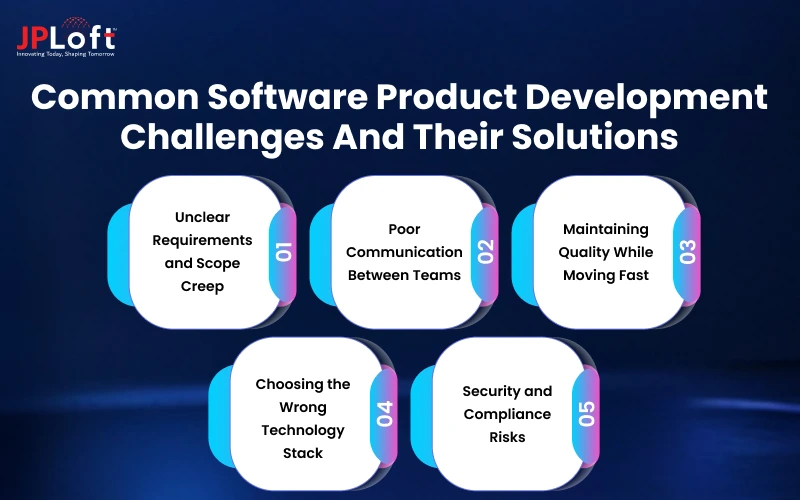
Knowing these challenges early and having a proven solution ready helps you avoid delays, budget overruns, and product failure:
1. Unclear Requirements and Scope Creep
Challenge: Vague requirements and constant change requests push the project beyond its original timeline and budget. Teams end up building features that users never asked for.
Solution: Document requirements clearly before development begins and prioritize features using the MoSCoW method. Use a formal change-request process so every new addition is reviewed for its cost and impact.
2. Poor Communication Between Teams
Challenge: When designers, developers, and stakeholders work in silos, misunderstandings lead to rework and missed deadlines. This gets worse with remote or outsourced teams across time zones.
Solution: Hold daily stand-ups, sprint reviews, and regular demos to keep everyone aligned. Tools like Jira, Slack, and Confluence keep tasks and decisions transparent.
3. Maintaining Quality While Moving Fast
Challenge: Pressure to launch quickly often leads to skipped testing and accumulating technical debt. Bugs discovered after release are far more expensive to fix.
Solution: Build automated testing and code reviews into every sprint, and use CI/CD pipelines for stable releases. Ship in small increments so issues are caught early rather than at launch.
4. Choosing the Wrong Technology Stack
Challenge: A stack that cannot scale or lacks developer support creates performance problems and costly rewrites later. Trend-driven choices often ignore long-term needs.
Solution: Select technology based on your product goals, expected user load, and team expertise. Start with a scalable, well-supported architecture, and validate it with a proof of concept if unsure.
5. Security and Compliance Risks
Challenge: Data breaches and non-compliance with regulations such as GDPR or HIPAA can cause legal trouble and damage user trust. Security is often treated as an afterthought.
Solution: Follow a security-first approach with secure coding standards, regular vulnerability testing, and data encryption. Involve compliance checks from the design stage, not just before launch.

How to Find the Right Partner for Software Product Development?
Finding and hiring a development partner is a lot like choosing a co-founder: the wrong one can quietly drain your budget, while the right one can turn a rough idea into a market-ready product.
That is why the decision deserves as much attention as the idea itself.
Look for a team with proven industry experience, transparent communication, a strong portfolio, flexible engagement models, and reliable post-launch support.
This is where JPLoft stands out. With years of experience delivering end-to-end software development services, JPLoft supports businesses from ideation and UI/UX design to development, testing, deployment, and long-term maintenance.
Its experienced team, agile approach, and client-first mindset help startups and enterprises build scalable products with confidence.
Conclusion
Building a successful software product takes more than a great idea. It needs a clear plan, the right team, a realistic budget, and a partner who understands your vision.
By understanding the development process, estimating your software product development cost, avoiding common challenges, and following proven best practices, you can reduce risk and launch faster.
Whether you are creating an MVP or a full-scale enterprise platform, the key is to start with clarity and build with the right expertise.
Choose a partner who values transparency, quality, and long-term growth, and your product will be positioned to succeed in a competitive market.
FAQs
Software product development is the process of planning, designing, building, testing, launching, and maintaining a software product that solves a specific user or business problem. It covers everything from the initial idea and market research to post-launch updates and support.
The timeline depends on complexity. An MVP usually takes 2-4 months, a mid-level product takes 4-8 months, and a complex enterprise platform can take 8-12 months or more. Clear requirements and quick decision-making help shorten the timeline.
Costs typically range from 15,000-50,000 for an MVP, 50,000-150,000 for a mid-level product, and 150,000-500,000+ for a complex solution. Features, design, technology, team location, integrations, and maintenance all influence the final budget.
The main stages are idea validation, requirement analysis, UI/UX design, development, testing, deployment, and maintenance. Following these stages in order, ideally in agile sprints, reduces risk and keeps the product aligned with user needs.
A typical team includes a product manager, business analyst, UI/UX designers, frontend and backend developers, QA engineers, a DevOps engineer, and a project manager. Post-launch, a support and maintenance team keeps the product stable and up to date.
Look for relevant industry experience, a strong portfolio, transparent communication, flexible engagement models, and dependable post-launch support. Check client reviews and case studies, and ask for a detailed estimate. A partner like JPLoft, offering end-to-end services from ideation to maintenance, can make the process smoother.

Priyanka Sukhwal is the Managing Director and Business Head of JPLoft, with 10+ years of experience in technology, digital product strategy, and business growth. She has worked closely with businesses building mobile applications, custom software, marketplaces, and on-demand platforms across mobility, automotive, consumer services, and startup ecosystems. At JPLoft, she focuses on understanding business models, identifying product opportunities, and helping companies plan digital solutions that can scale with changing market needs.




Share this blog