


Walk through The Avenues or 360 Mall on a busy weekend and notice how many shoppers check prices on their phones before they even enter a store.
Kuwait is one of the most connected markets in the world. Internet penetration is close to 99%, and most online orders start on a mobile screen.
So the real question for a retail owner is no longer whether to sell online. The question is how to do it without wasting months or burning your marketing budget.
That is exactly where the Shopify vs. custom app Kuwait debate begins.
Shopify gives you a ready-made store that can go live in a few weeks. A custom app gives you full control over every tap but asks for a bigger budget and a lot more patience.
Both paths can work well. The wrong one can quietly drain your cash before your first big sale.
In this guide, we compare features, costs, payments, and growth potential in plain language.
We also cover local details like KNET, Arabic layouts, and cash on delivery that most global guides skip.
By the end, you will know which route fits your brand today and which one to plan for tomorrow.

Shopify vs Custom Mobile App: Key Differences
Both options help you sell online, but they get you there in very different ways. Here is the simple view before we go deeper.
The Shopify vs custom app Kuwait decision usually comes down to speed versus control. Shopify is a hosted platform where products, checkout, and hosting come ready.
Custom mobile app development is created from scratch around your own workflows. In the custom mobile app vs Shopify comparison, Shopify wins on launch time while the custom app wins on uniqueness.
The table below shows how they stack up on the factors that matter most to Kuwaiti retailers.
|
Factor |
Shopify |
Custom Mobile App |
|
Time to launch |
About 2 to 6 weeks for most stores |
Usually 3 to 6 months or more |
|
Upfront cost |
Low. Plans start at roughly KWD 9 to 12 per month |
High. A full e-commerce app often runs KWD 8,000 to 36,000+ |
|
Design freedom |
Theme-based with some limits |
Complete freedom over every screen |
|
Mobile app |
Needs a separate app or a headless build |
Native iOS and Android by design |
|
KNET and local payments |
Added through a third-party gateway |
Integrated directly the way you want |
|
Arabic and RTL |
Handled through themes and apps |
Built exactly to your brand rules |
|
Maintenance |
Shopify manages hosting and security |
You or your agency manage everything |
|
Scalability |
Strong up to enterprise level with Plus |
Unlimited when the architecture is right |
|
Best for |
New brands and fast testing |
Established brands with loyalty goals |
These differences look neat on paper. Real impact depends on your market, so let us first look at what Kuwaiti shoppers actually expect.
Why Kuwaiti Retail Brands Need a Digital Storefront?
Kuwaiti shoppers already live on their phones. A digital storefront simply puts your brand where they are looking. Here are six reasons it matters.
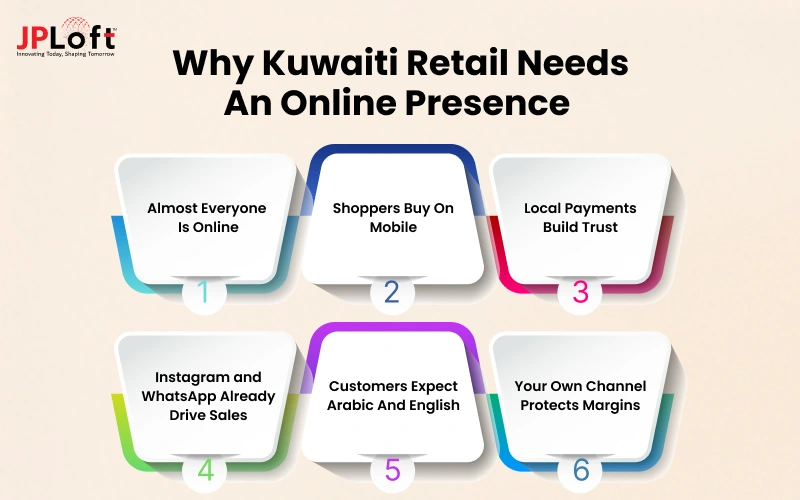
1. Almost Everyone Is Online
Kuwait has about 5.05 million internet users and penetration close to 99 percent. That means an online store can reach almost every shopper in the country.
Brands in Salmiya, Hawally, and Kuwait City already compete for the same screens. A store that lives only on the shelf quietly loses to the one that shows up in every search.
2. Shoppers Buy On Mobile
Smartphones contributed 70.89% of total consumer spending. Desktop is no longer the main door to your brand.
A slow mobile checkout can lose you the sale. This is why a mobile app for retail brand Kuwait shoppers can open every day is turning into a growth tool.
3. Local Payments Build Trust
KNET handles more than 70 percent of digital transactions in Kuwait, according to one market guide. Shoppers trust it because they use it every day.
If your checkout hides KNET or pushes only international cards, many shoppers simply leave. A digital storefront lets you offer KNET, cards, Apple Pay, and cash on delivery in one place.
4. Instagram and WhatsApp Already Drive Sales
Kuwaiti brands sell heavily through Instagram stories, influencers, and WhatsApp chats. But orders taken in DMs are hard to track and impossible to scale.
A proper storefront turns that chat traffic into trackable orders with stock updates and payments. It also helps you build a customer list you own instead of renting attention from social platforms.
5. Customers Expect Arabic And English
Kuwaiti customers switch between Arabic and English throughout the day.
A store that supports right-to-left layouts, Arabic product names, and bilingual search feels more familiar and convenient.
With English-Arabic app development, businesses can create digital storefronts that support both languages naturally.
This gives brands greater control over language, content, and layout while delivering a shopping experience that feels local to Kuwaiti customers.
6. Your Own Channel Protects Margins
Marketplaces and delivery apps take a commission on every order. Selling through your own storefront or app lets you keep more of each sale and own the customer data.
Over a year, that difference can fund new stock or ads. It also lets you run loyalty offers during Ramadan, White Friday, and National Day without asking anyone for permission.
The numbers support this shift.
The Kuwait e-commerce market is expected to reach USD 2.49 billion by 2031, growing at a CAGR of 5.02% during the forecast period.
Online demand is growing, and brands that build a strong digital presence now will own the customer relationship later.
Key Features: Shopify vs Custom Mobile App
App features decide how your store feels every single day. Let us start with what Shopify gives you and then move to what a custom app can do.
Shopify Features
-
Ready-Made Storefront: Themes, product pages, collections, and discount codes come built-in so you can focus on products instead of code.
-
Tested Checkout: Shopify’s checkout runs for millions of stores, which keeps payment pages fast and secure.
-
App Store: Thousands of apps cover reviews, loyalty points, Arabic translation, shipping labels, and email marketing.
-
Multi-Channel Selling: Sell on your website and connect Instagram, Facebook, Google, and TikTok from one dashboard.
-
Multi-Location Inventory: Core plans support up to 10 locations, which suits brands with several branches or showrooms across Kuwait.
-
POS For Physical Stores: Link in-store sales with online stock so your numbers always match.
-
Hosting and Security: Uptime, updates, and security patches are handled for you.
-
A Path To An App: If you want an app later, a headless Shopify mobile app lets your React Native or Flutter app read products and carts through the Storefront API while Shopify keeps the backend and checkout.
Custom Mobile App Features
-
Fully Branded Experience: Every screen, animation, and gesture follows your brand instead of a template.
-
Push Notifications: Flash sale alerts, restock messages, and order updates reach customers directly without ad spend.
-
Loyalty and Wallet: Points, tiers, gift cards, and store credit can live inside the app and feel native.
-
ERP and POS integration: Connect your warehouse, accounting, and branch systems exactly the way your business runs.
-
Kuwait-Style Delivery Logic: Build address fields around governorate, area, block, street, and house number, and set delivery fees by area or time slot.
-
Biometric Login: Face ID and fingerprint make login and checkout faster for repeat buyers.
-
Personalisation: Show product suggestions and home-screen banners based on each customer’s behaviour.
-
Full Data Ownership: Every tap becomes data you can use without platform limits.
Features are only half the story. The other half is how much they cost.
Shopify vs Custom App: Development Cost in Kuwait
Money usually settles this debate faster than features do. The two options charge you in completely different ways.
Shopify spreads the cost over time. You pay a monthly plan fee plus gateway charges and a few apps.
A custom app asks for most of the money upfront and then adds yearly maintenance. For easy comparison, we use a rough rate of 1 KWD = 3.25 USD in this section.
What Shopify Costs in Kuwait
|
Plan |
Billed monthly |
Billed yearly |
Approx. in KWD (monthly / yearly) |
|
Basic |
USD 39 |
USD 29 per month |
KWD 12 / KWD 9 |
|
Grow |
USD 105 |
USD 79 per month |
KWD 32 / KWD 24 |
|
Advanced |
USD 399 |
USD 299 per month |
KWD 123 / KWD 92 |
|
Plus |
From USD 2,300 |
Custom contract |
From KWD 708 |
On top of the plan fee, Shopify adds a charge when you use an outside gateway for KNET such as MyFatoorah, Tap Payments, UPayments, or Checkout.com.
It is about 2% on Basic and 1% on Grow, and drops to roughly 0.6% on Advanced. Your gateway also charges its own fees, which depend on your contract.
Setup is the other piece.
Agency rates in Kuwait vary widely from about KWD 10 to KWD 50 per hour (USD 33 to 163), so the cost of building your store depends heavily on who you hire and how much design work you need.
What A Custom App Costs in Kuwait
Local agency guides place a full e-commerce app between KWD 8,000 and KWD 50,000+.
When you compare e-commerce app development Kuwait quotes, always check what is included.
Design, backend, admin panel, payment integration, testing, and app store submission are often billed separately.
|
App level |
What you usually get |
Cost in KWD |
Cost in USD (approx.) |
|
Lean MVP |
Catalogue, cart, KNET checkout, push alerts |
5,000 to 10,000 |
16,000 to 32,500 |
|
Standard retail app |
Accounts, loyalty, order tracking, admin panel |
8,000 to 25,000 |
26,000 to 81,000 |
|
Advanced app |
ERP sync, personalisation, multi-branch logic |
25,000 to 50,000+ |
81,000 to 162,500+ |
App maintenance is the cost people forget. Agency estimates put it near 20% of the build price every year. On a KWD 15,000 app, that means around KWD 3,000 (USD 9,750) per year for updates, bug fixes, and server costs.
There is also a middle route. One agency estimates USD 40,000 to 80,000 (about KWD 12,300 to 24,600) for a React Native app built on Shopify’s Storefront API.
That is not affordable, but you keep Shopify’s backend and checkout instead of building them again.
Is Shopify Worth It for a Kuwaiti Retail Brand? Pros and Cons
Shopify is popular for good reasons, but it may not suit every brand's needs.
While Shopify app development offers flexibility and useful features, it's important to understand its advantages and limitations before choosing it for your business.
Pros of Shopify
-
Fast Launch: Many stores go live in a few weeks, which helps you catch seasonal moments like Ramadan and White Friday.
-
Low Starting Cost: Plans begin around KWD 9 to 12 a month, so you can test demand before a big investment.
-
Reliable And Secure: Shopify handles hosting, uptime, and checkout security, removing a major technical burden.
-
Easy Daily Management: Your team can add products, run discounts, and track orders without a developer.
-
Huge App Ecosystem: For Shopify Kuwait stores that need Arabic translation, loyalty points, or shipping labels, there is usually an app ready.
-
Room to Grow: You can move up to Advanced or Plus and later add a mobile app on top of the same backend.
Cons of Shopify
-
Knet Is Not Built In: Shopify KNET integration depends on a third-party gateway such as Tap, UPayments, or MyFatoorah, so you need a merchant account with one of them before you can accept local cards.
-
Extra Fees Stack Up: Shopify adds a transaction fee when you use an outside gateway, and your gateway charges its own fees too.
-
Design Limits: Themes are flexible, but truly unique features often need a developer or a paid app.
-
App Subscriptions Add Up: Five or six useful apps can easily double your monthly bill.
-
No App By Default: Customers shop in their browser unless you build or buy a separate mobile app.
-
Arabic Polish Varies: Some themes handle right-to-left layouts better than others, so test before you commit.
Is a Custom Mobile App Worth It for a Kuwaiti Retail Brand? Pros and Cons
The custom ecommerce app vs Shopify debate gets louder once a brand reaches a certain size. Repeat customers and many branches make an app far more attractive.
Retail software development in Kuwait can help your shoppers to lift loyalty and repeat orders, but only when the business is ready to support it.
Pros of A Custom Mobile App
-
Complete Control: Every screen, animation, and workflow follows your brand and not a template.
-
Home-Screen Presence: Your icon sits next to WhatsApp and Instagram, which keeps your brand in front of customers all day.
-
Push Notifications: Sale alerts and order updates reach people directly without paying for ads each time.
-
Deep Integrations: Connect your ERP, warehouse, and POS exactly as your operations work.
-
Own Your Data: Behaviour insights stay with you and shape smarter offers.
-
Stronger Conversion: One agency report on Shopify Plus merchants found app conversion of 2.5% to 5.5% against 1.5% to 3.5% on mobile web. Treat it as a guide and not a promise.
Cons of A Custom Mobile App
-
High Upfront Cost: Most full e-commerce apps start around KWD 8,000 before you spend anything on marketing.
-
Slow Start: A proper build takes three to six months, which can cost you a key sales season.
-
Ongoing Upkeep: Plan for roughly 20% of the build cost every year, plus updates for new iOS and Android versions.
-
Download Barrier: Customers must install your app first, so you need offers and ads to earn those downloads.
-
Two Platforms To Manage: iOS and Android have different review rules, and a cross-platform build only reduces the pain.
-
Risk Of Overbuilding: It is easy to pay for features that customers never use.
Payment Gateways and Local Integrations in Kuwait
Payments can make or break a store in Kuwait. Shoppers here have clear habits, and they notice quickly when a checkout ignores them.
As covered earlier, KNET is the non-negotiable base. Shopify’s own payment tools do not cover it, so most merchants pick a local or regional gateway. Here are the names worth comparing.
-
MyFatoorah: Headquartered in Kuwait City and widely used for KNET, cards, and multi-currency checkout across the Gulf.
-
Tap Payments: Supports KNET, Apple Pay, Google Pay, and cards, and is regulated in Kuwait by the Central Bank.
-
UPayments: A Kuwait-based gateway known for KNET, cash on delivery, and installment options.
-
Hesabe and SkipCash: Other local gateways that are worth a quote when you compare fees and settlement times.
-
Buy Now Pay Later: Tabby supports Kuwait and settles in KWD. Tamara, Deema and Taly are also popular options for split payments.
-
Cash On Delivery: It still matters for first-time buyers who want to see the product before paying.
-
WAMD: Kuwait launched this real-time payment system in June 2024. It is worth watching even if it is not a must-have today.
How It Works On Shopify
You open a merchant account with your chosen gateway and then connect it to your Shopify checkout.
A good Shopify KNET integration also needs webhook reconciliation, so order status always matches the real payment result.
Skipping that step leads to paid orders stuck as pending and unhappy customer chats.
How It Works In A Custom App
Your developers connect the gateway directly through its API or hosted payment page. This gives you more control over the flow but also more testing work.
KNET redirects, Apple Pay merchant setup, and failed payment handling all need careful testing before launch.
Which Option Is Better for Kuwaiti Retail Brands?
There is no universal winner here. The better choice depends on your size, budget, and how often your customers come back. Use this quick guide to see where you fit.
|
Your situation |
Better fit |
|
New brand testing demand |
Shopify |
|
Budget under KWD 5,000 |
Shopify |
|
Need to launch before Ramadan or White Friday |
Shopify |
|
Many branches and an ERP to connect |
Custom app |
|
Strong repeat customers and a loyalty plan |
Custom app or headless build |
|
Budget above KWD 15,000 and a clear feature list |
Custom app |
Choose Shopify If:
-
New brands need a simple way to launch an online store.
-
Instagram sellers want to move to a dedicated e-commerce platform.
-
Small teams prefer managing stores without handling servers or developers.
-
Businesses want to test customer demand before making a larger investment.
Choose a Custom App If:
-
Established brands have loyal customers and multiple branches.
-
Unique features can help increase repeat purchases.
-
Businesses need greater control over app functionality and customer experience.
-
Long-term budgets support ongoing maintenance and feature upgrades.
The Smart Middle Path
Many Kuwaiti brands do not need to pick only one.
Start with Shopify and collect real data on what sells. Once repeat customers justify it, you can add a headless Shopify mobile app that reuses your products, inventory, and checkout.
In the custom mobile app vs Shopify choice, timing matters as much as technology.
Whichever way you go, pick a partner with real e-commerce app development Kuwait experience who understands KNET, Arabic layouts, and local delivery habits.

How JPLoft Helps Kuwaiti Retail Brands Make the Right Choice?
Choosing between Shopify and a custom mobile app depends on your retail business needs, budget, and growth plans.
Shopify suits brands looking for a ready-made online store with essential eCommerce features. A custom mobile app offers greater control over shopping experiences, integrations, and business workflows.
As a mobile app development company in Kuwait, JPLoft helps retail businesses compare both options based on their requirements.
Our team evaluates your product catalog, payment needs, Arabic language support, delivery integrations, and future expansion plans.
We also help identify the features worth investing in and the costs involved. This guidance helps you choose a solution that fits your business today and supports its growth in Kuwait's retail market.
Final Thoughts
The Shopify vs custom app Kuwait question has no single winner. Shopify is the faster and safer way to start. A custom app is the stronger long-term play for brands with loyal customers and complex operations.
The best move is to match your choice to your stage. Launch lean and learn from real orders. Add KNET and cash on delivery from day one. Then invest in an app when your numbers prove it will pay back.
If you are unsure where your brand stands, write down your budget, your launch deadline and your repeat purchase rate. Those three numbers will usually point you to the right answer.
FAQs
Yes for most small and mid-size brands. It launches fast and handles hosting and security for you. You will need a third-party gateway for KNET and a theme that supports Arabic. With those two pieces in place Shopify works well for local stores.
Not natively. Merchants connect a gateway such as Tap, UPayments or MyFatoorah which then shows KNET at checkout. You need an approved merchant account with the gateway you pick and the available methods depend on what your contract enables.
Agency guides place a full ecommerce app between KWD 8,000 and KWD 50,000+ (about USD 26,000 to 162,500+). A lean MVP can start near KWD 5,000. Add roughly 20% of the build cost each year for maintenance.
For most small businesses Shopify is the safer start. It costs less and lets you test demand quickly. A custom app makes more sense later when repeat customers and daily operations justify the spend.
Yes. Shopify’s Storefront API lets a mobile app reuse your products, inventory and checkout so you do not rebuild the backend. Many brands launch a store first and add an app once they see steady repeat purchases.
Yes. Kuwaiti shoppers move between Arabic and English so a bilingual store with proper right-to-left layout builds trust. Test product names, search and checkout in both languages before you launch.

Savannah Bustos is a technology professional with experience across financial platforms, mobility solutions, and on-demand digital products. Her areas of expertise include FinTech, digital banking, eWallets, lending, BNPL, stock trading, fuel delivery, and taxi-booking platforms. She combines a strong understanding of business requirements with practical technology insight, helping companies evaluate challenges, define product needs, and make informed decisions about scalable digital solutions.


Share this blog