


Key Takeaways:
Agentic analytics enables enterprises to analyze data, identify patterns, generate insights, and support actions with less manual intervention.
AI copilots enhance enterprise analytics by enabling natural-language data queries, contextual insights, recommendations, and continuous analysis.
Connecting AI copilots with enterprise workflows helps businesses bridge the gap between data analysis, decision-making, and approved operational actions.
Successful AI copilot-powered analytics requires reliable data, secure integrations, access controls, governance, human oversight, and continuous monitoring.
The future of AI-powered analytics will focus on proactive insights, multi-agent analytics, greater enterprise context, and controlled workflow orchestration.
A dashboard can tell you that sales are declining. But what if your analytics system could also explain why, identify the accounts most at risk, and help your team decide what to do next?
This is where AI copilots and agentic analytics are changing enterprise analytics. Instead of relying only on predefined reports and manual data exploration, businesses can use AI copilots to interact with enterprise data, investigate trends, and uncover relevant insights through natural-language conversations.
Agentic analytics adds greater autonomy to this process by enabling AI to analyze data, identify patterns, and support recommendations. When connected to enterprise workflows, AI copilots can take these insights beyond analytics platforms and help teams move from data to insight to action within their existing processes.
This blog explores how AI copilots enhance agentic analytics, improve enterprise workflows, deliver business value, and shape the future of AI-driven analytics.
What is Agentic Analytics?
Agentic analytics refers to AI-powered analytics that can analyze enterprise data, identify patterns, generate insights, and support recommendations with minimal manual intervention.
AI copilots bring these capabilities into an interactive experience, allowing employees to ask questions, explore data, and understand analytical findings through natural-language conversations.
Unlike traditional analytics, an AI copilot can integrate data from connected sources and provide contextual responses tailored to the user's business needs.
Organizations can build AI copilot solutions that combine agentic analytics with enterprise data, business rules, and workflows to make analytics more proactive and actionable.
This combination helps businesses move beyond static dashboards toward intelligent analytics that connects data, insights, decisions, and business actions.
AI Copilot-Powered Analytics vs Traditional Enterprise Analytics
Traditional analytics depends largely on predefined dashboards, reports, and manual data exploration. AI copilots make analytics more conversational and context-aware by helping users query, interpret, and act on enterprise data.
Here’s a brief analysis of traditional analytics vs AI copilot-powered agentic analytics.
|
Analytics Aspect |
Traditional Enterprise Analytics |
AI Copilot-Powered Analytics |
|
User Interaction |
Users navigate dashboards, reports, and predefined interfaces. |
Users interact with analytics through natural-language conversations. |
|
Data Queries |
Requires predefined queries, filters, or technical knowledge. |
Users can ask questions in plain language and refine them conversationally. |
|
Data Exploration |
Users manually explore dashboards and datasets to find relevant information. |
Copilots can guide users toward relevant data based on the context of their questions. |
|
Insight Generation |
Primarily presents metrics, trends, and historical information. |
Interprets data and generates contextual insights from relevant information. |
|
Cross-Source Analysis |
Often requires switching between systems or reports to compare information. |
Can bring information from connected enterprise data sources into a unified interaction. |
|
Pattern Detection |
Analysts typically identify patterns, anomalies, or relationships manually. |
AI can assist in identifying unusual patterns, trends, and relationships across data. |
|
Decision Support |
Users interpret analytical results and determine what to do next. |
Copilots can explain findings and provide recommendations based on available context. |
|
Workflow Connection |
Insights may remain within dashboards or analytics platforms. |
Insights can be connected to business processes and approved workflow actions. |
|
Personalization |
Reports are often standardized for specific teams or roles. |
Responses can be tailored to the user's question, role, and business context. |
|
Human Involvement |
Humans handle most stages from analysis to interpretation and action. |
Humans can remain in control while AI assists with analysis, recommendations, and selected actions. |
How Do AI Copilots Ensure Enterprise Workflow Automation?
AI copilots improve the analytics workflow by helping users move from a business question to a useful answer with less manual effort.
Instead of relying entirely on predefined reports, they can support multiple stages of analysis and make the process more interactive.
-
Natural-Language Data Queries: Users can ask questions in conversational language rather than writing complex queries or navigating multiple dashboards.
-
Data Discovery and Analysis: Copilots can identify relevant datasets, analyze available information, compare metrics, and uncover relationships based on the user's request.
-
Contextual Insight Generation: Beyond presenting numbers, AI copilots can explain significant changes, trends, and anomalies in a way that aligns with the business context.
-
Recommendations and Decision Support: Based on analytical findings, copilots can highlight potential next steps and help users evaluate possible decisions.
-
Continuous Analysis: Copilots can support ongoing monitoring of relevant metrics and help surface important changes that may require attention.
How to Connect AI Copilots With Enterprise Workflows
Connecting an AI copilot with enterprise workflows or an agentic analytics platform requires more than giving an AI system access to business applications.
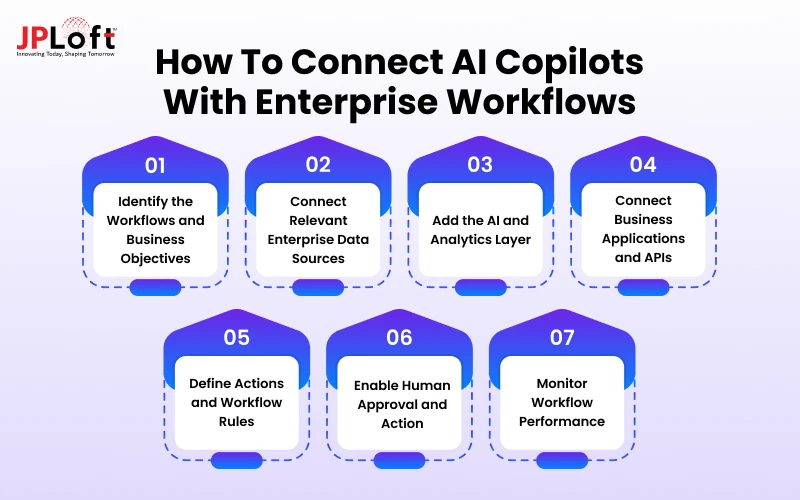
Organizations need to establish how the copilot accesses data, understands business context, communicates with existing systems, and takes action within defined permissions.
A structured integration process helps ensure that the copilot can move reliably from user request to data analysis, recommendation, and enterprise workflow automation.
Stage 1: Identify the Workflows and Business Objectives
Start by identifying the business processes where an AI automation for enterprises can add meaningful value. Define the decisions, repetitive tasks, and analytical activities the copilot should support, along with the users who will interact with it.
For example, an enterprise may want a copilot to analyze sales performance, identify declining accounts, recommend follow-up actions, and help sales teams update their CRM records.
Stage 2: Connect Relevant Enterprise Data Sources
The copilot needs access to the information required to understand and respond to user requests. Connect relevant sources such as CRM and ERP systems, data warehouses, BI platforms, internal databases, and enterprise knowledge bases.
Data access should be governed by user roles and permissions so the copilot only retrieves information that the requesting user is authorized to access.
Stage 3: Add the AI and Analytics Layer
Next, connect the copilot with the models and analytics capabilities required to interpret business data. The system can use LLMs, retrieval mechanisms, analytical tools, and business rules to understand requests, retrieve relevant information, analyze it, and generate contextual responses.
This layer enables the copilot to move beyond simple question answering toward reasoning over enterprise information.
Stage 4: Connect Business Applications and APIs
The copilot must be able to communicate with the applications where business processes occur. APIs and integration layers can connect it with CRM, ERP, project management, customer support, communication, and workflow automation systems.
This allows the copilot to exchange information with existing applications without requiring organizations to replace their current technology infrastructure.
Stage 5: Define Actions and Workflow Rules
Not every recommendation should result in automatic execution. Organizations should define which actions the copilot can perform, which require approval, and which should remain entirely human-driven.
For example, a copilot may be allowed to generate a report automatically but require approval before updating customer records or initiating a business process.
Stage 6: Enable Human Approval and Action
For decisions that carry financial, operational, or compliance implications, introduce human checkpoints. The copilot can present its findings, explain the reasoning, and recommend an action while the authorized employee makes the final decision.
This creates a controlled human-in-the-loop model rather than unrestricted automation.
Stage 7: Monitor Workflow Performance
After deployment, continuously monitor how the copilot performs across connected workflows. Track response accuracy, data usage, recommendations, workflow outcomes, user interactions, and failed actions.
These insights can help teams identify issues, improve business rules, refine the copilot, and expand its role across additional workflows.
Benefits of AI Copilot-Powered Agentic Analytics
By combining intelligent analytics with conversational AI and workflow connectivity, enterprises can gain more value from their data while reducing the effort required to interpret and act on it.
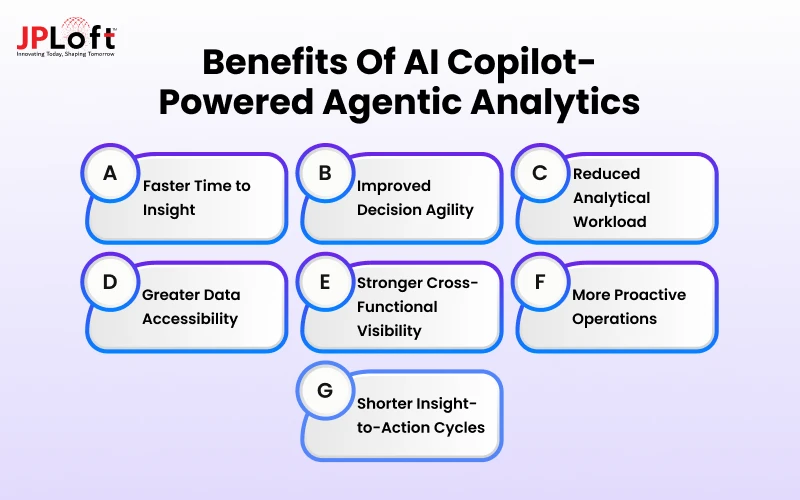
Here are the potential benefits and enterprise use cases of AI copilots in managing and optimizing workflows.
1. Faster Time to Insight
Teams can move from asking a business question to understanding relevant findings without spending excessive time searching through reports and dashboards.
2. Improved Decision Agility
Access to timely, contextual information helps teams respond more effectively to changing business conditions.
3. Reduced Analytical Workload
Automating repetitive analysis and information-gathering tasks allows analysts and business teams to focus on higher-value activities.
4. Greater Data Accessibility
Natural-language interaction makes complex enterprise data easier for employees to understand and use without advanced analytical expertise.
5. Stronger Cross-Functional Visibility
Insights drawn from connected data sources can provide teams with a more comprehensive view of business performance.
6. More Proactive Operations
Continuous analysis can help organizations recognize emerging trends, anomalies, and potential risks earlier.
7. Shorter Insight-to-Action Cycles
Connecting analytics with enterprise workflows reduces the gap between discovering an insight and responding to it.
Challenges of Implementing Agentic Analytics With AI Copilots
While AI copilot for analytics can make enterprise decision-making more intelligent and action-oriented, successful implementation depends on the quality of data, system connectivity, governance, and operational controls.
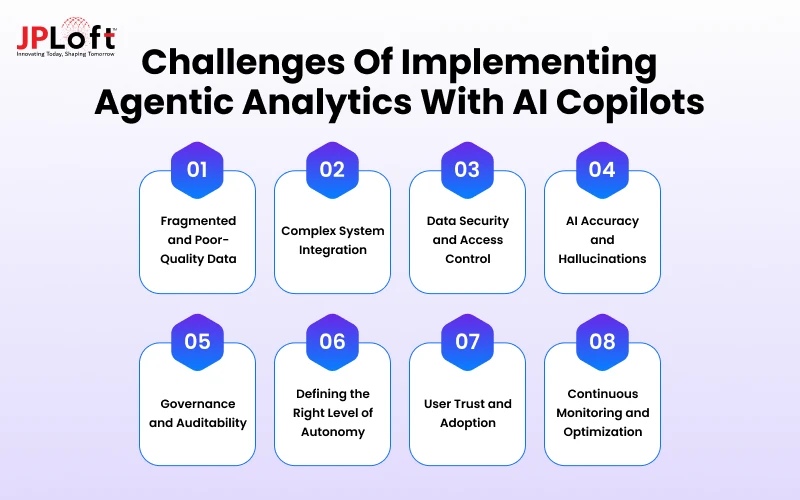
Enterprises must address several challenges to ensure that AI-generated insights and actions remain accurate, secure, and aligned with business requirements.
Challenge 1: Fragmented and Poor-Quality Data
Enterprise data is often spread across multiple systems and may contain duplicates, inconsistencies, missing values, or outdated information. Poor-quality data can lead to incomplete analysis and unreliable insights.
Solution: Establish data quality standards and connect trusted data sources through a unified data layer. Data validation, cleansing, and governance processes can help ensure the copilot works with accurate and relevant information.
Challenge 2: Complex System Integration
Connecting an AI copilot with CRM, ERP, BI platforms, data warehouses, and other enterprise applications can be technically complex. Differences in APIs, data formats, and system architectures can create integration challenges.
Solution: Use well-defined APIs and integration layers to establish secure connections between the copilot, analytics platforms, and business applications. Hire AI developers A modular integration architecture can also make it easier to expand connections over time.
Challenge 3: Data Security and Access Control
AI copilots may access sensitive business information across multiple systems. Without appropriate controls, users could receive data beyond their authorization or expose confidential information through AI interactions.
Solution: Implement role-based access controls, authentication, encryption, and permission-aware data retrieval. Access policies should apply consistently across the copilot and connected enterprise systems.
Challenge 4: AI Accuracy and Hallucinations
AI models can sometimes generate inaccurate interpretations or unsupported responses. In analytics environments, unreliable insights can affect business decisions and reduce confidence in the system.
Solution: Ground AI responses in trusted enterprise data using techniques such as RAG and validated analytical sources. Business rules, response validation, confidence checks, and guardrails can further reduce inaccurate outputs.
Challenge 5: Governance and Auditability
When AI copilots analyze data and recommend or initiate actions, enterprises need visibility into how information was accessed and how decisions were supported. Lack of traceability can create compliance and accountability concerns.
Solution: Establish clear AI governance policies with audit logs, activity tracking, data lineage, and defined accountability. Organizations should maintain records of relevant queries, data access, recommendations, and workflow actions.
Challenge 6: Defining the Right Level of Autonomy
Giving a copilot too much autonomy can introduce operational risks, while excessive restrictions can limit its usefulness. Not every analytical recommendation should automatically trigger a business action.
Solution: Define autonomy levels based on task sensitivity. Allow low-risk activities to run automatically while requiring human approval for financial, operational, customer-impacting, or compliance-sensitive actions.
Challenge 7: User Trust and Adoption
Employees may hesitate to rely on AI-powered analytics if they cannot understand how recommendations are generated or question the accuracy of AI outputs. Poor user experience can further limit adoption.
Solution: Provide clear explanations, supporting data, and transparent reasoning where appropriate. Involve business users during implementation and provide training that helps teams understand how to interact with and validate AI-generated insights.
Challenge 8: Continuous Monitoring and Optimization
Enterprise data, workflows, models, and business requirements change over time. A copilot that performs well initially may produce less relevant results as the surrounding environment changes.
Solution: Partner with an experienced AI development company that can build systems to continuously monitor response quality, data usage, analytical accuracy, workflow outcomes, and user feedback. Regular evaluation and model, data, and workflow updates can help maintain reliable performance as requirements evolve.
Future of AI Copilots in Enterprise Analytics
AI copilots are expected to move AI analytics for business workflows beyond reactive reporting and on-demand data queries.
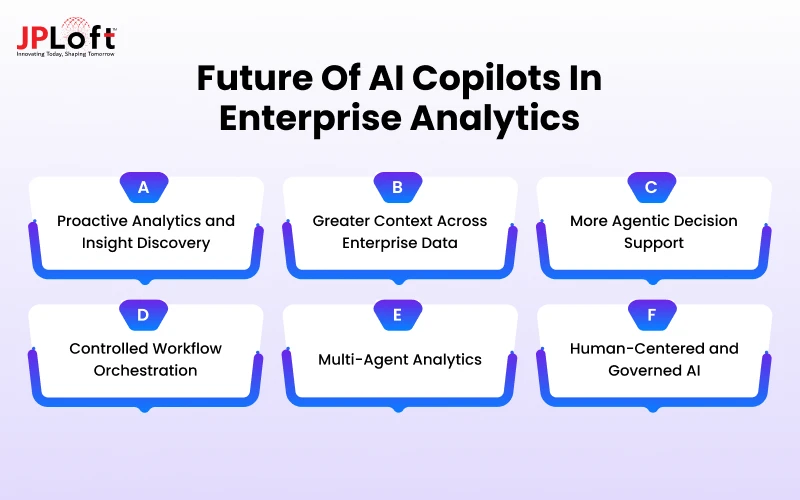
As AI models, enterprise integrations, and agentic capabilities advance, copilots will increasingly help organizations identify changes, understand their potential impact, and support timely responses across connected workflows.
[A] Proactive Analytics and Insight Discovery
Future agentic AI analytics systems may continuously monitor relevant enterprise data and surface significant trends, anomalies, or changes without waiting for users to initiate a query. This can help teams focus on information that requires attention rather than manually reviewing multiple reports.
[B] Greater Context Across Enterprise Data
As copilots connect with more enterprise systems, they can develop a broader understanding of relationships between operational data, business processes, and organizational objectives. This could enable more contextual analysis instead of isolated insights from individual data sources.
[C] More Agentic Decision Support
AI copilots are likely to play a larger role in investigating business questions, evaluating relevant information, and suggesting next steps. Rather than simply presenting findings, they may coordinate multiple analytical tasks to help users move from a question to a more complete recommendation.
[D] Controlled Workflow Orchestration
The next stage will involve closer connections between analytics and enterprise workflows. Copilots may initiate predefined actions, trigger processes, or coordinate tasks based on analytical insights, while operating within defined permissions, business rules, and approval requirements.
[E] Multi-Agent Analytics
Complex enterprise analytics may increasingly involve multiple specialized AI agents working together. An AI agent development company can help design these specialized agents for tasks such as data retrieval, analysis, validation, and workflow coordination, with the copilot providing a unified interface for users.
[F] Human-Centered and Governed AI
Greater analytical autonomy will also increase the need for strong governance. Future enterprise copilots will require clear access controls, audit trails, explainability, and human oversight, particularly when insights influence high-impact business decisions.
JPLoft: Building AI Copilots for Analytics-Driven Workflows
Turning enterprise analytics into actionable intelligence requires AI copilots that can understand business questions, analyze multiple data sources, and connect insights with workflows.
JPLoft’s AI copilot development services help businesses create solutions that fit their existing data infrastructure while making analytics more accessible and interactive.
Our developers help build solutions that integrate with CRM, ERP, BI platforms, data warehouses, databases, and workflow systems to retrieve relevant information, identify patterns, generate contextual insights, and support data-driven decisions.
For advanced analytics workflows, JPLoft can incorporate LLMs, RAG, enterprise APIs, access controls, governance, and human-in-the-loop mechanisms.
These capabilities help businesses connect enterprise data, analytical insights, and approved actions through secure, workflow-aware AI copilot solutions.
Conclusion
AI copilots are reshaping enterprise analytics by making data analysis more interactive, contextual, and actionable.
When combined with agentic analytics, they can help businesses move beyond static dashboards to continuously analyze information, surface relevant insights, support decisions, and connect analytics with operational workflows.
The value of these solutions depends on more than AI capabilities alone. Reliable enterprise data, secure integrations, strong governance, human oversight, and clearly defined workflows are essential for turning AI-generated insights into meaningful business outcomes.
As agentic capabilities advance, AI copilots will increasingly connect enterprise data, analytics, and action within a unified experience.
FAQs
Agentic analytics uses AI to analyze enterprise data, identify patterns, generate insights, and support actions with limited manual intervention. It makes analytics more proactive, contextual, and connected to business workflows.
AI copilots let users interact with enterprise data through natural language, explore relevant information, understand trends, and receive contextual insights. They can also help connect analytical findings with business decisions and workflows.
Traditional analytics primarily relies on predefined dashboards, reports, and manual data exploration. AI copilots add a conversational and context-aware layer that helps users analyze data, interpret findings, and receive relevant decision support.
Businesses can use role-based access controls, authentication, encryption, audit trails, governance policies, and human approval mechanisms. These controls help protect enterprise data and ensure AI-generated insights and actions remain within defined boundaries.
Businesses can use role-based access controls, authentication, encryption, audit trails, governance policies, and human approval mechanisms. These controls help protect enterprise data and ensure AI-generated insights and actions remain within defined boundaries.

Rahul Sukhwal is the CEO and Founder of JPLoft, a visionary technologist with 18+ years at the forefront of emerging tech innovation and software engineering. He channels deep software engineering and AI expertise into building smarter, scalable solutions that shape how forward-thinking businesses worldwide harness the true power of AI.


Share this blog