



Looking to build the next Tinder or Hinge? It may sound exciting until reality hits.
Several dating app development challenges can quietly drain your budget and crush your launch timeline if you’re not prepared.
One of the huge issues in dating apps is dating app design spam and swiping fatigue. To stand out, you need to move past standard profile matching and features and focus on a new frontier.
Founders who build “anti-ghosting’’ mechanics, such as time-locked icebreakers, mutual commitment gates, or algorithmic penalties for unresponsive profiles, are winning the market.
Furthermore, integrating hyper-local, real-world venue partnerships turns your app into an engaging experience.
This approach instantly sets your product apart from traditional dating apps.
It shifts the focus from mindless swiping to meaningful interactions that users are willing to pay for.
With that being said, let’s explore this guide to understand the challenges of developing dating mobile apps.
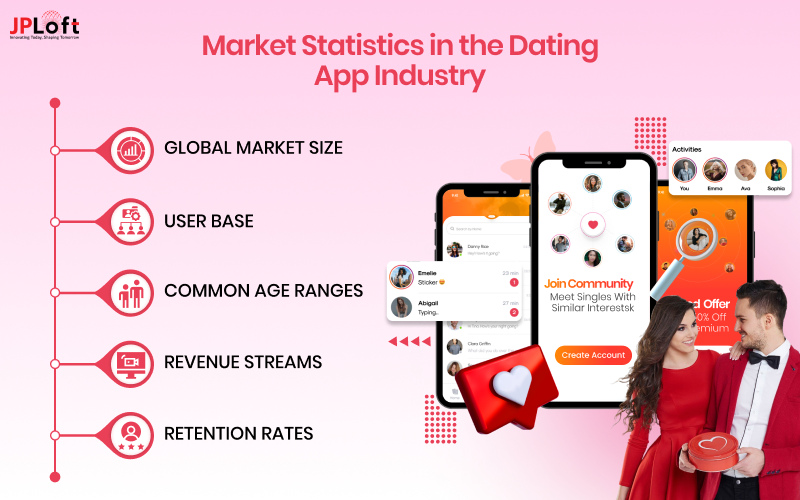
Market Statistics in the Dating App Industry
The dating app industry remains a strong force in the tech world. Here are some recent statistics that underscore its current and future impact:
-
Global Market Size: The market volume is anticipated to reach US$3.51bn by 2030.
-
User Base: The online dating user base is projected to reach 475.1 million globally by the year 2030.
-
Common Age Ranges: The main age range for dating app users is 18-34, although there has been a high rise in usage among older demographics.
-
Revenue Streams: In-app purchases, premium subscriptions, and advertisements are the primary revenue channels, fueling app profitability.
-
Retention Rates: Around 30% of users remain active on a dating app after one month, highlighting the importance of engaging dating app features to sustain user interest.
Dating App Development Challenges & Their Solutions
Developing a dating app involves tackling numerous challenges, with each one significantly influencing user experience, safety, and involvement.
Below are the ten most frequent challenges in developing a dating app, along with actionable solutions for each:
1. Data Privacy and Security
Challenge: The privacy and security of users are major challenges in dating app development, where individuals frequently disclose personal information such as images, preferences, and whereabouts.
The absence of robust security measures is one of the biggest dating app development mistakes, users might find it difficult to trust the application, resulting in decreased user engagement.
Solution: Implementing robust data security protocols like end-to-end encryption can protect sensitive information.
Integrating elements like two-factor authentication (2FA) and biometric login methods improves security, while transparent data policies and compliance with data protection regulations such as GDPR reassure users about their privacy.
2. User Verification
Challenge: Fake profiles and bots are a big reason why a dating app fails. No one wants to swipe through catfish accounts or scammers pretending to be someone else. If users don't feel safe, they leave fast, and your churn rate goes through the roof.
Solution: Add AI-powered checks like photo verification, video selfies, and live face detection to spot fake accounts early. Government ID checks add another layer of trust and show users you mean business.
You can also use smart AI to catch suspicious behavior, like spam messages or fake locations. This kind of multi-step safety net builds real user trust and helps your app avoid the trap of losing users within their first year.
3. Optimization of Matching Algorithms
Challenge: Providing suitable matches is the core of a dating application. An inefficiently designed matching algorithm may cause irrelevant or duplicate matches, leading to user dissatisfaction and a significant drop-off rate.
Solution: Incorporate AI-driven dating app algorithms and machine learning that adjust according to user preferences and actions.
Examining new trends, choices, and responses aids the algorithm in enhancing match quality progressively, guaranteeing that users enjoy a more customized and pleasant experience.
4. User Retention and Engagement
Challenge: With so many top dating apps available, retaining users can be one of the most difficult challenges in dating app development.
If the app fails to keep users interested, they may quickly switch to alternatives, leading to low retention and low growth.
Solution: Applying user engagement tactics such as gamification, daily login incentives, and tailored notifications can enhance retention.
By including distinctive elements like in-app games, chat prompts, and live streaming capabilities, the app becomes more captivating and motivates users to visit frequently.
5. UI/UX Design
Challenge: A disorganized or unclear design can irritate users, leading them to leave the app. Dating applications necessitate smooth navigation since users often toggle between profiles, conversations, and additional functions.
Solution: A user-friendly UI/UX design with a clear layout and easy navigation is essential.
Employing visual cues, concise icons, and intuitive design choices can improve user flow and enhance the overall experience.
Regular user testing allows for continuous improvement based on real feedback.

6. Scalability Issues
Challenge: As the app’s user base grows, the platform must handle increased data traffic without performance issues. Inadequate scalability can lead to slow load times and crashes, driving users away.
Solution: Design the app with a scalable architecture from the beginning.
Using cloud-based infrastructure, load balancing, and caching mechanisms ensures that the app can handle heavy traffic and increased data loads without compromising performance.
However, implementing these measures can increase the development cost of a dating app.
7. Profile Customization
Challenge: Users want control over how they present themselves, and limited customization options can make profiles feel generic. Without meaningful customization, users may struggle to stand out or attract the right matches.
Solution: Allow users to customize their profiles with details about their interests, relationship goals, and personality traits.
Adding options for profile themes, photo galleries, and personalized bios gives users more freedom to express themselves, making the app more engaging and enhancing the matching process.
8. In-App Messaging
Challenge: Messaging is the heart of any dating app, it's where sparks fly and connections grow. But laggy chats, delayed messages, or missing features can kill the vibe instantly.
Users get frustrated, stop replying, and eventually uninstall. While planning the cost to develop a dating app, many founders cut corners here, and it almost always backfires.
Solution: Integrate live chat capabilities with enhanced features such as typing notifications, read confirmations, and options to share multimedia (e.g., images, GIFs, and audio messages).
Focusing on immediate delivery and message encryption guarantees secure, dependable, and engaging communication.
9. Location-Based Services
Challenge: Many dating applications depend on location-focused matching to link users in proximity. Yet, incorrect or vague location tracking may result in unhelpful matches, reducing the app’s usability.
Solution: Use advanced GPS and location-based algorithms to ensure precise and reliable location matching.
Allow users to set their distance preferences and offer a “location lock” option to safeguard their exact location.
Regularly updating location data without draining battery life enhances user experience and satisfaction.
10. Selecting Monetization Strategy
Challenge: Figuring out how dating apps make money without compromising user experience is one of the trickiest balancing acts founders face.
Bombarding users with intrusive ads or forcing constant paywalls can quickly drive your audience straight to competitors.
Solution: Offer a freemium structure that comprises optional premium features, such as ad-free browsing, super likes, or advanced search filters, which improve the experience for users who pay.
Additional revenue can be generated through in-app purchases or partnership agreements, forming a balanced approach that prevents free users from feeling overwhelmed while still providing a profitable path for growth.
11. Managing Real-Time Updates
Challenge: Real-time updates, such as new matches, message notifications, and user activity indicators, are critical for keeping users engaged in a dating app.
Nevertheless, efficiently handling these updates poses challenges for maintaining speed, data precision, and uniform synchronization. Hiccups or mistakes in real-time updates can annoy users and result in disengagement.
Solution: Implementing efficient real-time communication protocols like WebSockets or push notifications can improve the responsiveness of updates.
Using load balancers and distributed servers can help manage large volumes of traffic seamlessly, ensuring that updates are delivered promptly.
Employing a reliable backend infrastructure to handle concurrent connections also boosts performance and user satisfaction.
12. Performance Optimization
Challenge: Dating apps often deal with high volumes of user data and real-time interactions, which can impact performance, especially during peak usage times.
Poor performance, including slow loading times and lags, can lead to user dissatisfaction and abandonment.
Solution: Optimize server response times through scalable cloud-based solutions and content delivery networks (CDNs).
Use efficient coding practices, compress data, and cache frequently accessed content to improve app speed.
Regularly monitoring and stress-testing the app can identify potential bottlenecks and ensure a smooth user experience even under heavy loads.
13. Integration with Social Media
Challenge: Integrating social media platforms enables users to sign up, verify their identity, and share content easily.
However, ensuring seamless integration while maintaining data security and user privacy is a significant challenge.
Differences in API structures and frequent updates by social media platforms can also cause compatibility issues.
Solution: Partnering with reliable social media APIs and keeping abreast of any changes in their integration guidelines is key.
Building robust user consent protocols and safeguarding shared data through encrypted transfers helps maintain user trust.
Periodic updates and app testing can help keep the integration stable and secure over time.
14. Third-Party Integration
Challenge: Dating apps often rely on third-party services for functionalities like payment gateways, map services, and analytics.
Ensuring these integrations work smoothly with the app while maintaining performance and security is a complex task.
Compatibility issues or data breaches with third-party providers can affect user experience and trust.
Solution: Choose trusted and reputable third-party services that offer strong customer support and reliable SLAs.
Implement robust API management practices to handle any compatibility issues and conduct regular security audits to ensure all third-party interactions comply with the app’s security standards.
Hire mobile app developers who can use monitoring tools to detect and resolve integration issues promptly.
15. Security of Payment Information
Challenge: If you want to start an online dating business, premium subscriptions and in-app purchases will likely become your biggest revenue drivers.
Protecting this sensitive financial information from breaches and fraud is crucial to maintaining user trust and preventing liability issues.
Solution: Incorporate secure payment methods by utilizing payment processors that comply with PCI DSS standards. Employ tokenization and encryption methods to protect data throughout transactions.
Implement multi-factor authentication (MFA) for enhanced security measures and make certain to regularly update security protocols to remain proactive against possible threats.
How JPLoft Helps Overcome Dating App Development Challenges?
Launching a dating app looks easy until you are in the process.
When investing so much money, time, and effort, choosing the right company for your dating app development can make all the difference.
JPLoft has a team of skilled professionals that offers substantial expertise in the market.
Over the years, we have developed several dating apps and served over 70 countries, with a client retention rate of 98%. If you are looking for a partner, we are right here.
Conclusion
The dating app market is growing incredibly fast. With millions of users and billions in revenue, it is a massive opportunity for startups.
However, success depends on how well you handle a few key challenges, like user privacy, smart matchmaking, and keeping people active on your app.
If you solve these problems with the right approach, your app will easily stand out in a crowded market.
With users constantly looking for better ways to connect, now is the perfect time to build your app and launch your business.
FAQs
Common challenges in dating app development include ensuring data privacy and security, verifying user identities to prevent fake profiles, optimizing matching algorithms, engaging users to improve retention rates, creating intuitive UI/UX design, handling scalability, allowing for profile customization, offering reliable in-app messaging, accurate location-based services, and establishing a balanced monetization strategy.
Dating apps typically ensure data privacy and security by using encryption protocols, such as end-to-end encryption for messages, two-factor authentication, and biometric login options. Additionally, they adhere to data protection regulations like GDPR to protect user data and reassure users about their privacy.
User verification is essential to maintain trust and safety in dating apps. By implementing AI-driven verification methods, like photo and video checks or ID verification, apps can reduce the number of fake profiles and bots, creating a safer environment for users.
A matching algorithm in dating apps uses data such as user preferences, behavior, and location to suggest compatible profiles. Advanced dating apps use AI and machine learning to refine these matches continuously, resulting in better and more relevant recommendations for users.
To improve user engagement and retention, dating apps may offer features like gamification, daily login rewards, personalized notifications, and unique in-app activities (like games or chat prompts). These strategies help keep users interested and encourage them to return to the app regularly.

Rahul Sukhwal is the CEO and Founder of JPLoft, with 18+ years of experience in software engineering, emerging technologies, and digital product development. His expertise spans artificial intelligence, including AI agents, generative AI, LLMs, chatbots, computer vision, and machine learning, as well as blockchain, IoT, AR/VR, mobile, web, and enterprise software. He focuses on applying these technologies to real business challenges across industries such as healthcare, education, mobility, finance, real estate, and on-demand services.


Share this blog