


Key Takeaways:
AI product engineering helps EdTech platforms personalize lessons, automate assessments, guide careers, and improve student performance.
It helps EdTech businesses reduce repetitive work, improve learning experiences, make better decisions, and serve more learners.
Common issues, such as data privacy, biased AI results, and system integration, must be addressed before launching AI-powered edtech products.
JPLoft’s AI expertise helps EdTech businesses improve learning experiences and meet learners’ needs.
What makes an EdTech product stand out when learners have so many options? Have you thought about it?
It’s the ability to solve real learning challenges through useful product features. From personalized lessons and data-driven decisions to gamified learning, AI product engineering helps EdTech businesses improve learning experiences through better product design and AI capabilities.
The global market of AI in education is projected to reach $57.2 billion by 2033, at a CAGR of 25.9%.
For EdTech businesses, this growth creates opportunities to develop products that meet learner needs, simplify assessments, and help educators make better decisions. However, success depends on choosing the right use cases, managing costs, and delivering value beyond basic AI features.
In this blog, we will explore:
-
What is AI Product Engineering for the EdTech industry?
-
Benefits of AI-powered EdTech
-
Key use cases of AI Product Engineering for EdTech
-
What are the common challenges in AI-powered EdTech platforms
What Is AI Product Engineering in EdTech?
AI product engineering is the practice of embedding AI capabilities, such as machine learning, adaptive analysis, and large language models, to develop educational software that solves specific learning challenges.
For example, an AI-powered EdTech platform can analyze student performance and recommend notes and learning methods accordingly. For businesses, developing this feature starts with identifying the learning gaps, defining product requirements, and choosing the right AI capabilities to solve them.
Benefits of AI Product Engineering for EdTech Businesses
The EdTech industry was working amazingly with traditional teaching, so what changed? AI product engineering created stronger value for businesses by adding useful features and improving the learning experience.
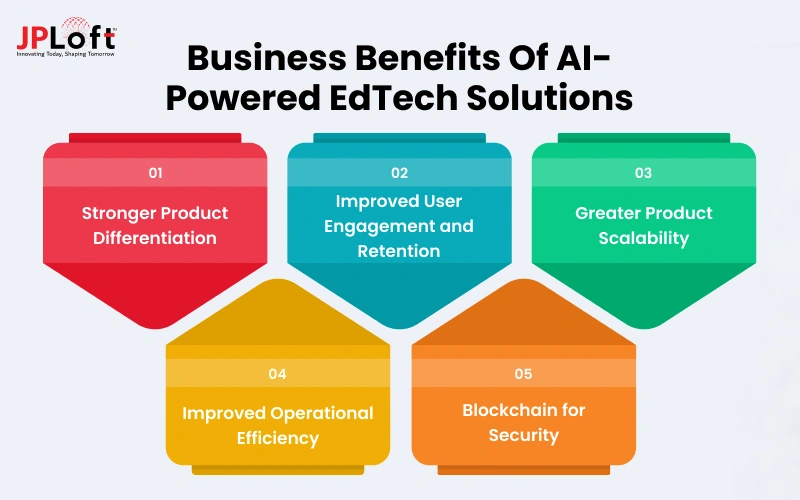
Here are the key benefits of AI-powered EdTech solutions.
1. Stronger Product Differentiation
Several EdTech businesses compete with platforms that offer similar courses and learning guide preparation through general AI models. Therefore, using AI alone may not be beneficial, whereas custom AI product engineering solutions can help create a differentiator.
It helps to create personalized learning experiences for students based on course structures and their capabilities. It can improve its recommendations over time with updated data.
2. Improved User Engagement and Retention
For EdTech businesses, keeping users engaged and active is very important. AI-powered platforms can recommend gamification features and AR/VR integrations to make learning more interactive through immersive experiences.
These features give students a reason to return to the platform and improve their learning, supporting user retention and better engagement.
3. Greater Product Scalability
As education businesses grow, AI-powered EdTech solutions require to support more user base and learning activities. AI product engineering helps EdTech businesses support a growing user base without depending on manual developers’ efforts.
Through digital transformation services, AI product engineering helps businesses add features that can serve a growing user base and modernize their digital infrastructure to support advanced learning needs.
4. Improved Operational Efficiency
As EdTech businesses grow, managing educational content, user requests and other routine task becomes difficult to manage . AI product engineering allows EdTech businesses to automate workflows through AI-powered features.
By generating draft quizzes, summarizing course materials, and helping answer common learning questions, these features can help to manage operational task.
5. Blockchain for Security
As more students started taking online courses, secure certification has become more important. This is one of the effective reasons to invest in AI product engineering.
EdTech platforms can use blockchain-based verification to verify the authenticity and credibility of the certificate.

Key Use Cases of AI Product Engineering in the EdTech Industry
AI product engineering helps EdTech businesses add intelligent features through various technologies to improve digital learning experiences for users.
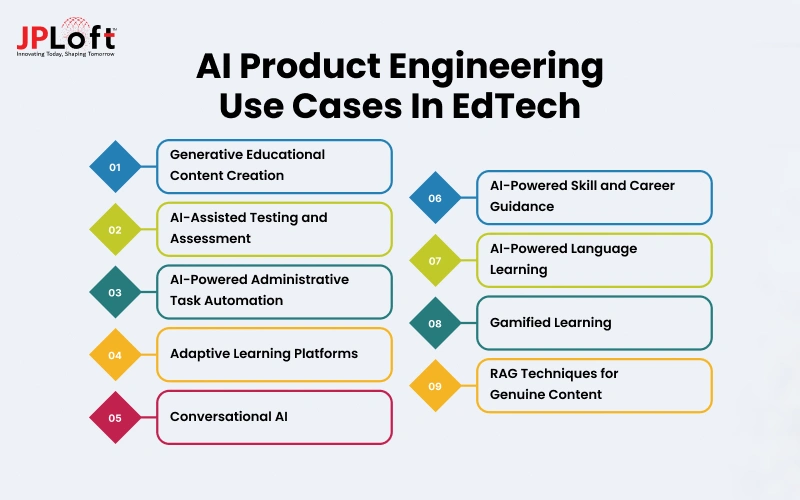
Here are some of the key use cases driving EdTech industry growth with AI product engineering.
1. Generative Educational Content Creation
Creating educational content takes time and effort. Teachers and tutors need to prepare lessons, notes, quizzes, test papers, and presentations for different subjects, which can be a tiring and hectic process.
EdTech businesses can use AI product engineering to add content generation features to their platforms. This means that when teachers upload a textbook, PDF, videos, or several other reference learning materials, the AI feature can analyze these sources and generate lesson outlines, quiz questions, and lesson plans.
Teachers can then review this and edit the generated content. These features can help EdTech businesses offer more useful tools to educators.
2. AI-Assisted Testing and Assessment
AI product engineering helps businesses develop an AI-based assessment product that helps to check, rank, and provide feedback based on assessments. By adding features such as automated grading, personalized question generation, instant feedback, student performance tracking, and teacher review tools, it creates better opportunities to improve users’ learning.
For instance, if a student struggles with a particular topic, the platform can generate more questions on that topic to help assess their understanding. By integrating AI in education systems, businesses offer more flexible assessments and reduce the manual work involved in grading and feedback.
3. AI-Powered Administrative Task Automation
Another potential use case of AI product engineering is creating an autonomous product that handles ongoing administrative tasks. These tasks include managing attendance reports, answering common student queries, and sending notifications about curriculum updates.
By adding these features, it helps to reduce manual work for educators and tutors. Such platforms handle routine tasks more efficiently, while tutors can focus on teaching.
4. Adaptive Learning Platforms
Adaptive learning platforms use artificial intelligence, machine learning, and data analytics to personalize each user’s journey on the edtech platforms. These features adjust learning content based on each student’s progress, performance, and interactions with the platforms.
For EdTech businesses, this can help improve user engagement and encourage learners to keep using the platform. However, businesses do not need to start with complex AI models; they can begin with rule-based personalization, such as suggesting lessons based on quiz scores.
5. Conversational AI
EdTech businesses can use conversational AI to add voice-based learning features to their platforms. AI product engineering brings new solutions by enabling users to have a conversation with AI like a real person. It can be about understanding the pronunciation of particular words, while there are some students who have a learning habit when someone explains it in a real voice.
AI-powered learning app can explain a difficult topic through voice instead of text alone. However, before implementing AI in the product, it is necessary to test speech-to-text accuracy across different accents and ensure the AI sounds natural for user comfort.
6. AI-Powered Skill and Career Guidance
EdTech business can use AI product engineering to add skills and career guidance features to help learners choose the right courses. It can analyze a learner’s completed courses, skills, interests, and career goals to suggest relevant courses or education programs.
For example, an EdTech platform can recommend data analytics careers to users based on their existing skills and career goals. This helps to offer personalized career paths beyond just course delivery, and saves hours of manual course selection.
7. AI-Powered Language Learning
In EdTech businesses, language platforms can use AI product engineering to create more interactive practice experiences. A user could complete a speaking exercise, receive pronunciation feedback, practice conversations, and receive corrections based on their performance.
The platform could adjust the difficulty as the learner improves. For a growing EdTech business, this can help create more personalized practice for students and increase their confidence on such platforms.
8. Gamified Learning
EdTech businesses can use AI product engineering solutions to add gamified learning features to their platforms. These features turn real-world concepts into games with challenges, rewards, and interactive activities. It helps students not only learn but also understand the core concept behind the particular theory.
AI can adjust the difficulty level of games based on a student’s performance. For example, an educational app can unlock new levels or offer harder questions when a student answers correctly. It motivates them to achieve new levels and improves progress.
9. RAG Techniques for Genuine Content
Retrieval-augmented generation (RAG) helps AI-powered EdTech products answer questions from connected data sources. It includes textbooks, course notes, institutional documents, and actual course content.
Whenever a student asks a question, RAG retrieves relevant information from these sources to provide a well-researched answer and reduce misleading answers. This makes AI product engineering more reliable for the edtech industry.
Challenges of Bringing AI Product Engineering Into EdTech Platforms
AI product engineering helps EdTech businesses improve the learning experience for users, but it also comes with common challenges. Identifying these challenges early helps businesses make development decisions and build a reliable platform.
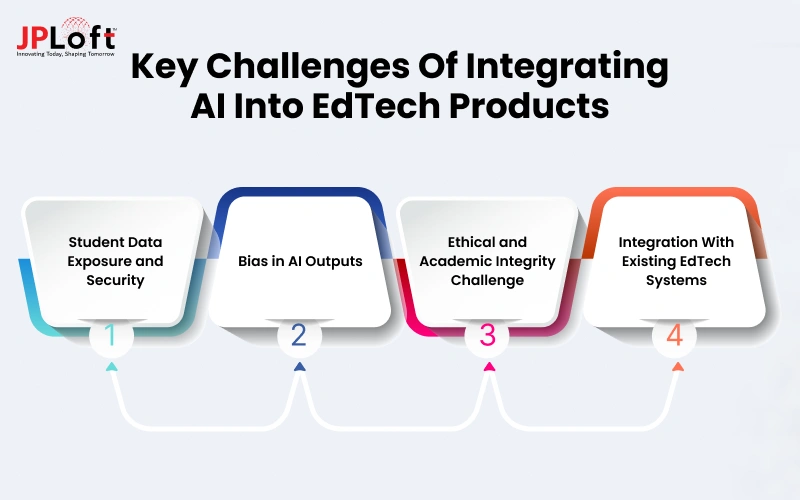
Here are the common challenges of AI product engineering in EdTech platforms.
Challenge 1: Student Data Exposure and Security
AI product engineering collects sensitive information, such as student records, test scores, and learning activities. If businesses fail to protect this data, unauthorized third parties may access or misuse it. This can impact user trust and create legal risks.
Solution: Collect only the data the product needs and restrict access to unauthorized third parties. Follow data protection laws such as FERPA and GDPR to store data securely.
Challenge 2: Bias in AI Outputs
AI product engineering in EdTech platforms can produce biased results for users if the model is not trained properly. For example, AI grading tools may give lower scores to non-native English speakers even when their answers are correct. Such bias can lead to unfair assessments, and can cause serious issues of ethical AI shortcomings.
Solution: To fix this, connecting with an AI development company can help you test for AI output bias before launch. Using diverse data makes AI decisions explainable and allows teachers to check the accuracy of AI product engineering solutions.
Challenge 3: Ethical and Academic Integrity Challenge
AI-powered EdTech platforms may allow students to complete assignments and tests using AI-generated answers. Copying or plagiarizing content can highly impact students’ performance and progress while giving exams. This can reduce trust among teachers and educational institutions, making it harder for EdTech businesses to retain customers.
Solution: Businesses need to establish clear rules on how students can use AI-powered edtech apps for learning and completing assignments. It should clearly indicate when using AI is ethical and when it is not.
Challenge 4: Integration With Existing EdTech Systems
One of the challenges of AI product engineering in EdTech is integrating AI with existing systems. Many EdTech businesses rely on older learning management systems (LMS) that may not support easy AI integration. Adding AI product engineering capabilities to these systems can require changes to the existing software, increasing development time, cost, and technical effort.
Solution: Choose scalable AI-powered solutions, audit your existing LMS, identify compatibility issues, and use APIs to connect AI features with the current system. This allows businesses to integrate technologies without removing the old learning management systems.
Why Choose JPLoft for AI Product Engineering in EdTech?
Building an AI-powered EdTech product requires more than connecting an AI model to an application. The product needs the right user experience, data flow, AI architecture, testing process, and ongoing improvement strategy.
JPLoft is a reliable AI product engineering company that helps EdTech businesses turn these requirements into practical AI-powered products. The focus starts with the business problem and moves toward the right AI use case.
Our teams can support AI product development for EdTech across personalized learning, AI assistants, recommendations, content generation, and intelligent assessments.
The expert team also helps to address data security, AI accuracy, and LMS integration challenges through secure data handling and rigorous product testing.
Whether you are planning to build or improve existing EdTech platforms and workflows, the JPLoft team focuses on building AI features that support real users while creating measurable business value.
Conclusion
AI product engineering is changing how EdTech businesses build and improve learning platforms. Its value comes from solving specific problems across learning, assessment, content, support, and product operations.
The major use cases of AI product engineering for EdTech businesses include adaptive learning, educational content generation, career guidance, gamified learning, administrative task automation, and RAG solutions.
These use cases help businesses build personalized learning experiences, reduce teachers’ workload, scale learning experiences, and improve data-driven decision-making.
However, developing AI-powered EdTech products also brings challenges, such as data privacy, biased results, ethical AI integrity, and AI integration with existing systems.
The key is to choose AI features that solve real learning and business problems. By selecting the right use cases and addressing challenges early, EdTech businesses can develop useful products that support learners and educators while meeting business goals.
FAQs
AI in EdTech helps businesses offer personalized learning, reduce educators’ workload, and optimize costs. It also enables a data-driven learning experience, identifies learning gaps, and improves digital certificate security.
The common use cases include adaptive learning, content generation, AI-assisted assessment, gamified learning, and conventional AI.
Common challenges in AI product engineering in EdTech involve biased training data, student data privacy, incorrect or misleading AI responses, and a shortage of skilled AI EdTech engineers.
No, AI software development for EdTech is designed to support teachers, not replace them. It helps to automate repetitive tasks, prepare learning materials, and personalize learning activities.
Machine learning, intelligent tutoring systems, natural language processing, predictive learning analytics, and data engineering pipelines are some of the top technologies used in AI-powered products in the education industry.

Rahul Sukhwal is the CEO and Founder of JPLoft, with 18+ years of experience in software engineering, emerging technologies, and digital product development. His expertise spans artificial intelligence, including AI agents, generative AI, LLMs, chatbots, computer vision, and machine learning, as well as blockchain, IoT, AR/VR, mobile, web, and enterprise software. He focuses on applying these technologies to real business challenges across industries such as healthcare, education, mobility, finance, real estate, and on-demand services.



Share this blog