


Key Takeaways:
AI governance provides the policies, processes, and technical controls needed to manage AI throughout its lifecycle.
Effective governance covers AI risk management, data security, human oversight, transparency, monitoring, and accountability.
Frameworks such as NIST AI RMF, ISO/IEC 42001, and the EU AI Act help organizations structure their governance approach.
As AI becomes more autonomous, agentic AI governance requires stronger controls for permissions, tool access, actions, and runtime monitoring.
Successful AI governance combines clear policies with technical enforcement, helping businesses manage risks while scaling AI responsibly.
AI is no longer limited to experiments and pilot projects. In 2026, organizations are embedding AI into customer experiences, business operations, decision-making, and increasingly autonomous workflows.
As AI systems gain access to sensitive data, enterprise tools, and business processes, the risks become harder to manage through policies alone.
This makes AI governance a critical part of responsible AI adoption. Businesses need clear ownership, risk controls, data safeguards, human oversight, monitoring, and technical enforcement across the AI lifecycle.
The challenge is turning these requirements into a governance approach that works in real-world environments without slowing innovation.
This guide explores AI governance best practices in 2026, covering key frameworks, implementation strategies, emerging challenges, and the governance requirements of agentic AI.
What Is AI Governance?
AI governance is the set of policies, processes, roles, and technical controls that guide how artificial intelligence is developed, deployed, used, and monitored. It defines accountability, establishes risk controls, and ensures appropriate oversight throughout the AI lifecycle.
An effective AI governance strategy addresses areas such as data privacy, security, transparency, bias, model performance, and human oversight.
It also connects organizational policies with technical controls such as AI inventories, risk classification, access controls, monitoring, documentation, and audit trails. The specific controls depend on the AI system, its use case, the data involved, and potential impact.
Why is AI Governance Important in 2026?
In 2026, organizations are moving from AI experimentation to broader deployment across business operations. This shift is changing how AI is developed, integrated, and used, making a strong AI governance culture increasingly important.
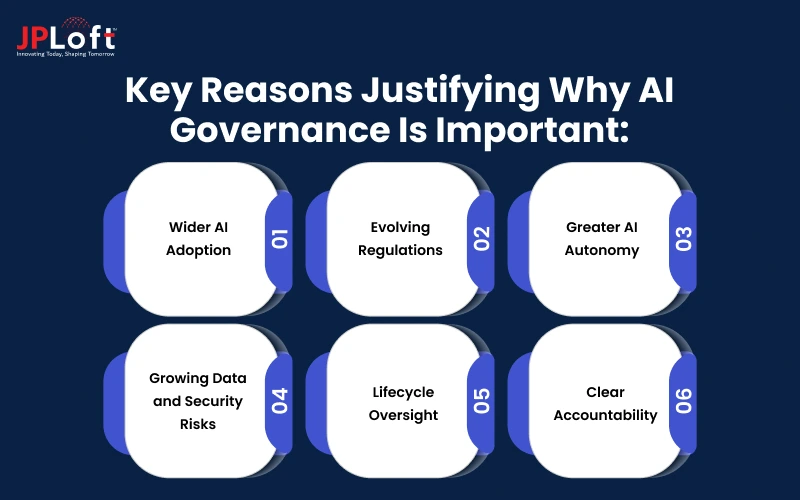
Here are the key factors driving the need for AI governance in 2026:
1. Wider AI Adoption
AI is being integrated throughout the organizations into their customer service, operations, decision-making, software development, and other business functions, increasing the need for consistent oversight.
2. Evolving Regulations
Regulatory bodies are introducing policies and AI regulations setting clearer requirements around transparency, risk management, documentation, and human oversight. For example, key transparency obligations under the EU AI Act began applying on August 2, 2026.
3. Greater AI Autonomy
Artificial intelligence systems has moved from being dependent to independent agentic systems can access tools, data, and business systems and perform actions with limited intervention, creating new requirements for permissions, monitoring, and accountability.
4. Growing Data and Security Risks
As organizations adopt more advanced AI, these systems process sensitive business and customer data, making privacy, access control, cybersecurity, and data governance increasingly important.
5. Lifecycle Oversight
AI systems can change as models, data, prompts, integrations, and use cases evolve. Governance therefore needs to continue beyond initial deployment through monitoring, updates, and ongoing evaluation.
6. Clear Accountability
As operational scenarios evolve, organizations need defined ownership, documented decisions, monitoring, and audit trails to maintain visibility into AI use and respond to unexpected outcomes.
What Are the Key Components of an AI Governance Framework?
An AI governance framework defines the policies, responsibilities, controls, and evidence needed to manage AI across its lifecycle.
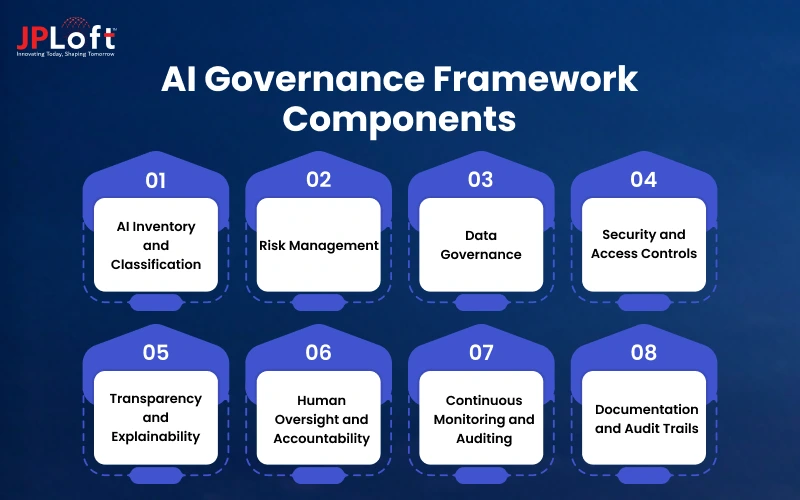
A mature framework connects business objectives with technical safeguards and regulatory requirements rather than treating governance as a standalone compliance exercise.
1. AI Inventory and Classification
Maintain a centralized inventory of AI models, applications, vendors, and use cases. Classify systems according to factors such as business purpose, data sensitivity, autonomy, decision criticality, and potential impact. This helps determine the level of review and controls each system requires.
2. Risk Management
Identify and assess risks before deployment and reassess them as systems change. Risk reviews can cover inaccurate outputs, bias, privacy exposure, security threats, misuse, model drift, and operational impact. Document mitigation measures and define escalation procedures for material risks.
3. Data Governance
Establish rules for how data is collected, processed, stored, accessed, and used by AI systems. Governance should address data quality, provenance, privacy, retention, access permissions, and contextual accuracy so models receive appropriate and reliable information.
4. Security and Access Controls
Protect AI models, prompts, datasets, APIs, and connected tools from unauthorized access or misuse. Controls can include identity and access management, encryption, environment separation, API permissions, secrets management, and monitoring of AI-related activity.
5. Transparency and Explainability
Provide appropriate visibility into an AI system's purpose, capabilities, limitations, data sources, and decision processes. The level of explanation should reflect the system's risk and the people affected by its outputs.
6. Human Oversight and Accountability
Assign clear ownership for AI systems and establish human review where decisions can create significant business, financial, legal, or social impact. Oversight should define when people must approve, intervene, override, or stop an AI-driven process.
7. Continuous Monitoring and Auditing
Monitor AI systems after deployment for performance changes, policy violations, unexpected behavior, security events, and model drift. Regular audits can verify that controls remain effective as models, data, integrations, and use cases change.
8. Documentation and Audit Trails
Maintain records covering system owners, models, datasets, evaluations, approvals, policy decisions, changes, incidents, and human interventions. These records provide evidence for internal reviews, compliance assessments, and incident investigations.
AI Governance Frameworks and Standards in 2026
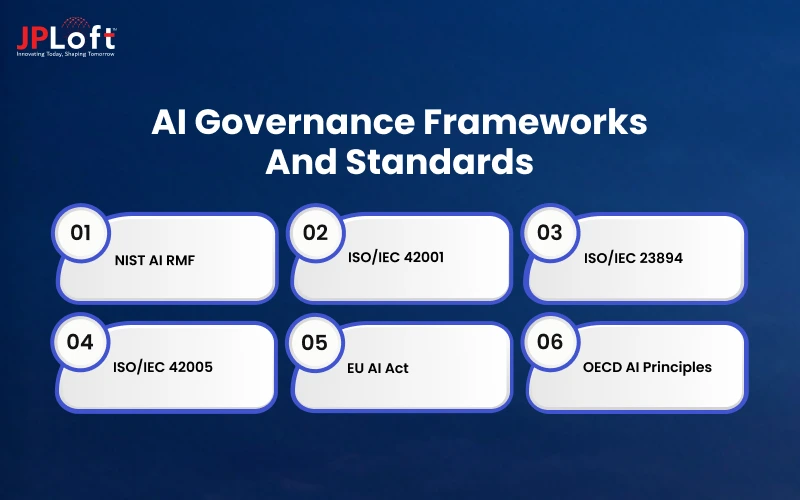
Organizations can use different frameworks, standards, and regulations for engineering AI governance strategies that align with their business and risk requirements. These resources serve different purposes, from managing AI risks and establishing management systems to assessing impacts and addressing regulatory requirements.
1. NIST AI Risk Management Framework
The NIST AI Risk Management Framework (AI RMF) provides a voluntary approach for managing AI risks across design, development, deployment, use, and evaluation.
Its Govern, Map, Measure, and Manage functions help organizations identify risks, assess their potential impact, and establish appropriate controls. In 2026, NIST is revising AI RMF 1.0 and developing additional resources for specific use cases and sectors.
2. ISO/IEC 42001
ISO/IEC 42001 is an international standard for establishing, implementing, maintaining, and continually improving an AI Management System (AIMS).
It provides an organization-wide structure for AI policies, responsibilities, risk management, operations, performance evaluation, and continual improvement. Unlike a framework focused primarily on individual AI risks, it establishes a management-system approach for governing AI across an organization.
3. ISO/IEC 23894
ISO/IEC 23894 provides guidance specifically for managing AI-related risks. It helps organizations integrate risk management into AI-related activities and functions while allowing the approach to be adapted to their specific context.
It can complement ISO/IEC 42001 by providing more detailed guidance for identifying and treating AI risks.
4. ISO/IEC 42005
ISO/IEC 42005 focuses on AI system impact assessment. It provides a structured approach for identifying, analyzing, and documenting the intended and unintended impacts of AI systems on individuals, groups, and society.
The standard complements ISO/IEC 42001 and ISO/IEC 23894 by adding a more specific focus on human and societal impacts throughout the AI lifecycle.
5. EU AI Act
The EU AI Act is a risk-based regulatory framework covering AI risk management, documentation, transparency, human oversight, cybersecurity, and traceability for applicable systems.
In 2026, Article 50 transparency obligations began applying from August 2, introducing specific transparency requirements for certain AI-generated content and AI interactions.
6. OECD AI Principles
The OECD AI Principles provide an international policy foundation for trustworthy AI. Updated in 2024, they address human rights and democratic values, transparency and explainability, robustness and security, and accountability.
In 2026, the OECD also published practical due-diligence guidance to help enterprises implement its AI Principles and address potential adverse impacts.
How Does AI Governance Change With Agentic AI?
A key transformation in the AI space is the introduction of agentic models that can work beyond what generic AI systems can do.
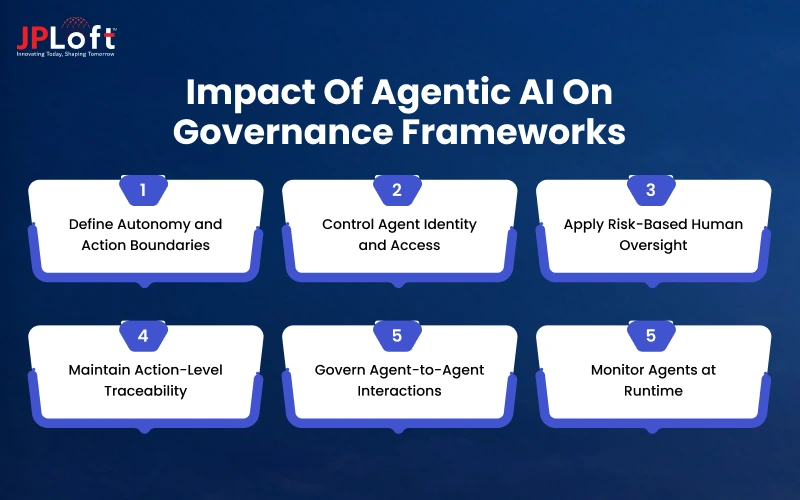
Agents can access data, use tools, call APIs, and execute tasks with varying levels of autonomy. Hence, it is important to focus on agentic AI Governance that can address authorization, oversight, action boundaries, and traceability.
1. Define Autonomy and Action Boundaries
Not every agent should have the same level of autonomy. An agent that retrieves information presents a different risk from one that can modify customer records or initiate financial transactions.
Governance approach: AI governance best practices define permitted actions, autonomy levels, risk thresholds, and conditions that require escalation or human approval.
2. Control Agent Identity and Access
Agents may need access to databases, APIs, applications, and external tools to complete tasks. Broad or persistent permissions can increase the consequences of incorrect, unauthorized, or compromised actions.
Governance approach: Assign distinct identities to agents and apply least-privilege access, scoped permissions, authentication, authorization, and tool-level controls.
3. Apply Risk-Based Human Oversight
Human involvement should reflect the potential impact of an agent's actions. Requiring approval for every low-risk task can reduce the benefits of automation, while high-impact actions may require meaningful human control.
Governance approach: Define which actions can run autonomously, which require approval, and when an agent must pause and escalate to a human.
4. Maintain Action-Level Traceability
For conventional AI, governance may focus heavily on the model and its outputs. Agentic systems also require visibility into the sequence of actions that produced an outcome, including tools used, data accessed, and APIs called.
Governance approach: Maintain detailed logs of agent decisions, tool calls, data access, approvals, failures, and executed actions to support monitoring and investigation.
5. Govern Agent-to-Agent Interactions
Multiple agents can delegate tasks, exchange information, or trigger actions in connected systems. Without defined boundaries, these interactions can create unexpected chains of activity.
Governance approach: Establish rules for delegation, communication, permissions, and resource access between agents. Monitor interactions and maintain accountability across the workflow.
6. Monitor Agents at Runtime
Agent behavior can vary based on user instructions, retrieved context, available tools, and changing system conditions. Pre-deployment testing alone may not capture every runtime scenario.
Governance approach: Continuously monitor agent activity, policy violations, unusual behavior, failed actions, security events, and changes in capabilities. Trigger reassessment when an agent's tools, permissions, or operating environment change.
How to Implement AI Governance: Framework, Process, and Technical Controls
Implementing AI governance standards requires more than creating policies. Organizations need a repeatable process that connects governance requirements with technical controls and day-to-day AI operations.
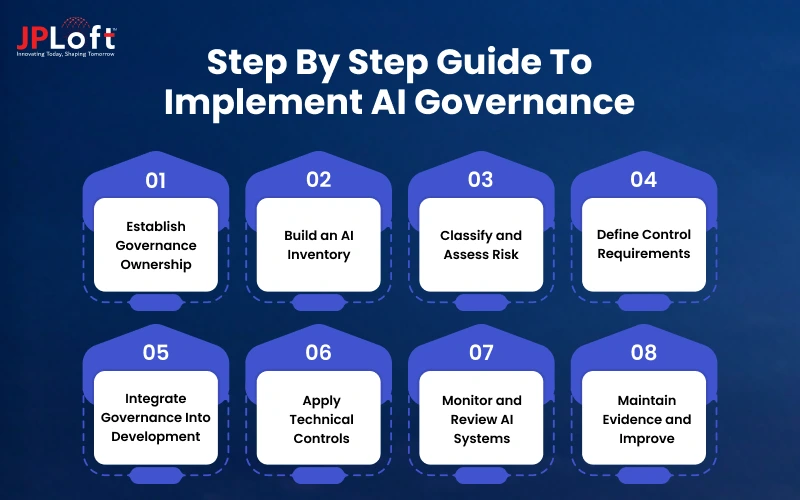
A practical implementation can follow these steps:
Step 1. Establish Governance Ownership
Define who is accountable for AI governance across business, legal, security, data, and engineering teams.
Assign system owners and establish an AI governance committee or equivalent oversight structure for high-impact use cases.
Step 2. Build an AI Inventory
Identify AI models, applications, third-party services, agents, and internal use cases across the organization.
Record their purpose, owners, data sources, vendors, integrations, autonomy, and decision criticality to establish visibility into the AI environment.
Step 3. Classify and Assess Risk
Apply consistent criteria to determine the risk level of each AI system. Evaluate factors such as data sensitivity, potential impact, level of autonomy, user population, and decision criticality.
Ensure AI governance contextual accuracy by aligning review and control requirements with the risk level of each system, with higher-risk systems receiving stronger oversight.
Step 4. Define Policies and Control Requirements
Translate governance objectives into clear policies for acceptable AI use, data handling, security, human oversight, model evaluation, vendor management, and incident response.
Map each requirement to measurable controls that teams can apply during development and deployment.
Step 5. Integrate Governance Into Development
Introduce governance checks throughout the AI development lifecycle rather than waiting until deployment.
This can include data validation, model evaluation, bias and safety testing, documentation, approval gates, and security reviews before production release.
Step 6. Apply Technical Controls
Enforce governance through AI gateways, access controls, policy engines, and guardrails that regulate access to data, models, APIs, and tools.
Add monitoring, logging, and approval workflows to detect violations, restrict risky actions, and maintain visibility into AI activity.
Step 7. Monitor and Review AI Systems
Track performance, usage, policy violations, security events, model drift, and unexpected behavior after deployment.
Establish review schedules and trigger-based reassessments when models, data, integrations, or use cases change significantly.
Step 8. Maintain Evidence and Improve
Keep documentation, evaluation results, approvals, incidents, system changes, and audit logs up to date.
Use monitoring and audit findings to identify control gaps, update policies, and improve the AI governance strategy over time.
How to Measure AI Governance Effectiveness?
Organizations can measure AI governance strategy visibility by tracking how consistently AI systems are identified, assessed, controlled, and monitored.
The right metrics should cover governance coverage, risk management, compliance, human oversight, and operational performance.
-
AI Inventory Coverage: Track the percentage of AI models, applications, agents, and third-party AI tools documented in the organization's inventory.
-
Risk Assessment Coverage: Measure how many AI systems complete risk assessments before deployment and how often they are reassessed after significant changes.
-
Policy Compliance: Monitor policy violations, unauthorized AI usage, approved exceptions, and the time taken to resolve governance issues.
-
Human Oversight: Track the percentage of high-risk AI decisions that receive required human review, approval, or intervention.
-
Control Effectiveness: Assess whether security controls, guardrails, access restrictions, approval workflows, and monitoring mechanisms are implemented and working as intended.
-
AI Incident Rate: Track the number, severity, and recurrence of AI-related incidents, along with response and resolution times.
-
Audit Trail Coverage: Measure how many AI systems maintain complete records of approvals, evaluations, changes, decisions, and other required governance activities.
-
Governance Visibility: Track how effectively teams can monitor AI usage, risk levels, system status, policy compliance, and emerging issues across the organization.
What Are the Common Challenges of AI Governance?
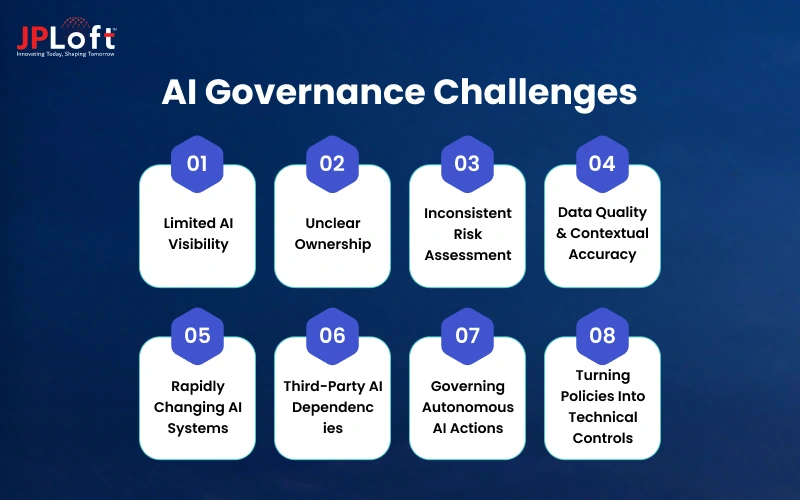
AI governance becomes difficult as organizations manage more AI systems, distributed data, third-party services, and evolving models. Common AI governance challenges include:
1. Limited AI Visibility
Organizations may lack visibility into internally developed models, employee-deployed AI tools, third-party services, and AI agents. This makes consistent risk assessment and AI governance strategy visibility difficult.
Solution: Maintain a centralized AI inventory covering systems, owners, use cases, data sources, vendors, integrations, and risk classifications. Regular discovery can help identify undocumented AI usage.
2. Unclear Ownership
AI systems often involve product, engineering, data, security, legal, and business teams. Without defined responsibilities, accountability for AI risks and future governance decisions can become unclear.
Solution: Assign accountable owners to AI systems and establish clear responsibilities for approval, monitoring, incident response, and policy exceptions.
3. Inconsistent Risk Assessment
Different teams may use different criteria to assess AI risks, resulting in inconsistent governance across similar systems. Higher-impact use cases may require stronger controls than routine applications.
Solution: Establish standardized risk criteria covering data sensitivity, autonomy, decision criticality, affected users, and potential impact. Link each risk level to specific controls and review requirements.
4. Data Quality and Contextual Accuracy
Inaccurate, outdated, or irrelevant data can lead to unreliable AI outputs. The AI governance challenges increase when systems retrieve information from multiple databases, documents, APIs, or external sources.
Solution: Apply controls for data quality, provenance, access, validation, and freshness. Retrieval and validation mechanisms can help ensure AI systems use relevant context.
5. Rapidly Changing AI Systems
Models, prompts, datasets, integrations, and capabilities can change after deployment. These changes can introduce new risks or make existing controls insufficient.
Solution: Establish change-management and reassessment processes. Trigger additional testing or approval when significant changes affect models, data, capabilities, or use cases.
6. Third-Party AI Dependencies
External models, APIs, and AI platforms can create risks involving data handling, security, availability, transparency, and regulatory responsibilities.
Solution: Assess vendors for security, privacy, data usage, model documentation, and contractual responsibilities. Continue monitoring third-party services throughout their use.
7. Governing Autonomous AI Actions
Agentic AI can access data, call APIs, use tools, and execute actions with limited intervention. This increases the need to control what an AI system can access and do.
Solution: Use least-privilege access, defined action boundaries, tool-level permissions, human approvals for high-impact actions, and detailed activity logs.
8. Turning Policies Into Technical Controls
Organizations may have AI policies without mechanisms to enforce them within applications and infrastructure. This creates a gap between governance requirements and actual AI behavior.
Solution: Hire expert AI developers and translate policies into technical controls using AI gateways, access management, guardrails, policy engines, API restrictions, monitoring, and audit logs.
AI Governance Trends to Watch in 2026
AI governance is shifting from broad responsible-AI principles toward more operational controls that can be applied throughout the AI lifecycle.
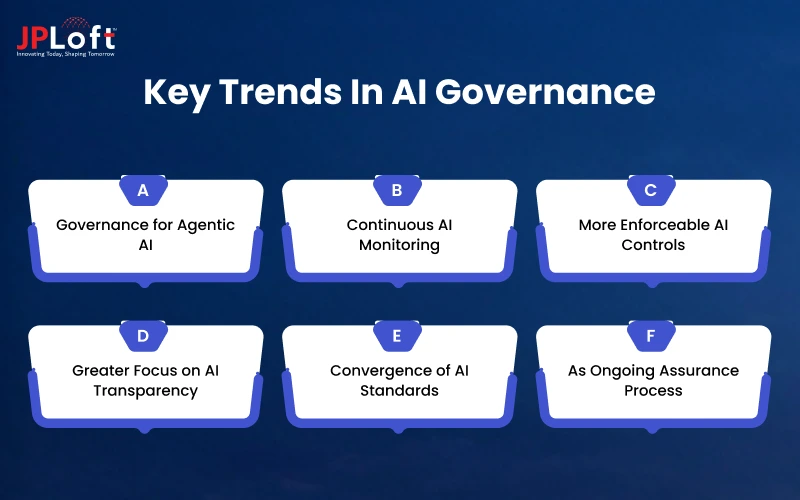
Here are the AI governance best practices and key trends that are shaping governance practices in 2026:
1. Governance for Agentic AI
The capabilities of AI agents to access data, use tools, interact with applications, and perform tasks autonomously is improving.
This is driving greater attention toward agent identity, authorization, action boundaries, monitoring, and human intervention. NIST launched an AI Agent Standards Initiative in 2026 focused on secure agentic AI governance and interoperable agent ecosystems.
2. Continuous AI Monitoring
Governance is moving beyond pre-deployment testing toward continuous monitoring after AI systems enter production.
Organizations are increasingly looking at unexpected outputs, model changes, performance degradation, security events, and real-world impacts.
3. More Enforceable AI Controls
AI governance is increasingly being implemented through technical mechanisms rather than policy documents alone.
AI gateways, identity controls, policy engines, logging, guardrails, and automated evaluations can help enforce governance requirements within AI applications.
4. Greater Focus on AI Transparency
Transparency requirements are becoming more concrete, particularly for generative and interactive AI.
Under Article 50 of the EU AI Act, certain transparency obligations began applying on August 2, 2026, including requirements covering AI interactions and AI-generated or manipulated content.
5. Convergence of AI Standards
Organizations are increasingly working across multiple governance standards and regulatory frameworks rather than relying on a single reference point.
NIST continues to develop AI standards and crosswalks with international frameworks, supporting greater alignment across AI risk management and governance practices.
6. AI Governance as an Ongoing Assurance Process
Governance is increasingly treated as a continuous assurance activity involving evaluation, monitoring, documentation, incident management, and periodic reassessment.
This approach reflects the fact that AI systems and their operating environments can change significantly after deployment.
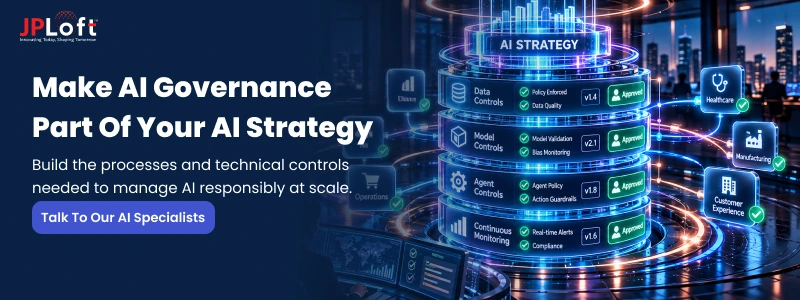
How JPLoft Helps Businesses Implement AI Governance
JPLoft combines AI engineering expertise with governance practices to help businesses build AI systems that are secure, accountable, and ready to scale.
Our AI governance consulting services help translate governance requirements into practical processes and technical controls across AI applications, models, and agentic systems.
We assess AI use cases, data flows, integrations, and risk levels to identify governance gaps and establish controls for access, data protection, human oversight, guardrails, monitoring, and auditability.
For agentic AI, our approach extends to tool permissions, action boundaries, approval workflows, and runtime monitoring.
By embedding governance into AI architecture and infrastructure, we help businesses improve visibility, enforce policies consistently, detect risks earlier, and maintain greater control as AI systems and regulatory requirements evolve.
Conclusion
AI governance is becoming an operational requirement as businesses expand their use of AI across applications, workflows, and autonomous systems.
In 2026, effective governance goes beyond policies to include risk assessment, data controls, human oversight, security, monitoring, and technical enforcement.
A practical approach combines established frameworks and standards with governance processes that fit the organization’s AI use cases and risk profile.
As agentic AI becomes more capable, businesses also need stronger controls over permissions, tool access, autonomous actions, and runtime behavior.
Organizations that build governance into the AI lifecycle can improve visibility, manage risks more consistently, and maintain greater control as AI systems scale. The goal is not to slow AI adoption, but to create the structure needed to deploy AI responsibly and confidently.
FAQs
AI governance is the framework of policies, processes, roles, and technical controls used to manage how AI systems are developed, deployed, monitored, and used. It helps organizations manage risks related to security, privacy, transparency, accountability, and AI performance.
AI governance is important in 2026 as businesses expand AI adoption while regulations, AI capabilities, and autonomous systems continue to develop. Effective governance helps organizations maintain oversight, manage risks, and address evolving compliance requirements.
Key components include AI inventory and classification, risk management, data governance, security and access controls, transparency, human oversight, continuous monitoring, documentation, and audit trails.
Organizations can implement AI governance by establishing ownership, creating an AI inventory, assessing risks, defining policies and controls, integrating governance into AI development, enforcing technical controls, monitoring deployed systems, and conducting regular audits.
Agentic AI governance must address more than model outputs. Organizations need controls for agent identity, permissions, tool and API access, action boundaries, human approval, runtime monitoring, and activity logs to maintain control over autonomous actions.

Rahul Sukhwal is the CEO and Founder of JPLoft, with 18+ years of experience in software engineering, emerging technologies, and digital product development. His expertise spans artificial intelligence, including AI agents, generative AI, LLMs, chatbots, computer vision, and machine learning, as well as blockchain, IoT, AR/VR, mobile, web, and enterprise software. He focuses on applying these technologies to real business challenges across industries such as healthcare, education, mobility, finance, real estate, and on-demand services.


Share this blog