



Key Takeaways:
Strong planning is necessary for laundry apps to ensure smooth payments, deliveries, and general business operations.
Quick scheduling, simple booking, and real-time order tracking contribute to increased client retention and satisfaction.
Proper system management is required to address deliveries and multiple user portals, as well as various retail store locations.
Downtime, technical problems, and system crashes can be reduced through updating and performance monitoring of apps.
Working with an experienced company like JPLoft can help businesses handle these challenges more effectively.
What happens when laundry app development challenges begin to impact customer satisfaction, payments, and deliveries?
In the on-demand service industry, even minor technical issues can quickly frustrate users and reduce customer retention.
At the same time, the market continues to grow rapidly. The dry cleaning and laundry services market is expected to reach $134.47 billion by 2030 at a CAGR of 3.8%.
This growing demand is encouraging startups and businesses to invest in digital laundry platforms. However, building a successful laundry app is a more complex process.
Modern laundry apps often face challenges with real-time tracking, delivery coordination, scheduling, payments, and app performance.
Without the right strategy, these issues can increase operational costs, slow business growth, and negatively impact customer satisfaction.
In this blog, we will discuss the most common laundry app challenges that businesses face nowadays, along with effective solutions to overcome them.
Complex Laundry App Development Challenges to Consider
Let’s discuss the top laundry app development challenges that every business comes across when choosing to build a laundry app.
Challenge 1: Handling Complex Logistics Issues
Coordinating with laundry pickups and deliveries can turn out to be tricky when there is increased demand for orders. Businesses should consider tracking drivers, the timing of delivery, the location, and the order status.
Missed pickups, unclear routes, and poor traffic conditions can affect customer experience adversely. Ineffective logistics management can also raise operational expenses and lower delivery efficiency.
Modern on-demand laundry apps are expected to provide quick pickups and timely deliveries with real-time tracking information. One of the most significant laundry app challenges for businesses continues to be the smooth management of all these procedures.
Solutions:
-
Make use of order tracking in real time
-
Include GPS-enabled delivery systems
-
Optimize delivery routes automatically
-
Provide real-time order status updates
-
Improve driver management systems
-
Regularly monitor delivery performance
Challenge 2: Creating a Smooth User Experience
Confusing interfaces or difficult booking procedures can irritate users and rapidly raise app abandonment rates. Users expect smooth payments, fast scheduling, and immediate updates on orders.
Poor app design and slow-loading displays reduce trust and affect customer retention negatively. Understanding important laundry app features helps in improving customer experience across Android, iOS, and web platforms.
For businesses, maintaining a consistent experience across devices continues to be among the most significant common laundry app challenges.
Solutions:
-
Keep the booking process simple
-
Create clear, easy-to-use screens
-
Eliminate unnecessary app steps
-
Speed up app load time
-
Provide quick order scheduling
-
Regularly test the usability of the app
Challenge 3: Managing Multiple User Panels Efficiently
It can be challenging to coordinate all of the panels for customers, delivery agents, store owners, and administrators in a laundry app during regular business operations.
Different features, permissions, dashboards, and notifications are required for each user panel. Any synchronization problem could lead to misunderstandings, delays, or gaps in user communication.
Businesses planning to start an online laundry business must ensure smooth coordination between multiple user panels for better order management and operational control. Among the major challenges to build a laundry app is ensuring seamless synchronization across several panels.
Solutions:
-
Create different dashboards for different users
-
Consider centralized admin controls
-
Sync data in real time
-
Automate order notifications
-
Simplify user panel navigation
-
Regularly monitor the activity of users
Challenge 4: Safeguarding Payment and Transaction Processes
Laundry apps manage the payment process on an ongoing basis. Poor payment security will result in increased risks of fraud and decreased trust from users.
Customers want to have secure and smooth transaction processes without any problems. Issues related to the payment process may affect customers' decisions to make refunds and give poor feedback.
Businesses should ensure their financial data is protected. They should offer various ways for users to pay for the services provided. Payment integration and transaction management continue to be major challenges to develop a laundry app.
Solutions:
-
Make use of safe payment gateways
-
Turn on encrypted transactions
-
Accept a variety of payment methods
-
Keep an eye on suspicious payment activities.
-
Conduct routine security testing
-
Improve payment processing speed

Challenge 5: Integrating Third-Party Services Efficiently
For payments, GPS tracking, notifications, maps, and customer interactions, laundry apps sometimes rely on outside services. Failure to properly integrate services could lead to delays, transaction failures, and poor app performance.
Managing multiple APIs at the same time without impacting the performance and speed of the app could be challenging. Investing in on-demand app development often focuses on smooth third-party integrations to maintain stable app performance.
Even the slightest integration failure might impact delivery and tracking, as well as customers' experiences. Third-party integration becomes essential for laundry apps, especially when many functionalities are introduced into the app.
Solutions:
-
Utilize trustworthy third-party APIs
-
Regularly test integrations
-
Continue to track API performance
-
Cut down on integration delays
-
Regularly update third-party services
-
Create backup plans in case of emergencies
Challenge 6: Scaling Laundry App During Peak Traffic
During weekends, holidays, and special discounts, laundry apps usually receive a large number of users. Inappropriate preparations for increased user activity can lead to poor app performance, negatively impacting the business overall.
Poor performance, crashes, and delays can make users irritated quite quickly. App scalability issues might be an additional reason for losing customers' trust.
Businesses often partner with an experienced mobile app development company in USA to build scalable applications that maintain stable performance during peak usage. Stability under peak usage is among the most common laundry app development challenges.
Solutions:
-
Utilize scalable cloud-based infrastructure
-
Improve app backend performance
-
Continuously monitor server load
-
Speed up app response time
-
Conduct regular performance tests
-
Upgrade systems as traffic grows
Challenge 7: Protecting Customer Data and Application Security
Ensuring the safety of customer data and application security remains among the major challenges in laundry app development. Customer information, such as addresses, contact numbers, payment details, and order histories, is stored by laundry apps.
Users expect protection of the information shared while using a laundry app. Any security breaches reduce trust of customers and damage a business's reputation.
Organizations must secure user data and application systems. App security remains an important concern for businesses developing laundry applications.
Solutions:
-
Make use of strong data encryption
-
Incorporate secure login authentication
-
Conduct regular security audits
-
Protect the payment details of customer
-
Regularly update the security of apps
-
Restrict access to unauthorized data
Challenge 8: Reducing App Downtime and Technical Failures
Preventing app crashes and technical issues falls among the key challenges to build a laundry app. When a server fails, an app crashes, or technical glitches happen, it leads to customer dissatisfaction and affects their trust.
Laundry apps manage several operations at the same time. These operations consist of payments, notifications, scheduling, and live tracking.
Poor backend performance impacts app stability and increases downtime. Investors should regularly measure the performance of the application and fix technical issues before it affects users.
Solutions:
-
Regularly monitor the app's performance
-
Quickly fix bugs and technical glitches
-
Perform regular system maintenance
-
Make use of reliable cloud hosting providers
-
Test the application on various devices
-
Regularly update application
Challenge 9: Managing Multi-Store and Multi-Location Operations
Numerous laundry businesses run across several locations, cities, and delivery zones. Managing the orders, employees, and inventory across multiple sites can be an obstacle.
Delivery, price, customer service, and store performance must be coordinated by businesses. Poor management leads to delays and operational confusion between locations.
As it continues to grow, the handling quality of the service across all branches becomes more difficult. Managing multiple store locations efficiently remains one of the top laundry app development challenges.
Solutions:
-
Consider the use of centralized management systems
-
Regularly track orders across locations
-
Track each store's performance independently
-
Standardize the delivery process
-
Automate assignments based on location
-
Improve communication between branches
Challenge 10: Balancing App Features With Development Costs
Firms may require many advanced features such as live tracking, AI suggestions, loyalty programs, and automation services. An excess of features will lead to delays and a rise in cost to build a laundry app.
On the other hand, eliminating some useful features might negatively impact the experience of users and the application. Balancing between these factors is not an easy task for many companies.
Investors need to focus on the most necessary features while being mindful of their budget.
Solutions:
-
Start with the most important characteristics.
-
Create an MVP before expanding
-
Give user-focused features priority
-
Establish a development budget early
-
Gradually add more complex features
-
Collaborate with skilled developers
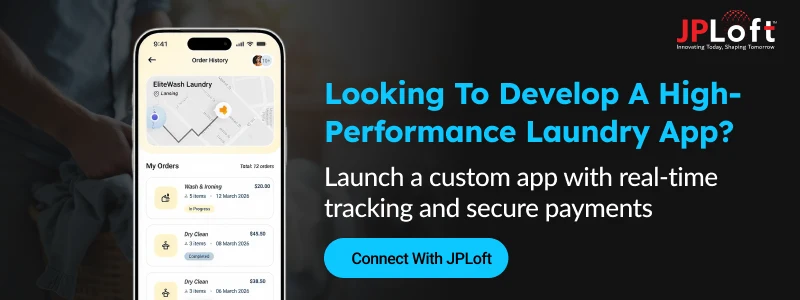
How Can JPLoft Simplify Challenges in Laundry App Development?
Developing an efficient laundry app requires strong technology infrastructure, smooth operations, and reliable development expertise.
JPLoft assists in overcoming laundry app challenges by developing highly scalable and feature-rich solutions made for the on-demand service industry.
Starting from real-time tracking of orders, efficient delivery management, payment management, and the development of multi-user panels, our experienced team focuses on developing an excellent user experience across all platforms.
As a trusted company for custom laundry app development, JPLoft builds solutions that are designed for long-term growth and better operational performance.
Our team understands changing customer expectations and develops platforms that support faster deliveries, improved user retention, and smooth functionality across devices.
Be it launching a laundry delivery business or expanding the existing services, JPLoft offers end-to-end development solutions for long-term growth in the market.
Conclusion
The process of developing a laundry app brings along a range of problems that may have an impact on end-users' experience and performance.
From controlling deliveries and assuring app reliability to securing payments and addressing user demand, each issue requires adequate preparation and implementation of appropriate technology.
Failing to address these challenges will result in delayed services, unreliable app operation, unhappy customers, and high operational costs.
One must make sure their app is scalable, secure, easy to use for customers, and effectively managed.
When one understands challenges to develop a laundry app early, they can create stronger solutions, improve service quality, and build apps that support long-term growth.
FAQs
The biggest challenges while creating a laundry app include managing deliveries, maintaining app performance, handling payments securely, improving user experience, and scaling the app as customer demand rises.
The cost to develop a laundry app ranges from $10,000 to $120,000 or more. Cost varies depending on the features of the app, design complexity, platforms, and custom development requirements.
By carefully arranging features, utilizing scalable technology, and improving app testing, businesses can reduce these challenges.
A smooth user experience helps customers book services easily, track orders quickly, and use the app without confusion, which improves customer satisfaction and retention.
With live tracking, route optimization, automatic scheduling, and real-time messaging for both clients and delivery drivers, laundry apps can handle deliveries more effectively.

Conor has 10+ years of experience in software development, application engineering, solution design, and UX/UI. He has worked across digital products in restaurant technology, food and grocery delivery, healthcare, media, streaming, and social platforms, bringing both technical and user-experience perspectives to product development. His experience working with large organizations and growth-focused digital products helps businesses translate complex requirements into practical, user-focused solutions.



Share this blog