


Banks used to treat artificial intelligence as a helper, something that gave answers while a person handled the next step. That era is closing fast.
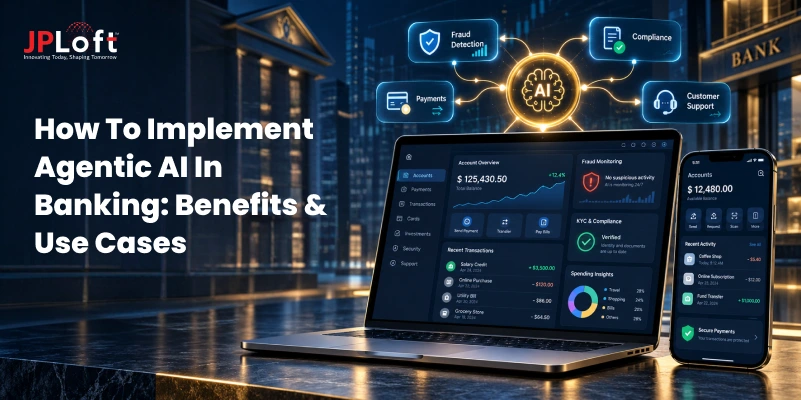
Agentic AI in banking marks a shift from assistance to action, where intelligent systems plan, decide, and execute entire workflows with little to no human input at each step.
A fraud alert no longer waits for an analyst to open a ticket. A loan application no longer sits in a queue for days.
Instead, autonomous agents verify identities, cross-check data, and move the process forward on their own, all while staying inside strict compliance guardrails.
For banks under pressure to cut costs, stop fraud faster, and keep customers loyal, this shift is not optional anymore. It is quickly becoming the difference between institutions that lead and institutions that fall behind.
In this blog, we will break down what agentic AI means for banking, where it delivers real value, and how to bring it into your operations the right way.
What are the Benefits of Considering Agentic AI in Banking?
Adopting agentic AI for banking operations helps you gain more than automation. They build systems that think, adapt, and act, delivering measurable benefits in banking across cost, risk, and customer trust.
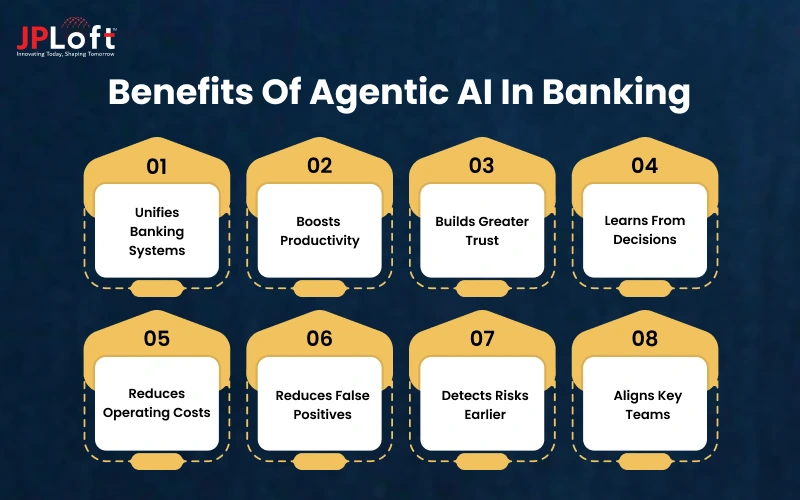
So, below we will discuss the top benefits of considering agentic AI in the banking industry.
1. Connects Siloed Banking Systems Into One Working Flow
Most banks run core banking, CRM, risk, and compliance tools on separate platforms. Agentic AI for banks pulls data from these systems and moves it where it is needed, without manual handoffs slowing the process down.
With everything connected, departments stop waiting on each other. Every team sees the same customer and transaction data, and work keeps moving without anyone having to chase it.
2. Improves Productivity Without Adding Headcount
Agentic AI for banking takes over the repetitive coordination work that eats into employee time, like gathering documents, enriching records, and triggering the next step in a workflow.
With that load lifted, banking teams can handle higher volumes without hiring more staff. Employees can focus on judgment calls and customer relationships instead of routine, low-value tasks.
3. Builds Trust Through Explainable, Auditable Decisions
Every action an agent takes leaves a clear trail. Agentic AI applications in banking show exactly why a transaction was flagged or why an application was declined.
This transparency matters for regulators and customers alike. When decisions stay traceable, audits move faster, and trust grows, since nobody is left guessing how or why the system acted.
4. Learns and Improves From Every Decision Made
Most banking tools stay the same until someone manually updates them. Agentic AI in banking is different. It looks at past decisions, like confirmed fraud cases or approved loans, and adjusts its own approach based on what actually happened.
This means the system gets better on its own over time, without waiting for a full rebuild. It catches new fraud patterns sooner and makes smarter calls as customer behavior changes, keeping the bank one step ahead.
5. Cuts the Cost-to-Income Ratio Over Time
By simplifying resource-heavy processes, agentic AI helps lower operating costs while keeping output high. Fewer manual steps mean fewer errors and less rework across departments.
As throughput increases without a matching rise in expenses, banks see a healthier cost-to-income ratio. This kind of operational leverage supports steady growth without stretching budgets or teams too thin.
6. Reduces False Positives Without Weakening Controls
Traditional fraud and compliance systems often flag too many harmless transactions, wasting analyst time. Agentic AI in banking use cases shows how context-aware agents cut through this noise effectively.
By checking account history, behavior, and patterns before raising an alert, agents send fewer false alarms to human reviewers. Controls stay strong while teams spend time only on cases that matter.
7. Shifts Risk Detection Earlier in the Workflow
Most losses happen before a problem is even flagged. An AI agent catches warning signs earlier, at the point data first looks unusual, rather than after damage is already done.
This earlier detection gives banks room to act before a small issue becomes a costly one. Preventive action replaces reactive cleanup, protecting both revenue and customer confidence.
8. Aligns Business, Risk, and Technology Teams on One View
When systems run in silos, teams often see different versions of the same problem. This process usually starts by giving every department one shared, accurate view.
By streamlining agentic AI in software development and system maintenance, IT and engineering teams gain better visibility alongside risk and business units, eliminating conflicting data and accelerating feature releases.

Use Cases of Agentic AI in the Banking Industry
Every banking department has processes that eat up time without needing much real judgment. These are exactly where use cases of agentic AI deliver the most value, from daily operations to long-term strategy.
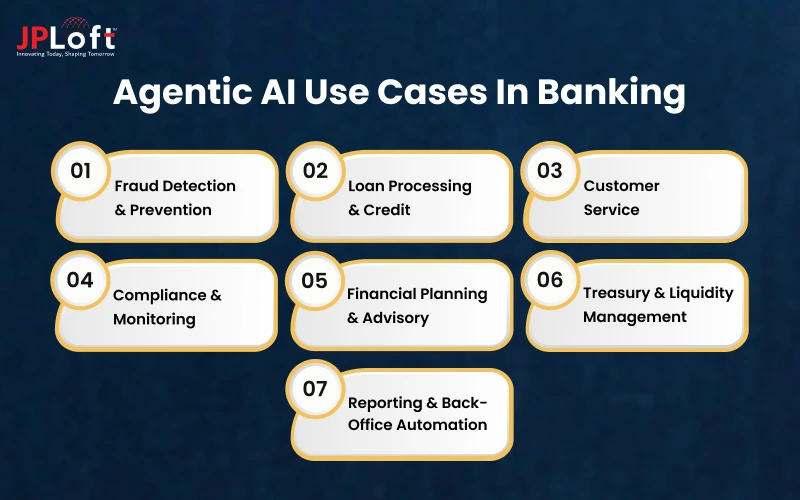
1. Fraud Detection and Financial Crime Prevention
Suspicious activity can happen at any hour. Agentic AI for fraud detection studies account history and spending patterns before raising an alert, cutting down on noise.
Once risk is confirmed, the system freezes a card or notifies the customer instantly. This active response separates modern fraud tools from older, rule-based systems.
2. Loan Processing and Credit Underwriting
Manual underwriting often means slow approvals. Agentic AI for loan processing pulls financial data, verifies documents, and runs eligibility checks automatically, cutting days down to minutes.
The system also studies income patterns and behavioral signals beyond credit scores. This gives a fairer picture of each applicant and helps qualified borrowers get approved faster.
3. Customer Service in Banking
Long hold times frustrate customers who expect quick answers. Agentic AI for customer service in banking resolves account questions and balance checks directly, without passing customers between departments.
When a request needs a human touch, the system hands it off with full context already gathered, so support teams focus only on cases that truly need attention.
4. Compliance and Regulatory Monitoring
Regulations change often, and updating policies by hand is slow. Agentic AI applications in banking track new rules and compare them against existing policies, flagging gaps right away.
For KYC and AML checks, the system verifies identities and screens watchlists, escalating only cases that genuinely need human review, which keeps audits organized.
5. Personalized Financial Planning and Advisory
Generic financial advice rarely fits a customer's actual situation. Agentic AI in banking use cases includes reviewing spending habits and savings goals to suggest moves that make sense for each person.
Rather than waiting for the customer to ask, the system flags a good moment to save more, building trust and keeping customers engaged with their bank.
6. Treasury and Liquidity Management
Cash flow and interest rate shifts change constantly, and static reports cannot keep pace. Agentic AI for banks runs ongoing simulations, giving treasury teams a current view instead of a delayed one.
When conditions shift, recommendations update automatically, helping teams adjust positions before risk grows across the portfolio.
7. Internal Reporting and Back-Office Automation
Manual reporting and reconciliation eat up hours that could go toward higher-value work. Use cases of agentic AI in banking include pulling data from systems and generating reports without repeated manual steps.
Errors drop since the same logic runs consistently every time, letting back-office teams focus on reviewing exceptions instead of routine numbers.
How to Implement Agentic AI in the Banking Industry?
Rolling out agentic AI in banking takes more than new software. This guide to agentic AI in banking breaks the process into seven practical steps.
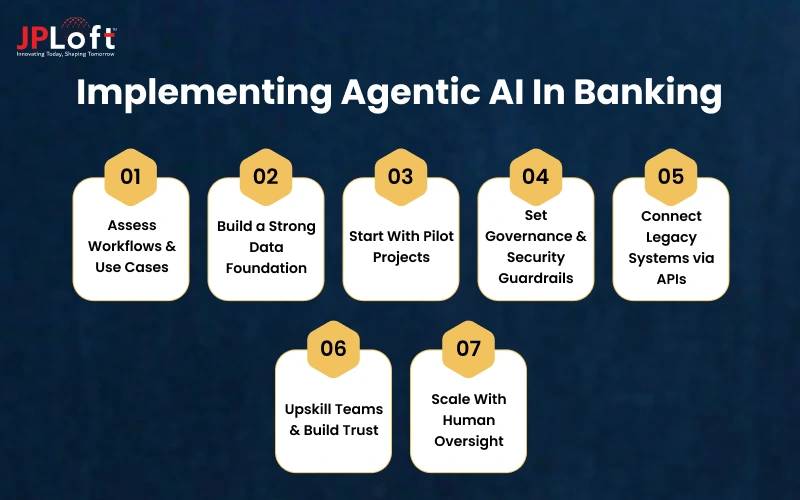
Step 1: Assess Existing Workflows and Identify High-Value Use Cases
Before any rollout, banks need a clear view of where time and money are being lost. Agentic AI for banking works best when applied to workflows that already cause friction.
-
Map current processes across departments.
-
Flag repetitive, high-volume tasks
-
Prioritize areas with clear ROI, like fraud checks or loan approvals
This groundwork ensures the bank invests its first efforts where agentic AI can deliver the fastest, most visible impact.
Step 2: Build a Strong Data Foundation Before Scaling
Agentic AI is only as reliable as the data behind it. Scattered or inconsistent records lead to poor decisions and slow adoption across teams.
-
Clean and standardize data across systems
-
Break down silos between departments
-
Ensure data flows in real time, not batches
A solid foundation here prevents costly rework once agentic AI for fraud detection or loan processing goes live.
Step 3: Start With Focused Pilot Projects
Trying to automate everything at once rarely works. Banks get better results by testing agentic AI applications in banking on one contained process first.
-
Choose one use case, such as customer service or compliance checks
-
Set clear success metrics upfront
-
Run the pilot for a fixed period
Early wins from a focused pilot build confidence and make the case for wider rollout across the bank.
Step 4: Establish Governance, Security, and Compliance Guardrails
Autonomous systems still need clear boundaries, especially in a regulated industry. Governance keeps agentic AI for banks accountable and auditable at every step.
-
Define what agents can and cannot do
-
Set up encryption and access controls
-
Maintain a transparent decision trail for regulators
Agentic AI in cybersecurity for banking protects both customer trust and the bank's standing with compliance authorities.
Step 5: Integrate With Legacy Banking Systems Through APIs
Most banks run on infrastructure built years ago, and agentic AI needs to work with it, not replace it overnight.
-
Use APIs to connect agents with core banking platforms
-
Avoid disruptive, full system overhauls
-
Choose cloud or hybrid setups based on data sensitivity
This layered approach lets banks modernize gradually while keeping daily operations stable and uninterrupted throughout the transition.
Step 6: Upskill Teams and Build Internal Trust
Technology alone will not drive adoption. Employees need to understand how agentic AI in banking works and why it supports their role rather than replacing it.
-
Train staff on how agents make decisions
-
Involve teams early in pilot feedback
-
Communicate changes clearly and consistently
When employees trust the system, they use it well, which is what ultimately determines whether implementation succeeds.
Step 7: Scale Gradually With Human Oversight in Place
Once a pilot proves successful, expansion should still happen in stages, not all at once. Agentic AI in banking use cases grows safer with human checkpoints intact.
-
Extend to related workflows one at a time
-
Keep humans reviewing high-stakes decisions
-
Refine the system using real-world feedback
This measured pace keeps risk manageable while the bank builds long-term, sustainable value from its AI investment.

Why Choose JPLoft to Implement Agentic AI in Banking Operations?
Banking leaders need a partner who understands both compliance and technical depth, and JPLoft brings exactly that combination. As an experienced agentic AI development company, JPLoft builds autonomous systems for real banking workflows.
This includes fraud detection, loan processing, and customer service, without disrupting existing infrastructure.
Every solution comes with security and auditability built in from day one, so banks never have to choose between innovation and compliance.
To get there, JPLoft's team works closely with stakeholders to map high-value use cases, then integrates with legacy systems through APIs and scales gradually, keeping human oversight intact at every stage.
From pilot to full deployment, JPLoft delivers agentic AI systems that are reliable, transparent, and built to grow with the bank's needs.
Final Words
Agentic AI in banking is no longer a distant concept reserved for tech giants. It is quickly becoming the standard for banks that want to move faster, cut costs, and serve customers better without adding operational strain.
From fraud detection to loan processing to customer service, agentic AI applications in banking are already reshaping how every department gets work done.
The benefits of agentic AI in banking go beyond automation. They touch cost efficiency, compliance, and long-term trust between banks and the customers they serve.
But real success depends on the right implementation approach, one built on strong data, clear governance, and gradual scaling with human oversight.
For banks ready to take that step, an experienced partner like JPLoft can make the transition smoother and far less risky. The future of banking is autonomous, and the time to prepare for it is now.
FAQs
Traditional automation follows fixed rules and needs updates when conditions change. Agentic AI works toward a goal, learns from outcomes, and completes multi-step tasks across systems with minimal human input.
Yes. Agentic AI sits as a layer on top of current platforms and connects through APIs. It integrates with core banking, CRM, and compliance tools without replacing existing infrastructure entirely.
Key risks include biased decisions, data privacy gaps, unclear accountability, and weak explainability. Banks reduce these through human oversight, audit trails, encryption, role-based access, and regular fairness testing of models.
A focused pilot usually runs for a few months, depending on data readiness and complexity. Full production rollout takes longer, since banks scale in stages with governance checks and human oversight.
No. It takes over repetitive tasks so employees can focus on complex decisions and customer relationships. Roles shift toward supervising AI, reviewing exceptions, and handling cases that need human judgment.

Rahul Sukhwal is the CEO and Founder of JPLoft, a visionary technologist with 18+ years at the forefront of emerging tech innovation and software engineering. He channels deep software engineering and AI expertise into building smarter, scalable solutions that shape how forward-thinking businesses worldwide harness the true power of AI.




Share this blog