


Key Takeaways
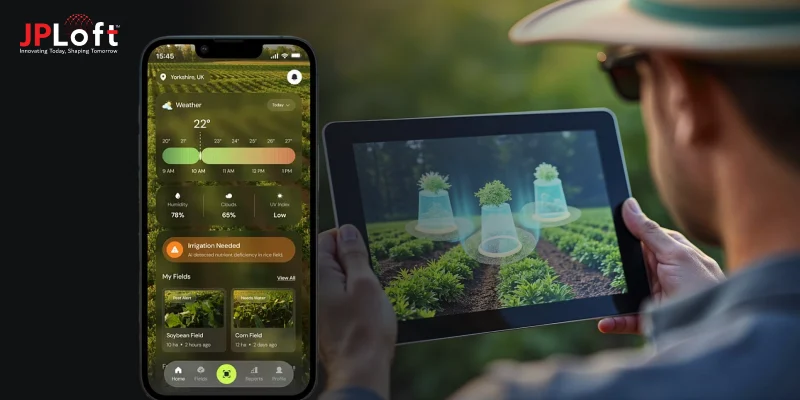
AI is transforming the agriculture industry through precision farming, crop health monitoring, soil health analysis, livestock monitoring, and smart productivity.
The cost to develop AI agricultural solutions ranges from $20,000 to $300,000+, depending on feature complexity, AI model training, and maintenance.
Building an AI agriculture solution includes defining business goals, preparing agricultural data, selecting the right-fit AI technologies, and continuous improvement.
Core AI technologies, such as machine learning, computer vision, IoT, robotics, and deep learning, ensure real-time farm monitoring.
Partnering with a custom AI solution company helps turn your ideas into scalable AI-enabled agriculture software.
The agriculture industry is changing faster than ever. With the increasing global population, there is growing pressure to increase crop production and ensure sufficient food resources.
Rising food demand, changing weather, and limited resources are pushing the agriculture industry to find smarter ways to manage farming activities.
As these challenges grow, Artificial Intelligence in agriculture helps businesses make smarter decisions by addressing these problems.
From monitoring crop health to detecting diseases and managing supply chains and inventories, AI is helping farmers to produce crops for the rising population in every way.
Understanding the role of AI in the agriculture industry helps businesses explore new opportunities and invest in innovative solutions. In this blog, we will explore new and interesting AI applications in agriculture, their benefits, core technologies, the development process, and more.
What is AI in Agriculture?
Artificial Intelligence in agriculture uses machine learning, cloud computing, and real-time data analysis to transform raw farm data into decision-making strategies.
The data is collected through software, sensors, drones, weather stations, and farm equipment. AI analyzes this data and provides predictive solutions.
Through smart, real-time farm solutions, AI technology helps farmers, governments, and food-processing businesses anticipate risks and plan supply chains.
As agriculture continues to evolve, it requires support from smart AI technologies. This explains how AI is used in agriculture to support everyday farming decisions.
Why the Agriculture Industry Needs AI Technology?
The agriculture industry is facing severe challenges today. To stay competitive and improve farming efficiency, it is the right time to invest in custom mobile app development in USA, UK, and other regions to leverage the potential of AI in agriculture.
1. Rising Global Food Demand
Global food demand is increasing as the world’s population continues to grow, forcing the agriculture industry to increase crop yields. AI helps farmers improve crop productivity through weather predictions and automated labor tasks, helping meet the rising food demand.
2. Climate Change and Unpredictable Weather
Unpredictable climate change, including droughts and irregular rainfall, is making it difficult for farmers to plan crop production. AI helps solve this issue by forecasting weather, using predictive analytics, and historical data.
3. Labor Shortages
The agricultural industry requires intense physical work, and the rising labor shortage is encouraging businesses to use AI. Robotic harvesters and AI-powered automation help with smart farming, everyday practices, and balance labor shortages.
4. Water and Resource Scarcity
The increasing demand for water-intensive crops is putting pressure on limited water and natural resources. Therefore, AI-enabled systems can carefully identify when and where water and other resources are needed. It helps ensure farm efficiency with smart water usage.
5. Need for Sustainable Farming
Sustainable farming practices supported by AI-enabled technology are helping farmers with maximum resource utilisation and limited chemical use. It helps to use fertilizers and pesticides at specific locations, improving crop yields and soil management.
Benefits of Considering AI in the Agriculture Industry
In recent years, the agriculture industry has seen rapid advancements. Instead of guesswork decisions, farmers are now relying on data and smart technologies like AI to improve the farming process. Here are the impactful benefits of AI in agriculture.
A. Improved Crop Productivity
AI helps businesses increase crop productivity by using drones and satellites to detect diseases early, which can ruin the harvest.
By using weather forecasts, AI can help farmers prepare for floods, rain, and climate-related conditions and protect crops.
B. Better Decision-Making With Data
AI technology is simplifying agribusinesses' decision-making strategies by providing quality data insights. AI collects data from weather, soil, crops, and market trends.
By analyzing this information, these systems provide farmers with quick insights into crop harvesting location, market prices, demand, and the effective use of pesticides on plants.
C. Reduced Operational Costs
Integrating AI in agriculture improves precision farming, where smart and data-based decisions can help reduce operational costs.
With real-time data and insights, it helps with the right fertilizers, irrigation, or pesticide treatment, saving costs while maximising crop production.
D. Efficient Use of Water and Fertilizers
Machine learning and IoT technologies help to collect data from weather reports, analyze soil conditions, and understand when and where water is required.
Similarly, drones and advanced systems determine crop health and low-nutrient areas, and machines perform precise fertilizer spraying.
E. Labor Shortage Detection
By providing self-driving tractors, irrigation systems, and AI-based robot technology, many labor-intensive farming tasks are automated with precision.
From planting seeds and spraying pesticides to detecting pests and diseases, these automations work smoothly on time, solving labor shortage problems.
How is AI used in Agriculture: Key Applications
With the rising adoption, the global AI in agriculture market is projected to reach $46.6 billion by 2034 at a CAGR of 26.3%. With the majority of farmers and startups using AI technology, it is proving to ensure fast, efficient results.
Here are some of the most valuable AI use cases in Agriculture.
►AI for Precision Farming
Precision farming uses AI and smart technologies to make farming more accurate and data-driven. AI analyzes data collected from IoT sensors, drones, and other connected devices.
It helps detect diseases and factors affecting crop yields and soil conditions. Based on such AI use cases in Agriculture, businesses can optimize and improve crop productivity.
►AI-Powered Crop Health Monitoring
Using drone technology to monitor crop health is one of the effective uses of AI. Drone-powered solutions in the field improve farmers' productivity and monitor plant growth.
AI-enabled drones and satellites are used in the field to collect images and videos of plants. Farmers can easily identify problems and consult an expert for assistance.
►Soil Health Analysis
AI analyzes soil data to assess moisture levels, nutrient content, pH balance, temperature, and overall soil condition.
Based on this analysis, AI recommends suitable crops, irrigation schedules, and fertilizer requirements for different areas of the field.
►Livestock Monitoring and Management
AI helps in monitoring livestock management by analyzing animal behavior. If the farmers are busy, wearable sensors and AI-powered monitoring systems track movement.
Sensors are attached to animals to help analyze their regular behavior patterns. AI analyzes this data, and if an animal shows signs of illness or unusual behavior, it suggests brief treatments.
►Supply Chain and Inventory Optimization
Rising food demand and inconsistent movement increase the demand for supply chain management. ML technology predicts market demand, using historical data and weather patterns.
It forecasts where and how much produce will be required. It reduces product shortages and ensures timely deliveries by checking humidity and scheduling delivery times.
►Weather Risk Assessment
Unpredictable climate changes can cause serious issues when sowing fields. However, using artificial intelligence technology helps to predict weather conditions.
It helps inform farmers and agribusinesses in advance about climate risk. This allows enough time for harvesting, irrigation, and crop protection planning.
►Produce Quality Inspection
AI-powered computer vision tools help farmers inspect fruit and vegetable quality with high-resolution images to maintain quality.
It analyses quality based on size, color, and appearance, and alerts farmers when produce does not meet quality standards and should not be sold to end users.
►Financial Risk Assessment
Agricultural businesses face financial risks due to changing weather, fluctuating market prices, crop failures, and supply chain disruptions.
AI predicts potential risks by analyzing historical data, climate patterns, production records, and market trends. This clearly explains how AI can help in agricultural financial risk assessment.
How to Build an AI Agriculture Solution?
To build an agriculture software solution with AI technology requires a strategic approach and step-by-step guidance. A smart, feature-rich AI agriculture solution improves farming efficiency and productivity.
Follow the step-by-step process and examine each step to understand how AI works smoothly in agriculture.
Step 1: Identify Business Objectives
Clearly defining the business objectives, target audience, and solutions you plan to deliver helps create a successful AI-driven agricultural solution. Conduct detailed market research and identify the core problems faced by farmers that AI applications can solve.
This will help gain greater clarity in solving particular challenges, whether it is crop monitoring, yield prediction, or pest control for farms.
Step 2: Access to Agricultural Data
For reliable AI applications in agriculture, collect data from multiple sources. AI makes predictions using high-quality information. So, use sensors, drones, IoT, cloud computing, historical records, and real-world farming experience to collect data.
The more accurate, reliable, and updated the data is, the more AI technology will be able to help decision-making. Once the data is collected, prepare it in a clear, detailed format.
Step 3: Select the Right AI Technologies
Choosing the right technology stack requires careful consideration to determine how AI is used in agriculture. Machine learning helps with yield protection, predictive analytics assist in real-time weather conditions prediction, and computer vision detects existing crop diseases and pests.
These are the important technologies that make farming productive and efficient, and solve specific challenges you are aiming to solve.
Step 4: Design Intuitive User Interfaces
Simple, clean, and fast-performing UI/UX design services improve user experience and help users navigate the platform. Start by developing simple menus and clear language, and making them usable in sunlight or harsh rays.
Along with a simple interface, focus on app features, as farmers do not have time to find each navigation; using voice-over assistants to share doubts makes daily farming tasks faster.
Step 5: Develop and Train AI Models
With selected technology and a database, start with the AI model development phase. Train the models with agricultural data. It helps farmers recognize patterns, generate predictions, and automate decision-making.
Adding quality, historical, updated, and visual data will be effective in training AI models smoothly and for smart working.
Step 6: Test and Validate the Solution
AI model app testing helps ensure the solution works smoothly in real-world conditions. Share crop images, soil information, weather records, and data to measure the AI model’s accuracy when working.
Check the behavior of connected devices in different networks. And finally, check your solution with different user behaviors and gather feedback from farmers or experts.
Step 7: Deploy and Monitor Performance
Once testing is completed, deploy the system for farmers to use for their farming activities and production. Integrate with existing farm software and different technologies. After deployment, continuously monitor the platform efficiency, AI predictions, and farmers' interactions.
This helps identify technical issues, user challenges, and bugs, while ensuring optimal performance over the long term.
Step 8: Continuously Improve the System
AI in farming is a never-ending task. It requires continuous improvement to maintain precise performance. Create a review loop where the target audience can share continuous feedback. Regularly update datasets, retrain AI models, and introduce new features.
Continuous improvement ensures alignment with rapidly changing farming conditions and creates competitive value for the AI agriculture solution for business growth.
Cost of Developing an AI Agriculture Solution
While implementing AI solutions in agriculture, costs can vary from $20,000 to $300,000+. The agriculture software development cost for AI-powered solutions depends on the complexity, technology adoption, and core app features. To avoid confusion, here is the cost breakdown to develop an AI agriculture solution.
|
Software Complexity |
Cost |
Features |
|
Small-scale or Basic MVP solution |
$20,000 - $80,000 |
Plant disease identification, offline functionality, interactive dashboard, AI chatbot, and weather forecasting schedules. |
|
Mid-Level Solution |
$80,000 - $150,000 |
Machine learning algorithms, crop yield and supply chain planning, precision watering schedules, input cost, and revenue management. |
|
Advanced-Level Solution |
$150,000 - $300,000+ |
Extensive AI model training, autonomous machines, real-time soil moisture calculation, security, and API integrations. |
Key Factors Affecting Development Cost
The cost of an AI-enabled agricultural app depends on some crucial factors. Here are the key factors affecting the development cost.
-
AI Features and Functionalities: AI in agriculture industry includes crop monitoring, livestock and supply management, which requires a standard budget to support advanced functionalities.
-
AI Model Development Expenses: Building and training different AI models on agricultural datasets takes time and resources for smooth functioning.
-
Third-Party Integrations: IoT and sensor networks, satellite imagery, autonomous machinery, and climate APIs in AI-powered solutions require a higher upfront cost.
-
Infrastructure and Maintenance Costs: AI-based technology requires high infrastructure costs for IoT networks, self-driving tractors, AI model retraining, security updates, and performance monitoring.
Core AI Technologies Powering Modern Agriculture
AI-enabled technology helps in better farming planning, understanding weather risks, and operating with a strategic mindset in modern farming. Along with AI, several technology advancements in agriculture contribute to improving farming efficiency.
|
Technologies |
Functions |
Benefits |
|
Machine Learning (ML) |
Generates farm-based predictions using real-time data. Crop classification and soil condition. |
Improving safety, food quality, and helping farmers with personalised planning, irrigation, and fertilization. |
|
Computer Vision |
Using images from sensors and drones for early detection of crop diseases, nutrient deficiencies, or weaker plant growth. |
Enabling farmers to use AI tools, supporting green farming practices, and reducing the spread of harsh chemicals. |
|
Robotics and Automation |
Controls autonomous tractors, using GPS tracking for planting seeds, robotic harvesters, and precision sprayers. |
Helps with daily farming tasks, reducing farming costs, and decreasing harsh chemical use. |
|
Internet of Things (IoT) |
Connects sensors, irrigation systems, weather stations, and farm equipment to collect real-time data. |
Improving crop yield quality, reducing labor costs, and optimising better use of resources. |
|
Satellite and Drone Imaging |
Satellites use sensors to monitor plant health and nutrition levels. Drones create 3D farm maps for better decisions. |
Improving field visibility, enabling early problem detection, and reducing the need for manual field inspections. |
Challenges of Implementing AI in Farming
During the implementation of AI in the agricultural business, it is very common to find mobile app development challenges. Here are the top challenges that can affect the performance and potential of AI in the farming industry.
Challenge 1: High Initial Investment
Adopting AI technology in agriculture requires higher initial investment in training, technology knowledge, and infrastructure setup. With limited financial resources, small and medium-scale businesses are finding it difficult to afford.
Solution: Several government tax incentives, low-interest loans, and startup incubation programs are provided to lower the financial burden.
Challenge 2: Limited Technical Expertise
Several farmers and agribusinesses are still facing the problem of a lack of technical expertise. With limited knowledge, utilizing AI technology properly requires training and expertise, which many lack.
Solution: Regular training on how to use AI tools by an expert AI agriculture technician can improve knowledge and ensure future growth.
Challenge 3: Data Security and Privacy Concerns
Implementing AI technology in agriculture raises serious questions about data privacy and app security. Cyberattacks and unauthorized access to confidential data can create serious problems for farmers.
Solution: Use clear privacy policies, robust encryption protocols, and follow GDPR to handle sensitive and farm-associated data privacy concerns.
Challenge 4: Internet Connectivity in Rural Areas
In many farming regions, internet connectivity is a major problem. AI-integrated systems that use cloud computing work on the internet, and if that’s not available, it creates serious delays in managing daily farming tasks and the supply chain.
Solution: Build AI functionality in offline modes, or use edge AI solutions that process data directly on local devices.
Why Choose JPLoft for Custom AI Solutions?
Building an AI agriculture solution requires strategic planning, market research, and an understanding of the development process.
This is where JPLoft, an agriculture software development company, can help you turn your ideas into an AI-enabled solution.
Our expert team carefully understands your business objective and target audience needs, and helps to build custom AI solutions that solve real farming challenges.
Whether you need startup, agribusiness, or enterprise-level assistance, JPLoft follows a tailored approach to every business's needs and focuses on delivering secure, scalable, and user-friendly solutions.
We combine updated technology and practical insights to develop AI-powered crop monitoring and precision farming solutions while ensuring the long-term performance of AI in farming.
If you are building or scaling an AI agriculture development solution, the right team assistance can help guide you with cost-effective solutions.
Conclusion
As technology continues to evolve, adopting the right AI solutions in the agricultural industry will enhance food production and strategic farming management.
A successful AI-powered technology requires careful planning, the right technologies, quality data, and a clear development strategy. It helps businesses make data-driven decisions by analyzing weather patterns, crop production, and market trends.
From precision farming and crop health monitoring to supply chain optimization and weather forecasting, AI helps farmers and agribusinesses reduce operational challenges.
As the demand for sustainable and smart farming continues to grow, investing in AI-powered agriculture solutions can create new business opportunities.
Whether you are a startup, agribusiness, or enterprise, adopting AI technology in the agriculture industry helps you solve common challenges and invest in a smart future for agriculture.
FAQs
AI-powered smartphone apps help detect plant diseases and pests. The technology analyses the shared images and delivers a diagnostic and responsive solution to understand the main problems.
AI in agriculture helps to successfully conduct precision farming, manage operational costs, early and easy detection of diseases and pests in the field, and monitor livestock movements.
The cost to develop an AI agriculture app ranges from $20,000 to $300,000+. It depends on app features and complexity. The basic custom app costs less, while advanced features with AI and other technological advancements require a higher investment.
The future of AI in agriculture includes smart automation, addressing climate change, planning a smart farming system, and building agricultural robotics to support technology.
Building an agriculture app with AI-powered solutions takes 3-9+ months. The basic MVP app takes less time. However, complex features or custom-built apps with technological advancements take longer.
Implementing AI in agriculture faces common challenges: high initial investment, lack of internet connectivity, and the need to collect high-quality data to train AI models in modern farming.

Rahul Sukhwal is the CEO and Founder of JPLoft, a visionary technologist with 18+ years at the forefront of emerging tech innovation and software engineering. He channels deep software engineering and AI expertise into building smarter, scalable solutions that shape how forward-thinking businesses worldwide harness the true power of AI.




Share this blog